
 100% FREE ACCESS
12th Standard Syllabus & Materials
12th Standard
TN 12th Maths Applications of Matrices and Determinants Sample Question Papers Study Material - QB365 Set A
NEW12th Standard
TN 12th Computer Applications மின்னணு தரவு பரிமாற்றம் Sample Question Papers Study Material - QB365 Set A
NEW12th Standard
TN 12th Computer Applications மின் - வணிக பாதுகாப்பு அமைப்புகள் Sample Question Papers Study Material - QB365 Set A
NEW12th Standard
TN 12th Computer Applications மின்னணு செலுத்தல் முறைகள் Sample Question Papers Study Material - QB365 Set A
NEW12th Standard
TN 12th Computer Applications மின் - வணிகம் Sample Question Papers Study Material - QB365 Set A
NEW12th Standard
TN 12th Computer Applications திறந்த மூல கருத்துருக்கள் Sample Question Papers Study Material - QB365 Set A

Published on: 05/08/2019
Chemical Kinetics
Download Tamil Nadu 12th Standard Chemistry question papers, model tests, one-mark questions, important questions, and public exam papers in PDF format. Free study materials and answer keys for TN State Board students.
Questions + Answers key
Take MCQ Chemistry Test
1.
The Unit of rate constant and rate of reaction are same for ______.
First order
second order
Third order
zero order
2.
In pseudo-order reactions ______.
The actual order of reaction is different from that expected using rate law expression
The concentration of at least one reactant is taken in large excess.
The concentration of reactant taken in excess may be taken as constant
All of these
3.
For a reaction, 2A + B ⟶ 3C, The rate of appearance of C at time 't' is 1.2 x 10⁻⁴ mol L-1s-1. Identify the rate of reaction.
4 x 10⁻⁵mol L-1s-1
4.5 x 10⁻¹mol L-1s-1
3.6 x 10⁻⁴ mol L-1s-1
None of these
4.
What would be the rate of disappearance of oxygen, if the rate of formation of nitric oxide (NO) is 3.6 x 10⁻³mol L-1 s-1?
4 x 10⁻³mol L-1s-1
4 x 10⁻³mol-1 L-1s-1
4.5 x 10⁻³mol L-1s-1
4.5 x 10⁻³mol-1 L-1s-1
5.
2N2O5 ⟶ NO2 + O2, \(\frac { d\left[ { N }_{ 2 }{ O }_{ 5 } \right] }{ dt } \) = k1[N2O5], \(\frac { d\left[ { NO }_{ 2 } \right] }{ dt } \)= k2[N2O5] and \(\frac { d{ O }_{ 2 } }{ dt } \) = k 3[N2O5], the relation between k1, k2 and k3 is _____.
2k1 = 4k2 = k3
k1 = k2 = k3
2k1 = k2 = 4k3
2k1 = k2 = k3
6.
In a first order reaction x ⟶ y; if k is the rate constant and the initial concentration of the reactant x is 0.1M, then, the half life is_____.
\(\left( \frac { \log2 }{ k } \right) \)
\(\left( \frac { 0.693 }{ (0.1)k } \right) \)
\(\left( \frac { In2 }{ k } \right) \)
none of these
7.
What is the activation energy for a reaction if its rate doubles when the temperature is raised from 200K to 400K? (R = 8.314 JK-1 mol-1)
234.65 kJ mol-1
434.65 kJ mol-1
2.305 kJ mol-1
334.65 J mol-1
8.
The addition of a catalyst during a chemical reaction alters which of the following quantities?
Enthalpy
Activation energy
Entropy
Internal energy
9.
A zero order reaction X ⟶ Product, with an initial concentration 0.02M has a half life of 10 min. if one starts with concentration 0.04M, then the half life is
10 s
5 min
20 min
cannot be predicted using the given information
10.
For a first order reaction A ⟶ B the rate constant is x min−1. If the initial concentration of A is 0.01M, the concentration of A after one hour is given by the expression.
001. e−x
1 x 10⁻²(1-e-60x)
(1 x 10⁻²)e-60x
none of these
11.
The rate constant, the activation energy and frequency factor of a chemical reaction at 25oC are 3.0 x 10⁻⁴ S-1; 104.4 kJ mol-1 and 6.0 x 10¹⁴ S-1 respectively. What is the value of the rate constant when T ⟶ ∞?
12.
Give the characteristics of first order reaction.
13.
Give examples for first order reaction.
14.
Derive integrated rate law for a zero order reaction A\(\longrightarrow \) product.
15.
Define rate law and rate constant.
16.
Define average rate and instantaneous rate.
17.
State the characteristics of order of reactions.
18.
Explain briefly the collision theory of bimolecular reactions.
19.
Rate of chemical reaction is not uniform throughout. Justify you answer:
20.
For a reaction A + B ⟶ C, the rate of the reaction is denoted \(\frac { -dA }{ dt } \) or \(\frac { -dB }{ dt } \) or \(\frac { +dC }{ dt } \). State the significance of plus and minus sign.
21.
A zero order reaction is 20% complete in 20 minutes. Calculate the value of the rate constant. In what time will the reaction be 80% complete?
22.
The decomposition of Cl2O7 at 500K in the gas phase to Cl2 and O2 is a first order reaction. After 1 minute at 500K, the pressure of Cl2O7 falls from 0.08 to 0.04 atm. Calculate the rate constant in s-1
23.
N2O5(g) ⟶ 2NO2(g) + \(\frac { 1 }{ 2 } \) O2(g)
24.
Arrhenius
25.
n = 2
26.
t1/2
27.
k1
1.
(d)
zero order
2.
(d)
All of these
3.
(a)
4 x 10⁻⁵mol L-1s-1
4.
(c)
4.5 x 10⁻³mol L-1s-1
5.
(c)
2k1 = k2 = 4k3
6.
\(k=\frac { 1 }{ t } ln \frac { \left[ { A }_{ 0 } \right] }{ \left[ A \right] } \)
[A0] = 0.1: [A] = 0.05
\(k= \left[ \frac { 1 }{ t _{1/2}} \right] ln\left[ \frac { { 0.1 } }{ 0.05 }\right] \)
\(k= \left[ \frac { 1 }{ t _{1/2}} \right] ln (2)\)
t1/2 = In(2)/K
7.
T1= 200 K ; k = k1
T2 =400 K ; k1 = k2 = 2k1
log\(\frac {{ k }_{ 2 } }{ { k }_{ 1 } } =\frac { { E }_{ a } }{ 2.303R } \left[ \frac { { T }_{ 2 }-{ T }_{ 1 } }{ { T }_{ 1 }{ T }_{ 2 } } \right] \)
log \( [\frac {{2 k }_{ 1 } }{ { k }_{ 1 } }]\)
\(= \left[ \frac { E_{a} }{ 2.303\times 8.314 JK^{-1} mol^{-1} } \right] \)
\(= \left[ \frac { 400 k - 200K }{200 k \times 400 k } \right] \)
\(E_{a} = \frac{ 0.3010 \times 2.303 \times 8.314 JK^{-1}mol^{-1} \times 200K \times 400 K}{200 K}\)
Ea = 2305 J mol-1
Ea = 2.305 kJ mol-1
8.
A catalyst provides a new path to the reaction with low activation energy. i.e., it lowers the activation energy.
9.
for n ≠ 1 t1/2 = \(\frac{2^{n-1} -1}{(n- 1) k[A_{0}]^{-1}}\)
for n = 0; t1/2 = \(\frac{1}{2 k[A_{0}]^{-1}}\)
t1/2 = \(\frac{[A_{0}]}{2 k}\)
t1/2 α [A0] ...(1)
Given [A0] = 0.002 M; t1/2 = 10 min
[A0] = 0.04M; t1/2 = ?
Substitute in (1)
10 min α 0.02 M...(2)
t1/2 α 0.04M ....(3)
(3)(2)
⇒ t1/2 / 10 min
= 0.04 M/0.02 M
t1/2 = 2 x 10 min = 20 min
10.
\(k=\frac { 2.303 }{ t } log\frac { \left[ { A }_{ 0 } \right] }{ \left[ A \right] } \)
\(k=\frac { 1 }{ t } ln \frac { \left[ { A }_{ 0 } \right] }{ \left[ A \right] } \)
\(e^{kt}=\frac { \left[ { A }_{ 0 } \right] }{ \left[ A \right] }\)
[A] = [A0] ekt
In this case
k = x min-1 and [A0] = 0.01 M = 1 x 10⁻²M
t = 1 hour = 60 min
[A] = (1 x 10⁻²)e-60x
11.
Formula:
k1 = A.e-Ea/RT
Given:
Rate constant, k1 - 3.0 x 10⁻⁴ s-1
Frequency factor, A = 6.0 x 10¹⁴ s-1
Activation energy, Ea = 104.4 kJ
= 104400 J
Temperatures, T1 = 25o C; T2 =∞
Solution:
\({ k }_{ 2 }=A.{ e }^{ -\frac { { E }_{ a } }{ RT } }\)
k2 = 6.0 x 10¹⁴ x \(\frac { 104400 }{ { e }^{ 8.314\times \infty } } \)
k2 = 6.0 x 1014 x 1 \(\left( \therefore e\frac { -{ { E }_{ a } } }{ R\infty } =1 \right) \)
∴ The rate constant at T ⟶ ∞ is 6.0 x 10¹⁴ s-1
12.
(i) When the concentration of the reactant is increased by 'n' times, the rate of reaction is also increased by n times. That is, if the concentration of the reactant is doubled, the rate is doubled.
(ii) The unit of rate constant of a first order reaction is sec-1 or time-1.
\({ k }_{ 1 }=\frac { rate }{ (a-x) } =\frac { { mol.lit }^{ -1 }{ sec }^{ -1 } }{ { mol.lit }^{ -1 } } \)
(iii) The time required to complete a definite fraction of reaction is independent of the initial concentration, of the reactant if t1/u is the time of one 'u' th fraction of reaction to take place then from equation.
\({ k }_{ 1 }=\frac { 2.303 }{ t } \log { \frac { a }{ a-x } } \)
\(x=\frac { a }{ u } and\quad { t }_{ \frac { 1 }{ u } }=\frac { 2.303 }{ { k }_{ 1 } } \log { \frac { a }{ a-\frac { a }{ u } } } ;\)
\({ t }_{ \frac { 1 }{ u } }=\frac { 2.303 }{ { k }_{ 1 } } \log { \frac { u }{ (u-1) } } \)
since k1 = rate constant, t1/u is independent of initial concentration 'a'.
13.
(i) All radioactive transformations follow first order kinetics. For example,
92U238 ⟶ 90U234 +2He4
(ii) Decomposition of sulphuryl chloride in the gas phase proceeds by first order kinetics.
SO2Cl2(g) ⟶ SO2(g) + Cl2(g)
(iii) Inversion of sucrose in acidic aqueous medium follows first order reaction.
C12H22O11 +H2O \(\overset { H+ }{ \longrightarrow } \) C6H12O6 +C6H12O6
14.
A reaction in which the rate is independent of the concentration of the reactant over a wide range of concentration is called a zero order reaction.
Let us consider the following by hypothetical zero order reaction.
A⟶ product
The rate law can be written as,
Rate = k[A]0
\(\frac { -d\left[ A \right] }{ dt } =k(1)\ \ \ \therefore \left( { \left[ A \right] }^{ 0 }=1 \right) \)
\(\Rightarrow -d\left[ A \right] =kdt\)
Integrate the above equation between the limits of [A0] at zero time and [A] at some later time 't',
\(-\int _{ \left[ { A }_{ 0 } \right] }^{ \left[ A \right] }{ d\left[ A \right] } =k\int _{ 0 }^{ t }{ dt } \)
\(-{ \left( \left[ A \right] \right) }_{ \left[ { A }_{ 0 } \right] }^{ \left[ A \right] }=k{ \left( t \right) }_{ 0 }^{ t }\)
[A0] - [A] = kt
\(k=\frac { \left[ { A }_{ 0 } \right] -\left[ A \right] }{ t } \)
Straight line equation y = mx + c
ie., \(\left[ A \right] =-kt+\left[ { A }_{ 0 } \right] \)
⇒ y = c + mx
A plot [A] vs time gives a straight line with a slope of -k and y intercept of [A0]
15.
Rate law:
(i) Rate law or rate equation is an expression which relates the rate of a reaction with rate constant and the concentration of reactants.
(ii) For xA + yB → products
(iii) The rate law is r = k[A]m[B]n
Rate constant:
(i) It is the rate of the reaction when the concentration of the reactants are taken unity.
In above rate law if[A] = [B] = 1, rate constant k = Rate
16.
Average rate of reaction:
The average rate is defined as the ratio of change in the final concentration of reactants and the initial concentration of reactants over the entire time period of reaction.
Average rate=\(\frac{-[Final \space concentration \space of \space reactants - Initial \space concentration \space of \space reactants}{(Change \space in \space time)}\)
R \(=\frac{-\left(\left[A_{2}\right]-\left[A_{1}\right]\right)}{\left(t_{2}-t_{1}\right)}=-\left(\frac{\Delta[A]}{\Delta t}\right)\)
[A]1 = Concentration of reactant A1 at time t1
[A]2 = Concentration of reactant A2 at time t2
Instantaneous rate of reaction:
The rate of reaction at any particular instant during the course of reaction is called as instantaneous rate.
Instantaneous rate \(=(\text { Average rate })_{\Delta t \rightarrow 0}\)
Rate of the reaction \(=\left(\frac{-\Delta \mathrm{A}}{\Delta \mathrm{t}}\right)\)
17.
(i) The magnitude of order of a reaction may be zero or fractional or integral values. Order is never fractional for elementary reaction.
(ii) It should be determined only by experiments.
(iii) Simple reactions possess low values of order like n = 0, 1, 2 reactions with order greater than or equal to 3.0 are called complex reactions.
(iv) Some reactions show fractional order depending on rate.
(v) Higher order reactions may be experimentally converted into simpler order (pseudo) reactions by using excess concentrations of one or more reactants.
18.
(i) Collision theory is based on the kinetic theory of gases. According to this theory, a chemical reaction occurs as a result of collisions between the reacting molecules.
(ii) Let us understand this theory by considering the following reaction.
A2(g) + B2(g) ⟶ 2AB(g)
(iii) If we consider that, the reaction between A2 and B2 molecules proceeds through collisions between them, then the rate would be proportional to the number of collisions per second.
(iv) Rate ∝ number of molecules colliding per litre per second (collision rate).
(v) The number of collisions is directly proportional to the concentration of both A2 and B2.
Collison rate ∝ [A2][B2]
Collision rate = Z [A2][B2]
(vi) Where, Z is a constant
(vii) A fraction of effective collisions (f) is given by the following expression
\(f={ e }^{ \frac { { -E }_{ a } }{ RT } }\)
(xiv) This fraction of collisions is further reduced due to orientation factor i.e., even if the reactant collides with sufficient energy, they will not react unless the orientation of the reactant molecules is suitable for the formation of the transition state.
(viii) The diagram illustrates the importance of proper alignment of molecules which leads to reaction.
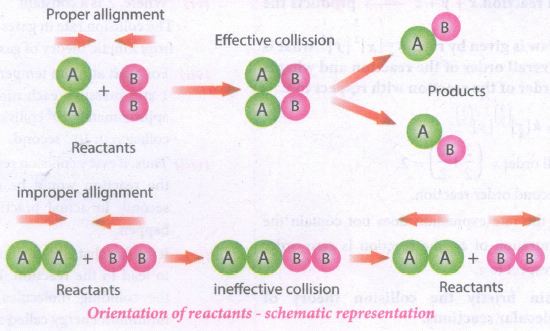
(ix) The fraction of effective collisions (f) having proper orientation is given by the steric factor p.
⇒ Rate = p x f x collision rate
\(\Rightarrow Rate=p\times { e }^{ \frac { -Ea }{ RT } }\times Z\left[ { A }_{ 2 } \right] \left[ { B }_{ 2 } \right] \quad ...(1)\)
As per the rate law,
Rate = \(k=\left[ { A }_{ 2 } \right] \left[ { B }_{ 2 } \right] \quad ...(2)\)
Where k is the rate constant
On comparing equation (1) and (2), the rate constant k is
\(k=pZ{ e }^{ \frac { -Ea }{ RT } }\)
19.
Rate of a reaction at any time depends on the concentration of the reactants which keeps on decreasing with time.
20.
Minus sign i.e. \(\frac { -dA }{ dt } \) or \(\frac { -dB }{ dt } \) indicates decreases in the concentration of reactants whereas + sign indicates in the concentration of products with time i.e. \(\frac { +dC }{ dt } \)
21.
(i) Let A = 100M, [A0] - [A] = 20M,
For the zero order reaction
\(k=\left( \frac { \left[ { A }_{ 0 } \right] -\left[ A \right] }{ t } \right) \)
(i) 20% completion \(k=\left( \frac { 20M }{ 20min } \right) \) = 1 mol L-1 min-1
(ii) 80% completion
\(\mathrm{K}=1 \mathrm{~mol} \mathrm{~L}{ }^{-1} \mathrm{~s}^{-1} ;\left[\mathrm{A}_{0}\right]=100 \mathrm{M} ;\left[\mathrm{A}_{0}\right]-[\mathrm{A}]=80 \mathrm{M} ; \mathrm{t}=?\)
\(\therefore t=\left(\frac{\left[A_{O}\right]-[A]}{K}\right)=\frac{80}{1}=80 \mathrm{mins}\)
22.
For the first order reaction
\(\mathrm{k}=\frac{2.303}{\mathrm{t}} \log \frac{\mathrm{A}_{\mathrm{o}}}{\mathrm{A}}\) (or)
\(\mathrm{k} =\frac{2.303}{t} \log \frac{P_o}{P_t} \)
Here, Po=0.08 atm (Pt)=0.04 atm; t = 60 s
\(\mathrm{k}=\frac{2.303}{60} \log \frac{[0.08]}{[0.04]}\)
\(=0.0383 \times \log 2 \)
\(=0.0383 \times 0.3010 \)
\(=1.152 \times 10^{-2} \mathrm{~s}^{-1}\)
23.
1
24.
\(k={ Ae }^{ -\left( \frac { Ea }{ RT } \right) }\)
25.
II Order
26.
\(\frac { 0.693 }{ { k }_{ 1 } } sec\)
27.
\(\frac { 2.303 }{ t } \log { \frac { a }{ a-x } } \)

12th Standard Syllabus & Materials
12th Standard
TN 12th Computer Applications வலையமைப்பு வடமிடல் Sample Question Papers Study Material - QB365 Set A
NEW12th Standard
TN 12th Computer Applications களப்பெயர் முறைமை (DNS) Sample Question Papers Study Material - QB365 Set A
NEW12th Standard
TN 12th Computer Applications வலையமைப்பு எடுத்துக்காட்டுகள் மற்றும் நெறிமுறைகள் Sample Question Papers Study Material - QB365 Set A
NEW12th Standard
TN 12th Computer Applications கணினி வலையமைப்பு ஓர் அறிமுகம் Sample Question Papers Study Material - QB365 Set A



Tamilnadu Stateboard 12th Standard Subjects

Maths
Chemistry

Physics

Biology

Computer Science

Business Maths and Statistics

Economics

Commerce

Accountancy

History

Computer Applications
Biology
Computer Technology
Computer Applications
Computer Science
Business Maths and Statistics
Commerce
Economics
Maths
Chemistry
Physics
Computer Technology
History
Accountancy

Tamil

English

French
Tamilnadu Stateboard Standards
