
 100% FREE ACCESS
12th Standard Syllabus & Materials
12th Standard
TN 12th Computer Applications மின்னணு தரவு பரிமாற்றம் Sample Question Papers Study Material - QB365 Set A
NEW12th Standard
TN 12th Computer Applications மின் - வணிக பாதுகாப்பு அமைப்புகள் Sample Question Papers Study Material - QB365 Set A
NEW12th Standard
TN 12th Computer Applications மின்னணு செலுத்தல் முறைகள் Sample Question Papers Study Material - QB365 Set A
NEW12th Standard
TN 12th Computer Applications மின் - வணிகம் Sample Question Papers Study Material - QB365 Set A
NEW12th Standard
TN 12th Computer Applications திறந்த மூல கருத்துருக்கள் Sample Question Papers Study Material - QB365 Set A
NEW12th Standard
TN 12th Computer Applications வலையமைப்பு வடமிடல் Sample Question Papers Study Material - QB365 Set A

Published on: 01/10/2019
Chemical Kinetics
Download Tamil Nadu 12th Standard Chemistry question papers, model tests, one-mark questions, important questions, and public exam papers in PDF format. Free study materials and answer keys for TN State Board students.
Questions + Answers key
Take MCQ Chemistry Test
1.
Show that in case of first order reaction, the time required for 99.9% completion is nearly ten times the time required for half completion of the reaction.
2.
The half life of a first order reaction x →products is 6.932 x 10⁴ s at 500K. What percentage of x would be decomposed on heating at 500K for 100 min. (e0.06 = 1.06).
3.
For the reaction 2x+y ⟶ L find the rate law from the following data.
| [x] (min) |
[y] (min) |
rate (ms-1) |
| 0.2 | 0.02 | 0.15 |
| 0.4 | 0.02 | 0.30 |
| 0.4 | 0.08 | 1.20 |
4.
Hydrolysis of methyl acetate in aqueous solution has been studied by titrating the liberated acetic acid against sodium hydroxide. The concentration of an ester at different temperatures is given below.
| t(min) | 0 | 20 | 40 | 60 | ∝ |
|---|---|---|---|---|---|
| v (ml) | 20.2 | 25.6 | 29.5 | 32.8 | 50.4 |
Show that the reaction is the first order reactions.
5.
The rate of formation of a dimer in a second order reaction is 7.5 x 10⁻³ mol L-1 s-1 at 0.05 mol L-1 monomer concentration. Calculate the rate constant.
6.
Identify the order for the following reactions
(i) Rusting of Iron
(ii) Radioactive disintegration of 92U238
(iii) 2A+3B⟶ products ;rate = k[A]1/2[B]2
7.
The decomposition of Cl2O7 at 500K in the gas phase to Cl2 and O2 is a first order reaction. After 1 minute at 500K, the pressure of Cl2O7 falls from 0.08 to 0.04 atm. Calculate the rate constant in s-1
8.
Write Arrhenius equation and explains the terms involved.
9.
For a reaction x + y + z\(\longrightarrow \) products the rate law is given by rate =k[x]3/2[y]1/2. What is the overall order of the reaction and what is the order of the reaction with respect to z.
10.
Explain briefly the collision theory of bimolecular reactions.
1.
Let [A0] = 100;
When t = t99.9%; [A] = (100-99.9) = 0.1
\(k=\frac { 2.303 }{ t } \log\left( \frac { [{ A }_{ 0 }] }{ [A] } \right) \)
\({ t }_{ 99.9\% }=\frac { 2.303 }{ K } \log\left( \frac { 100 }{ 0.1 } \right) \)
\({ t }_{ 99.9\% }=\frac { 2.303 }{ K } \log1000\)
\({ t }_{ 99.9\% }=\frac { 2.303 }{ K } (3)\)
\({ t }_{ 99.9\% }=\frac { 6.909 }{ K } \)
\({ t }_{ 99.9\% }=10\times \frac { 0.69 }{ K } \)
\({ t }_{ 99.9\% }={ 10 } t_{ 1/2 }\)
2.
Given t1/2= 0.6392 \(\times\)104 s
To solve: when t = 100 min,
\(\frac { [{ A }_{ 0 }]-[A] }{ [{ A }_{ 0 }] } \times 100=?\)
We know that
For a first order reaction, \({ t }_{ 1/2 }=\frac { 0.6932 }{ k } \)
\(k=\frac { 0.6932 }{ 6.932\times { 10 }^{ 4 } } \)
\(k={ 10 }^{ -5 }{ s }^{ -1 }\)
\(k=\left( \frac { 1 }{ t } \right) In\left( \frac { [{ A }_{ 0 }] }{ [{ A }] } \right) \)
\({ 10 }^{ -5 }{ s }^{ -1 }\times 100\times 60s=In\left( \frac { [{ A }_{ 0 }] }{ [{ A }] } \right) \)
\(0.06-In\ \left( \frac { [{ A }_{ 0 }] }{ [{ A }] } \right) \)
\(\frac { [{ A }_{ 0 }] }{ [{ A }] } ={ e }^{ 0.06 }\) ?(given : e0.06 = 1.06)
\(\frac { [{ A }_{ 0 }] }{ [{ A }] } =1.06\)
\(\therefore \frac { [{ A }_{ 0 }]-[{ A }] }{ [{ A }_{ 0 }] } \times 100\%\)
\(=\left( 1-\frac { [{ A }] }{ [{ A }_{ 0 }] } \right) \times 100\%\)
=\(\left( 1-\frac { 1 }{ 1.06 } \times 100\% \right) \)
= 5.66%
3.
Reaction Rate = k[x]n [y]n
0.15 = k[0.2]n [0.02]m ...(1)
0.30 = k[0.4]n [0.02]m ...(2)
1.20 = k[0.4]n [0.08]m ...(3)
eqn(3) \(\div\) eqn(2)
\(\Rightarrow\)\(\frac { 1.2 }{ 0.3 } =\frac { k{ \left[ 0.4 \right] }^{ n }{ \left[ 0.08 \right] }^{ m } }{ k{ \left[ 0.4 \right] }^{ n }{ \left[ 0.02 \right] }^{ m } } \)
\(4={ \left( \frac { \left[ 0.08 \right] }{ \left[ 0.02 \right] } \right) }^{ m }\)
\(4^1={ \left( 4 \right) }^{ m }\)
\(m=1\)
eqn(2) \(\div\) eqn(1), \(\frac{0.30}{0.15}=\frac{\mathrm{k}[0.4]^{\mathrm{n}}[0.02]^{\mathrm{m}}}{\mathrm{k}[0.2]^{\mathrm{n}}[0.02]^{\mathrm{m}}}\)
\( 2={ \left( \frac { \left[ 0.4 \right] }{ \left[ 0.2 \right] } \right) }^{ n}\)
\(2^1= 2 ^{ n }\)
\(\therefore n=1\)
Rate = \(k{ \left[ x \right] }^{ 1 }{ \left[ y \right] }^{ 1 }\)
\(0.15=k{ \left[ 0.1 \right] }^{ 1 }{ \left[ 0.02 \right] }^{ 1 }\)
\(\frac { 0.15 }{ { \left[ 0.2 \right] }^{ 1 }{ \left[ 0.02 \right] }^{ 1 } } =k\)
k = 37.5 mol−1L s−1
4.
\(k=\frac { 2.303 }{ t } \log\frac { \left( { V }_{ \infty }-{ V }_{ 0 } \right) }{ \left( { V }_{ \infty }-{ V }_{ 0 } \right) } \)
\(k=\frac { 2.303 }{ 20 } \log\frac { 50.4-20.2 }{ 50.4-25.6 } \)
\(=0.1151 \log\frac { 30.2 }{ 24.8 } \)
= 0.1151 log 1.2479
= 0.1151 x 0.0959
= 11.03 x10⁻³ min-1
When t = 40 mts
\(k=\frac { 2.303 }{ 40 } \log\frac { 50.4-20.2 }{ 50.4-25.6 } \)
\(=0.0576\times \log\frac { 30.2 }{ 20.9 } \)
= 9.19 x 10⁻³ min-1
When t = 60 mts
\(k=\frac { 2.303 }{ 60 } \log\frac { 50.4-20.2 }{ 50.4-25.6 } \)
\(=0.03838\times \log\frac { 30.2 }{ 17.6 } \)
= 0.03838 x 0.2343
= 8.99 x 10⁻³ min-1
The constant values of K show that the reaction is of first order.
5.
If the monomer is represented by X. Then
\(2 \mathrm{M} \rightarrow(\mathrm{M})_{2}\)
Since the reaction is of second order, the rate of reaction will be given by,
\(\text { Rate }=\mathrm{k}[\mathrm{M}]^{n} \)
\(7.5 \times 10^{-3} \mathrm{~mol} \mathrm{~L}^{-1} \mathrm{~s}^{-1}=\mathrm{k}\left(0.05 \mathrm{~mol} \mathrm{} \mathrm{~L}^{-1}\right)^{2} \)
\(\mathrm{k} =\frac{Rate}{[M]^{n}} \)
\(\mathrm{k} =\frac{7.5 \times 10^{-3}}{(0.05)^{2}} \)
\(=3 \mathrm{~mol}^{-1} \mathrm{~L} \mathrm{~s}^{-1}\)
6.
(i) First order reaction
(ii) First order reaction
(iii) \(\frac{1}{2}+2=2 \frac{1}{2}\); Pseudo first order reaction
7.
For the first order reaction
\(\mathrm{k}=\frac{2.303}{\mathrm{t}} \log \frac{\mathrm{A}_{\mathrm{o}}}{\mathrm{A}}\) (or)
\(\mathrm{k} =\frac{2.303}{t} \log \frac{P_o}{P_t} \)
Here, Po=0.08 atm (Pt)=0.04 atm; t = 60 s
\(\mathrm{k}=\frac{2.303}{60} \log \frac{[0.08]}{[0.04]}\)
\(=0.0383 \times \log 2 \)
\(=0.0383 \times 0.3010 \)
\(=1.152 \times 10^{-2} \mathrm{~s}^{-1}\)
8.
Arrhenius equation is,
\(k=Ae^\left ({ \frac { -Ea }{ RT } } \right )\)
Here,
A \(\rightarrow\) Frequency factor
Ea \(\rightarrow\) Activation energy of the reaction
R \(\rightarrow\) Gas constant
T \(\rightarrow\) Absolute temperature (in K)
9.
Reaction rate = k[x]3/2[y]1/2
(i) Over all order of reaction = (3/2 + 1/2)=2
i.e., second order reaction.
(ii) Since the rate expression does not contain the concentration of z, the reaction is zero order with respect to z.
10.
(i) Collision theory is based on the kinetic theory of gases. According to this theory, a chemical reaction occurs as a result of collisions between the reacting molecules.
(ii) Let us understand this theory by considering the following reaction.
A2(g) + B2(g) ⟶ 2AB(g)
(iii) If we consider that, the reaction between A2 and B2 molecules proceeds through collisions between them, then the rate would be proportional to the number of collisions per second.
(iv) Rate ∝ number of molecules colliding per litre per second (collision rate).
(v) The number of collisions is directly proportional to the concentration of both A2 and B2.
Collison rate ∝ [A2][B2]
Collision rate = Z [A2][B2]
(vi) Where, Z is a constant
(vii) A fraction of effective collisions (f) is given by the following expression
\(f={ e }^{ \frac { { -E }_{ a } }{ RT } }\)
(xiv) This fraction of collisions is further reduced due to orientation factor i.e., even if the reactant collides with sufficient energy, they will not react unless the orientation of the reactant molecules is suitable for the formation of the transition state.
(viii) The diagram illustrates the importance of proper alignment of molecules which leads to reaction.
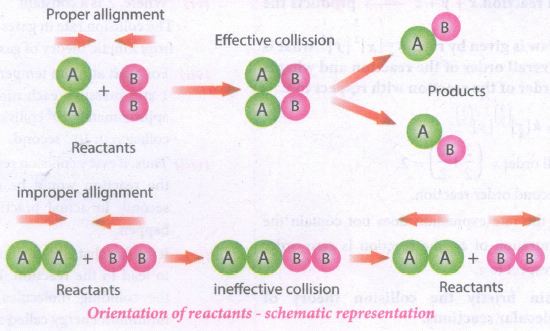
(ix) The fraction of effective collisions (f) having proper orientation is given by the steric factor p.
⇒ Rate = p x f x collision rate
\(\Rightarrow Rate=p\times { e }^{ \frac { -Ea }{ RT } }\times Z\left[ { A }_{ 2 } \right] \left[ { B }_{ 2 } \right] \quad ...(1)\)
As per the rate law,
Rate = \(k=\left[ { A }_{ 2 } \right] \left[ { B }_{ 2 } \right] \quad ...(2)\)
Where k is the rate constant
On comparing equation (1) and (2), the rate constant k is
\(k=pZ{ e }^{ \frac { -Ea }{ RT } }\)

12th Standard Syllabus & Materials
12th Standard
TN 12th Computer Applications களப்பெயர் முறைமை (DNS) Sample Question Papers Study Material - QB365 Set A
NEW12th Standard
TN 12th Computer Applications வலையமைப்பு எடுத்துக்காட்டுகள் மற்றும் நெறிமுறைகள் Sample Question Papers Study Material - QB365 Set A
NEW12th Standard
TN 12th Computer Applications கணினி வலையமைப்பு ஓர் அறிமுகம் Sample Question Papers Study Material - QB365 Set A
NEW12th Standard
TN 12th Computer Applications PHP-உடன் MySQL-ஐ இணைத்தல் Sample Question Papers Study Material - QB365 Set A



Tamilnadu Stateboard 12th Standard Subjects

Maths
Chemistry

Physics

Biology

Computer Science

Business Maths and Statistics

Economics

Commerce

Accountancy

History

Computer Applications
Biology
Computer Technology
Computer Applications
Computer Science
Business Maths and Statistics
Commerce
Economics
Maths
Chemistry
Physics
Computer Technology
History
Accountancy

Tamil

English

French
Tamilnadu Stateboard Standards
