
 100% FREE ACCESS
12th Standard Syllabus & Materials
12th Standard
TN 12th Computer Applications மின்னணு தரவு பரிமாற்றம் Sample Question Papers Study Material - QB365 Set A
NEW12th Standard
TN 12th Computer Applications மின் - வணிக பாதுகாப்பு அமைப்புகள் Sample Question Papers Study Material - QB365 Set A
NEW12th Standard
TN 12th Computer Applications மின்னணு செலுத்தல் முறைகள் Sample Question Papers Study Material - QB365 Set A
NEW12th Standard
TN 12th Computer Applications மின் - வணிகம் Sample Question Papers Study Material - QB365 Set A
NEW12th Standard
TN 12th Computer Applications திறந்த மூல கருத்துருக்கள் Sample Question Papers Study Material - QB365 Set A
NEW12th Standard
TN 12th Computer Applications வலையமைப்பு வடமிடல் Sample Question Papers Study Material - QB365 Set A

Published on: 09/10/2019
Coordination Chemistry
Download Tamil Nadu 12th Standard Chemistry question papers, model tests, one-mark questions, important questions, and public exam papers in PDF format. Free study materials and answer keys for TN State Board students.
Questions + Answers key
Take MCQ Chemistry Test
1.
Define coordination number.
2.
What is crystal field stabilization energy (CFSE)?
3.
Why tetrahedral complexes do not exhibit geometrical isomerism.
4.
Classify the following ligands based on the number of donor atoms.
a) NH3
b) en
c) ox2-
d) pyridine
5.
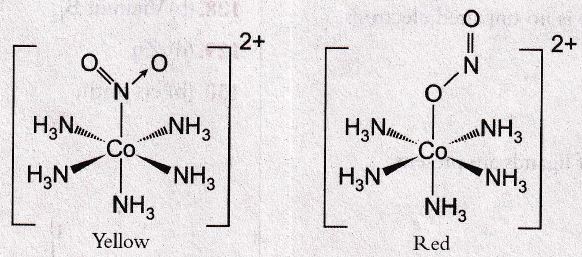
What is linkage isomerism? Explain with an example.
6.
Give an example for complex of the type [Ma2b2c2] where a, b, c are monodentate ligands and give the possible isomers.
7.
[Ti(H2O)6]3+ is coloured, while [Sc(H2O)6]3+ is colourless- explain.
8.
Give an example of coordination compound used in medicine and two examples of biologically important coordination compounds.
9.
[CuCl4]2- exists while [Cul4]2- does not exist why?
10.
Write the formula for the co-ordination compounds.
11.
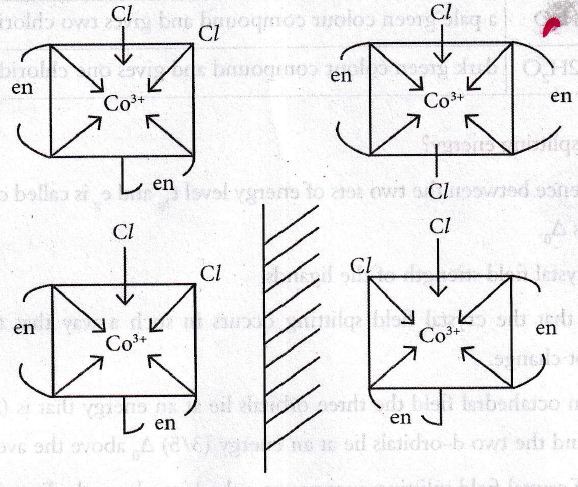
Draw all possible geometrical isomers of the complex [Co(en)2Cl2]+ and identify the optically active isomer.
12.
What are the limitations of VB theory?
13.
What is crystal field splitting energy?
14.
Write the postulates of Werner’s theory.
15.
Give the difference between double salts and coordination compounds.
16.
Fac-mer isomerism is shown by _______.
[CO(en)3]3+
[Co(NH3)4(Cl)2]+
[Co(NH3)3(Cl)3]
[Co(NH3)5Cl]SO4
17.
A complex in which the oxidation number of the metal is zero is_______.
K4[Fe(CN)6]
[Fe(CN)3(NH3)3]
[Fe(CO)5]
both (b) and (c)
18.
Which kind of isomerism is possible for a complex [Co(NH3)4Br2]CI?
geometrical and ionization
geometrical and optical
optical and ionization
geometrical only
19.
How many geometrical isomers are possible for [Pt(Py)(NH3)(Br)(Cl)]
3
4
0
15
20.
Which one of the following will give a pair of enantiomorphs?
[Cr(NH3)6][Co(CN)6]
[Co(en)2Cl2]Cl
[Pt(NH3)4][PtCl4]
[Co(NH3)4Cl2]NO2
21.
In which of the following coordination entities the magnitude of Δ0 will be maximum?
[Co(CN)6]3-
[Co(C2O4)3]3-
[Co(H2O)6]3+
[Co(NH3)6]3+
22.
A magnetic moment of 1.73BM will be shown by one among the following.
TiCl4
[CoCl6]4-
[Cu(NH3)4]2+
[Ni(CN)4]2-
23.
24.
An excess of silver nitrate is added to 100ml of a 0.01M solution of Pentaaquachlorochromium (III)chloride. The number of moles of AgCl precipitated would be _______.
0.02
0.002
0.01
0.2
25.
The sum of primary valence and secondary valence of the metal M in the complex [M(en)2(Ox)]Cl is________.
3
6
-3
9
26.
Chlorophyll
27.
Sp
28.
[Ti(H2O)6]3+
29.
Tin
30.
Lead
1.
Coordination number is the number of co-ordinate bonds formed by the ligands with the central metal atom.
2.
The CFSE is defined as the energy of the electronic configuration in the ligand field minus the energy of the electronic configuration in the isotropic field.
CFSE (\(\Delta\)Eo) = {ELf}-{Eiso}
={[nt2g(-0.4) + neg(0.6)]\(\Delta\)o + npP} - {n'pP}
Here, nt2g is the number of electrons in t2g orbitals;
neg is number of electrons in eg orbitals;
np is number of electron pairs in the ligand field; &
n'p is the number of electron pairs in the isotropic field (barycenter).
P - pairing energy
3.
Tetrahedral complexes do not exhibit geometrical isomerism. Because the relative position of donor atoms of ligand the unidentate Iigands (donor atom) attached to the central atom are same with respect to each other.
4.
| Ligand | Type of Ligand | Number of donor atoms |
| NH3 | monodentate ligand | 1 |
| en | bidentate ligand | 2 |
| ox2- | bidentate ligand | 2 |
| pyridine | monodentate ligand | 1 |
5.
(i) This is also called as salt isomerism.
(ii) This type of isomers arises when an ambidentate ligand is bonded to the central metal atom/ion through either of its two different donor atoms. In the below mentioned examples, the nitrite ion is bound to the central metal ion Co3+ through a nitrogen atom in one complex and through oxygen atom in other complex.
\(\left[\mathrm{Co}\left(\mathrm{NH}_{3}\right)_{5}\left(\mathrm{NO}_{2}\right)\right]^{2+}\)
6.
[Ma2b2C2]\(\pm\)n where a, b, c are monodentate ligands.
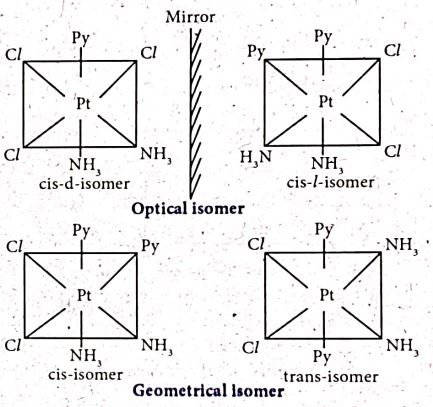
[Pt(py2)(NH3)2Cl2]2+. It exhibits both optical and geometrical isomerism. c is isomer exhibit optical isomerism also. While trans isomer exhibits geometrical isomerism only.
7.
\({ }_{22} \mathrm{Ti}-{ }_{18}[\mathrm{Ar}] 4 \mathrm{s}^{2} 3 \mathrm{d}^{2} / {}_{21}\mathrm{Sc}-{ }_{18}[\mathrm{Ar}] 4 \mathrm{~s}^{2} 3 \mathrm{~d} \)
\({ }_{22} \mathrm{Ti}^{3+}-{ }_{18}[\mathrm{Ar}] 3 \mathrm{~d}^{1} /{ }_{18} \mathrm{Sc}^{3+}{ }_{18}[\mathrm{Ar}] 3 \mathrm{~d}^{0}\)
(i) In this complex the central metal ion is Ti3+, which has d1 configuration. This single electron occupies one of the t2g orbitals in the octahedral aqua ligand field. When white light falls on this complex the electron absorbs light and promotes itself to eg level. The spectral data show the absorption maximum is at 20000 cm-1 corresponding to the crystal field splitting energy \(\left(\Delta_{o}\right)\) 239.7 kJmol-1. The transmitted colour associated with this absorption is purple and hence the complex appears purple in colour.
(ii) Thus in \(\left[\mathrm{Ti}\left(\mathrm{H}_{2} \mathrm{O}\right)_{6}\right]^{3+} \mathrm{d}-\mathrm{d}\) transition takes place.
(iii) But in \(\left[\mathrm{Sc}\left(\mathrm{H}_{2} \mathrm{O}\right)_{6}\right]^{3+} \mathrm{Sc}^{3+}\) has the outer electronic configuration of 3d0 where d-d transition is not possible and it is colourless.
8.
Medicinal uses
(i) Ca-EDTA chelate, is used in the treatment of lead and radioactive poisoning.
(ii) That is for removing lead and radioactive metal ions from the body.
(iii) Cis-platin is used as an antitumor drug in cancer treatment.
Biological Importance compounds:-
(i) Fe2+ - porphyrin complex: It plays an important role in carrying oxygen from lungs to tissues and tissue carbon dioxide from to lungs.
(ii) Chlorophyll - useful in photosynthesis in plants.
9.
In [CuCI4]-2 Cu2+, is reduced to Cu+ by I-. Hence Cupric Iodide in converted to cuprous Iodide so [CuI4]-2 does not exist. In [CuCI4]-2 Cl- cannot effect this change and so exists.
10.
a) potassiumhexacyanidoferrate(II) - Potassiumhexacyanidoferrate(II) - K4[Fe(CN)6]
b) Pentacarbonyliron(0) - [Fe(CO)5]
c) Pentaamminenitrito −kNcobalt(III)ion - [Co(NH3)5(NO2)]2+
d) Hexaamminecobalt(III) Sulphate - [CO(NH3)6](SO4)3
e) Sodiumtetrafluoridodihydroxidochromate(III) - Na2[CrF4(OH)2]
11.
[Co (en)2 Cl2]+ This is an octahedral complex
12.
(i) It does not explain the colour of the complex.
(ii) It considers only the spin only magnetic moments and does not consider the other components of magnetic moments.
(iii) It does not provide a quantitative explanation as to why certain complexes are inner orbital complexes and the others are outer orbital complexes for the same metal. For example, [Fe(CN)6]4- is diamagnetic (low spin) whereas [FeF6]4- is paramagnetic (high spin).
13.
In an Octahedral complex, the d-orbitals of the central metal ion, divide (1) into two sets of different energies. The separation in energy is the crystal field splitting energy.
The d-orbitals lying along the axes dx2, dy2 and dz2 orbitals will experience strong repulsion and raise in energy to a greater extent than the orbitals with lobes directed between the axes (dxy, dyz, and dzx)Thus the degenerate d-orbitals now split into two sets and the process is called crystal field splitting.
14.
Most of the elements exhibit, two types of valence namely primary valence and secondary valence and each element tend to satisfy both the valences.
The primary valence is referred the oxidation state of the metal atom.
The secondary valence as the coordination number. For example, according to Werner, the primary and secondary valences of cobalt are 3 and 6 respectively.
The primary valence of a metal ions ae always satisfied by negative ions.
For example in the complex CoCI3.6NH3. The primary valence of Co is +3 and is satisfied by 3CI- ions.
The secondary valence is satisfied by negative ions, neutral molecules, positive ions or the combination of these.
For example, in CoCl3.6NH3 complex primary valence of cobalt +3 and it is satisfied by 3 CI-.
The secondary valence of cobalt is 6 and is satisfied by six neutral ammonia molecules. where as in CoCI6.NH3.
Secondary valence of Co = 5{It is satisfied five neutral molecules and a Cl- ion}
According to Werner, there are two spheres of attraction around a metal atom/ion in a complex.
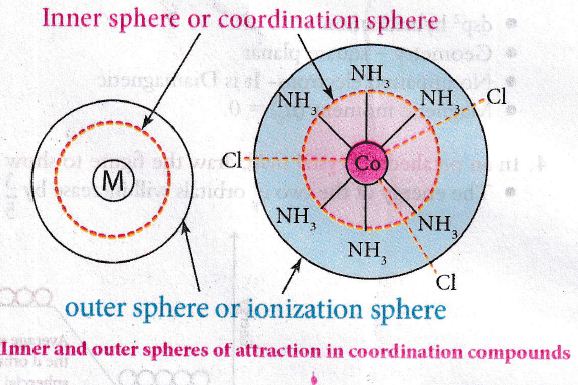
The inner /coordination sphere:
The groups present in this sphere are firmly attached to the metal.
The outer sphere / ionisation sphere:
The groups present in this sphere are loosely bound to the central metal ion and hence can be separated into ions upon dissolving the complex in a suitable solvent.
The primary valencies are non-directional. while the secondary valencies are directional.
The geometry of the complex is determined by the special arrangement of the groups which satisfy the secondary valence.
| Secondary valence | Geometry |
| 4 | Tetrahedral / Square planar |
| 6 | Octahedral |
15.
| S. No | Double salts | Co-ordination compound |
|---|---|---|
| 1. | They usually contain two simple salt in equimolar proportions | The simple salts from which they are formed may or may not be in equimolar proportion. |
| 2. | They exists only in the solid state. In aqueous solution they dissociate completely into ions. | They exist in the solid state as well as in aqueous solution. This is because even in solution, the complex ion does not dissociate into ions. |
| 3. | They are ionic compounds and do not contain any co-ordinate bond. | They may or may not be ion but the complex part always contain coordinate bonds |
| 4. | The properties of the double salts are same as those of its constituent compounds. | The properties of the coordination compounds are different for its constituent bonds. |
| 5. | In a double salt, the metal ion show their normal valency. | In a coordinate compound the metal ion satisfies its two types of valence called primary & secondary valenices. |
| 6. | A double salt loses its identity and dissociates into its constitute simple ions in solution. | The complex ion does not lose its identity and never dissociate to give simple ions. |
| Example: FeSO4 (NH4)2 SO4.6H2O | Example: K4[Fe(CN)6), K3[Fe(SCN)6) |
16.
(c)
[Co(NH3)3(Cl)3]
17.
a) Fe2+ b) Fe3+ c) Fe0
18.
For [MA4B2]4+ complexes - geometrical isomerism is possible
{[Co(NH3)4Br2]CI,[Co(NH3)4Br CI]Br} - ionisation isomers
19.
Three isomers. If we consider any one of the ligands as reference (say Py), the arrangement of other three ligands (NH3, Br- and Cl-) with respect to (Py) gives three geometrical isomers.
20.
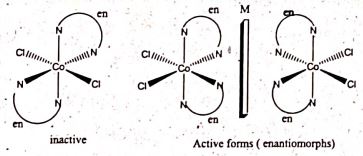
Complexes given in other options (a), (c) and (d) have symmetry elements and hence they are optically inactive.
21.
In all the complexes, the central metal ion is Co3+, among the given ligands CN- is the strongest ligand, which causes large crystal
field splitting i.e maximum Δ0
22.
Ti4+ (d0 ⇒ 0BM)
Co2+ (d7 spain free ⇒ t2g5, e2g; n = 3; μ = 3.9BM)
Cu2+ (d9 Low spain ⇒ t2g6, e3g; n = 1; μ = 1.732BM)
Ni2+ (d8 Low spain ⇒ t2g6, e2g; n = 2; μ = 2.44 BM)
23.
(d)
24.
The complex is [M(H2O)5Cl]Cl2
1000 ml of 1 M solution of the complex gives 2 moles of Cl- ions 1000 ml of 0.01 M solution of the complex will give
\(\frac{100 ml \times 0.01M \times 2Cl^-}{1000 ml \times 1M}\)
= 0.002 moles of Cl- ions
25.
In the complex [M(en)2(Ox)]Cl For the central metal ion M3+
The primary valence is = +3
The secondary valence = 6
sum of primary valence and secondary valence = 3 + 6 = 9
26.
Photosynthesis
27.
Linear
28.
Octahedral, d2sp3
29.
Stannate
30.
Plumbate

12th Standard Syllabus & Materials
12th Standard
TN 12th Computer Applications களப்பெயர் முறைமை (DNS) Sample Question Papers Study Material - QB365 Set A
NEW12th Standard
TN 12th Computer Applications வலையமைப்பு எடுத்துக்காட்டுகள் மற்றும் நெறிமுறைகள் Sample Question Papers Study Material - QB365 Set A
NEW12th Standard
TN 12th Computer Applications கணினி வலையமைப்பு ஓர் அறிமுகம் Sample Question Papers Study Material - QB365 Set A
NEW12th Standard
TN 12th Computer Applications PHP-உடன் MySQL-ஐ இணைத்தல் Sample Question Papers Study Material - QB365 Set A



Tamilnadu Stateboard 12th Standard Subjects

Maths
Chemistry

Physics

Biology

Computer Science

Business Maths and Statistics

Economics

Commerce

Accountancy

History

Computer Applications
Biology
Computer Technology
Computer Applications
Computer Science
Business Maths and Statistics
Commerce
Economics
Maths
Chemistry
Physics
Computer Technology
History
Accountancy

Tamil

English

French
Tamilnadu Stateboard Standards
