
 100% FREE ACCESS
12th Standard Syllabus & Materials
12th Standard
TN 12th Computer Applications மின்னணு தரவு பரிமாற்றம் Sample Question Papers Study Material - QB365 Set A
NEW12th Standard
TN 12th Computer Applications மின் - வணிக பாதுகாப்பு அமைப்புகள் Sample Question Papers Study Material - QB365 Set A
NEW12th Standard
TN 12th Computer Applications மின்னணு செலுத்தல் முறைகள் Sample Question Papers Study Material - QB365 Set A
NEW12th Standard
TN 12th Computer Applications மின் - வணிகம் Sample Question Papers Study Material - QB365 Set A
NEW12th Standard
TN 12th Computer Applications திறந்த மூல கருத்துருக்கள் Sample Question Papers Study Material - QB365 Set A
NEW12th Standard
TN 12th Computer Applications வலையமைப்பு வடமிடல் Sample Question Papers Study Material - QB365 Set A

Published on: 01/10/2019
Coordination Chemistry
Download Tamil Nadu 12th Standard Chemistry question papers, model tests, one-mark questions, important questions, and public exam papers in PDF format. Free study materials and answer keys for TN State Board students.
Questions + Answers key
Take MCQ Chemistry Test
1.
Why tetrahedral complexes do not exhibit geometrical isomerism.
2.
Classify the following ligands based on the number of donor atoms.
a) NH3
b) en
c) ox2-
d) pyridine
3.
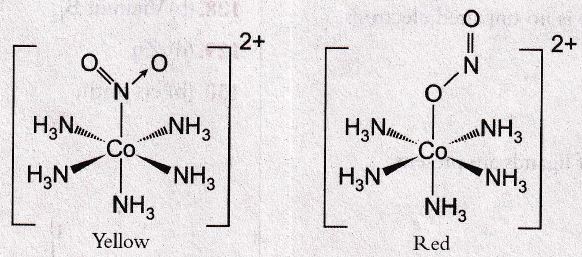
What is linkage isomerism? Explain with an example.
4.
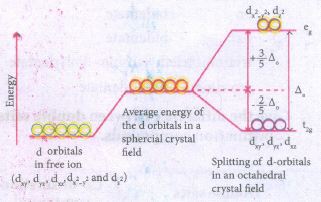
In an octahedral crystal field, draw the figure to show splitting of d orbitals
5.
Give an example for complex of the type [Ma2b2c2] where a, b, c are monodentate ligands and give the possible isomers.
6.
[Ni(CN)4]2- is diamagnetic, while [NiCl4]2- is paramagnetic, explain using crystal field theory.
7.
Write briefly about the applications of coordination compounds in volumetric analysis
8.
Give one test to differentiate [Co(NH3)5Cl]SO4 and [Co(NH3)5SO4]Cl.
9.
Write the postulates of Werner’s theory.
10.
Give the difference between double salts and coordination compounds.
1.
Tetrahedral complexes do not exhibit geometrical isomerism. Because the relative position of donor atoms of ligand the unidentate Iigands (donor atom) attached to the central atom are same with respect to each other.
2.
| Ligand | Type of Ligand | Number of donor atoms |
| NH3 | monodentate ligand | 1 |
| en | bidentate ligand | 2 |
| ox2- | bidentate ligand | 2 |
| pyridine | monodentate ligand | 1 |
3.
(i) This is also called as salt isomerism.
(ii) This type of isomers arises when an ambidentate ligand is bonded to the central metal atom/ion through either of its two different donor atoms. In the below mentioned examples, the nitrite ion is bound to the central metal ion Co3+ through a nitrogen atom in one complex and through oxygen atom in other complex.
\(\left[\mathrm{Co}\left(\mathrm{NH}_{3}\right)_{5}\left(\mathrm{NO}_{2}\right)\right]^{2+}\)
4.
The energy of the two eg orbitals will increase by \(\frac{3}{5} \Delta_{O}\) and that of the three t2g will decrease by (2/5) \(\Delta_{O}\)
5.
[Ma2b2C2]\(\pm\)n where a, b, c are monodentate ligands.
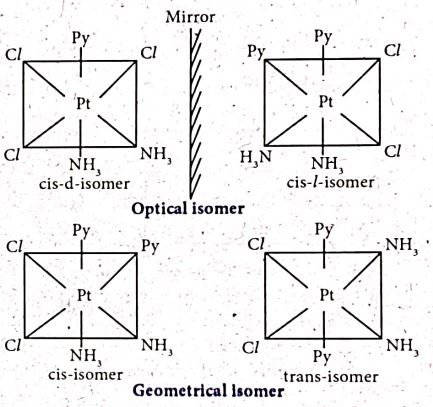
[Pt(py2)(NH3)2Cl2]2+. It exhibits both optical and geometrical isomerism. c is isomer exhibit optical isomerism also. While trans isomer exhibits geometrical isomerism only.
6.
1. [Ni(CN)4]2- is a low spin square planar complex as it contains strong field CN- ligand in it.
2. Oxidation state of Ni in complex is +2 Electronic Configuration of Ni2+ is 3d8 4s0
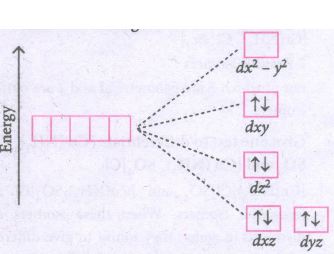
Crystal field splitting in square planar complex.
1. No unpaired electrons, so the complex is diamagnetic.
2. [NiCl4]2- is a high spin tetrahedral complex as it contains weak field Cl- ligand in it.
3. Oxidation state of Ni in complex in +2
4. Electronic Configuration of Ni2+ is 3d8 4s6.
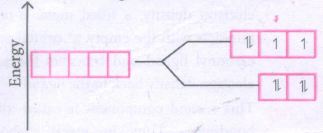
It has two unpaired electrons, so the complex is paramagnetic.
7.
(i) EDTA is used in the volumetric determination of a wide variety of metal ions in solution.
Eg. Zn2+, Pb2+, Ca2+, CO2+, Ni2+,Cu2+, etc.
(ii) By careful adjustment of the pH and using suitable indication, mixtures of metals can v be analyzed.
Eg. Bi3+in the presence of Pb2+
(iii) Hardness of water due to the presence of Ca2+ and Mg2+ ions is estimated by complexometric titrations using EDTA.
8.
These two are ionisation isomers. [Co(NH3)5Cl]SO4 gives white precipitate with BaCl2 solution, but not with AgNO3 solution. [Co(NH3)5SO4]Cl gives curdy white precipitate with AgNO3 solution but not with BaCl2 solution.
9.
Most of the elements exhibit, two types of valence namely primary valence and secondary valence and each element tend to satisfy both the valences.
The primary valence is referred the oxidation state of the metal atom.
The secondary valence as the coordination number. For example, according to Werner, the primary and secondary valences of cobalt are 3 and 6 respectively.
The primary valence of a metal ions ae always satisfied by negative ions.
For example in the complex CoCI3.6NH3. The primary valence of Co is +3 and is satisfied by 3CI- ions.
The secondary valence is satisfied by negative ions, neutral molecules, positive ions or the combination of these.
For example, in CoCl3.6NH3 complex primary valence of cobalt +3 and it is satisfied by 3 CI-.
The secondary valence of cobalt is 6 and is satisfied by six neutral ammonia molecules. where as in CoCI6.NH3.
Secondary valence of Co = 5{It is satisfied five neutral molecules and a Cl- ion}
According to Werner, there are two spheres of attraction around a metal atom/ion in a complex.
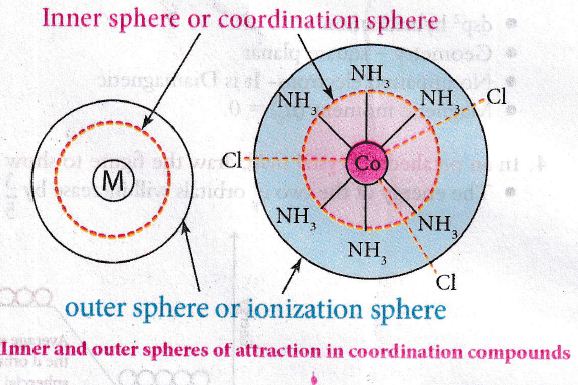
The inner /coordination sphere:
The groups present in this sphere are firmly attached to the metal.
The outer sphere / ionisation sphere:
The groups present in this sphere are loosely bound to the central metal ion and hence can be separated into ions upon dissolving the complex in a suitable solvent.
The primary valencies are non-directional. while the secondary valencies are directional.
The geometry of the complex is determined by the special arrangement of the groups which satisfy the secondary valence.
| Secondary valence | Geometry |
| 4 | Tetrahedral / Square planar |
| 6 | Octahedral |
10.
| S. No | Double salts | Co-ordination compound |
|---|---|---|
| 1. | They usually contain two simple salt in equimolar proportions | The simple salts from which they are formed may or may not be in equimolar proportion. |
| 2. | They exists only in the solid state. In aqueous solution they dissociate completely into ions. | They exist in the solid state as well as in aqueous solution. This is because even in solution, the complex ion does not dissociate into ions. |
| 3. | They are ionic compounds and do not contain any co-ordinate bond. | They may or may not be ion but the complex part always contain coordinate bonds |
| 4. | The properties of the double salts are same as those of its constituent compounds. | The properties of the coordination compounds are different for its constituent bonds. |
| 5. | In a double salt, the metal ion show their normal valency. | In a coordinate compound the metal ion satisfies its two types of valence called primary & secondary valenices. |
| 6. | A double salt loses its identity and dissociates into its constitute simple ions in solution. | The complex ion does not lose its identity and never dissociate to give simple ions. |
| Example: FeSO4 (NH4)2 SO4.6H2O | Example: K4[Fe(CN)6), K3[Fe(SCN)6) |

12th Standard Syllabus & Materials
12th Standard
TN 12th Computer Applications களப்பெயர் முறைமை (DNS) Sample Question Papers Study Material - QB365 Set A
NEW12th Standard
TN 12th Computer Applications வலையமைப்பு எடுத்துக்காட்டுகள் மற்றும் நெறிமுறைகள் Sample Question Papers Study Material - QB365 Set A
NEW12th Standard
TN 12th Computer Applications கணினி வலையமைப்பு ஓர் அறிமுகம் Sample Question Papers Study Material - QB365 Set A
NEW12th Standard
TN 12th Computer Applications PHP-உடன் MySQL-ஐ இணைத்தல் Sample Question Papers Study Material - QB365 Set A



Tamilnadu Stateboard 12th Standard Subjects

Maths
Chemistry

Physics

Biology

Computer Science

Business Maths and Statistics

Economics

Commerce

Accountancy

History

Computer Applications
Biology
Computer Technology
Computer Applications
Computer Science
Business Maths and Statistics
Commerce
Economics
Maths
Chemistry
Physics
Computer Technology
History
Accountancy

Tamil

English

French
Tamilnadu Stateboard Standards
