
 100% FREE ACCESS
12th Standard Syllabus & Materials
12th Standard
TN 12th Computer Applications மின்னணு தரவு பரிமாற்றம் Sample Question Papers Study Material - QB365 Set A
NEW12th Standard
TN 12th Computer Applications மின் - வணிக பாதுகாப்பு அமைப்புகள் Sample Question Papers Study Material - QB365 Set A
NEW12th Standard
TN 12th Computer Applications மின்னணு செலுத்தல் முறைகள் Sample Question Papers Study Material - QB365 Set A
NEW12th Standard
TN 12th Computer Applications மின் - வணிகம் Sample Question Papers Study Material - QB365 Set A
NEW12th Standard
TN 12th Computer Applications திறந்த மூல கருத்துருக்கள் Sample Question Papers Study Material - QB365 Set A
NEW12th Standard
TN 12th Computer Applications வலையமைப்பு வடமிடல் Sample Question Papers Study Material - QB365 Set A

Published on: 29/01/2021
12th Standard Chemistry English Medium Bio Molecules Reduced Syllabus Important Questions 2021
Download Tamil Nadu 12th Standard Chemistry question papers, model tests, one-mark questions, important questions, and public exam papers in PDF format. Free study materials and answer keys for TN State Board students.
Questions + Answers key
Take MCQ Chemistry Test
1.
Which among the following bases in not found in RNA?
cytosine
guanine
uracil
thymine
2.
Glucose + aceticanhydrid \(\overset { pyridine }{ \longrightarrow } ?\)
di acetate
tetra acetate
penta acetate
hexa acetate
3.
The ultimate product of hydrolysis of starch in the presence of dilute acid is
dextrin
maltose
maltase
glucose
4.
Which among the following contains triglyceride?
Wax
Cooking oil
Essential oil
Albumin
5.
Denaturation does not involve
breaking up of H-bonding in proteins
the loss of biological action of enzyme
the loss of secondary structure
loss of primary structure of proteins
6.
Inversion of sucrose refers to
oxidation of sucrose
reduction of sucrose
hydrolysis of sucrose to glucose and fructose
polymerisation of sucrose
7.
Identify the reducing sugar.
Sucrose
Cellulose
Starch
Glucose
8.
Name the base present only in RNA
adenine
guanine
uracil
thymine
9.
If one strand of the DNA has the sequence ‘ATGCTTGA’, then the sequence of complementary strand would be ______.
TACGAACT
TCCGAACT
TACGTACT
TACGRAGT
10.
Glucose is an aldose. Which one of the following reactions is not expected with glucose?
It does not form oxime
It does not react with Grignard reagent
It does not form osazones
It does not reduce tollens reagent
11.
Complete hydrolysis of cellulose gives ______.
L-Glucose
D-Fructose
D-Ribose
D-Glucose
12.
13.
In aqueous solution of amino acids mostly exists in ______.
NH2-CH(R)-COOH
NH2-CH(R)-COO-
H3N+-CH(R)-COOH
H3N+-CH(R)-COO-
14.
In a protein, various amino acids linked together by ______.
Peptide bond
Dative bond
\(\alpha\) - Glycosidic bond
\(\beta\) - Glycosidic bond
15.
The correct corresponding order of names of four aldoses with configuration given below Respectively is ______.
L-Erythrose, L-Threose, L-Erythrose, D-Threose
D-Threose, D-Erythrose, L-Threose, L-Erythrose,
L-Erythrose, L-Threose, D-Erythrose, D-Threose
D-Erythrose, D-Threose, L-Erythrose, L-Threose
16.
Distinguish glucose from fructose.
17.
Outline the classification of carbohydrates giving example for each.
18.
List the importance of proteins in biological processes.
19.
Elucidate the structure of fructose.
20.
Give the uses of carbohydrates.
21.
Write a short note on peptide bond.
22.
What type of linkages hold together monomers of DNA?
23.
Distinguish between nucleosides and nucleotides.
24.
Name the vitamin responsible for coagulation of blood.
25.
How are lipids classified?
26.
Distinguish between fibrous and globular proteins.
27.
What is meant by blood sugar?
28.
What is epimerisation?
29.
A sugar contains 4 carbon atoms and the functional group is -CHO group. Identify the type of sugar and give an example for it.
30.
Write a note on formation of α-helix .
31.
Write the structure of all possible dipeptides which can be obtained form glycine and alanine
32.
How are vitamins classified?
33.
Classify the following into monosaccharides, oligosaccharides and polysaccharides.
i) Starch
ii) fructose
iii) sucrose
iv) lactose
iv) maltose
34.
Give two difference between Hormones and vitamins.
35.
Name the Vitamins whose deficiency cause i) rickets ii) scurvy
36.
Write note on oligosaccharides and polysaccharides with examples.
37.
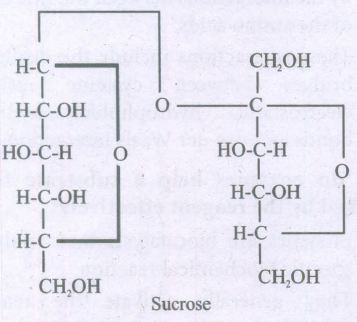
Give the structure of sucrose.
38.
How do enzymes help a substrate to be attacked by the reagent effectively?
39.
Distinguish between fat soluble and water soluble vitamins.
40.
Justify the presence of keto group in C2 in fructose.
41.
Explain the reaction which indicates the presence of ketonic group in fructose.
42.
What are reducing and non – reducing sugars?
1.
(d)
thymine
2.
(c)
penta acetate
3.
(d)
glucose
4.
(b)
Cooking oil
5.
(d)
loss of primary structure of proteins
6.
(c)
hydrolysis of sucrose to glucose and fructose
7.
(d)
Glucose
8.
(c)
uracil
9.
(a)
TACGAACT
10.
(b)
It does not react with Grignard reagent
11.
(d)
D-Glucose
12.
(d)
13.
(d)
H3N+-CH(R)-COO-
14.
(a)
Peptide bond
15.
(d)
D-Erythrose, D-Threose, L-Erythrose, L-Threose
16.
| Glucose | Fructose |
|---|---|
| It contains 4 asymmetric carbon atoms | It contains 3 asymmetric carbon atoms |
| Dextro rotatory. | Laevo rotatory |
| Glucose reduces Tollen's reagent and Fehling's solution. This indicates the presence of aldehyde group | Fructose does not reduce Tollen's reagent and Fehling's solution. This indicates the absence of aldehyde group. It contains ketone group. |
| Glucose is aldohexose | Fructose is keto hexose |
| Mild oxidation of glucose with bromine water gives gluconic acid. | Fructose is not oxidised by bromine water |
| Further oxidation of glucose with cone, gives saccharic acid. This indicates the presence of primary alcoholic group | Further oxidation of fructose with gives a mixture of glycollic and tartaric acid since oxidation occurs with rupture of the carbon chain, the carbonyl must be present as a ketone group. |
17.
Carbohydrates are polyhydroxy aldehydes or polyhydroxy ketones.
The carbohydrates may be summarised as below.
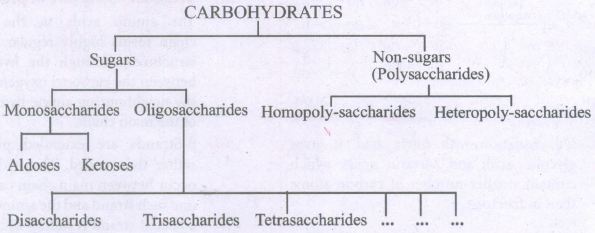
(i) Sugar: They are sweet crystalline substance and soluble in water.
(a) Monosaccharides: They are polyhydroxy aldehydes (or) polyhydroxy ketones.
Aldoses - Carbohydrates containing aldehyde group. Eg: Glucose
Ketoses - Carbohydrates containing ketone group. Eg: Fructose.
(b) Oligosaccharides: They are sugars that yield two to ten monosaccharide molecules on hydrolysis.
Disaccharides: They are sugars which on hydrolysis give two molecules of same or different monosaccharides. Eg: Sucrose, maltose.
\(\underset { Sucrose }{ { C }_{ 12 }{ H }_{ 22 }{ O }_{ 11 } } +{ H }_{ 2 }O\longrightarrow \underset { Glucose }{ { C }_{ 6 }{ H }_{ 12 }{ C }_{ 6 } } +\underset { Frutose }{ { C }_{ 6 }{ H }_{ 12 }{ O }_{ 6 } } \)
Trisaccharides: They are sugars which gives three molecules of monosaccharides on hydrolysis
Eg: Raffinose
\(\underset { Raffinose }{ { C }_{ 18 }{ H }_{ 32 }{ O }_{ 16 } } +{ 2H }_{ 2 }O\longrightarrow \underset { Gialactose }{ { C }_{ 6 }{ H }_{ 12 }{ O }_{ 6 } } +\underset { Glucose }{ { C }_{ 6 }{ H }_{ 12 }{ O }_{ 6 } } +\underset { Frutose }{ { C }_{ 6 }{ H }_{ 12 }{ O }_{ 6 } } \)
(ii) Non-sugars (or) Polysaccharides:
They are non-sugars which involve a large number of monosaccharide units linked to each other by oxide bridges. These bridges are called glycosidic linkages. Eg: starch, cellulose.
\(\underset { Starch }{ \left( { C }_{ 6 }{ H }_{ 10 }{ O }_{ 5 } \right) _{ n } } +n{ H }_{ 2 }O\overset { { H }^{ + } }{ \longrightarrow } \underset { Glucose }{ { nC }_{ 6 }{ H }_{ 12 }{ O }_{ 6 } } \)
18.
Importance of proteins:
Proteins are the functional units of living things : play vital role in all biological processes
(i) All biochemical reactions occur in the living systems are catalysed by the catalytic proteins called enzymes.
(ii) Proteins such as keratin, collagen acts as structural back bones.
(iii) Proteins are used for transporting molecules (Haemoglobin), organelles (Kinesins) in the cell and control the movement of molecules in and out of the cells (Transporters).
(iv) Antibodies help the body to fight various diseases
(v) Proteins are used as messengers to coordinate many functions. Insulin & glucagon controls the glucose level in the blood.
(vi) Proteins act as receptors that detect presence of certain signal molecules and activate the proper response.
(vii) Proteins are also used to store metals such as iron (Ferritin) etc.
19.
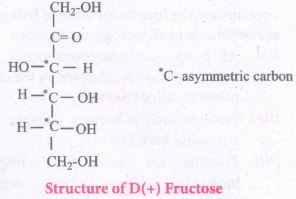
Structure of fructose: Fructose is the sweetest of all known sugars. It is readily soluble in water. Fresh solution of fructose has a specific rotation -1330 which changes to - 920 at equilibrium due to mutarotation. Similar to glucose, the structure of fructose is deduced from the following facts.
(i) Elemental analysis and molecular weight determination of fructose show that it has the molecular formula C6H12O6.
(ii) Fructose on reduction with HI and red phosphorus gives a mixture of n - hexane (major product) and 2 - iodohexane (minor product). This reaction indicates that the six carbon atoms in fructose are in a straight chain.

(ii) Fructose reacts with NH2OH and HCN. It shows the presence of carbonyl groups in the molecule of fructose.
(iv) Fructose reacts with acetic anhydride in the presence of pyridine to form penta acetate. This reaction indicates the presence of five hydroxyl groups in a fructose molecule. ,
(v) Fructose is not oxidized by bromine water. This rules out the possibility of presence of an aldehyde (-CHO) group.
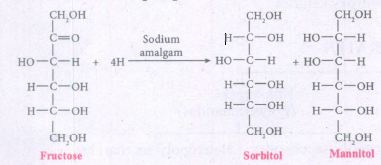
(vi) Partial reduction of fructose with sodium amalgam and water produces mixtures of sorbitol and mannitol which are epimers at second carbon. New asymmetric carbon is formed at C-2. This confirms the presence of keto group.
(vii) On oxidation with nitric acid, it gives glycolic acid and tartaric acids which contain smaller number of carbon atoms than in fructose.
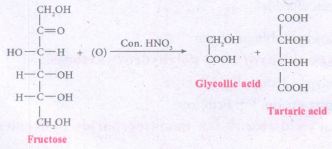
This shows that a keto group is present in C-2. It also shows the presence of 10 alcoholic groups at C- 1 and C- 6
20.
Importance of carbohydrates:
(i) Carbohydrates, widely distributed in plants and animals, acts mainly as energy sources and structural polymers.
(ii) Carbohydrate is stored in the body as glycogen and in plant as starch.
(iii) Carbohydrates such as cellulose which is the primary components of plant cell wall, is used to make paper, furniture (wood) and cloths (cotton)
(iv) Simple sugar glucose serves as an instant source of energy.
(v) Ribose sugars are one of the components of nucleic acids.
(vi) Modified carbohydrates such as hyaluronate (glycosaminoglycans) act as shock absorber and lubricant.
21.
(i) The amino acids are linked covalently by peptide bonds. The carboxyl group of the first amino acid react with the amino group of the second amino acid to give an amide linkage between these amino acids. This amide linkage is called peptide bond. The resulting compound is called a dipeptide. Addition an another amino acid to this dipeptide a second peptide bond results in tripeptide.
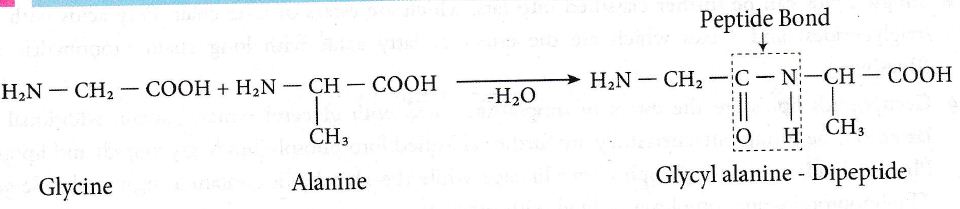
(ii) Thus we can generate tetra peptide, penta peptide etc... When you have more number of amino acids linked this way you get a polypeptide. If the number of amino acids are less it is called as a polypeptide, if it has large number of amino acids (and preferably has a function) then it is called a protein.
(iii) The amino end of the peptide is known as N - terminal or amino terminal while the carboxy end is called C-terminal or carboxy terminal. In general protein sequences are written from N-Terminal to C-Terminal.The atoms other than the side chains (R-groups) are called main chain or the back bone of the polypeptide.
22.
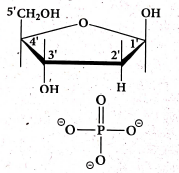
Watson & Crick proposed a 3-dimensional secondary structure of DNA. In this DNA molecule, Monomners of DNA are held together by Phosphodiester linkage. This linkages are occured in 5' & 3' carbon atoms of Pentose sugar.
23.
| Nucleosides | Nucleotides |
| The molecule without the phosphate group is called a nucleoside | A nucleotide is derived from a nucleoside by the addition of a molecule of phosphoric acid. |
| Sugar + Base ⟶ Nucleoside | Nucleoside + Phosphate ⟶Nucleotide |
24.
Vitamin K.
25.
Lipids can be classified as simple lipids, compounds lipids and derived lipids.
26.
| Fibrous Proteins | Globular Proteins |
| They are linear molecules | They have a spherical shape |
| Insoluble in water | Generally soluble in water |
| Eg: Keratin, Collagen | Eg: Myoglobin, Insulin |
27.
Human blood contains about 100 mg/dL of glucose, hence it is also known as blood sugar.
28.
The process by which one epimer is converted into other is called epimerisation and it requires the enzymes epimerase. Galactose is converted to glucose by this manner in our body.
29.
The type of sugar that contains 4 carbon atoms and -CHO group is Aldotetrose. Example of Aldotetrose is Erythrose.
30.
α - Helix:
In the a-helix sub-structure, the amino acids are arranged in a right handed helical (spiral) structure and are stabilised by the hydrogen bond between the carbonyl oxygen one amino acid (nth residue) with amino hydrogen of the fifth residue (n + 4th residue).The side chains of the residues protrude, outside of the helix. Each turn of an a-helix contains about 3.6 residues and is about 5.4 Å long.The amino acid proline produces a kink in the helical structure and often called as a helix breaker due to its rigid cyclic structure.
31.
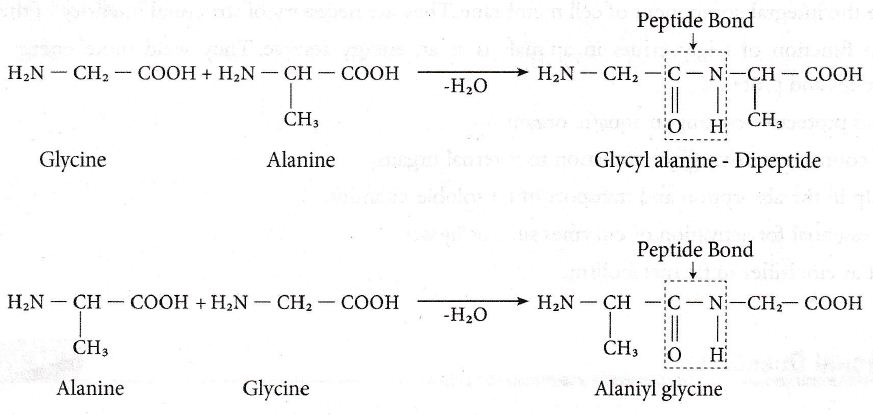
∴ Two dipeptides structures are possible from glycine and alanine. They are glycyl alanine and Alanyl glycine.
32.
Vitamins are classified into two groups based on their solubility in water or in fat.
(a) Fat soluble vitamins:
These vitamins absorbed best when taken with fatty food and are stored in fatty tissues and livers. These vitamins do not dissolve in water. Hence they are called fat soluble vitamins. Vitamin A, D, E & K are fatsoluble vitamins.
(b) Water soluble vitamins:
Vitamins B (B1, B2, B3, B5, B6, B7, B9 & B12) and C are readily soluble in water. On the contrary to fat soluble vitamins, these can't be stored. The excess vitamins present will be excreted through urine and are not stored in our body. Hence, these two vitamins should be supplied regularly to our body.
33.
i) Starch - Polysaccharide
ii) fructose - monosaccharide
iii) sucrose - oligosaccharides
iv) lactose - oligosaccharides
iv) maltose - oligosaccharides
34.
| Hormone | Vitamin |
|---|---|
| Synthesized in animal bodies | Synthesised in plants |
| Produced in ductless (endocrine glands) | Have to be supplied in diet except (Vitamin D) |
| These are not stored in body but are continuously produced | These remain stored in the body to keep away diseases |
| Eg: Androgen, Estrogen, thyroxine etc. | Eg: Vitamin A (Retinol) Vitamin C (Ascorbic acid) |
35.
i) Rickets - Vitamin - D (Cholecalciferol - (D3) Ergocalciferol - (D2)
ii) Scurvy (bleeding gums) - vitamin - C (Ascorbic acid)
36.
(i) Oligosaccharides are sugars that yield two to ten monosaccharide molecules on hydrolysis. Eg: Sucrose, Raffinose
(ii) Polysaccharides are carbohydrates which involve a large number of monosaccharide units linked to each other by oxide bridges. These linkages are called glycosidic linkages.
Eg: Starch, cellulose and inulin.
37.
38.
(i) Enzymes are biocatalysts that catalyse a specific biochemical reaction.
(ii) They generally activate the reaction by reducing the activation energy by stabilising the transition state.
(iii) In a typical reaction, enzyme E binds with the substrate molecule reversibly to produce an enzyme substrate complex.
(iv) During this stage,the substrate is converted into product and the enzyme becomes free and is ready to bind to another substrate molecule.
\(\underset { Enzyme }{ E } +\underset { Substance }{ S } \longrightarrow \underset { Enzyme-substratecomplex }{ [ES] } \)
[ES]➝E+P
39.
| Fat Soluble Fat Soluble | Water Soluble Vitamins |
|---|---|
| Do not dissolve in water | Readily soluble in water |
| They are stored in fatty tissues and liver | These can't be stored |
| Eg: Vitamin A, D, E and K | Eg: Vitamin Band |
40.
On oxidation with nitric acid, it gives glycolic acid and tartaric acids which contain smaller number of carbon atoms than in fructose.
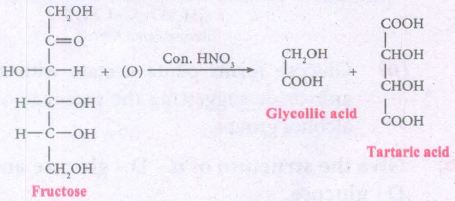
This shows that a keto group is present in C-2.
41.
(i) Oxidation of fructose yields a mixture of glycollic acid and tartaric acid.
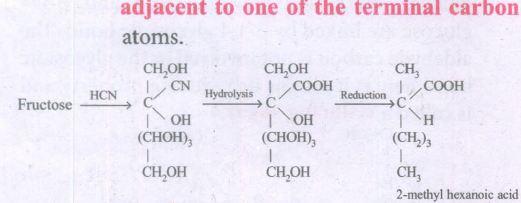
(ii) When fructose is treated with HCN, it forms an addition product which upon hydrolysis and subsequent reduction with hydroiodic acid and red phosphorous gives 2-methyl-hexanoic acid.
This indicates that the ketone group is
42.
i) Reducing sugars:
1. Sugars which reduce Tollen's reagent or Fehling's solution or Benedict's solution are called reducing sugars.
2. These contain either α - hydroxyl ketone or cyclical hemi acetal or hemi ketal or structures in equilibrium with open chain forms having a free- CHO or C=O group.
3. E.g. a) All monosaccharide's like D - glucose, D - fructose (aldoses and ketoses)
b) Sugars like Lactose and maltose except sucrose.
ii) Non - reducing sugars:
1. Sugars which do not reduce either Tollen's reagent, Fehling's solution or Benedict's solution are called non-reducing sugars.
2. They contain a stable acetal or ketal structures which cannot be opened into a free carbonyl group.
E.g. Sucrose, starch, cellulose, glycogen, dextrin etc.

12th Standard Syllabus & Materials
12th Standard
TN 12th Computer Applications களப்பெயர் முறைமை (DNS) Sample Question Papers Study Material - QB365 Set A
NEW12th Standard
TN 12th Computer Applications வலையமைப்பு எடுத்துக்காட்டுகள் மற்றும் நெறிமுறைகள் Sample Question Papers Study Material - QB365 Set A
NEW12th Standard
TN 12th Computer Applications கணினி வலையமைப்பு ஓர் அறிமுகம் Sample Question Papers Study Material - QB365 Set A
NEW12th Standard
TN 12th Computer Applications PHP-உடன் MySQL-ஐ இணைத்தல் Sample Question Papers Study Material - QB365 Set A



Tamilnadu Stateboard 12th Standard Subjects

Maths
Chemistry

Physics

Biology

Computer Science

Business Maths and Statistics

Economics

Commerce

Accountancy

History

Computer Applications
Biology
Computer Technology
Computer Applications
Computer Science
Business Maths and Statistics
Commerce
Economics
Maths
Chemistry
Physics
Computer Technology
History
Accountancy

Tamil

English

French
Tamilnadu Stateboard Standards
