
 100% FREE ACCESS
12th Standard Syllabus & Materials
12th Standard
TN 12th Computer Applications மின்னணு தரவு பரிமாற்றம் Sample Question Papers Study Material - QB365 Set A
NEW12th Standard
TN 12th Computer Applications மின் - வணிக பாதுகாப்பு அமைப்புகள் Sample Question Papers Study Material - QB365 Set A
NEW12th Standard
TN 12th Computer Applications மின்னணு செலுத்தல் முறைகள் Sample Question Papers Study Material - QB365 Set A
NEW12th Standard
TN 12th Computer Applications மின் - வணிகம் Sample Question Papers Study Material - QB365 Set A
NEW12th Standard
TN 12th Computer Applications திறந்த மூல கருத்துருக்கள் Sample Question Papers Study Material - QB365 Set A
NEW12th Standard
TN 12th Computer Applications வலையமைப்பு வடமிடல் Sample Question Papers Study Material - QB365 Set A

Published on: 29/01/2021
12th Standard Chemistry English Medium Bio Molecules Reduced Syllabus Important Questions With Answer Key 2021
Download Tamil Nadu 12th Standard Chemistry question papers, model tests, one-mark questions, important questions, and public exam papers in PDF format. Free study materials and answer keys for TN State Board students.
Questions + Answers key
Take MCQ Chemistry Test
1.
Fructose is not oxidised by bromine water indicates
the presence of aldehydic group
presence of ketonic group
absence of aldehydic group
absence of ketonic group
2.
Sugars that yield two to ten monosaccharide molecules on hydrolysis is
monosaccharides
disaccharides
oligosaccharides
polysaccharides
3.
Pick out the odd one.
Wax
Starch
Glucose
Fructose
4.
Starch when heated with enzyme diastase yields
glucose
sucrose
maltose
glycogen
5.
Specificity of enzyme is due to
the sequence of amino acids
secondary structure
tertiary structure
all of the above
6.
The building block of proteins are
α - hydroxy acids
α-amino acids
β-hydroxy acids
β-amino acids
7.
Which is a monosaccharide among the following?
Sucrose
Cellulose
Maltose
Glucose
8.
Which of the following are epimers?
D(+)-Glucose and D(+)-Galactose
D(+)-Glucose and D(+)-Mannose
Neither (a) nor (b)
Both (a) and (b)
9.
Which of the following statement is correct?
Ovalbumin is a simple food reserve in egg-white
Blood proteins thrombin and fibrinogen are involved in blood clotting
Denaturation makes protein more active
Insulin maintains the sugar level of in the human body
10.
Complete hydrolysis of cellulose gives ______.
L-Glucose
D-Fructose
D-Ribose
D-Glucose
11.
The pyrimidine bases present in DNA are ______.
Cytosine and Adenine
Cytosine and Guanine
Cytosine and Thiamine
Cytosine and Uracil
12.
The number of sp2 and sp3 hybridised carbon in fructose are respectively ______.
1 and 4
4 and 2
5 and 1
1 and 5
13.
Which one of the following is not produced by body?
DNA
Enzymes
Hormones
Vitamins
14.
Among the following the achiral amino acid is ______.
2-ethylalanine
2-methylglycine
2-hydroxymethylserine
Tryptophan
15.
The central dogma of molecular genetics states that the genetic information flows from______.
Amino acids Protein DNA
DNA Carbohydrates Proteins
DNA RNA Proteins
DNA RNA Carbohydrates
16.
Show the formation of a peptide bond with an equation.
17.
List the importance of proteins in biological processes.
18.
Define the following terms as related to proteins
(i) Primary structure
(ii) Secondary structure
(iii) β strands
19.
Give the uses of carbohydrates.
20.
Write a short note on peptide bond.
21.
Give the differences between primary and secondary structure of proteins.
22.
Write a note on rRNA.
23.
Give the uses of cellulose.
24.
Why cellulose is not used as food by humans?
25.
Why are polysaccharides called non-sugars?
26.
How is fructose prepared from inulin?
27.
What are anomers? Give example.
28.
List the expected products of hydrolysis of lactose.
29.
Is the following sugar, D – sugar or L – sugar?
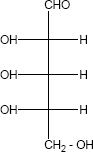
30.
Write the structure of all possible dipeptides which can be obtained form glycine and alanine
31.
Classify the following into monosaccharides, oligosaccharides and polysaccharides.
i) Starch
ii) fructose
iii) sucrose
iv) lactose
iv) maltose
32.
Give two difference between Hormones and vitamins.
33.
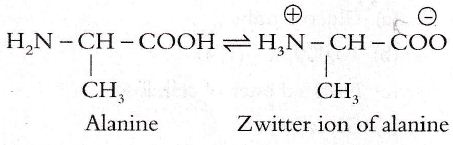
Write the Zwitter ion structure of alanine
34.
Write the monomers of the following sugars and explain how they are linked.
(i) Sucrose
(ii) Maltose
(iii) Lactose
35.
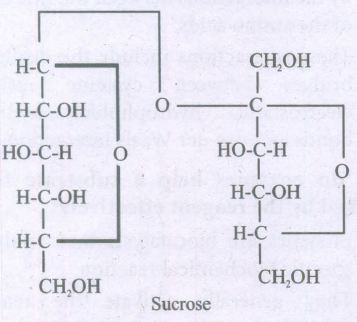
Give the structure of sucrose.
36.
Amino acids are amphoteric in nature. Explain.
37.
ExpIain the classification of proteins based on their structure.
38.
Complete the following reaction.
(i) Glucose + acetic anhydride ➝ _______?_______
(ii) What does the above reaction suggest?
39.
Write the product formed when HCN reacts with glucose.
40.
Explain the reaction which indicates the presence of ketonic group in fructose.
41.
42.
What are reducing and non – reducing sugars?
1.
(c)
absence of aldehydic group
2.
(c)
oligosaccharides
3.
(a)
Wax
4.
(c)
maltose
5.
(d)
all of the above
6.
(b)
α-amino acids
7.
(d)
Glucose
8.
(d)
Both (a) and (b)
9.
(c)
Denaturation makes protein more active
10.
(d)
D-Glucose
11.
(c)
Cytosine and Thiamine
12.
(d)
1 and 5
13.
(d)
Vitamins
14.
(c)
2-hydroxymethylserine
15.
(c)
DNA RNA Proteins
16.
(i) The bond formed between two amino acids by the elimination of a water molecule is called peptide linkage or bond
(ii) The amino group of one amino acid and a carboxyl group of other amino acid undergoes condensation to remove a water molecule and it results in the formation of bond.

(iii) The product formed by linking amino acid molecules through peptide linkages is called a peptide.
(iv) In peptide formation the two different amino acid molecules may react in one of the two ways.
\({ NH }_{ 2 }-{ CH }_{ 2 }-COOH+{ H }_{ 2 }N-\overset { \underset { | }{ { CH }_{ 3 } } }{ CH } -COOH\longrightarrow { H }_{ 2 }N-{ CH }_{ 2 }-CO-NH-\overset { \underset { | }{ { CH }_{ 3 } } }{ CH } -COOH\)
\({ H }_{ 2 }N-\underset { Alanine }{ \overset { \underset { | }{ \overset { Glycine }{ { CH }_{ 3 } } } }{ CH } } -COOH+{ H }_{ 2 }N-\underset { Glycine }{ { CH }_{ 2 } } -COOH\longrightarrow \underset { Alanyl\quad glycine\quad (Dipeptide) }{ { H }_{ 2 }N-\overset { \underset { | }{ { CH }_{ 3 } } }{ CH } -CO-NH } -{ CH }_{ 2 }COOH\)
17.
Importance of proteins:
Proteins are the functional units of living things : play vital role in all biological processes
(i) All biochemical reactions occur in the living systems are catalysed by the catalytic proteins called enzymes.
(ii) Proteins such as keratin, collagen acts as structural back bones.
(iii) Proteins are used for transporting molecules (Haemoglobin), organelles (Kinesins) in the cell and control the movement of molecules in and out of the cells (Transporters).
(iv) Antibodies help the body to fight various diseases
(v) Proteins are used as messengers to coordinate many functions. Insulin & glucagon controls the glucose level in the blood.
(vi) Proteins act as receptors that detect presence of certain signal molecules and activate the proper response.
(vii) Proteins are also used to store metals such as iron (Ferritin) etc.
18.
(i) Primary structure of proteins: Proteins are polypeptide chains made up of amino acids connected through peptide bonds. The relative arrangement of the amino acids in the polypeptide chain is called the primary structure of the protein.
(ii) Secondary structure of proteins: The amino acids in the polypeptide chain forms highly regular shapes (substructures) through the hydrogen bond between the carbonyl oxygen (-C=O) and the neighbouring amine hydrogen (- NH) of the main chain.
(iii) β-Strands are extended peptide chain rather than coiled. The hydrogen bonds occur between main chain carbonyl group one such strand and the amino group of the adjacent strand resulting in the formation of a sheet like structure. This arrangement is called β-sheets.
19.
Importance of carbohydrates:
(i) Carbohydrates, widely distributed in plants and animals, acts mainly as energy sources and structural polymers.
(ii) Carbohydrate is stored in the body as glycogen and in plant as starch.
(iii) Carbohydrates such as cellulose which is the primary components of plant cell wall, is used to make paper, furniture (wood) and cloths (cotton)
(iv) Simple sugar glucose serves as an instant source of energy.
(v) Ribose sugars are one of the components of nucleic acids.
(vi) Modified carbohydrates such as hyaluronate (glycosaminoglycans) act as shock absorber and lubricant.
20.
(i) The amino acids are linked covalently by peptide bonds. The carboxyl group of the first amino acid react with the amino group of the second amino acid to give an amide linkage between these amino acids. This amide linkage is called peptide bond. The resulting compound is called a dipeptide. Addition an another amino acid to this dipeptide a second peptide bond results in tripeptide.
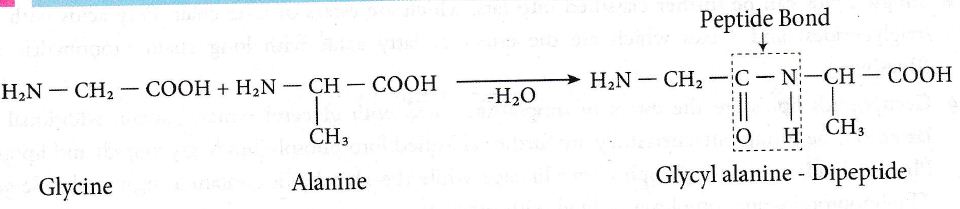
(ii) Thus we can generate tetra peptide, penta peptide etc... When you have more number of amino acids linked this way you get a polypeptide. If the number of amino acids are less it is called as a polypeptide, if it has large number of amino acids (and preferably has a function) then it is called a protein.
(iii) The amino end of the peptide is known as N - terminal or amino terminal while the carboxy end is called C-terminal or carboxy terminal. In general protein sequences are written from N-Terminal to C-Terminal.The atoms other than the side chains (R-groups) are called main chain or the back bone of the polypeptide.
21.
Primary structure of Proteins:
Proteins are polypeptide chains, made up of amino acids are connected through peptide bonds. The relative arrangement of the amino acids in the polypeptide chain is called the primary structure of the protein. Knowledge of this is essential as even small changes have potential to alter the overall structure and function of a protein.
\(\mathrm{H}_{2} \mathrm{~N}-\mathrm{Gly}-\mathrm{Met}-\mathrm{Phe}-\mathrm{Cys}-\mathrm{Arg}-\mathrm{Asp}-\mathrm{COOH}\)
α - Helix:
In the α-helix sub-structure, the amino acids are arranged in a right handed helical (spiral) structure and are stabilised by the hydrogen bond between the carbonyl oxygen of one amino acid (n residue) with amino hydrogen of the fifth residue (n + 4th residue). The side chains of the residues protrude outside of the helix. Each turn of an α-helix contains about 3.6 residues and is about 5.4 Å long. The amino acid proline produces a kink in the helical structure and often called as a helix breaker due to its rigid cyclic structure.
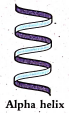
1. Linear sequence of aminoacids
2. Linear
3. Composed of peptide bonds formed between amino acids.
Secondary structure of Proteins:
The amino acids in the polypeptide chain forms highly regular shapes (sub-structures) through the hydrogen bond between the carbonyl oxygen (-C=O) and the neighbouring amine hydrogen (-NH) of the main chain. α-Helix and β-strands or sheets are two most common substructures formed by proteins.
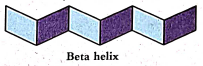
β-Strand:
β-Strands are extended peptide chain rather than coiled. The hydrogen bonds occur between main chain carbonyl group one such strand and the amino group of the adjacent strand resulting in the formation of a sheet like structure. This arrangement is called β-sheets.
22.
rRNA is mainly found in cytoplasm and in ribosomes, which contain 60% RNA and 40% protein. Ribosomes are the sites at which protein synthesis takes place.
23.
Cellulose is used extensively in manufacturing paper, cellulose fibres and rayon explosive.
24.
Humans cannot use cellulose as food because our digestive systems do not contain the necessary enzymes (glycosidases or cellulases) that can hydrolyse the cellulose.
25.
Polysaccharides are called as non-sugars since they don't have an sweet taste.
26.
Fructose is prepared commercially by hydrolysis of Inulin (a polysaccharide) in acidic medium.
\(\underset { Inulin }{ \left( { C }_{ 6 }{ H }_{ 12 }{ O }_{ 5 } \right) _{ 5 } } +n{ H }_{ 2 }O\overset { { H }^{ + } }{ \longrightarrow } \underset { Frutose }{ { nC }_{ 6 }{ H }_{ 12 }{ O }_{ 6 } } \)
27.
Anomers are cyclic monosaccharide differing from each other in the configuration of C1 if they are aldoses or in the configuration of C2 if they are ketoses.
E.g. α and βD - glucose.
28.
Lactose is a dissaccharide so on hydrolysis gives I two monosaccharides.
\(\underset { Lactose }{ { C }_{ 12 }{ H }_{ 22 }{ O }_{ 11 }+{ H }_{ 2 }O } \overset { + }{ \longrightarrow } \underset { D(+)G1ucoseD(+)Galactose }{ { C }_{ 6 }{ { H }_{ 12 }{ O }_{ 6 } }+{ C }_{ 6 }{ H }_{ 12 }{ O }_{ 6 } } \)
29.
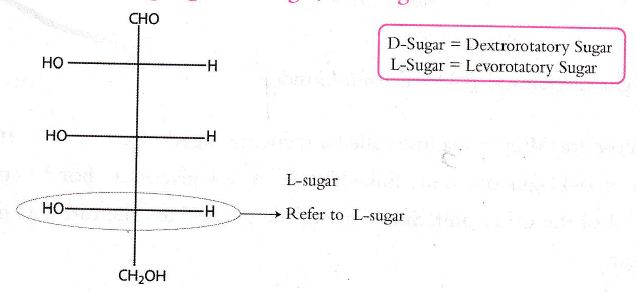
(a) C4 carbon of the given sugar contains H and OH on the same configuration like C4 carbon in L-Glyceraldehyde. Therefore the sugar is L-sugar.
(b) Because the H and OH on C4 carbon are in the same configuration as the Hand OH on C4 carbon in L-Glyceraldehyde
30.
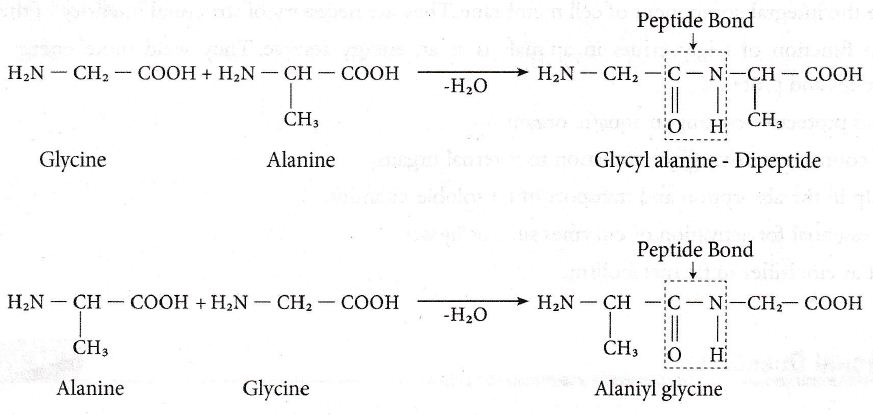
∴ Two dipeptides structures are possible from glycine and alanine. They are glycyl alanine and Alanyl glycine.
31.
i) Starch - Polysaccharide
ii) fructose - monosaccharide
iii) sucrose - oligosaccharides
iv) lactose - oligosaccharides
iv) maltose - oligosaccharides
32.
| Hormone | Vitamin |
|---|---|
| Synthesized in animal bodies | Synthesised in plants |
| Produced in ductless (endocrine glands) | Have to be supplied in diet except (Vitamin D) |
| These are not stored in body but are continuously produced | These remain stored in the body to keep away diseases |
| Eg: Androgen, Estrogen, thyroxine etc. | Eg: Vitamin A (Retinol) Vitamin C (Ascorbic acid) |
33.
34.
(i) Sucrose: D - glucose and D - fructose linked by α. - 1, 2 glycosidic bond.
(ii) Maltose: Two molecules of α. - D - glucose linked by α. - 1, 4 glycosidic bond.
(iii) Lactose: f3 - D - glucose and f3 - D galactose linked by β - 1, 4 glycosidic bond
35.
36.
At aqueous solution, the proton from carboxyl group can be transferred to the amino group of an amino acid leaving these groups with opposite charges. Despite having both positive and negative charges, this molecule is neutral and has amphoteric behaviour. These ions are called zwitter ions.
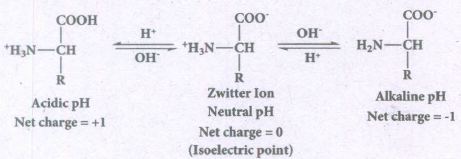
Zwitter ions behave as neutral molecules at pH isoelectric point.
37.
Proteins are classified based on their structure (overall shape) into two major types. They are fibrous protein and globular proteins.
(i) Fibrous proteins: These proteins are linear molecules. These are generally insoluble in water and are held together by disulphide bridges and weak intermolecular hydrogen bonds. The Example: Keratin, Collagen etc
(ii) Globular proteins: These proteins have an overall spherical shape. The polypeptide chain is folded into a spherical shape. These proteins are usually soluble in water and have many functions including catalysis.
38.
(i)
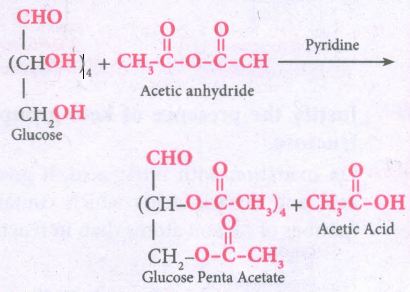
(ii) Glucose forms penta acetate with acetic anhydride suggesting the presence of five alcohol groups.
39.
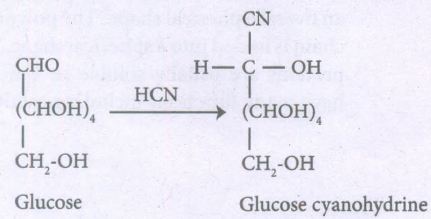
Glucose reacts with HCN to form cyanohydrin.
40.
(i) Oxidation of fructose yields a mixture of glycollic acid and tartaric acid.
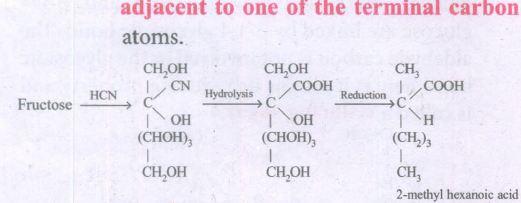
(ii) When fructose is treated with HCN, it forms an addition product which upon hydrolysis and subsequent reduction with hydroiodic acid and red phosphorous gives 2-methyl-hexanoic acid.
This indicates that the ketone group is
41.
42.
i) Reducing sugars:
1. Sugars which reduce Tollen's reagent or Fehling's solution or Benedict's solution are called reducing sugars.
2. These contain either α - hydroxyl ketone or cyclical hemi acetal or hemi ketal or structures in equilibrium with open chain forms having a free- CHO or C=O group.
3. E.g. a) All monosaccharide's like D - glucose, D - fructose (aldoses and ketoses)
b) Sugars like Lactose and maltose except sucrose.
ii) Non - reducing sugars:
1. Sugars which do not reduce either Tollen's reagent, Fehling's solution or Benedict's solution are called non-reducing sugars.
2. They contain a stable acetal or ketal structures which cannot be opened into a free carbonyl group.
E.g. Sucrose, starch, cellulose, glycogen, dextrin etc.

12th Standard Syllabus & Materials
12th Standard
TN 12th Computer Applications களப்பெயர் முறைமை (DNS) Sample Question Papers Study Material - QB365 Set A
NEW12th Standard
TN 12th Computer Applications வலையமைப்பு எடுத்துக்காட்டுகள் மற்றும் நெறிமுறைகள் Sample Question Papers Study Material - QB365 Set A
NEW12th Standard
TN 12th Computer Applications கணினி வலையமைப்பு ஓர் அறிமுகம் Sample Question Papers Study Material - QB365 Set A
NEW12th Standard
TN 12th Computer Applications PHP-உடன் MySQL-ஐ இணைத்தல் Sample Question Papers Study Material - QB365 Set A



Tamilnadu Stateboard 12th Standard Subjects

Maths
Chemistry

Physics

Biology

Computer Science

Business Maths and Statistics

Economics

Commerce

Accountancy

History

Computer Applications
Biology
Computer Technology
Computer Applications
Computer Science
Business Maths and Statistics
Commerce
Economics
Maths
Chemistry
Physics
Computer Technology
History
Accountancy

Tamil

English

French
Tamilnadu Stateboard Standards
