
 100% FREE ACCESS
12th Standard Syllabus & Materials
12th Standard
TN 12th Maths Applications of Matrices and Determinants Sample Question Papers Study Material - QB365 Set A
NEW12th Standard
TN 12th Computer Applications மின்னணு தரவு பரிமாற்றம் Sample Question Papers Study Material - QB365 Set A
NEW12th Standard
TN 12th Computer Applications மின் - வணிக பாதுகாப்பு அமைப்புகள் Sample Question Papers Study Material - QB365 Set A
NEW12th Standard
TN 12th Computer Applications மின்னணு செலுத்தல் முறைகள் Sample Question Papers Study Material - QB365 Set A
NEW12th Standard
TN 12th Computer Applications மின் - வணிகம் Sample Question Papers Study Material - QB365 Set A
NEW12th Standard
TN 12th Computer Applications திறந்த மூல கருத்துருக்கள் Sample Question Papers Study Material - QB365 Set A

Published on: 02/09/2022
QB365 provides a detailed and simple solution for every Possible Creative Questions in Class 12 Chemistry Subject - Biomolecules, English Medium. It will help Students to get more practice questions, Students can Practice these question papers in addition to score best marks.
Download Tamil Nadu 12th Standard Chemistry question papers, model tests, one-mark questions, important questions, and public exam papers in PDF format. Free study materials and answer keys for TN State Board students.
Questions + Answers key
Take MCQ Chemistry Test
1.
What is a peptide bond? Illustrate the formation of a peptide bond in glycin alanine.
2.
Write a note on composition and structure of nucleic acids.
3.
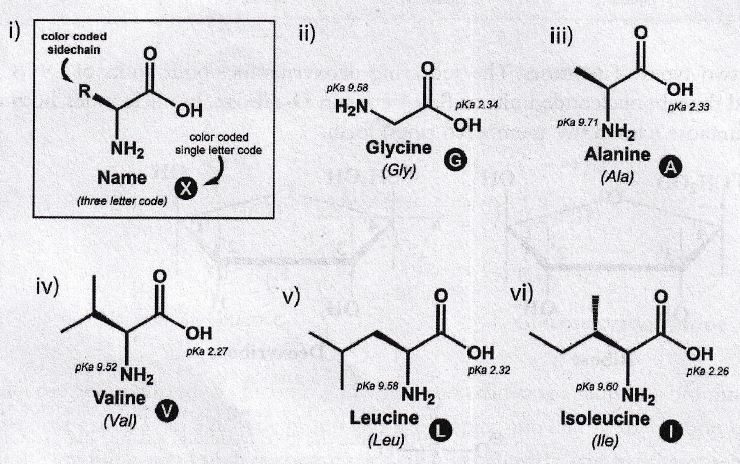
Give the structures of any five amino acids.
4.
Explain the cyclic structure of glucose.
5.
How is the structure of glucose elucidated?
6.
Show the formation of a peptide bond with an equation.
7.
Distinguish glucose from fructose.
8.
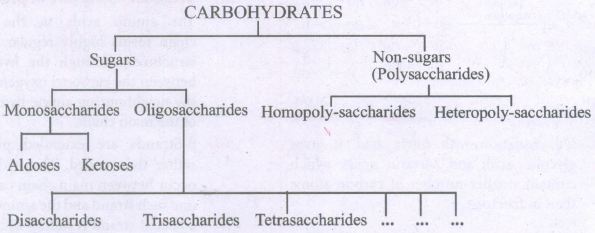
Outline the classification of carbohydrates giving example for each.
9.
Explain the classification of hormones.
10.
List the importance of proteins in biological processes.
11.
Define the following terms as related to proteins
(i) Primary structure
(ii) Secondary structure
(iii) β strands
12.
Elucidate the structure of fructose.
13.
Elucidate the structure of glucose.
14.
Give the uses of carbohydrates.
1.
(i) The bond formed between two amino acids by the elimination of a water molecule is called peptide linkage or bond
(ii) The amino group of one amino acid and a carboxyl group of other amino acid undergoes condensation to remove a water molecule and it results in the formation of bond.

(iii) The product formed by linking amino acid molecules through peptide linkages is called a peptide.
(iv) In peptide formation the two different amino acid molecules may react in one of the two ways.
\({ NH }_{ 2 }-{ CH }_{ 2 }-COOH+{ H }_{ 2 }N-\overset { \underset { | }{ { CH }_{ 3 } } }{ CH } -COOH\longrightarrow { H }_{ 2 }N-{ CH }_{ 2 }-CO-NH-\overset { \underset { | }{ { CH }_{ 3 } } }{ CH } -COOH\)
\({ H }_{ 2 }N-\underset { Alanine }{ \overset { \underset { | }{ \overset { Glycine }{ { CH }_{ 3 } } } }{ CH } } -COOH+{ H }_{ 2 }N-\underset { Glycine }{ { CH }_{ 2 } } -COOH\longrightarrow \underset { Alanyl\quad glycine\quad (Dipeptide) }{ { H }_{ 2 }N-\overset { \underset { | }{ { CH }_{ 3 } } }{ CH } -CO-NH } -{ CH }_{ 2 }COOH\)
2.
Nucleic acids are biopolymers of nucleotides. Controlled hydrolysis of DNA and RNA yields three components namely a nitrogenous base, a pentose sugar and phosphate group.
Nitrogen base:
These are nitrogen containing organic compounds which are derivatives of two parent compounds, pyrimidine and purine. Both DNA and RNA have two major purine bases, adenine (A) and guanine (G). In both DNA and RNA, one of the pyrimidines is cytosine (C), but the second pyrimidine is thymine (T) in DNA and uracil (U) in RN
.JPG)
.JPG)
Pentose sugar:
Nucleic acids have two types of pentoses. The recurring deoxyribonucleotide units of DNA contain 2'-deoxy-D-ribose and the ribonucleotide units of RNA contain D-ribose. In nucleotides, both types of pentoses are in their β-furanose (closed five membered rings) form.
.JPG)
Phosphate group:
Phosphoric acid forms phosphor diester bond between nucleotides. Based on the number of phosphate group present in the nucleotides, they are classified mono nucleotide, dinucleotide and trinucleotide.
Nucleosides and nucleotides:
The molecule without the phosphate group is called a nucleoside. A nucleotide is derived from a nucleoside by the addition of a molecule of phosphoric acid. Phosphorylation occurs generally in the 5 ' OH group of the sugar. Nucleotides are linked in DNA and RNA by phospho diester bond between 5' OH group of one nucleotide and 3' OH group on another nucleotide.
Sugar + Base → Nucleoside
Nucleoside + Phosphate → Nucleotide
Nucleotide → Polynucleotide (Nucleic Acid)
3.
4.
1. Fischer identified that the open chain penta hydroxyl aldehyde structure of glucose, that he proposed, did not completely explain its chemical behaviour. Unlike simple aldehydes, glucose did not form crystalline bisulphite compound with sodium bisulphite. Glucose does not give schiff's test and the penta acetate derivative of glucose was not oxidized by Tollen's reagent (or) Fehling's solution. This behaviour could not be explained by the open chain structure.
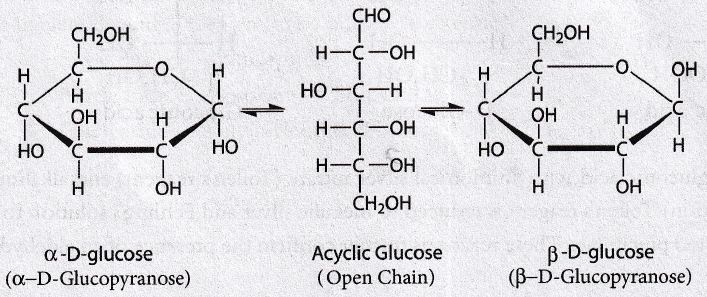
2. In addition, glucose found to crystallise in two different forms depending upon the crystallisation conditions with different melting points (419 and 423 K). In order to explain these it was proposed that one of the hydroxyl group reacts with the aldehyde group to form a cyclic structure (hemiacetal form). This also results in the conversion of the achiral aldehyde carbon into a chiral one leading the possibility two isomers. These two isomers differ only in the configuration of C 1 carbon. These isomers are called anomers.
3. The two anomeric forms of glucose are called α - and β-forms. This cyclic structure of glucose is similar to pyran, a cyclic compound with 5 carbon and one oxygen atom, and hence is called pyranose form. The specific rotation of pure α - and β-(D) glucose are 112o and 18.7o respectively. However, when a pure form of any one of these sugars is dissolved in water, slow interconversion of α-D glucose and β-D glucose via open chain form until equilibrium is established giving constant specific rotation +53o. This phenomenon is called mutarotation.
5.
1. Elemental analysis and molecular weight determination show that the molecular formula of glucose is \(\mathrm{C}_{6} \mathrm{H}_{12} \mathrm{O}_{6}\)
.JPG)
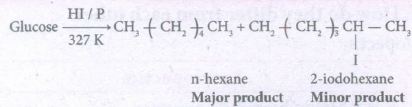
2. On reduction with concentrated HI and red phosphorus at 373 K, glucose gives a mixture of n hexane and 2-iodohexane indicating that the six carbon atoms are bonded linearly.
.JPG)
3. Glucose reacts with hydroxylamine to form oxime and with HCN to form cyanohydrin. These reactions indicate the presence of carbonyl group in glucose.
.JPG)
4. Glucose gets oxidized to gluconic acid with mild oxidizing agents like bromine water suggesting that the carbonyl group is an aldehyde group and it occupies one end of the carbon chain. When oxidised using strong oxidising agent such as conc. nitric acid gives glucaric acid (saccharic acid) suggesting the other end is occupied by a primary alcohol group.
.JPG)
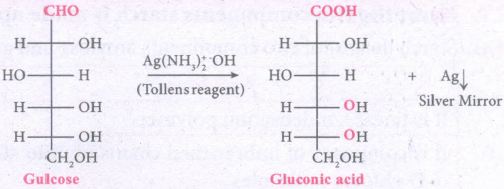
5. Glucose is oxidised to gluconic acid with ammonical silver nitrate (Tollen's reagent) and alkaline copper sulphate (Fehling's solution). Tollen's reagent is reduced to metallic silver and Fehling's solution to cuprous oxide which appears as red precipitate. These reactions further confirm the presence of an aldehyde group.
.JPG)
6. Glucose is a stable compound and does not undergo dehydration easily. It indicates that not more than one hydroxyl group is bonded to a single carbon atom. Thus the five hydroxyl groups are attached to five different carbon atoms and the sixth carbon is an aldehyde group.
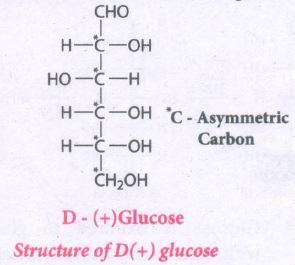
7. The exact spacial arrangement of -OH groups was given by Emil Fischer as shown in figure, The glucose is referred to as D(+) glucose as it has D configuration and is dextrorotatory.
6.
(i) The bond formed between two amino acids by the elimination of a water molecule is called peptide linkage or bond
(ii) The amino group of one amino acid and a carboxyl group of other amino acid undergoes condensation to remove a water molecule and it results in the formation of bond.
(iii) The product formed by linking amino acid molecules through peptide linkages is called a peptide.
(iv) In peptide formation the two different amino acid molecules may react in one of the two ways.
\({ NH }_{ 2 }-{ CH }_{ 2 }-COOH+{ H }_{ 2 }N-\overset { \underset { | }{ { CH }_{ 3 } } }{ CH } -COOH\longrightarrow { H }_{ 2 }N-{ CH }_{ 2 }-CO-NH-\overset { \underset { | }{ { CH }_{ 3 } } }{ CH } -COOH\)
\({ H }_{ 2 }N-\underset { Alanine }{ \overset { \underset { | }{ \overset { Glycine }{ { CH }_{ 3 } } } }{ CH } } -COOH+{ H }_{ 2 }N-\underset { Glycine }{ { CH }_{ 2 } } -COOH\longrightarrow \underset { Alanyl\quad glycine\quad (Dipeptide) }{ { H }_{ 2 }N-\overset { \underset { | }{ { CH }_{ 3 } } }{ CH } -CO-NH } -{ CH }_{ 2 }COOH\)
7.
| Glucose | Fructose |
|---|---|
| It contains 4 asymmetric carbon atoms | It contains 3 asymmetric carbon atoms |
| Dextro rotatory. | Laevo rotatory |
| Glucose reduces Tollen's reagent and Fehling's solution. This indicates the presence of aldehyde group | Fructose does not reduce Tollen's reagent and Fehling's solution. This indicates the absence of aldehyde group. It contains ketone group. |
| Glucose is aldohexose | Fructose is keto hexose |
| Mild oxidation of glucose with bromine water gives gluconic acid. | Fructose is not oxidised by bromine water |
| Further oxidation of glucose with cone, gives saccharic acid. This indicates the presence of primary alcoholic group | Further oxidation of fructose with gives a mixture of glycollic and tartaric acid since oxidation occurs with rupture of the carbon chain, the carbonyl must be present as a ketone group. |
8.
Carbohydrates are polyhydroxy aldehydes or polyhydroxy ketones.
The carbohydrates may be summarised as below.
(i) Sugar: They are sweet crystalline substance and soluble in water.
(a) Monosaccharides: They are polyhydroxy aldehydes (or) polyhydroxy ketones.
Aldoses - Carbohydrates containing aldehyde group. Eg: Glucose
Ketoses - Carbohydrates containing ketone group. Eg: Fructose.
(b) Oligosaccharides: They are sugars that yield two to ten monosaccharide molecules on hydrolysis.
Disaccharides: They are sugars which on hydrolysis give two molecules of same or different monosaccharides. Eg: Sucrose, maltose.
\(\underset { Sucrose }{ { C }_{ 12 }{ H }_{ 22 }{ O }_{ 11 } } +{ H }_{ 2 }O\longrightarrow \underset { Glucose }{ { C }_{ 6 }{ H }_{ 12 }{ C }_{ 6 } } +\underset { Frutose }{ { C }_{ 6 }{ H }_{ 12 }{ O }_{ 6 } } \)
Trisaccharides: They are sugars which gives three molecules of monosaccharides on hydrolysis
Eg: Raffinose
\(\underset { Raffinose }{ { C }_{ 18 }{ H }_{ 32 }{ O }_{ 16 } } +{ 2H }_{ 2 }O\longrightarrow \underset { Gialactose }{ { C }_{ 6 }{ H }_{ 12 }{ O }_{ 6 } } +\underset { Glucose }{ { C }_{ 6 }{ H }_{ 12 }{ O }_{ 6 } } +\underset { Frutose }{ { C }_{ 6 }{ H }_{ 12 }{ O }_{ 6 } } \)
(ii) Non-sugars (or) Polysaccharides:
They are non-sugars which involve a large number of monosaccharide units linked to each other by oxide bridges. These bridges are called glycosidic linkages. Eg: starch, cellulose.
\(\underset { Starch }{ \left( { C }_{ 6 }{ H }_{ 10 }{ O }_{ 5 } \right) _{ n } } +n{ H }_{ 2 }O\overset { { H }^{ + } }{ \longrightarrow } \underset { Glucose }{ { nC }_{ 6 }{ H }_{ 12 }{ O }_{ 6 } } \)
9.
(i) Hormones are classified according to the distance over which they act as, endocrine, paracrine and autocrine hormones.
(ii) Endocrine hormones act on cells distant from the site of their release. Example: insulin and epinephrine are synthesized and released in the bloodstream by specialized ductless endocrine glands.
(iii) Paracrine hormones (alternatively, local mediators) act only on cells close to the cell that released them. For example, interleukin -1 (IL-1) Autocrine hormones act on the same cell that released them. For example, protein growth factor interleukin-2 (IL-2).
10.
Importance of proteins:
Proteins are the functional units of living things : play vital role in all biological processes
(i) All biochemical reactions occur in the living systems are catalysed by the catalytic proteins called enzymes.
(ii) Proteins such as keratin, collagen acts as structural back bones.
(iii) Proteins are used for transporting molecules (Haemoglobin), organelles (Kinesins) in the cell and control the movement of molecules in and out of the cells (Transporters).
(iv) Antibodies help the body to fight various diseases
(v) Proteins are used as messengers to coordinate many functions. Insulin & glucagon controls the glucose level in the blood.
(vi) Proteins act as receptors that detect presence of certain signal molecules and activate the proper response.
(vii) Proteins are also used to store metals such as iron (Ferritin) etc.
11.
(i) Primary structure of proteins: Proteins are polypeptide chains made up of amino acids connected through peptide bonds. The relative arrangement of the amino acids in the polypeptide chain is called the primary structure of the protein.
(ii) Secondary structure of proteins: The amino acids in the polypeptide chain forms highly regular shapes (substructures) through the hydrogen bond between the carbonyl oxygen (-C=O) and the neighbouring amine hydrogen (- NH) of the main chain.
(iii) β-Strands are extended peptide chain rather than coiled. The hydrogen bonds occur between main chain carbonyl group one such strand and the amino group of the adjacent strand resulting in the formation of a sheet like structure. This arrangement is called β-sheets.
12.
Structure of fructose: Fructose is the sweetest of all known sugars. It is readily soluble in water. Fresh solution of fructose has a specific rotation -1330 which changes to - 920 at equilibrium due to mutarotation. Similar to glucose, the structure of fructose is deduced from the following facts.
(i) Elemental analysis and molecular weight determination of fructose show that it has the molecular formula C6H12O6.
(ii) Fructose on reduction with HI and red phosphorus gives a mixture of n - hexane (major product) and 2 - iodohexane (minor product). This reaction indicates that the six carbon atoms in fructose are in a straight chain.

(ii) Fructose reacts with NH2OH and HCN. It shows the presence of carbonyl groups in the molecule of fructose.
(iv) Fructose reacts with acetic anhydride in the presence of pyridine to form penta acetate. This reaction indicates the presence of five hydroxyl groups in a fructose molecule. ,
(v) Fructose is not oxidized by bromine water. This rules out the possibility of presence of an aldehyde (-CHO) group.
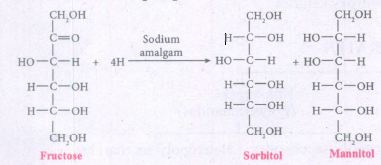
(vi) Partial reduction of fructose with sodium amalgam and water produces mixtures of sorbitol and mannitol which are epimers at second carbon. New asymmetric carbon is formed at C-2. This confirms the presence of keto group.
(vii) On oxidation with nitric acid, it gives glycolic acid and tartaric acids which contain smaller number of carbon atoms than in fructose.
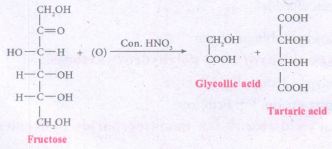
This shows that a keto group is present in C-2. It also shows the presence of 10 alcoholic groups at C- 1 and C- 6
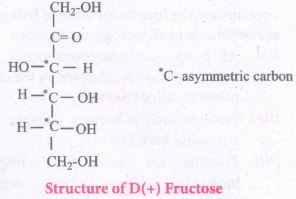
13.
Structure of glucose: Glucose is an aldohexose. It is optically active with four asymmetric carbons. Its solution is dextrorotatory and hence it is also called as dextrose. The proposed structure of glucose is shown in the figure which was derived based on the following evidences
(i) Elemental analysis and molecular weight determination show that the molecular formula of glucose is C6H120 6'
(ii) On reduction with concentrated HI and red phosphorus at 373K, glucose gives a mixture of n hexane and 2, iodohexane indicating that the six carbon atoms are bonded linearly.
(iii) Glucose reacts with hydroxylamine to form oxime and with HCN to form: cyanohydrin. These reactions indicate the I presence of carbonyl group in glucose
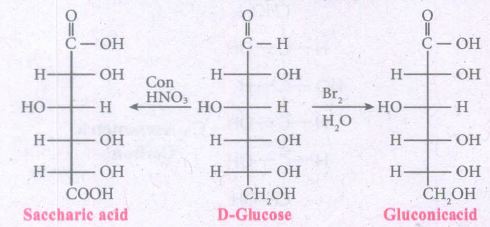
(v) Glucose is oxidised to gluconic acid with ammonical silver nitrate (Tollen's reagent) and alkaline copper sulphate (Fehling's solution). Tollens reagent is I reduced to metallic silver and Fehlings I solution to cuprous oxide which appears as red precipitate. These reactions further: confirm the presence of an aldehyde group
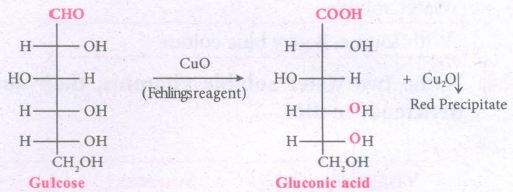
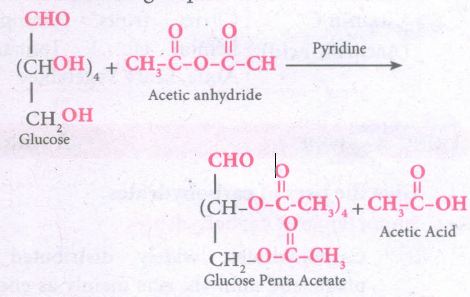
(vi) Glucose forms penta acetate with acetic anhydride suggesting the presence of five alcohol groups.
(vii) Glucoseis a stable compound and does not undergo dehydration easily. It indicates that not more than orie hydroxyl group is bonded to a single carbon atom. Thus the five hydroxyl groups are attached to five different carbon atoms and the sixth carbon is an aldehyde group.
14.
Importance of carbohydrates:
(i) Carbohydrates, widely distributed in plants and animals, acts mainly as energy sources and structural polymers.
(ii) Carbohydrate is stored in the body as glycogen and in plant as starch.
(iii) Carbohydrates such as cellulose which is the primary components of plant cell wall, is used to make paper, furniture (wood) and cloths (cotton)
(iv) Simple sugar glucose serves as an instant source of energy.
(v) Ribose sugars are one of the components of nucleic acids.
(vi) Modified carbohydrates such as hyaluronate (glycosaminoglycans) act as shock absorber and lubricant.

12th Standard Syllabus & Materials
12th Standard
TN 12th Computer Applications வலையமைப்பு வடமிடல் Sample Question Papers Study Material - QB365 Set A
NEW12th Standard
TN 12th Computer Applications களப்பெயர் முறைமை (DNS) Sample Question Papers Study Material - QB365 Set A
NEW12th Standard
TN 12th Computer Applications வலையமைப்பு எடுத்துக்காட்டுகள் மற்றும் நெறிமுறைகள் Sample Question Papers Study Material - QB365 Set A
NEW12th Standard
TN 12th Computer Applications கணினி வலையமைப்பு ஓர் அறிமுகம் Sample Question Papers Study Material - QB365 Set A



Tamilnadu Stateboard 12th Standard Subjects

Maths
Chemistry

Physics

Biology

Computer Science

Business Maths and Statistics

Economics

Commerce

Accountancy

History

Computer Applications
Biology
Computer Technology
Computer Applications
Computer Science
Business Maths and Statistics
Commerce
Economics
Maths
Chemistry
Physics
Computer Technology
History
Accountancy

Tamil

English

French
Tamilnadu Stateboard Standards
