
 100% FREE ACCESS
12th Standard Syllabus & Materials
12th Standard
TN 12th Maths Applications of Matrices and Determinants Sample Question Papers Study Material - QB365 Set A
NEW12th Standard
TN 12th Computer Applications மின்னணு தரவு பரிமாற்றம் Sample Question Papers Study Material - QB365 Set A
NEW12th Standard
TN 12th Computer Applications மின் - வணிக பாதுகாப்பு அமைப்புகள் Sample Question Papers Study Material - QB365 Set A
NEW12th Standard
TN 12th Computer Applications மின்னணு செலுத்தல் முறைகள் Sample Question Papers Study Material - QB365 Set A
NEW12th Standard
TN 12th Computer Applications மின் - வணிகம் Sample Question Papers Study Material - QB365 Set A
NEW12th Standard
TN 12th Computer Applications திறந்த மூல கருத்துருக்கள் Sample Question Papers Study Material - QB365 Set A

Published on: 02/09/2022
QB365 provides a detailed and simple solution for every Possible Creative Questions in Class 12 Chemistry Subject - Carbonyl Compounds, English Medium. It will help Students to get more practice questions, Students can Practice these question papers in addition to score best marks.
Download Tamil Nadu 12th Standard Chemistry question papers, model tests, one-mark questions, important questions, and public exam papers in PDF format. Free study materials and answer keys for TN State Board students.
Questions + Answers key
Take MCQ Chemistry Test
1.
Write a note on haloform reaction.
2.
Ethanal is more reactive towards nucleophilic addition reaction than propanone. Why?
3.
What is formalin? Write its use.
4.
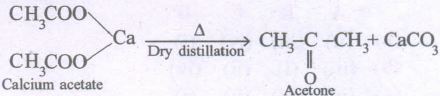
What happens when calcium acetate is dry distilled?
5.
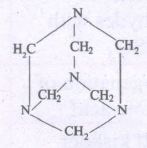
What is urotropine? Give its use.
6.
What type of aldehydes undergo Cannizaro reaction?
7.
Does formaldehyde undergo aldol condensation? Justify your answer.
8.
Give four examples of carbonyl compounds?
9.
Name one reagent used to distinguish acetaldehyde and acetone.
10.
What are the Cartesian sign conventions for a spherical mirror?
11.
Derive the relation between f and R for a spherical mirror.
12.
Give the characteristics of image formed by a plane mirror.
13.
What is angle of deviation due to reflection?
14.
State the laws of reflection.
15.
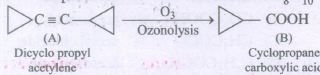
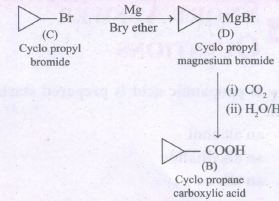
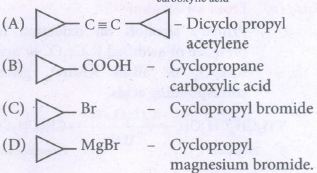
A hydrocarbon A (molecular formula C8H10) on ozonolysis gives B (C4H6O2) only. Compound C (C3H5Br) on treatment with magnesium in dry ether gives (D) which on treatment with CO2 followed by acidification gives(C). Identify A, B and C.
1.
Acetaldehyde and methyl ketones, containing \(\\ \\ { CH }_{ 3 }-\underset { \overset { | }{ O } }{ C } -group\) , when treated with halogen and alkali give the corresponding haloform. This is known as Haloform reaction
\({ CH }_{ 3 }-\underset { \overset { || }{ O } }{ C } -{ CH }_{ 3 }\overset { { 3Cl }_{ 2 } }{ \underset { Na }{ \longrightarrow } } { CCl }_{ 3 }-\underset { \overset { || }{ O } }{ C } -{ CH }_{ 3 }\overset { NaOH }{ \longrightarrow } { CHCl }_{ 3 }+{ CH }_{ 3 }-\underset { \overset { || }{ O } }{ C } -ONa\)
2.
(i) Ethanal (CH3CHO) is more reactive towards nucleophilic addition reaction than propanone (\({ CH }_{ 3 }-\underset { \overset { || }{ O } }{ C } -{ CH }_{ 3 }\)) because of steric and electronic reasons.
(ii) Greater the number of alkyl groups attached, less will be the reactivity of carbonyl compound towards nucleophilic addition.
(iii) Soethanal is more reactive than propanone.
3.
(i) 40 % aqueous solution of formaldehyde is known as formalin.
(ii) It is used as a preservative for biological specimens and in leather tanning.
4.
When calcium acetate is dry distilled, acetone is formed.
5.
Hexamethylene tetramine formed by the reaction of formaldehyde and ammonia is called urotropine.
6.
Aldehydes that do not have a-hydrogen atom undergo Cannizaro reaction.
Eg: HCHO, C6H5CHO.
7.
(i) Formaldehyde does not undergo aldol condensation.
(ii) Aldol condensation reaction is the characteristic of carbonyl compounds having a hydrogen atom. So this reaction does not take place in formaldehyde.
8.
(i) \(H-\underset { \overset { || }{ O } }{ C } -H\) - Formaldehyde
(ii) \({ CH }_{ 3 }-\underset { \overset { || }{ O } }{ C } -H\) - Acetaldehyde
(iii) \({ CH }_{ 3 }-\underset { \overset { || }{ O } }{ C } -{ { CH }_{ 3 } }\) - Acetone
(iv) \(\\ { C }_{ 6 }{ H }_{ 5 }-\underset { \overset { || }{ O } }{ C } -{ CH }_{ 5 }\) - Aceopenone
9.
(i) Schiff's reagent is used to .distinguish acetaldehyde and acetone.
(ii) Acetaldehyde restores the original colour (red-pink) of the Schiff's reagent.
(iii) Acetone does not restore this colour.
10.
(i) The Incident light is taken from left to right (i.e. object on the left of mirror).
(ii) All the distances are measured from the pole of the mirror (pole is taken as origin).
(iii) The distances measured to the right of pole along the principal axis are taken as positive.
(iv) The distances measured to the left of pole along the principal axis are taken as negative.
(v) Heights measured in the upward perpendicular direction to the principal axis are taken as positive.
(vi) Heights measured in the downward perpendicular direction to the principal axis, are taken as negative.
11.
(i) C be the centre of curvature of the mirror.
(ii) Consider a light ray parallel to the principal axis is incident on the mirror at M and passes through the principal focus F after reflection. An.
(iii) The line CM is the normal to the mirror at M. Let i be the angle of incidence and the same will be the angle of reflection.
(iv) If MP is the perpendicular from M on the principal axis, then from the geometry.
(v) The angles ∠MCP = i and ∠MFP = 2i
(vi) From right -angle triangles ΔMCP and ΔMFP,
\(tani=\cfrac { PM }{ PC } \) and \(tan2i=\cfrac { PM }{ PF } \)
(vii) As the angles are small, tan i≈i
\(i=\cfrac { PM }{ PC } \) and \(2i=\cfrac { PM }{ PF } \)
(viii) Simplifying
\(2\cfrac { PM }{ PC } =\cfrac { PM }{ PF } ;2PF=PC\)
12.
(i) The image formed by a plane mirror is virtual, erect, and laterally inverted.
(ii) The size of the image is equal to the size of the object.
(iii The image distance far behind the mirror is equal to the object distance in front of it.
(iv) If an object is placed between two plane mirrors inclined at an angle e, then the number of images n formed is as,
\(n=\left( \cfrac { 360 }{ \theta } -1 \right) \)
13.
The angle between the incident and deviated light ray is called angle of deviation of the light ray.
14.
According to law of reflection,
(i) The incident ray, reflected ray and normal to the reflecting surface all are coplanar (i.e: lie in the same plane).
(ii) The angle of incidence i is equal to the angle of reflection r.
i = r
15.
The compound with molecular formula C8H10
Compound (C) with molecular formula C3HSBr is

12th Standard Syllabus & Materials
12th Standard
TN 12th Computer Applications வலையமைப்பு வடமிடல் Sample Question Papers Study Material - QB365 Set A
NEW12th Standard
TN 12th Computer Applications களப்பெயர் முறைமை (DNS) Sample Question Papers Study Material - QB365 Set A
NEW12th Standard
TN 12th Computer Applications வலையமைப்பு எடுத்துக்காட்டுகள் மற்றும் நெறிமுறைகள் Sample Question Papers Study Material - QB365 Set A
NEW12th Standard
TN 12th Computer Applications கணினி வலையமைப்பு ஓர் அறிமுகம் Sample Question Papers Study Material - QB365 Set A



Tamilnadu Stateboard 12th Standard Subjects

Maths
Chemistry

Physics

Biology

Computer Science

Business Maths and Statistics

Economics

Commerce

Accountancy

History

Computer Applications
Biology
Computer Technology
Computer Applications
Computer Science
Business Maths and Statistics
Commerce
Economics
Maths
Chemistry
Physics
Computer Technology
History
Accountancy

Tamil

English

French
Tamilnadu Stateboard Standards
