
 100% FREE ACCESS
12th Standard Syllabus & Materials
12th Standard
TN 12th Computer Applications மின்னணு தரவு பரிமாற்றம் Sample Question Papers Study Material - QB365 Set A
NEW12th Standard
TN 12th Computer Applications மின் - வணிக பாதுகாப்பு அமைப்புகள் Sample Question Papers Study Material - QB365 Set A
NEW12th Standard
TN 12th Computer Applications மின்னணு செலுத்தல் முறைகள் Sample Question Papers Study Material - QB365 Set A
NEW12th Standard
TN 12th Computer Applications மின் - வணிகம் Sample Question Papers Study Material - QB365 Set A
NEW12th Standard
TN 12th Computer Applications திறந்த மூல கருத்துருக்கள் Sample Question Papers Study Material - QB365 Set A
NEW12th Standard
TN 12th Computer Applications வலையமைப்பு வடமிடல் Sample Question Papers Study Material - QB365 Set A

Published on: 02/09/2022
QB365 provides a detailed and simple solution for every Possible Creative Questions in Class 12 Chemistry Subject - Carbonyl Compounds, English Medium. It will help Students to get more practice questions, Students can Practice these question papers in addition to score best marks.
Download Tamil Nadu 12th Standard Chemistry question papers, model tests, one-mark questions, important questions, and public exam papers in PDF format. Free study materials and answer keys for TN State Board students.
Questions + Answers key
Take MCQ Chemistry Test
1.
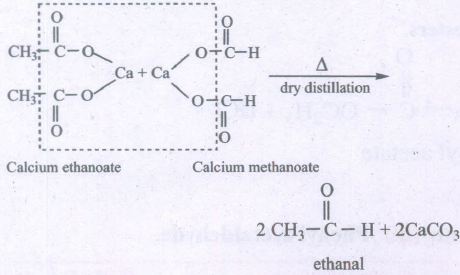
Predict the product when calcium ethanoate and calcium methanoate are dry distilled. Explain the reaction.
2.
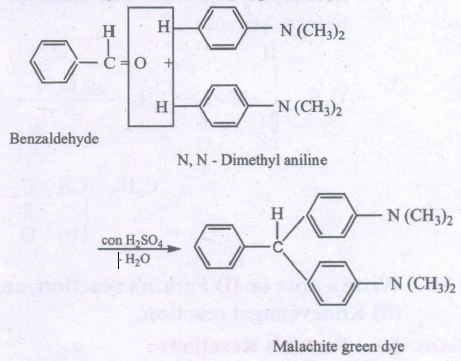
What is Malachite green dye? Explain its preparation?
3.
Organic compound with molecular formula C3H6O has two isomers (A) and (B). (A) on heating with NaOH in I2 forms a yellow precipitate while (B) does not. Identify the isomers A and B and explain the reactions.
4.
How will you convert benzaldehyde to
(I) C6H5COOH
(ii) C6HsCH2OH
(iii) C6HSCH3
5.
Write short notes on Popoff's rule.
6.
What happens when the following compounds are treated with dilute NaOH solution in cold?
(i) propanal
(ii) (CH3)3C-CHO
7.
An organic compound, C2H4O gives a red precipitate when warmed with Fehling's solution. It also undergoes aldol condensation in presence of alkali.
(i) Write IUPAC name of the compound.
(ii) Predict the hybridization of carbon atoms in the compound?
(iii) Write equation for the reaction
8.
Write a note on
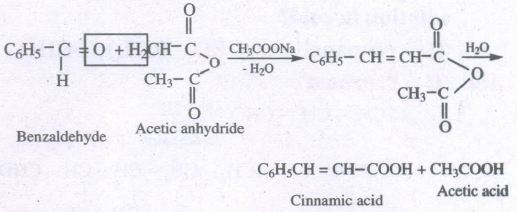
(i) Perkin's reaction, and
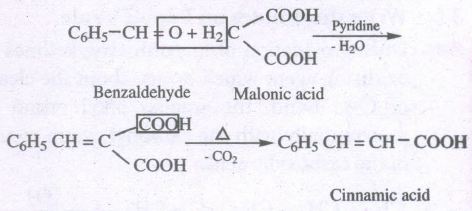
(ii) Knoevenagal reaction.
9.
How are the following conversions carried out?
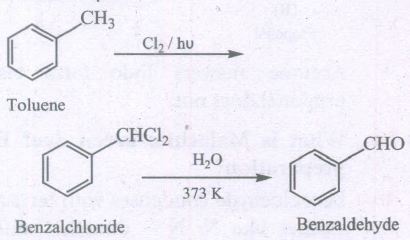
(i) Benzaldehyde from toluene
(ii) Benzoin from benzaldehyde
10.
How is carboxylic acid prepared from alcohols?
11.
Explain the isomerism exhibited by carboxylic acids.
12.
Formaldehyde and benzaldehyde give Cannizaro reaction but acetaldehyde does not - account for this.
13.
What is Rosenmund's reduction? What is the purpose of adding BaSO4 in it?
14.
Explain Stephen's reaction.
15.
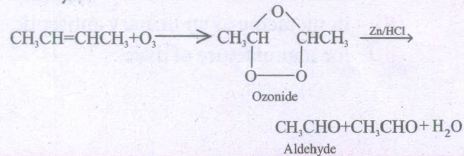
How is acetaldehyde prepared by the ozonolysis of CH3CH=CHCH3?
1.
The product obtained is ethanol
2.
Benzaldehyde condenses with tertiary aromatic amines like N, N - dimethyl aniline in the presence of strong acids to from triphenyl methane dye or malachite green dye.
3.
Two possible isomers of C3H6O are
\(\underset { \overset { (A) }{ Acetone } }{ { CH }_{ 3 }CO{ CH }_{ 3 } } \quad \underset { \overset { (B) }{ Propanal } }{ { CH }_{ 3 }{ CH }_{ 2 }CHO } \)
\(\\ \underset { \quad \quad (A)\\ Proponal }{ { CH }_{ 3 }CO{ CH }_{ 3 } } \overset { { I }_{ 2 }/NaOH\Delta }{ \underset { Iodo\ form\ \\ reaction }{ \longrightarrow } } \underset { Sodium\\ acetate }{ { CH }_{ 3 }COONa } +\underset { Iodoform\\ Yellow\ ppt }{ { CHI }_{ 3 } } \)
\(\underset { \quad \quad \quad (B)\\ Propanal }{ { CH }_{ 3 }{ CH }_{ 2 }CHO } \overset { { I }_{ 2 }/NaOH }{ \underset { \Delta }{ \longrightarrow } } No\quad ppt\quad of\quad { CHI }_{ 3 }\)
Acetone answers Iodo form test whereas proponal does not.
4.
(i) It is oxidised to benzoic acid by alkaline permanganate.
\({ C }_{ 6 }{ H }_{ 5 }CHO\overset { [O] }{ \longrightarrow } { C }_{ 6 }{ H }_{ 5 }COOH\)
(ii) It is reduced to benzyl alcohol by NaBH4 or LiAlH4
\({ C }_{ 6 }{ H }_{ 5 }CHO\overset { \left[ { H }^{ - } \right] }{ \longrightarrow } { C }_{ 6 }{ H }_{ 5 }{ CH }_{ 2 }OH\)
(iii) It can be reduced to toluene by Clemmenson or Wolff Kishner procedure.
\({ C }_{ 6 }{ H }_{ 5 }CHO\overset { Zn/Hg/HCl }{ \underset { \overset { or }{ { N }_{ 2 }{ H }_{ 4 }/KoH } }{ \longrightarrow } } { C }_{ 6 }{ H }_{ 5 }{ CH }_{ 3 }\)
5.
During oxidation of unsymmetric ketones with oxidising agent which brings about the cleavage of C-C bond, the smaller alkyl group goes preferentially with the carbonyl group resulting in the carboxylic acids.
\({ CH }_{ 3 }-{ CH }_{ 2 }-{ CH }_{ 2 }-\underset { \overset { || }{ O } }{ C } -{ CH }_{ 3 }\overset { (O) }{ \underset { Con.HNO_{ 3 } }{ \longrightarrow } } \underset { Propanoic\ acid }{ { CH }_{ 3 }{ CH }_{ 2 }-COOH } +\underset { acetic\ acid }{ { CH }_{ 3 }COOH } \)
6.
(i) \(\underset { Propanal }{ { 2CH }_{ 3 }-{ CH }_{ 2 }-CHO } \overset { Dil\quad NaOH }{ \underset { \quad Aldol\\ Condensation }{ \longrightarrow } } \underset { 3-hydroxy-2-methyl \ pentanal }{ { CH }_{ 3 }-{ CH }_{ 2 }-\underset { \overset { | }{ OH } }{ CH } -\underset { \overset { | }{ { CH }_{ 3 } } }{ CH } -CHO } \)
(ii) (CH3)C-CHO:
\({ CH }_{ 3 }-\overset { \underset { | }{ { CH }_{ 3 } } }{ \underset { \overset { | }{ { CH }_{ 3 } } }{ C } - } CHO\overset { dil.NaOH }{ \underset { Cannizzao\\ reaction }{ \longrightarrow } } \underset { 2,2diemthy-l-propanol }{ { CH }_{ 3 }-\overset { \underset { | }{ { CH }_{ 3 } } }{ \underset { \overset { | }{ { CH }_{ 3 } } }{ C } } -{ CH }_{ 2 }OH+ } \underset { 2,2-dimethyl \ sodium \ propionate }{ CH_{ 3 }-\overset { \underset { | }{ { CH }_{ 3 } } }{ \underset { \overset { | }{ { CH }_{ 3 } } }{ C } } -COONa } \)
7.
(i) Ethanal
(ii) sp2
(iii) CH3CHO + 2Cu2+ + 3OH- ⟶CH3COO- + 2Cu+ + 2H2O
\({ CH }_{ 3 }CHO+{ CH }_{ 3 }CHO\overset { NaOH }{ \longrightarrow } { H }_{ 3 }C-\overset { \underset { | }{ H } }{ \underset { \overset { | }{ OH\\ Aldol } }{ C } } -{ CH }_{ 2 }-CHO\)
8.
(i) Perkin's Reactions:
When an aromatic aldehyde is heated with an aliphatic acid anhydride in the presence of the sodium salt of the acid corresponding to the anhydride, condensation takes place and an α, β unsaturated acid is obtained
This reaction is known as Perkin's reaction.
(ii) Knoevengal Reaction:
(a) Benzaldehyde condenses with malonic acid in the presence of pyridine forming cinnamic acid
(b) Catalyst - Pyridine
(c) Carbanion formed from malonic acid.
9.
(i) Benzaldehyde from Toluene: Side chain chlorination of toluene gives benzal chloride, which on hydrolysis gives benzaldehyde.
(ii) Benzoin from benzaldehyde: Benzaldehyde reacts with alcoholic KCN to form benzoin.
\({ C }_{ 6 }{ H }_{ 5 }-\overset { \underset { | }{ H } }{ \underset { \overset { || }{ O } }{ C } } +H-\underset { \overset { || }{ O } }{ C } { -C }_{ 6 }{ H }_{ 6 }\overset { alc \ KCN }{ \underset { \Delta }{ \longrightarrow } } { C }_{ 6 }{ H }_{ 5 }-\underset { \overset { | }{ OH } }{ CH } -\underset { \overset { || }{ O } }{ C } -{ C }_{ 6 }{ H }_{ 5 }\)
10.
Primary alcohols and aldehydes can easily be oxidised to the corresponding carboxylic acids with oxidising agents such as potassium permanganate (in acidic or alkaline medium), potassium dichromate (in acidic medium)
Example:
\(\underset{Ethyl \ alcohol}{ { CH }_{ 3 }{ CH }_{ 2 }OH}\overset { { H }^{ + }/{ K }_{ 2 }{ Cr }_{ 2 }{ O }_{ 7 } }{ \underset { (O) }{ \longrightarrow } } \underset{Acetaldehyde}{{ CH }_{ 3 }CHO}\underset { (O) }{ \longrightarrow }
\underset{Acetic \ acid}{{ CH }_{ 3 }COOH}\)
11.
(i) Chain isomerism: This arises due to the difference in the carbon chain of alkyl group attached to carboxyl group. C5H10O2.
\({ CH }_{ 3 }-\underset { Pentanoic\ acid }{ { CH }_{ 2 }-{ CH }_{ 2 }-{ CH }_{ 2 } } -COOH\quad \underset { 3-mrthyl\ butanoic\ acid }{ { CH }_{ 3 }-\overset { \underset { | }{ { CH }_{ 3 } } }{ CH } -{ CH }_{ 2 }-COOH } \)
(ii) Functional isomerism: Carboxylic acids are functional isomers of ester . C3H6O2
\(\underset { Propanic \ acid }{ { CH }_{ 3 }-{ CH }_{ 2 }-COOH } \) and \(\underset { Methyl\ acetate }{ { CH }_{ 3 }COO{ H }_{ 5 } } \) \(\underset { Ethyl\ formate }{ HCOO{ C }_{ 2 }{ H }_{ 5 } } \)
12.
(i) Cannizzaro reaction is a redox reaction which takes place only in aldehydes which do not have α- hydrogen atom.
(ii) Formaldehyde (HCHO) and benzaldehyde (C6H5CHO) do not have a-hydrogen atom and so they undergo Cannizzaro reaction.
(iii) But acetaldehyde CH3CHO contains 3 α-H atoms and it does not undergo Cannizzaro reaction.
13.
(i) When reduced with hydrogen in the presence of 'poisoned' palladium catalyst, they form aldehydes. This reaction is called Rosenmund reduction.
\(\underset { acetyl\ chloride }{ { CH }_{ 3 }-\underset { \overset { || }{ O } }{ C } -Cl } +H-H\overset { Pd }{ \underset { Ba{ SO }_{ 4 } }{ \longrightarrow } } \underset { acetaldehyde }{ CH_{ 3 }-\underset { \overset { || }{ O } }{ C } -H+HCl } \)
(ii) BaSO4 is used as a catalytic poi on to stop the reduction at the stage of aldehyde.
(iii) Otherwise, the aldehyde formed will be further reduced to primary alcohol.
14.
When alkylcyanides are reduced using SnCl2 HCl, imines are formed, which on hydrolysis gives corresponding aldehyde.
\({ CH }_{ 3 }-C\equiv N\overset { { SnCl }_{ 2 }/HCl }{ \longrightarrow } { CH }_{ 3 }-CH={ NH }\overset { { H }_{ 3 }{ O }^{ + } }{ \longrightarrow } { CH }_{ 3 }-CHO\)
15.
Ozone forms addition product with olefin called I ozonide, which on reductive cleavage gives aldehyde.

12th Standard Syllabus & Materials
12th Standard
TN 12th Computer Applications களப்பெயர் முறைமை (DNS) Sample Question Papers Study Material - QB365 Set A
NEW12th Standard
TN 12th Computer Applications வலையமைப்பு எடுத்துக்காட்டுகள் மற்றும் நெறிமுறைகள் Sample Question Papers Study Material - QB365 Set A
NEW12th Standard
TN 12th Computer Applications கணினி வலையமைப்பு ஓர் அறிமுகம் Sample Question Papers Study Material - QB365 Set A
NEW12th Standard
TN 12th Computer Applications PHP-உடன் MySQL-ஐ இணைத்தல் Sample Question Papers Study Material - QB365 Set A



Tamilnadu Stateboard 12th Standard Subjects

Maths
Chemistry

Physics

Biology

Computer Science

Business Maths and Statistics

Economics

Commerce

Accountancy

History

Computer Applications
Biology
Computer Technology
Computer Applications
Computer Science
Business Maths and Statistics
Commerce
Economics
Maths
Chemistry
Physics
Computer Technology
History
Accountancy

Tamil

English

French
Tamilnadu Stateboard Standards
