
 100% FREE ACCESS
12th Standard Syllabus & Materials
12th Standard
TN 12th Computer Applications மின்னணு தரவு பரிமாற்றம் Sample Question Papers Study Material - QB365 Set A
NEW12th Standard
TN 12th Computer Applications மின் - வணிக பாதுகாப்பு அமைப்புகள் Sample Question Papers Study Material - QB365 Set A
NEW12th Standard
TN 12th Computer Applications மின்னணு செலுத்தல் முறைகள் Sample Question Papers Study Material - QB365 Set A
NEW12th Standard
TN 12th Computer Applications மின் - வணிகம் Sample Question Papers Study Material - QB365 Set A
NEW12th Standard
TN 12th Computer Applications திறந்த மூல கருத்துருக்கள் Sample Question Papers Study Material - QB365 Set A
NEW12th Standard
TN 12th Computer Applications வலையமைப்பு வடமிடல் Sample Question Papers Study Material - QB365 Set A

Published on: 02/09/2022
QB365 provides a detailed and simple solution for every Possible Creative Questions in Class 12 Chemistry Subject - Carbonyl Compounds, English Medium. It will help Students to get more practice questions, Students can Practice these question papers in addition to score best marks.
Download Tamil Nadu 12th Standard Chemistry question papers, model tests, one-mark questions, important questions, and public exam papers in PDF format. Free study materials and answer keys for TN State Board students.
Questions + Answers key
Take MCQ Chemistry Test
1.
Give two tests for aldehydes.
2.
How benzaldehyde is converted to
(i) m-nitrobenzaldehyde
(ii) m-benzaldehyde sulphonic acid
(iii) m- chlorobenzaldehyde
(iv) Benzoyl chloride
3.
How will acetic anhydride react with the following reagents?
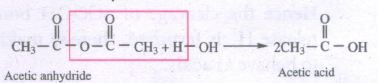
(i) HOH
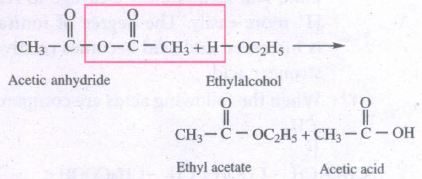
(ii) C2H5OH
4.
Explain electrophilic substitution reactions of benzoic acid.
5.
Explain the order of strength of the following acids.
6.
Account for reducing nature of formic acid.
7.
Explain why carboxylic acids behave as acids. Discuss briefly the effects of electron withdrawing and donating substituents on acid strength of carboxylic acids.
8.
How does NH3 react with the following?
(i) HCHO
(ii) CH3CHO
(iii) C6H5CHO
(iv) CH3COCH3
9.
Explain the mechanism of Cannizaro reaction.
10.
Write the crossed aldol condensation.
11.
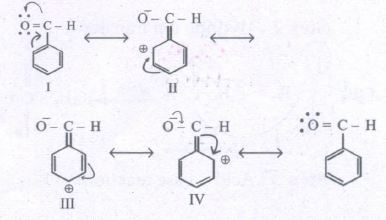
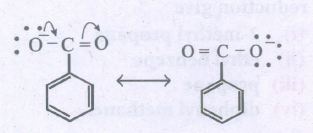
Draw resonance structures for the following
(i) CH3COO-
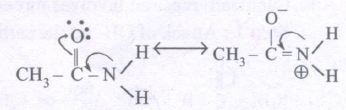
(ii)CH3CONH2
(iii) C6HsCHO
(iv) C6H5COO-
12.
Which compounds on Clemmenson reduction give
(i) 2-methyl propane
(ii) ethyl benzene
(iii) propane
(iv) diphenyl methane.
13.
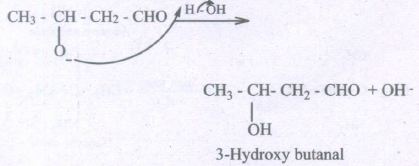
Discuss the mechanism of aldol condensation.
14.
Illustrate the reducing property of acetaldehyde with examples
15.
How does formaldehyde react with
(I) NH3
(ii) CH3Mg1 followed by hydrolysis and
(iii) NaOH
1.
(i) Tollens Reagent Test: Tollens reagent is an ammoniacal silver nitrate solution. When an aldehyde is warmed with Tollens reagent a bright silver mirror is produced due to the formation of silver metal. This reaction is also called silver mirror test for aldehydes.
\({ CH }_{ 3 }CHO+2\left[ Ag\left( { NH }_{ 3 } \right) _{ 2 } \right] ^{ + }+3{ OH }^{ - }\longrightarrow { CH }_{ 3 }CO{ O }^{ - }+\underset { Silver\ mirror }{ 4{ NH }_{ 3 }+2Ag+2{ H }_{ 2 }O } \)
(ii) Fehlings solution Test:
(a) Fehling's solution is prepared by mixing equal volumes of Fehlings solution A containing aqueous copper sulphate and Fehlings solution 'B' containing alkaline solution of sodium potassium tartarate (Rochelle salt).
(b) When aldehyde is warmed with Fehlings solution deep blue colour solution is changed to red precipitate of cuprous oxide.
\(\\ \\ { CH }_{ 3 }CHO+\underset { blue }{ 2{ Cu }^{ 2 } } +5{ OH }^{ - }\longrightarrow { CH }_{ 3 }{ COO }^{ - }+\underset { red }{ { Cu }_{ 2 }O\downarrow } +3{ H }_{ 2 }O\)
(iii) Schiffs' reagent Test: Dilute solution of aldehydes when added to Schiff's reagent (Rosaniline hydrochloride dissolved in water and its red colour decolourised by passing SO2) yields its red colour. This is known as Schiff's test for aldehydes. Ketones do not give this test. Acetone however gives a positive test but slowly.
2.
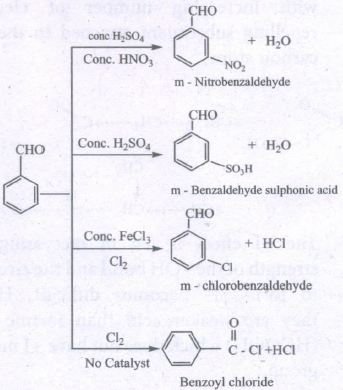
3.
(i) Hydrolysis: Acid anhydride are slowly hydrolysed, by water to form corresponding carboxylic acids.
(ii) Reaction with alcohol:
4.
Some common electrophilic substitution reactions of benzoic acid are given below
(i) Halogenation:
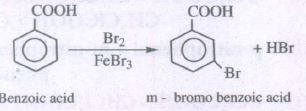
(ii) Nitration:
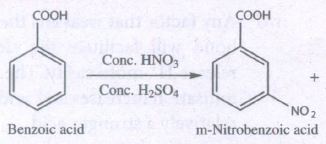
(iii) Sulphonation:
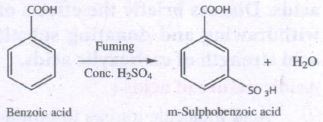
(iv) Benzoic acid does not undergo friedal craft's reaction. This is due to the strong deactivating nature of the carboxyl group.
5.
(i) CCl3COOH > CHCl2COOH > CH2CICOOH > CH3COOH
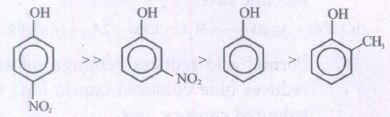
(ii) p-nitrophenol > m-nitrophenol > phenol> cresol.
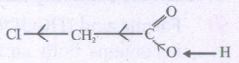
(i) CCl3COOH > CHCl2COOH > CH2CICOOH > CH3COOH :
(a) Any factor that weakens the -COOH bond will facilitate the cleavage to release H+ more easily. The degree of ionisation increases and acid becomes relatively a stronger acid.
(b) The acid strength increases with increase in electronegativity of substituents.
(c) In monochloro acetic acid, the -I effect of chlorine increases the strength of the acid.
(d) Thus monochloro acetic acid is stronger than acetic acid. The strength of dichloro acetic acid is greater than monochloro acetic acid.
(ii) p-nitrophenol> m-nitrophenol > phenol > cresol:
(a) In aromatic acid, the nitro group (electron withdrawing group) especially at ortho or para position increases its strength due to -I effect.
(b) So p-nitro phenol is more acidic than m-nitro phenol and it is more acidic than phenol.
(c) But cresol contains CH3 group which has +I effect (electron repelling group) and due to this strength of the acid decreases. So phenol is more acidic than cresol.
6.
(i) Formic acid (HCOOH) is unique because it contains both an aldehyde group and carboxyl group also.
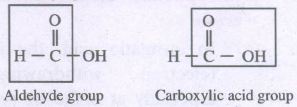
(ii) Hence it can act as a reducing agent. It reduces Fehling's solution Tollen's reagent and decolourises pink coloured KMnO4 solution.
(iii) Whereas in acetic acid, there is no aldehyde group and it cannot act as reducing agent.
(iv) Formic acid reduces ammoniacal silver nitrate solution (Tollen's reagent) to metallic silver.
HCOOH + Ag2O⟶H2O + CO2 + 2Ag↓ (metallic silver)
(v) Formic acid reduces Fehling's solution. It reduces blue coloured cupric ions to red coloured cuprous ions.
\(\mathrm{HCOO}^{-}+2 \mathrm{Cu}^{2+}+5 \mathrm{OH}^{-} \longrightarrow \mathrm{CO}_{3}^{2-}+\mathrm{Cu}_{2} \mathrm{O}+3 \mathrm{H}_{2} \mathrm{O}\\
\quad \quad \quad \quad (blue) \quad \quad \quad \quad \quad \quad \quad \quad \quad \quad \quad (red)\)
7.
Acidic nature of acids:
(i) Acid molecule ionises to produce H+ ions in solution.
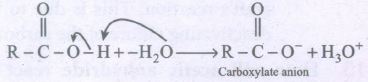
(ii) The carboxylate anion is stabilised by resonance.
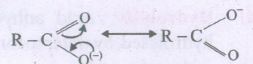
Hence the cleavage of -COOH bond to release H+ is favoured, thereby making it to behave as acids.
(iii) Any factor that weakens the -COOH bond will facilitate the cleavage to release H+ more easily. The degree of ionisation is increased and acid becomes relatively a stronger acid.
(iv) When the following acids are compared
Their strength varies as the above order.
(v) Methyl group is a + I group (electron pair repelling group). Acid strength decreases: with increasing number of electron repelling substituent attached to the α- carbon atom.
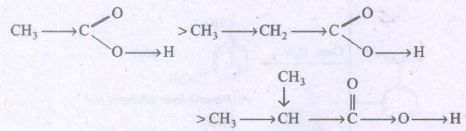
The +1 effect is felt in increasing the strength of the -OH bond and the cleavage to form H+ becomes difficult. Hence they are weaker acid than formic acid (HCOOH) which does not have + I methyl group.
(vi) Acid strength increases with increase in electronegativity of substituents
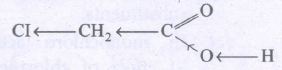
This effect weakness the -O- H bond there by facilitating the removal of H+ from -OH group. This acid becomes stronger than formic acid.
8.
(i) NH3 with HCHO:
Formaldehyde forms hexamethylene tetramine with NH3.
6HCHO + 4NH3 ➝ (CH2)6N4 + 6Hp
(ii) NH3 with CH3CHO:
Acetaldehyde reacts with NH3 to form aldimine.
\(CH_{ 3 }CHO+{ NH }_{ 3 }\longrightarrow { H }_{ 3 }C-\overset { \underset { | }{ { NH }_{ 2 } } }{ \underset { \overset { | }{ H } }{ C } } -OH\overset { -{ H }_{ 2 }O }{ \longrightarrow } \underset { aldimine }{ CH_{ 3 }-CH=NH } \)
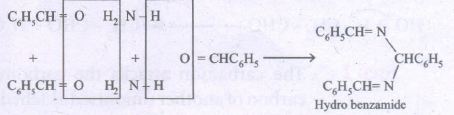
(iii) NH3 with C6H5CHO:
Benzaldehyde undergoes condensation with ammonia to form hydrobenzamide
(iv) NH3 with CH3CO - CH3:
Acetone with ammonia forms acetone ammonia initially at room temperature. On heating, it forms diacetone amine
\({ H }_{ 3 }C-\overset { \underset { | }{ { CH }_{ 3 } } }{ C } =O+{ HNH }_{ 2 }\longrightarrow \underset { acetone \ ammonia }{ CH_{ 3 }-\overset { \underset { | }{ { CH }_{ 3 } } }{ \underset { \overset { | }{ { NH }_{ 2 } } }{ C } } -{ OH }_{ 2 } } \)
\({ CH }_{ 3 }-\overset { \underset { | }{ { CH }_{ 3 } } }{ \underset { \overset { | }{ { NH }_{ 2 } } }{ C } } -OH+{ CH }_{ 3 }-\underset { \overset { || }{ O } }{ C } -{ CH }_{ 3 }
\overset { high \ temp }{ \underset { -{ H }_{ 2 }O }{ \longrightarrow } } \underset {Diacetone \ amine}{{ CH }_{ 3 }-\overset { \underset { | }{ { CH }_{ 3 } } }
{ \underset { \overset { | }{ { NH }_{ 3 } } }{ C } } -{ CH }_{ 2 }}-\underset { \overset { || }{ O } }{ C } -{ CH }_{ 3 }\)
9.
Cannizaro reaction involves three steps.
Step 1: Attack of OH- on the carbonyl carbons

Step 2: Hydride ion transfer

Step 3: Acid - base reaction
\({ C }_{ 6 }{ H }_{ 5 }-\overset { \underset { || }{ O } }{ C } -OH+{ C }_{ 6 }{ H }_{ 5 }H_{ 2 }{ O }^{ - }+{ Na }^{ + }\overset { Proton }{ \underset { exchange }{ \longrightarrow } } \underset { Sodium\quad benzoate }{ { C }_{ 6 }{ H }_{ 5 }-\overset { \underset { || }{ O } }{ C } -ONa } +\underset { Benzyl \ alcohol }{ { C }_{ 6 }{ H }_{ 5 }{ CH }_{ 2 }OH } \)
Cannizaro reaction is a characteristic of aldehyde having no a - hydrogen
10.
Aldol condensation can also takes place between two different aldehydes or ketones or between one aldehyde and one ketone such an aldol condensation is called crossed or mixed aldol condensation. This reaction is not very useful as the product is usually a mixture of all possible condensation products and cannot be separated easily.
\(\underset { formldehyde }{ HCHO } +\underset { acataldehyde }{ { CH }_{ 3 }CHO } \overset { dil.NaOH }{ \longrightarrow } \underset { 3-hydroxy \ propanol }{ HO-{ CH }_{ 2 }-{ CH }_{ 2 }-CHO } \)
\(\underset { formaldehyde }{ { HCHO } } +\underset { acetone }{ { CH }_{ 3 }-\underset { \overset { || }{ O } }{ C } -{ CH }_{ 3 } } \overset { dil.NaOH }{ \longrightarrow } \underset { 4-hydroxy \ butan-2-one }{ HO-{ CH }_{ 2 }-{ CH }_{ 2 }-\underset { \overset { || }{ O } }{ C } -{ CH }_{ 3 } } \)
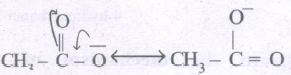
11.
(i) CH3COO-
(ii) CH3CONH2
(iii) C6HsCHO
(iv) C6H5COO-
12.
(i) \(\underset { Isobutylalcohol }{ { CH }_{ 3 }-\overset { \underset { | }{ { CH }_{ 3 } } }{ CH } -CHO } \overset { Zn/Hg }{ \longrightarrow } \underset { 2-methylpropane }{ { CH }_{ 3 }-\underset { \overset { | }{ { CH }_{ 3 } } }{ CH } -CH_{ 3 } } \)
(ii) \(\underset { Acetone }{ { C }_{ 6 }{ H }_{ 5 }-\underset { \overset { || }{ O } }{ C } -{ CH }_{ 3 } } \overset { Zn/Hg }{ \underset { HCI[H] }{ \longrightarrow } } \underset { Ethylbenzene }{ { C }_{ 6 }{ H }_{ 5 }{ CH }_{ 2 }{ CH }_{ 3 } } \)
(iii) \(\underset { Acetone }{ { CH }_{ 3 }-\underset { \overset { || }{ O } }{ C } -{ CH }_{ 3 } } \overset { Zn/Hg }{ \underset { HCI[H] }{ \longrightarrow } } \underset { Propane }{ { CH }_{ 3 }{ CH }_{ 2 }{ CH }_{ 3 } } \)
(iv) \(\underset { Benzophenone }{ { C }_{ 6 }{ H }_{ 5 }-\underset { \overset { || }{ O } }{ C } -{ C }_{ 6 }{ H }_{ 5 } } \overset { Zn/Hg }{ \underset { HCI[H] }{ \longrightarrow } } \underset { diphyenyl\quad metahne }{ { C }_{ 6 }{ H }_{ 5 }{ CH }_{ 2 }{ C }_{ 6 }{ H }_{ 5 } } \)
13.
This reaction is catalysed by base. The carbanion generated is nucleophilic in nature. Hence it can bring about nucleophilic attack on carbonyl group
Step 1: The carbanion is formed as the a-hydrogen atom is removed as a proton by the base

Step 2: The carbanion attacks the carbonyl carbon of another unionised aldehyde molecule
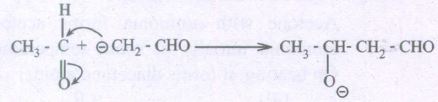
Step 3: The alkoxide ion formed is protonated by water to give 'aldol'.
14.
\(\underset { Acetaldehyde }{ { CH }_{ 3 }-\underset { \overset { || }{ O } }{ C } -H+4(H) } \overset { { NH }_{ 2 }{ NH }_{ 2 } }{ \underset { { C }_{ 2 }{ H }_{ 5 }ONa }{ \longrightarrow } } \underset { Ethane }{ { CH }_{ 3 }-{ CH }_{ 3 }+{ H }_{ 2 }O+{ N }_{ 2 } } \)
(i) Clemmensen reduction: Aldehydes and Ketones when heated with zinc amalgam and concentrated hydrochloric acid gives hydrocarbons.
Example:
\(\underset { Acetald4ehyde }{ { CH }_{ 3 }-\underset { \overset { || }{ O } }{ C } -{ H }^{ + }4(H) }
\overset { Zn^{ - }Hg }{ \underset { Conc.HCl }{ \longrightarrow } }
\underset {Ethane}{{ CH }_{ 3 }-{ CH }_{ 3 }\pm { H }_{ 2 }O}\)
\(\underset { Acetone }{ { CH }_{ 3 }-\underset { \overset { || }{ O } }{ C } -{ CH }_{ 3 }+4\left( H \right) } \overset { { Zn }^{ - }Hg }{ \underset { Conc.HCl }{ \longrightarrow } } { CH }_{ 3 }{ CH }_{ 2 }{ CH }_{ 3 }+{ H }_{ 2 }O\)
(ii) Wolff-Kishner Reduction: Aldehydes and Ketones when heated with hydrazine (NH2NH2) and sodium ethoxide, hydrocarbons are formed Hydrazine acts as a reducing agent and sodium ethoxide as a catalyst.
Example :
\(\underset { Acetaldehyde }{ { CH }_{ 3 }-\underset { \overset { || }{ O } }{ C } -H+4(H) } \overset { { NH }_{ 2 }{ NH }_{ 2 } }{ \underset { { C }_{ 2 }{ H }_{ 5 }ONa }{ \longrightarrow } } \underset { Ethane }{ { CH }_{ 3 }-{ CH }_{ 3 }+{ H }_{ 2 }O+{ N }_{ 2 } } \)
\(\underset { Acetone }{ { CH }_{ 3 }-\underset { \overset { || }{ O } }{ C } -{ CH }_{ 3 }+4(H) } \overset { { NH }_{ 2 }{ NH }_{ 2 } }{ \underset { { C }_{ 2 }{ H }_{ 5 }ONa }{ \longrightarrow } } { CH }_{ 3 }{ CH }_{ 2 }{ CH }_{ 3 }+{ H }_{ 2 }O+{ N }_{ 2 }\)
Aldehyde (or) ketones is first converted to its hydrazone which on heating with strong base gives hydrocarbons.
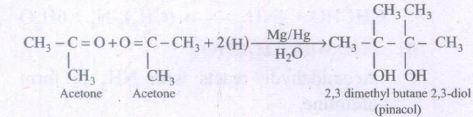
(iii) Reduction to pinacols: Ketones, on reduction with magnesium amalgam and water, are reduced to symmetrical diols known as pinacol.
15.
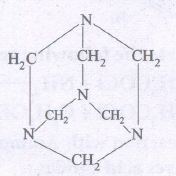
(i) With NH3 :
Formaldehyde forms hexa m ethylenetetramine with NH3
\(\underset { Formaldehyde }{ 6{ CH }_{ 2 }O+4N{ H }_{ 3 } } \longrightarrow \underset { Hexamethylene\quad tetramine }{ \left( { CH }_{ 2 } \right) _{ 6 }{ N }_{ 4 }+6{ H }_{ 2 }O } \)
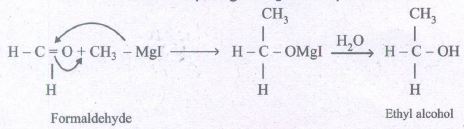
(ii) With CH3MgI
Formaldehyde gives primary alcohol
(iii) With NaOH :
Cannizaro Reaction
\(\underset { Formaldehyde }{ HCHO } +HCHO\overset { NaOH }{ \longrightarrow } \underset { Sodiumformate }{ HCOONa } +\underset { Methnol }{ { CH }_{ 3 }OH } \)

12th Standard Syllabus & Materials
12th Standard
TN 12th Computer Applications களப்பெயர் முறைமை (DNS) Sample Question Papers Study Material - QB365 Set A
NEW12th Standard
TN 12th Computer Applications வலையமைப்பு எடுத்துக்காட்டுகள் மற்றும் நெறிமுறைகள் Sample Question Papers Study Material - QB365 Set A
NEW12th Standard
TN 12th Computer Applications கணினி வலையமைப்பு ஓர் அறிமுகம் Sample Question Papers Study Material - QB365 Set A
NEW12th Standard
TN 12th Computer Applications PHP-உடன் MySQL-ஐ இணைத்தல் Sample Question Papers Study Material - QB365 Set A



Tamilnadu Stateboard 12th Standard Subjects

Maths
Chemistry

Physics

Biology

Computer Science

Business Maths and Statistics

Economics

Commerce

Accountancy

History

Computer Applications
Biology
Computer Technology
Computer Applications
Computer Science
Business Maths and Statistics
Commerce
Economics
Maths
Chemistry
Physics
Computer Technology
History
Accountancy

Tamil

English

French
Tamilnadu Stateboard Standards
