
 100% FREE ACCESS
12th Standard Syllabus & Materials
12th Standard
TN 12th Computer Applications மின்னணு தரவு பரிமாற்றம் Sample Question Papers Study Material - QB365 Set A
NEW12th Standard
TN 12th Computer Applications மின் - வணிக பாதுகாப்பு அமைப்புகள் Sample Question Papers Study Material - QB365 Set A
NEW12th Standard
TN 12th Computer Applications மின்னணு செலுத்தல் முறைகள் Sample Question Papers Study Material - QB365 Set A
NEW12th Standard
TN 12th Computer Applications மின் - வணிகம் Sample Question Papers Study Material - QB365 Set A
NEW12th Standard
TN 12th Computer Applications திறந்த மூல கருத்துருக்கள் Sample Question Papers Study Material - QB365 Set A
NEW12th Standard
TN 12th Computer Applications வலையமைப்பு வடமிடல் Sample Question Papers Study Material - QB365 Set A

Published on: 29/01/2021
12th Standard Chemistry English Medium Carbonyl Compounds and carboxylic acids Reduced Syllabus Important Questions 2021
Download Tamil Nadu 12th Standard Chemistry question papers, model tests, one-mark questions, important questions, and public exam papers in PDF format. Free study materials and answer keys for TN State Board students.
Questions + Answers key
Take MCQ Chemistry Test
1.
Aldehydes and ketones are reduced to hydrocarbons by zinc amalgam and cone.HCI. This is__________ reaction.
Clemmenson's reduction
Wolff krishner reduction
Rosenmmunds reduction
catalytic reduction
2.
Grignard reagent on addition with dry ice followed by hydrolysis gives __________.
aldehydes and acids
only ketones
aldehydes and ketones
only carboxylic acids
3.
Acid chloride acids are prepared by treating carboxylic acids with ________.
SOCl2
PCl5
PCl3
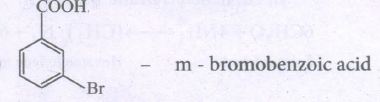
all the above
4.
Benzaldehyde condenses with N, N - dimethyl aniline in the presence of strong acid to give __________.
Benzal aniline
Cinnamic acid
Schiff's base
Malachite green dye
5.
The number of carbon atoms in a chain can be increased with _______ reaction.
Grignard
Cannizaro reaction
HVZ
Clemmensen
6.
The reagent that does not react with both acetone and benzaldehyde is __________.
Sodium hydrogen sulphite
Fehling's solution
Hydrazine
Semicarbazide
7.
The high boiling points of carboxylic acids is due to _______.
weak Vanderwaal's forces
intermolecular hydrogen bonding
intramolecular hydrogen bonding.
delocalisation of π electrons
8.
It is used as food preservative _______.
sodium benzoate
ammonium benzoate
benzoic acid
formic acid
9.
Which is unstable?
HCOOH
CH3CH2COCl
CH3COCl
HCOCl
10.
Ketones when reduced in the presence of Pt forms _______.
primary alcohols
secondary alcohol
tertiary alcohols
acids
11.
Which of the following statement is wrong?
2-pentanone and 3-pentanone are position isomers.
Aqueous solution of formaldehyde is known as formalin
Aldehydes and ketones undergo nucleophilic substitution
Aldehydes act as reducing agents
12.
Carboxylic acids have higher boiling points than aldehydes, ketones and even alcohols of comparable molecular mass. It is due to their ________.
more extensive association of carboxylic acid via van der Waals force of attraction
formation of carboxylate ion
formation of intramolecular H-bonding
formation of intermolecular H – bonding
13.
Which one of the following reaction is an example of disproportionation reaction.
Aldol condensation
cannizaro reaction
Benzoin condensation
none of these
14.
Identify the product formed in the reaction
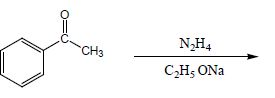
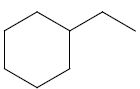
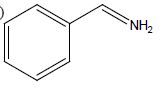
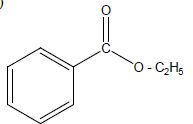
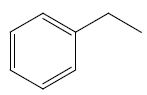
15.
Which of the following represents the correct order of acidity in the given compounds
FCH2COOH > CH3COOH > BrCH2COOH > ClCH2COOH
FCH2COOH > ClCH2COOH > BrCH2COOH > CH3COOH
CH3COOH > ClCH2COOH > FCH2COOH > Br-CH2COOH
Cl CH2COOH > CH3COOH > BrCH2COOH > ICH2COOH
16.
An organic compound A (C2H3N) on reduction with SnCI2/HCI gives B (C2H4O) which reduces Tollen's reagent. Compound B on reduction with N2H4/C2H5ONa gives C (C2H6). Identify the compounds A, B and C. Explain the reactions involved.
17.
An organic compound A (C7H6O) reduces Tollen's reagent. On treating with an alkali compound A forms B and C. B on treating with sodalime forms benzene and C (C7HsO) is an antiseptic. Identify compounds A, B and C. Explain the reactions.
18.
Give two tests for aldehydes.
19.
Illustrate the reducing property of acetaldehyde with examples
20.
How does formaldehyde react with
(I) NH3
(ii) CH3Mg1 followed by hydrolysis and
(iii) NaOH
21.
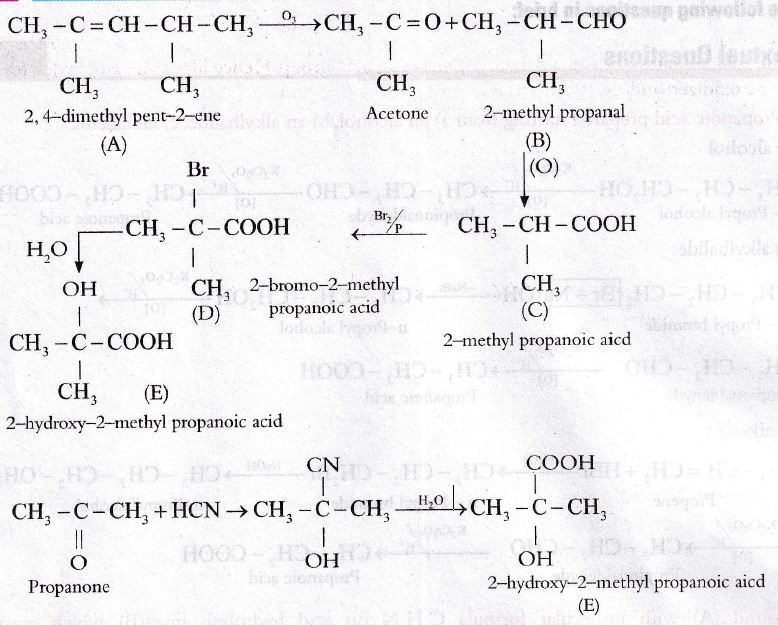
An alkene (A) on ozonolysis gives propanone and aldehyde (B). When (B) is oxidised (C) is obtained. (C) is treated with Br2/P gives (D) which on hydrolysis gives (E). When propanone is treated with HCN followed by hydrolysis gives (E). Identify A, B, C, D and E.
22.
Esters are colourless liquids with characteristic fruity smell. Identify the ester which gives the following flavours.
(i) Raspberry
(ii) Pine apple
(iii) Orange
23.
What is vinegar?
24.
Draw the structure of 2-methylcyclopent - 3- ene - 1- carboxylic acid.
25.
Write the structure formula of the following compounds.
(i) 3-bromo - 4 phenylpent -3- enoic acid
(ii) 2-methylbutanoic aicd
26.
Give any three uses of benzoic acid.
27.
What happens when soda lime is treated with
(i) CH3COONa
(ii) C6H5COOH?
28.
Give the resonance structure of carboxylate anion.
29.
Write two tests of carboxylic acid.
30.
What type of aldehydes undergo Cannizaro reaction?
31.
Give four examples of carbonyl compounds?
32.
A carbonyl compound A having molecular formula C5H10O forms crystalline precipitate with sodium bisulphate and gives positive iodoform test. A does not reduce Fehling solution. Identify A.
33.
What is the action of HCN on
(i) propanone
(ii) 2,4-dichlorobenzaldehyde
iii) ethanal
34.
How will you convert benzaldehyde into the following compounds?
(i) benzophenone
(ii) benzoic acid
(iii) α-hydroxyphenylaceticacid.
35.
Give the IUPAC names for the following:
(i) Crotonaldehyde
(ii) Methyl n-propyl ketone
(iii) Phenyl acetaldehyde.
36.
Write the structure of 'A' and 'B' in the following reaction
\({ C }_{ 6 }{ H }_{ 5 }MgBr+{ CO }_{ 2 }\overset { (i)CO_{ 2 } }{ \underset { (ii){ H }_{ 2 }O/{ H }^{ + } }{ \longrightarrow } } A\overset { { Br }_{ 2 } }{ \underset { FeBr_{ 3 } }{ \longrightarrow } } B\)
37.
What happens when the following compounds are treated with dilute NaOH solution in cold?
(i) propanal
(ii) (CH3)3C-CHO
38.
An organic compound, C2H4O gives a red precipitate when warmed with Fehling's solution. It also undergoes aldol condensation in presence of alkali.
(i) Write IUPAC name of the compound.
(ii) Predict the hybridization of carbon atoms in the compound?
(iii) Write equation for the reaction
39.
How are the following conversions carried out?
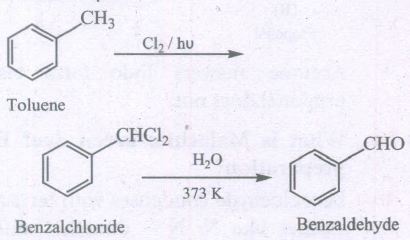
(i) Benzaldehyde from toluene
(ii) Benzoin from benzaldehyde
40.
Formaldehyde and benzaldehyde give Cannizaro reaction but acetaldehyde does not - account for this.
41.
Identify A, B and C
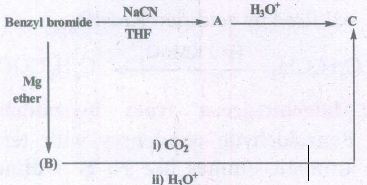
42.
How are the following conversions effected
(a) propanal into butanone
(b) Hex-3-yne into hexan-3-one.
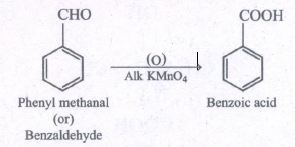
(c) phenylmethanal into benzoic acid
(d) phenylmethanal into benzoin
1.
(a)
Clemmenson's reduction
2.
(d)
only carboxylic acids
3.
(d)
all the above
4.
(d)
Malachite green dye
5.
(a)
Grignard
6.
(b)
Fehling's solution
7.
(b)
intermolecular hydrogen bonding
8.
(a)
sodium benzoate
9.
(d)
HCOCl
10.
(b)
secondary alcohol
11.
(c)
Aldehydes and ketones undergo nucleophilic substitution
12.
(d)
formation of intermolecular H – bonding
13.
(b)
cannizaro reaction
14.
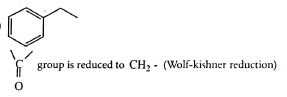
15.
- I etiect increases the acidity. If electronegativity is high, - I effect is also high.
16.
(i) An organic compound A (C2H3N) on reduction with SnCl2/HCI gives B (C2H4O) which reduces Tollens reagent.
\({ CH }_{ 3 }-C\overset { | }{ \underset { \underset { H-H\\ \quad (A) }{ | } }{ = } } N\overset { sn{ Cl }_{ 2 } }{ \underset { HCl }{ \longrightarrow } }
{ CH }_{ 3 }CH=NH-HCl\overset { Hydrolysis }{ \longrightarrow }\underset{(B)} {{ CH }_{ 3 }CHO}+{ NH }_{ 4 }Cl\)
(ii) Compound B on reduction with N2H4/C2H5ONa gives C (C2H6).
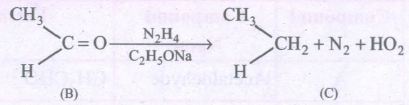
| Compound | Compound Name | Formula |
| A | Methyl cyanide | CH3-CN |
| B | Acetaldehyde | CH3CHO |
| C | Ethane | C2H6 |
17.
(i) From the molecular formula compound (A) is identified as Benzaldehyde I C6H5CHO and it reduces Tollen's reagent.
\(\underset { Tollen's\ regant\ silver\ mirror }{ { C }_{ 6 }{ H }_{ 5 }CHO+{ Ag }_{ 2 }O\longrightarrow 2Ag+{ C }_{ 6 }{ H }_{ 5 }COOH } \)
(ii) Benzaldehyde on treatment with alkali undergoes Cannizzaro reaction to give benzoic acid (B) and benzyl alcohol (C).
\(\underset { (A) }{ { C }_{ 6 }{ H }_{ 5 }CHO+{ C }_{ 6 }{ H }_{ 5 }CHO } \overset { NaOH }{ \longrightarrow } \underset { (B) }{ { C }_{ 6 }{ H }_{ 5 }COOH } +\underset { (C) }{ { C }_{ 6 }{ H }_{ 5 }{ CH }_{ 2 }OH } \)
(iii) Benzoic acid on treatment with sodalime gives benzene.
\(\underset { (B) }{ { C }_{ 6 }{ H }_{ 5 }COOH } \overset { NaOH }{ \underset { CaO }{ \longrightarrow } } \underset { Benzene }{ { C }_{ 6 }{ H }_{ 5 }+{ CO }_{ 2 } } \)
(iv) Benzyl alcohol acts as an antiseptic.
| Compound | Compound Name | Formula |
| A | Benzaldehyde | C6H5CHO |
| B | Benzoic acid | C6H5COOH |
| C | Benzyl alcohol | C6H5CH2OH |
18.
(i) Tollens Reagent Test: Tollens reagent is an ammoniacal silver nitrate solution. When an aldehyde is warmed with Tollens reagent a bright silver mirror is produced due to the formation of silver metal. This reaction is also called silver mirror test for aldehydes.
\({ CH }_{ 3 }CHO+2\left[ Ag\left( { NH }_{ 3 } \right) _{ 2 } \right] ^{ + }+3{ OH }^{ - }\longrightarrow { CH }_{ 3 }CO{ O }^{ - }+\underset { Silver\ mirror }{ 4{ NH }_{ 3 }+2Ag+2{ H }_{ 2 }O } \)
(ii) Fehlings solution Test:
(a) Fehling's solution is prepared by mixing equal volumes of Fehlings solution A containing aqueous copper sulphate and Fehlings solution 'B' containing alkaline solution of sodium potassium tartarate (Rochelle salt).
(b) When aldehyde is warmed with Fehlings solution deep blue colour solution is changed to red precipitate of cuprous oxide.
\(\\ \\ { CH }_{ 3 }CHO+\underset { blue }{ 2{ Cu }^{ 2 } } +5{ OH }^{ - }\longrightarrow { CH }_{ 3 }{ COO }^{ - }+\underset { red }{ { Cu }_{ 2 }O\downarrow } +3{ H }_{ 2 }O\)
(iii) Schiffs' reagent Test: Dilute solution of aldehydes when added to Schiff's reagent (Rosaniline hydrochloride dissolved in water and its red colour decolourised by passing SO2) yields its red colour. This is known as Schiff's test for aldehydes. Ketones do not give this test. Acetone however gives a positive test but slowly.
19.
\(\underset { Acetaldehyde }{ { CH }_{ 3 }-\underset { \overset { || }{ O } }{ C } -H+4(H) } \overset { { NH }_{ 2 }{ NH }_{ 2 } }{ \underset { { C }_{ 2 }{ H }_{ 5 }ONa }{ \longrightarrow } } \underset { Ethane }{ { CH }_{ 3 }-{ CH }_{ 3 }+{ H }_{ 2 }O+{ N }_{ 2 } } \)
(i) Clemmensen reduction: Aldehydes and Ketones when heated with zinc amalgam and concentrated hydrochloric acid gives hydrocarbons.
Example:
\(\underset { Acetald4ehyde }{ { CH }_{ 3 }-\underset { \overset { || }{ O } }{ C } -{ H }^{ + }4(H) }
\overset { Zn^{ - }Hg }{ \underset { Conc.HCl }{ \longrightarrow } }
\underset {Ethane}{{ CH }_{ 3 }-{ CH }_{ 3 }\pm { H }_{ 2 }O}\)
\(\underset { Acetone }{ { CH }_{ 3 }-\underset { \overset { || }{ O } }{ C } -{ CH }_{ 3 }+4\left( H \right) } \overset { { Zn }^{ - }Hg }{ \underset { Conc.HCl }{ \longrightarrow } } { CH }_{ 3 }{ CH }_{ 2 }{ CH }_{ 3 }+{ H }_{ 2 }O\)
(ii) Wolff-Kishner Reduction: Aldehydes and Ketones when heated with hydrazine (NH2NH2) and sodium ethoxide, hydrocarbons are formed Hydrazine acts as a reducing agent and sodium ethoxide as a catalyst.
Example :
\(\underset { Acetaldehyde }{ { CH }_{ 3 }-\underset { \overset { || }{ O } }{ C } -H+4(H) } \overset { { NH }_{ 2 }{ NH }_{ 2 } }{ \underset { { C }_{ 2 }{ H }_{ 5 }ONa }{ \longrightarrow } } \underset { Ethane }{ { CH }_{ 3 }-{ CH }_{ 3 }+{ H }_{ 2 }O+{ N }_{ 2 } } \)
\(\underset { Acetone }{ { CH }_{ 3 }-\underset { \overset { || }{ O } }{ C } -{ CH }_{ 3 }+4(H) } \overset { { NH }_{ 2 }{ NH }_{ 2 } }{ \underset { { C }_{ 2 }{ H }_{ 5 }ONa }{ \longrightarrow } } { CH }_{ 3 }{ CH }_{ 2 }{ CH }_{ 3 }+{ H }_{ 2 }O+{ N }_{ 2 }\)
Aldehyde (or) ketones is first converted to its hydrazone which on heating with strong base gives hydrocarbons.
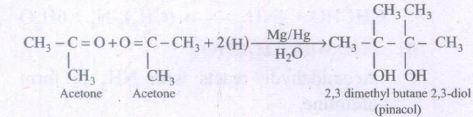
(iii) Reduction to pinacols: Ketones, on reduction with magnesium amalgam and water, are reduced to symmetrical diols known as pinacol.
20.
(i) With NH3 :
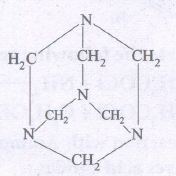
Formaldehyde forms hexa m ethylenetetramine with NH3
\(\underset { Formaldehyde }{ 6{ CH }_{ 2 }O+4N{ H }_{ 3 } } \longrightarrow \underset { Hexamethylene\quad tetramine }{ \left( { CH }_{ 2 } \right) _{ 6 }{ N }_{ 4 }+6{ H }_{ 2 }O } \)
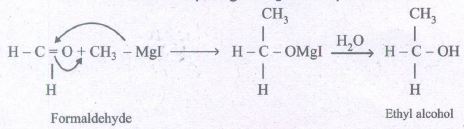
(ii) With CH3MgI
Formaldehyde gives primary alcohol
(iii) With NaOH :
Cannizaro Reaction
\(\underset { Formaldehyde }{ HCHO } +HCHO\overset { NaOH }{ \longrightarrow } \underset { Sodiumformate }{ HCOONa } +\underset { Methnol }{ { CH }_{ 3 }OH } \)
21.
22.
| Flavor | Ester |
| (i) Raspberry | isobutyl formate |
| (ii) Pine apple | ethyl butyrate |
| (iii) Orange | octyl acetate |
23.
Vinegar is 6 to 8% solution of acetic acid in water.
24.
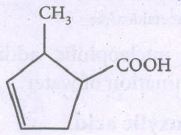
25.
(i) \({ CH }_{ 3 }-\underset { \overset { | }{ { C }_{ 6 }{ H }_{ 5 } } }{ C } =\underset { \overset { | }{ Br } }{ C } -{ CH }_{ 2 }-COOH\)
(ii) \({ CH }_{ 3 }-{ CH }_{ 2 }-\overset { \underset { | }{ { CH }_{ 3 } } }{ CH } -COOH\)
26.
(i) Benzoic acid is used as an urinary antiseptic.
(ii) Sodium benzoate is used as food preservative.
(iii) Benzoic acid vapours are used to disinfect bronchial tube.
27.
(i) Decarboxylation: When anhydrous: sodium salt of carboxylic acids are heated with soda lime, carboxyl group is removed with the· formation of hydrocarbon containing one carbon atom less.
\(\underset { Sodium \ acetate }{ { CH }_{ 3 }COONa } \overset { NaOH/CaO }{ \longrightarrow } \underset { Methane }{ { CH }_{ 4 } } +{ Na }_{ 2 }{ CO }_{ 3 }\)
(ii) Heating benzoic acid with soda lime gives benzene.
\({ C }_{ 6 }{ { H }_{ 5 }COOH }\underset { Sodalime }{ \overset { NaOH }{ \underset { CaO\Delta }{ \longrightarrow } } } { C }_{ 6 }{ H }_{ 6 }+{ CO }_{ 2 }\)
28.
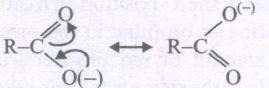
29.
(i) Aqueous solution of carboxylic acids turn blue litmus into red colour.
(ii) Carboxylic acids give brisk effervescence with sodium bicarbonate due to the I evolution of CO2,
30.
Aldehydes that do not have a-hydrogen atom undergo Cannizaro reaction.
Eg: HCHO, C6H5CHO.
31.
(i) \(H-\underset { \overset { || }{ O } }{ C } -H\) - Formaldehyde
(ii) \({ CH }_{ 3 }-\underset { \overset { || }{ O } }{ C } -H\) - Acetaldehyde
(iii) \({ CH }_{ 3 }-\underset { \overset { || }{ O } }{ C } -{ { CH }_{ 3 } }\) - Acetone
(iv) \(\\ { C }_{ 6 }{ H }_{ 5 }-\underset { \overset { || }{ O } }{ C } -{ CH }_{ 5 }\) - Aceopenone
32.
An carbonyl compound having molecular formula C5H10O giving positive iodoform test. It does not reduce Fehling solution.So it is 2- pentanone.
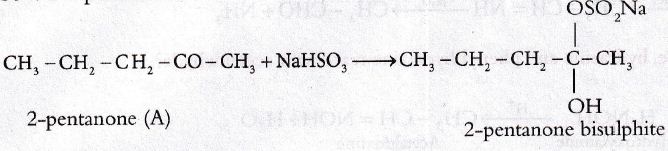
∴ (A) is 2-pentanone.
33.
.JPG)
(ii) 2,4-dichlorobenzaldehyde.
.JPG)
(iii) ethanal
.JPG)
34.
.JPG)
(ii) benzoic acid
.JPG)
(iii) α - hydroxyphenylaceticacid.
.JPG)
35.
| S.No. | Formula | Common name | IUPAC name |
| i. | CH3-CH=CH-CHO | Crotonaldehyde | 2-butenal |
| ii. | \(CH_{ 3 }-\underset { \overset { || }{ O } }{ C } -{ CH }_{ 2 }-{ CH }_{ 2 }-{ CH }_{ 3 }\) | Methyl n-propyl ketone | 2-pentanone |
| iii. | C6HsCH2CHO | Phenyl acetaldehyde | Phenyl ethanal |
36.
\(\underset { Phenyl\ magnesium\\ bromide }{ { C }_{ 6 }{ H }_{ 5 }MgBr } +{ CO_{ 2 }\longrightarrow \quad }{ C }_{ 6 }{ H }_{ 5 }\overset { \underset { || }{ O } }{ C } OMgBr\underset { { H }_{ 2 }O/{ H }^{ + } }{ \longrightarrow } \underset { \quad \quad \quad \quad (A)\\ Benzoic\ acid }{ { C }_{ 6 }{ H }_{ 5 }COOH } \)
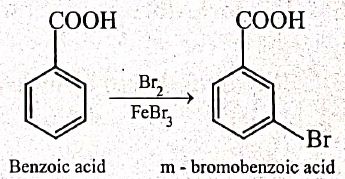
(A) C6H5COOH-Benzoic acid
(B)
37.
(i) \(\underset { Propanal }{ { 2CH }_{ 3 }-{ CH }_{ 2 }-CHO } \overset { Dil\quad NaOH }{ \underset { \quad Aldol\\ Condensation }{ \longrightarrow } } \underset { 3-hydroxy-2-methyl \ pentanal }{ { CH }_{ 3 }-{ CH }_{ 2 }-\underset { \overset { | }{ OH } }{ CH } -\underset { \overset { | }{ { CH }_{ 3 } } }{ CH } -CHO } \)
(ii) (CH3)C-CHO:
\({ CH }_{ 3 }-\overset { \underset { | }{ { CH }_{ 3 } } }{ \underset { \overset { | }{ { CH }_{ 3 } } }{ C } - } CHO\overset { dil.NaOH }{ \underset { Cannizzao\\ reaction }{ \longrightarrow } } \underset { 2,2diemthy-l-propanol }{ { CH }_{ 3 }-\overset { \underset { | }{ { CH }_{ 3 } } }{ \underset { \overset { | }{ { CH }_{ 3 } } }{ C } } -{ CH }_{ 2 }OH+ } \underset { 2,2-dimethyl \ sodium \ propionate }{ CH_{ 3 }-\overset { \underset { | }{ { CH }_{ 3 } } }{ \underset { \overset { | }{ { CH }_{ 3 } } }{ C } } -COONa } \)
38.
(i) Ethanal
(ii) sp2
(iii) CH3CHO + 2Cu2+ + 3OH- ⟶CH3COO- + 2Cu+ + 2H2O
\({ CH }_{ 3 }CHO+{ CH }_{ 3 }CHO\overset { NaOH }{ \longrightarrow } { H }_{ 3 }C-\overset { \underset { | }{ H } }{ \underset { \overset { | }{ OH\\ Aldol } }{ C } } -{ CH }_{ 2 }-CHO\)
39.
(i) Benzaldehyde from Toluene: Side chain chlorination of toluene gives benzal chloride, which on hydrolysis gives benzaldehyde.
(ii) Benzoin from benzaldehyde: Benzaldehyde reacts with alcoholic KCN to form benzoin.
\({ C }_{ 6 }{ H }_{ 5 }-\overset { \underset { | }{ H } }{ \underset { \overset { || }{ O } }{ C } } +H-\underset { \overset { || }{ O } }{ C } { -C }_{ 6 }{ H }_{ 6 }\overset { alc \ KCN }{ \underset { \Delta }{ \longrightarrow } } { C }_{ 6 }{ H }_{ 5 }-\underset { \overset { | }{ OH } }{ CH } -\underset { \overset { || }{ O } }{ C } -{ C }_{ 6 }{ H }_{ 5 }\)
40.
(i) Cannizzaro reaction is a redox reaction which takes place only in aldehydes which do not have α- hydrogen atom.
(ii) Formaldehyde (HCHO) and benzaldehyde (C6H5CHO) do not have a-hydrogen atom and so they undergo Cannizzaro reaction.
(iii) But acetaldehyde CH3CHO contains 3 α-H atoms and it does not undergo Cannizzaro reaction.
41.
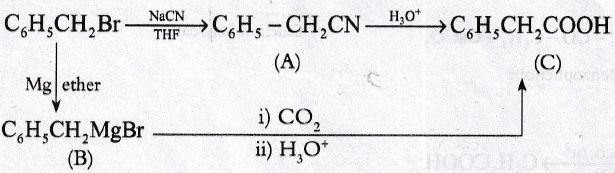 Phenyl Acetic acid
Benzyl Magnesium bromide
42.
Propanal into butanone:
.JPG)
(b) Hex-3-yne into hexan-3-one.
Hydration of alkynes in 42% sulphuric acid containg H2SO4 as catalyst
\(\underset {Hex-3-yne}{\mathrm{CH}_{3}-\mathrm{CH}_{2}}-\mathrm{C} \equiv \mathrm{C}-\mathrm{CH}_{2}-\mathrm{CH}_{3} \frac{\mathrm{HgSO}_{4}}{\mathrm{H}_{2} \mathrm{SO}_{4} / \mathrm{H}_{2} \mathrm{O}} \)
.JPG)
(c) phenylmethanal into benzoic acid
(d) phenylmethanal into benzoin
.JPG)

12th Standard Syllabus & Materials
12th Standard
TN 12th Computer Applications களப்பெயர் முறைமை (DNS) Sample Question Papers Study Material - QB365 Set A
NEW12th Standard
TN 12th Computer Applications வலையமைப்பு எடுத்துக்காட்டுகள் மற்றும் நெறிமுறைகள் Sample Question Papers Study Material - QB365 Set A
NEW12th Standard
TN 12th Computer Applications கணினி வலையமைப்பு ஓர் அறிமுகம் Sample Question Papers Study Material - QB365 Set A
NEW12th Standard
TN 12th Computer Applications PHP-உடன் MySQL-ஐ இணைத்தல் Sample Question Papers Study Material - QB365 Set A



Tamilnadu Stateboard 12th Standard Subjects

Maths
Chemistry

Physics

Biology

Computer Science

Business Maths and Statistics

Economics

Commerce

Accountancy

History

Computer Applications
Biology
Computer Technology
Computer Applications
Computer Science
Business Maths and Statistics
Commerce
Economics
Maths
Chemistry
Physics
Computer Technology
History
Accountancy

Tamil

English

French
Tamilnadu Stateboard Standards
