
 100% FREE ACCESS
12th Standard Syllabus & Materials
12th Standard
TN 12th Computer Applications மின்னணு தரவு பரிமாற்றம் Sample Question Papers Study Material - QB365 Set A
NEW12th Standard
TN 12th Computer Applications மின் - வணிக பாதுகாப்பு அமைப்புகள் Sample Question Papers Study Material - QB365 Set A
NEW12th Standard
TN 12th Computer Applications மின்னணு செலுத்தல் முறைகள் Sample Question Papers Study Material - QB365 Set A
NEW12th Standard
TN 12th Computer Applications மின் - வணிகம் Sample Question Papers Study Material - QB365 Set A
NEW12th Standard
TN 12th Computer Applications திறந்த மூல கருத்துருக்கள் Sample Question Papers Study Material - QB365 Set A
NEW12th Standard
TN 12th Computer Applications வலையமைப்பு வடமிடல் Sample Question Papers Study Material - QB365 Set A

Published on: 29/01/2021
12th Standard Chemistry English Medium Carbonyl Compounds and carboxylic acids Reduced Syllabus Important Questions With Answer Key 2021
Download Tamil Nadu 12th Standard Chemistry question papers, model tests, one-mark questions, important questions, and public exam papers in PDF format. Free study materials and answer keys for TN State Board students.
Questions + Answers key
Take MCQ Chemistry Test
1.
Partial reduction of acetic acid in the presence of LiAl H4 results in the formation of ________.
ethane
ethanol
ethene
ethyne
2.
It is a powerful acetylating agent for compounds containing -OH group and - NH group _______.
CH3CONH2
CH3COOH
CH3COCl
CH3COOCH3
3.
Which compound on strong oxidation gives propionic acid?
\({ CH }_{ 3 }-\underset { \overset { | }{ OH } }{ CH } -{ CH }_{ 3 }\)
\({ CH }_{ 3 }-CO-{ CH }_{ 3 }\)
\({ CH }_{ 3 }-\overset { \underset { | }{ { CH }_{ 3 } } }{ \underset { \overset { | }{ { CH }_{ 3 } } }{ C } } -OH\)
\({ CH }_{ 3 }{ CH }_{ 2 }{ CH }_{ 2 }OH\)
4.
The formation of cyanohydrin from a ketone is an example of _______.
electrophilic addition
nucleophilic addition
nucleophilic substitution
electrophilic substitution
5.
Tincture benzoin is obtained from _______.
benzoyl chloride
benzoin
benzyl alcohol
benzoic acid
6.
Schiff's reagent gives pink colour with _______.
acetone
acetaldehyde
ethyl alcohol
methyl acetate
7.
Which among the carbonyl compounds cannot be prepared by Rosenmund reduction?
Ketones
Formaldehyde
Acetaldehyde
Both (a) and (b)
8.
Cannizaro reaction is not given by _______.
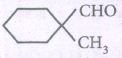
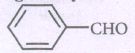
CH3CHO
HCHO
9.
Give the common and IUPAC name of the compound HO-CH2-\(\underset { \overset { | }{ OH } }{ CH } \)-CHO
glyceraldehyde, hydroxy prop anal
glyceraldehyde, 2, 3 - dihydroxy prop anal
crotonaldehyde, hydroxy propanal
crotonaldehyde, 2, 3 - dihydroxy propanal
10.
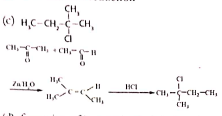
An alkene “A” on reaction with O3 and Zn - H2O gives propanone and ethanol in equimolar ratio. Addition of HCl to alkene “A” gives “B” as the major product. The structure of product “B” is ______.
\(Cl-{ CH }_{ 2 }-CH_{ 2 }-\overset { \overset { CH_{ 3 } }{ | } }{ \underset { \underset { CH_{ 3 } }{ | } }{ CH } } \)
\({ H }_{ 3 }C-{ CH }_{ 2 }-\overset { \overset { CH_{ 2 }Cl }{ | } }{ CH } -{ CH }_{ 3 }\)
\(\\ { H }_{ 3 }C-{ CH }_{ 2 }-\overset { \overset { CH_{ 3 } }{ | } }{ \underset { \underset { CL{ } }{ | } }{ C } } -{ CH }_{ 3 }\)
\({ H }_{ 3 }C-{ CH }-\overset { \overset { CH_{ 3 } }{ | } }{ \underset { \underset { Cl }{ | } }{ C } } \)
11.
In which of the following reactions new carbon – carbon bond is not formed?
Aldol condensation
Friedel craft reaction
Kolbe’s reaction
Wolf kishner reduction
12.
Which one of the following reaction is an example of disproportionation reaction.
Aldol condensation
cannizaro reaction
Benzoin condensation
none of these
13.
CH3Br \(\overset { KCN }{ \longrightarrow } (A)\overset { { H }_{ 2 }{ O }^{ + } }{ \longrightarrow } (B)\overset { { PCl }_{ 5 } }{ \longrightarrow } \) (C) product (c) is ______.
acetylchloride
chloro acetic acid
\(\alpha\)- chlorocyano ethanoic acid
none of these
14.
Predict the product Z in the following series of reactions Ethanoic acid \(\overset { { PCI }_{ 5 } }{ \longrightarrow } X\overset { { C }_{ 6 }{ H }_{ 6 } }{ \underset { Anhydrous \ AlCI }-_{3}{ \longrightarrow } } Y\overset { 1){ CH }_{ 3 }MgBr }{ \underset { II){ H }_{ 3 }{ O }^{ + } }{ \longrightarrow } } Z.\)
(CH3)2 C(OH)C6H5
CH3CH(OH)C6H5
CH3CH(OH)CH2- CH3

15.
Assertion: p – N, N – dimethyl amino benzaldehyde undergoes benzoin condensation
Reason: The aldehydic (-CHO) group is meta directing.
Codes:
A) if both assertion and reason are true and reason is the correct explanation of assertion.
B) if both assertion and reason are true but reason is not the correct explanation of assertion.
C) assertion is true but reason is false
D) both assertion and reason are false
if both assertion and reason are true and reason is the correct explanation of assertion.
if both assertion and reason are true but reason is not the correct explanation of assertion.
assertion is true but reason is false
both assertion and reason are false
16.
What are carboxylic acids?
17.
What is DIBAL -H? What is it used for?
18.
Arrange the following in increasing order of reactivity towards nucleophilic addition HCHO CH3CHO and CH3COCH3
19.
What is formalin? Write its use.
20.
Does formaldehyde undergo aldol condensation? Justify your answer.
21.
Name one reagent used to distinguish acetaldehyde and acetone.
22.
What are the Cartesian sign conventions for a spherical mirror?
23.
Give the characteristics of image formed by a plane mirror.
24.
A hydrocarbon A (molecular formula C8H10) on ozonolysis gives B (C4H6O2) only. Compound C (C3H5Br) on treatment with magnesium in dry ether gives (D) which on treatment with CO2 followed by acidification gives(C). Identify A, B and C.
25.
How is propanoic acid is prepared starting from
(a) an alcohol
(b) an alkylhalide
(c) an alkene
26.
Compound (A) with Molecular formula C7H6O does not reduce Fehling's solution. Compound (A) reacts with acetone in the presence of NaOH to give a compound (B) which is an α, β-unsaturated compound. Further (A) reacts with dimethyl aniline in the presence of cone, H2SO4 to give compound (C) which is a dye. Identify (A) (B) and (C). Explain the reactions.
27.
An organic compound (A) of molecular formula C7H8 on oxidation with air and in presence of V2O5 to form (B) of molecular formula C7H6O. (B) on reduction with lithium aluminium hydride to form (C) of molecular formula C7H8O. Identify (A), (B) and (C) and explain the reactions.
28.
An organic compound A (C2H3N) on reduction with SnCI2/HCI gives B (C2H4O) which reduces Tollen's reagent. Compound B on reduction with N2H4/C2H5ONa gives C (C2H6). Identify the compounds A, B and C. Explain the reactions involved.
29.
Explain why carboxylic acids behave as acids. Discuss briefly the effects of electron withdrawing and donating substituents on acid strength of carboxylic acids.
30.
Illustrate the reducing property of acetaldehyde with examples
31.
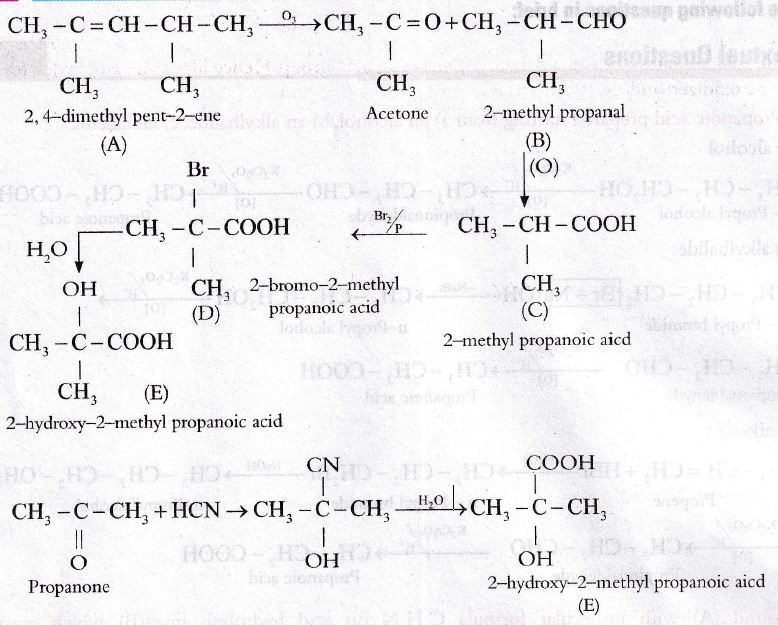
An alkene (A) on ozonolysis gives propanone and aldehyde (B). When (B) is oxidised (C) is obtained. (C) is treated with Br2/P gives (D) which on hydrolysis gives (E). When propanone is treated with HCN followed by hydrolysis gives (E). Identify A, B, C, D and E.
32.
Give the IUPAC names for the following:
(i) Crotonaldehyde
(ii) Methyl n-propyl ketone
(iii) Phenyl acetaldehyde.
33.
Complete the following reactions
(i) CH3COCI + NH2⟶
(ii) CH3COCI + C2H5OH⟶
34.
Formic acid reduces Tollen's reagent but acetic acid does not - Give reasons.
35.
Organic compound with molecular formula C3H6O has two isomers (A) and (B). (A) on heating with NaOH in I2 forms a yellow precipitate while (B) does not. Identify the isomers A and B and explain the reactions.
36.
How will you convert benzaldehyde to
(I) C6H5COOH
(ii) C6HsCH2OH
(iii) C6HSCH3
37.
What happens when the following compounds are treated with dilute NaOH solution in cold?
(i) propanal
(ii) (CH3)3C-CHO
38.
Explain the isomerism exhibited by carboxylic acids.
39.
Formaldehyde and benzaldehyde give Cannizaro reaction but acetaldehyde does not - account for this.
40.
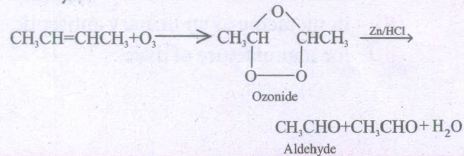
How is acetaldehyde prepared by the ozonolysis of CH3CH=CHCH3?
41.
Complete the following reaction
\({ CH }_{ 3 }-{ CH }_{ 2 }-{ CH }_{ 2 }-\underset { \overset { || }{ O } }{ C } -{ CH }_{ 3 }\overset { HO-{ CH }_{ 2 }-{ CH }_{ 2 }-OH }{ \underset { { dry }{ HCl} }{ \longrightarrow } } ?\)
42.
How are the following conversions effected
(a) propanal into butanone
(b) Hex-3-yne into hexan-3-one.
(c) phenylmethanal into benzoic acid
(d) phenylmethanal into benzoin
1.
(b)
ethanol
2.
(c)
CH3COCl
3.
(d)
\({ CH }_{ 3 }{ CH }_{ 2 }{ CH }_{ 2 }OH\)
4.
(b)
nucleophilic addition
5.
(b)
benzoin
6.
(b)
acetaldehyde
7.
(d)
Both (a) and (b)
8.
(c)
CH3CHO
9.
(b)
glyceraldehyde, 2, 3 - dihydroxy prop anal
10.
11.
(d)
Wolf kishner reduction
12.
(b)
cannizaro reaction
13.

14.

15.

B) if both assertion and reason are true but reason is not the correct explanation of assertion.
16.
(i) Organic compounds containing the carboxyl group -COOH are called carboxylic acids.
(ii) The acid may be monocarboxylic acid if it contains one -COO H group; a dicarboxylic acid if it contains two - COOH groups; a tricarboxylic acid if it contains three - COOH groups.
Eg: CH3COOH - Acetic acid; (COOH)2- Oxalic acid
17.
DIBAL -H is Diisobutyl aluminium hydride. Its is reducing agent.
18.
The order of reactivity of aliphatic carbonyl compounds towards the nudeophilic addition reaction is, HCHO > CH3CHO > CH3COCH3
19.
(i) 40 % aqueous solution of formaldehyde is known as formalin.
(ii) It is used as a preservative for biological specimens and in leather tanning.
20.
(i) Formaldehyde does not undergo aldol condensation.
(ii) Aldol condensation reaction is the characteristic of carbonyl compounds having a hydrogen atom. So this reaction does not take place in formaldehyde.
21.
(i) Schiff's reagent is used to .distinguish acetaldehyde and acetone.
(ii) Acetaldehyde restores the original colour (red-pink) of the Schiff's reagent.
(iii) Acetone does not restore this colour.
22.
(i) The Incident light is taken from left to right (i.e. object on the left of mirror).
(ii) All the distances are measured from the pole of the mirror (pole is taken as origin).
(iii) The distances measured to the right of pole along the principal axis are taken as positive.
(iv) The distances measured to the left of pole along the principal axis are taken as negative.
(v) Heights measured in the upward perpendicular direction to the principal axis are taken as positive.
(vi) Heights measured in the downward perpendicular direction to the principal axis, are taken as negative.
23.
(i) The image formed by a plane mirror is virtual, erect, and laterally inverted.
(ii) The size of the image is equal to the size of the object.
(iii The image distance far behind the mirror is equal to the object distance in front of it.
(iv) If an object is placed between two plane mirrors inclined at an angle e, then the number of images n formed is as,
\(n=\left( \cfrac { 360 }{ \theta } -1 \right) \)
24.
The compound with molecular formula C8H10
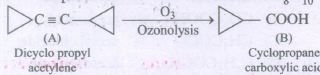
Compound (C) with molecular formula C3HSBr is
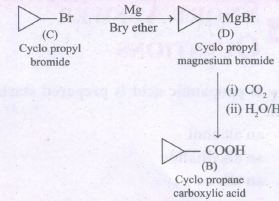
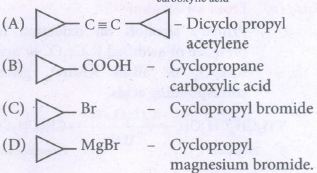
25.
An alcohol:
.JPG)
An alkylhalide:
.JPG)
An alkene:
.JPG)
26.
(i) Compound (A) does not reduce Fehling's solution, so it is benzaldehyde.
(ii) Benzaldehyde (A) reacts with acetone in the presence of NaOH to give on a, p unsaturated compound (B).
\(\\ \\ \\ \underset { (A) }{ { C }_{ 6 }{ H }_{ 5 }CHO } +{ CH }_{ 3 }-{ COCH }_{ 3 }\overset { NaoH }{ \longrightarrow } \underset { (B) }{ { C }_{ 6 }{ H }_{ 5 } } -\underset { Acetone }{ CH=CH-{ COCH }_{ 3 } } \)
(iii) (A) reacts with dimethyl aniline in the presence of conc. H2SO4 to give compound (C).
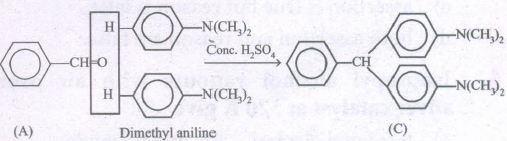
| Compound | Compound Name | Formula |
| A | Benzaldehyde | C6H5CHO |
| B | Benzal acetone | C6H5CH = CH-COCH3 |
| C | Triphenyl methane dye | 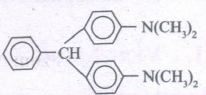 |
27.
(i) (A) on oxidation with air and V2O5 gives (B).
\(\underset{(A)}{{ C }_{ 6 }{ H }_{ 5 }{ CH }_{ 3 }}\overset { \left( O \right) }{ \underset { { V }_{ 2 }{ O }_{ 5 } }{ \longrightarrow } } \underset{(B)}{{ C }_{ 6 }{ H }_{ 5 }CHO}\)
(ii) (B) on reduction with LiAIH4 gives C.
\({ C }_{ 6 }{ H }_{ 5 }CH\overset { \left[ H \right] }{ \underset { LiA/{ H }_{ 4 } }{ \longrightarrow } } \underset{(C)}{{ C }_{ 6 }{ H }_{ 5 }CHO}\)
| Compound | Compound Name | Formula |
| A | Toluene | C6H5CH3 |
| B | Benzaldehyde | C6H5CHO |
| C | Benzylalcohol | C6H5CH2OH |
28.
(i) An organic compound A (C2H3N) on reduction with SnCl2/HCI gives B (C2H4O) which reduces Tollens reagent.
\({ CH }_{ 3 }-C\overset { | }{ \underset { \underset { H-H\\ \quad (A) }{ | } }{ = } } N\overset { sn{ Cl }_{ 2 } }{ \underset { HCl }{ \longrightarrow } }
{ CH }_{ 3 }CH=NH-HCl\overset { Hydrolysis }{ \longrightarrow }\underset{(B)} {{ CH }_{ 3 }CHO}+{ NH }_{ 4 }Cl\)
(ii) Compound B on reduction with N2H4/C2H5ONa gives C (C2H6).
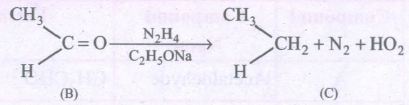
| Compound | Compound Name | Formula |
| A | Methyl cyanide | CH3-CN |
| B | Acetaldehyde | CH3CHO |
| C | Ethane | C2H6 |
29.
Acidic nature of acids:
(i) Acid molecule ionises to produce H+ ions in solution.
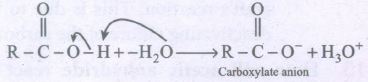
(ii) The carboxylate anion is stabilised by resonance.
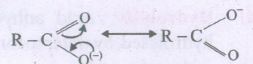
Hence the cleavage of -COOH bond to release H+ is favoured, thereby making it to behave as acids.
(iii) Any factor that weakens the -COOH bond will facilitate the cleavage to release H+ more easily. The degree of ionisation is increased and acid becomes relatively a stronger acid.
(iv) When the following acids are compared
Their strength varies as the above order.
(v) Methyl group is a + I group (electron pair repelling group). Acid strength decreases: with increasing number of electron repelling substituent attached to the α- carbon atom.
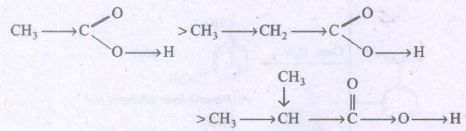
The +1 effect is felt in increasing the strength of the -OH bond and the cleavage to form H+ becomes difficult. Hence they are weaker acid than formic acid (HCOOH) which does not have + I methyl group.
(vi) Acid strength increases with increase in electronegativity of substituents
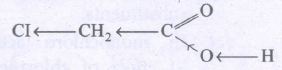
This effect weakness the -O- H bond there by facilitating the removal of H+ from -OH group. This acid becomes stronger than formic acid.
30.
\(\underset { Acetaldehyde }{ { CH }_{ 3 }-\underset { \overset { || }{ O } }{ C } -H+4(H) } \overset { { NH }_{ 2 }{ NH }_{ 2 } }{ \underset { { C }_{ 2 }{ H }_{ 5 }ONa }{ \longrightarrow } } \underset { Ethane }{ { CH }_{ 3 }-{ CH }_{ 3 }+{ H }_{ 2 }O+{ N }_{ 2 } } \)
(i) Clemmensen reduction: Aldehydes and Ketones when heated with zinc amalgam and concentrated hydrochloric acid gives hydrocarbons.
Example:
\(\underset { Acetald4ehyde }{ { CH }_{ 3 }-\underset { \overset { || }{ O } }{ C } -{ H }^{ + }4(H) }
\overset { Zn^{ - }Hg }{ \underset { Conc.HCl }{ \longrightarrow } }
\underset {Ethane}{{ CH }_{ 3 }-{ CH }_{ 3 }\pm { H }_{ 2 }O}\)
\(\underset { Acetone }{ { CH }_{ 3 }-\underset { \overset { || }{ O } }{ C } -{ CH }_{ 3 }+4\left( H \right) } \overset { { Zn }^{ - }Hg }{ \underset { Conc.HCl }{ \longrightarrow } } { CH }_{ 3 }{ CH }_{ 2 }{ CH }_{ 3 }+{ H }_{ 2 }O\)
(ii) Wolff-Kishner Reduction: Aldehydes and Ketones when heated with hydrazine (NH2NH2) and sodium ethoxide, hydrocarbons are formed Hydrazine acts as a reducing agent and sodium ethoxide as a catalyst.
Example :
\(\underset { Acetaldehyde }{ { CH }_{ 3 }-\underset { \overset { || }{ O } }{ C } -H+4(H) } \overset { { NH }_{ 2 }{ NH }_{ 2 } }{ \underset { { C }_{ 2 }{ H }_{ 5 }ONa }{ \longrightarrow } } \underset { Ethane }{ { CH }_{ 3 }-{ CH }_{ 3 }+{ H }_{ 2 }O+{ N }_{ 2 } } \)
\(\underset { Acetone }{ { CH }_{ 3 }-\underset { \overset { || }{ O } }{ C } -{ CH }_{ 3 }+4(H) } \overset { { NH }_{ 2 }{ NH }_{ 2 } }{ \underset { { C }_{ 2 }{ H }_{ 5 }ONa }{ \longrightarrow } } { CH }_{ 3 }{ CH }_{ 2 }{ CH }_{ 3 }+{ H }_{ 2 }O+{ N }_{ 2 }\)
Aldehyde (or) ketones is first converted to its hydrazone which on heating with strong base gives hydrocarbons.
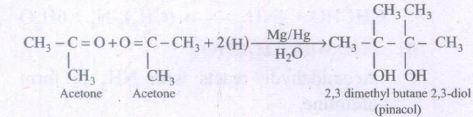
(iii) Reduction to pinacols: Ketones, on reduction with magnesium amalgam and water, are reduced to symmetrical diols known as pinacol.
31.
32.
| S.No. | Formula | Common name | IUPAC name |
| i. | CH3-CH=CH-CHO | Crotonaldehyde | 2-butenal |
| ii. | \(CH_{ 3 }-\underset { \overset { || }{ O } }{ C } -{ CH }_{ 2 }-{ CH }_{ 2 }-{ CH }_{ 3 }\) | Methyl n-propyl ketone | 2-pentanone |
| iii. | C6HsCH2CHO | Phenyl acetaldehyde | Phenyl ethanal |
33.
(i) Reaction with Ammonia (Ammonolysis) gives acid amides :
\(\underset { Acetyl\quad chloride }{ { CH }_{ 3 }-\overset { \underset { || }{ O } }{ C } - } \boxed { Cl+H } \underset { Ammonia }{ -{ NH }_{ 2 } } \longrightarrow \underset { Acetamide }{ { CH }_{ 3 }-\overset { \underset { || }{ O } }{ C } -{ NH }_{ 2 } } +HCl\)
(ii) Reaction with Alcohols (Alcoholysis) gives esters

34.
(i) Formic acid (HCOOH) is unique because it contains both an aldehyde group and carboxyl group also.
(ii) Hence it can act as a reducing agent. It reduces Fehling's solution Tollen's reagent and decolourises pink coloured KMnO4 solution.
(iii) Whereas in acetic acid, there is no aldehyde group and it cannot act as reducing agent.
(iv) Formic acid reduces ammoniacal silver nitrate solution (Tollen's reagent) to metallic silver
HCOOH + Ag2O⟶ H2O + CO2 + 2Ag↓ (metallic silver)
(v) Formic acid reduces Fehling's solution. It reduces blue coloured cupric ions to red coloured cuprous ions.
\(HCOO^{ - }+\underset { (blue) }{ 2{ Cu }^{ 2+ } } +5{ OH }^{ - }\longrightarrow { CO }_{ 3 }^{ 2- }+\underset { (red) }{ { Cu }_{ 2 }O } +3{ H }_{ 2 }O\)
35.
Two possible isomers of C3H6O are
\(\underset { \overset { (A) }{ Acetone } }{ { CH }_{ 3 }CO{ CH }_{ 3 } } \quad \underset { \overset { (B) }{ Propanal } }{ { CH }_{ 3 }{ CH }_{ 2 }CHO } \)
\(\\ \underset { \quad \quad (A)\\ Proponal }{ { CH }_{ 3 }CO{ CH }_{ 3 } } \overset { { I }_{ 2 }/NaOH\Delta }{ \underset { Iodo\ form\ \\ reaction }{ \longrightarrow } } \underset { Sodium\\ acetate }{ { CH }_{ 3 }COONa } +\underset { Iodoform\\ Yellow\ ppt }{ { CHI }_{ 3 } } \)
\(\underset { \quad \quad \quad (B)\\ Propanal }{ { CH }_{ 3 }{ CH }_{ 2 }CHO } \overset { { I }_{ 2 }/NaOH }{ \underset { \Delta }{ \longrightarrow } } No\quad ppt\quad of\quad { CHI }_{ 3 }\)
Acetone answers Iodo form test whereas proponal does not.
36.
(i) It is oxidised to benzoic acid by alkaline permanganate.
\({ C }_{ 6 }{ H }_{ 5 }CHO\overset { [O] }{ \longrightarrow } { C }_{ 6 }{ H }_{ 5 }COOH\)
(ii) It is reduced to benzyl alcohol by NaBH4 or LiAlH4
\({ C }_{ 6 }{ H }_{ 5 }CHO\overset { \left[ { H }^{ - } \right] }{ \longrightarrow } { C }_{ 6 }{ H }_{ 5 }{ CH }_{ 2 }OH\)
(iii) It can be reduced to toluene by Clemmenson or Wolff Kishner procedure.
\({ C }_{ 6 }{ H }_{ 5 }CHO\overset { Zn/Hg/HCl }{ \underset { \overset { or }{ { N }_{ 2 }{ H }_{ 4 }/KoH } }{ \longrightarrow } } { C }_{ 6 }{ H }_{ 5 }{ CH }_{ 3 }\)
37.
(i) \(\underset { Propanal }{ { 2CH }_{ 3 }-{ CH }_{ 2 }-CHO } \overset { Dil\quad NaOH }{ \underset { \quad Aldol\\ Condensation }{ \longrightarrow } } \underset { 3-hydroxy-2-methyl \ pentanal }{ { CH }_{ 3 }-{ CH }_{ 2 }-\underset { \overset { | }{ OH } }{ CH } -\underset { \overset { | }{ { CH }_{ 3 } } }{ CH } -CHO } \)
(ii) (CH3)C-CHO:
\({ CH }_{ 3 }-\overset { \underset { | }{ { CH }_{ 3 } } }{ \underset { \overset { | }{ { CH }_{ 3 } } }{ C } - } CHO\overset { dil.NaOH }{ \underset { Cannizzao\\ reaction }{ \longrightarrow } } \underset { 2,2diemthy-l-propanol }{ { CH }_{ 3 }-\overset { \underset { | }{ { CH }_{ 3 } } }{ \underset { \overset { | }{ { CH }_{ 3 } } }{ C } } -{ CH }_{ 2 }OH+ } \underset { 2,2-dimethyl \ sodium \ propionate }{ CH_{ 3 }-\overset { \underset { | }{ { CH }_{ 3 } } }{ \underset { \overset { | }{ { CH }_{ 3 } } }{ C } } -COONa } \)
38.
(i) Chain isomerism: This arises due to the difference in the carbon chain of alkyl group attached to carboxyl group. C5H10O2.
\({ CH }_{ 3 }-\underset { Pentanoic\ acid }{ { CH }_{ 2 }-{ CH }_{ 2 }-{ CH }_{ 2 } } -COOH\quad \underset { 3-mrthyl\ butanoic\ acid }{ { CH }_{ 3 }-\overset { \underset { | }{ { CH }_{ 3 } } }{ CH } -{ CH }_{ 2 }-COOH } \)
(ii) Functional isomerism: Carboxylic acids are functional isomers of ester . C3H6O2
\(\underset { Propanic \ acid }{ { CH }_{ 3 }-{ CH }_{ 2 }-COOH } \) and \(\underset { Methyl\ acetate }{ { CH }_{ 3 }COO{ H }_{ 5 } } \) \(\underset { Ethyl\ formate }{ HCOO{ C }_{ 2 }{ H }_{ 5 } } \)
39.
(i) Cannizzaro reaction is a redox reaction which takes place only in aldehydes which do not have α- hydrogen atom.
(ii) Formaldehyde (HCHO) and benzaldehyde (C6H5CHO) do not have a-hydrogen atom and so they undergo Cannizzaro reaction.
(iii) But acetaldehyde CH3CHO contains 3 α-H atoms and it does not undergo Cannizzaro reaction.
40.
Ozone forms addition product with olefin called I ozonide, which on reductive cleavage gives aldehyde.
41.

2- Pentanone.
42.
Propanal into butanone:
.JPG)
(b) Hex-3-yne into hexan-3-one.
Hydration of alkynes in 42% sulphuric acid containg H2SO4 as catalyst
\(\underset {Hex-3-yne}{\mathrm{CH}_{3}-\mathrm{CH}_{2}}-\mathrm{C} \equiv \mathrm{C}-\mathrm{CH}_{2}-\mathrm{CH}_{3} \frac{\mathrm{HgSO}_{4}}{\mathrm{H}_{2} \mathrm{SO}_{4} / \mathrm{H}_{2} \mathrm{O}} \)
.JPG)
(c) phenylmethanal into benzoic acid
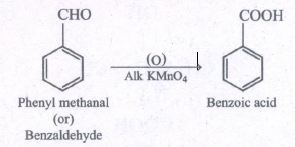
(d) phenylmethanal into benzoin
.JPG)

12th Standard Syllabus & Materials
12th Standard
TN 12th Computer Applications களப்பெயர் முறைமை (DNS) Sample Question Papers Study Material - QB365 Set A
NEW12th Standard
TN 12th Computer Applications வலையமைப்பு எடுத்துக்காட்டுகள் மற்றும் நெறிமுறைகள் Sample Question Papers Study Material - QB365 Set A
NEW12th Standard
TN 12th Computer Applications கணினி வலையமைப்பு ஓர் அறிமுகம் Sample Question Papers Study Material - QB365 Set A
NEW12th Standard
TN 12th Computer Applications PHP-உடன் MySQL-ஐ இணைத்தல் Sample Question Papers Study Material - QB365 Set A



Tamilnadu Stateboard 12th Standard Subjects

Maths
Chemistry

Physics

Biology

Computer Science

Business Maths and Statistics

Economics

Commerce

Accountancy

History

Computer Applications
Biology
Computer Technology
Computer Applications
Computer Science
Business Maths and Statistics
Commerce
Economics
Maths
Chemistry
Physics
Computer Technology
History
Accountancy

Tamil

English

French
Tamilnadu Stateboard Standards
