
 100% FREE ACCESS
12th Standard Syllabus & Materials
12th Standard
TN 12th Maths Applications of Matrices and Determinants Sample Question Papers Study Material - QB365 Set A
NEW12th Standard
TN 12th Computer Applications மின்னணு தரவு பரிமாற்றம் Sample Question Papers Study Material - QB365 Set A
NEW12th Standard
TN 12th Computer Applications மின் - வணிக பாதுகாப்பு அமைப்புகள் Sample Question Papers Study Material - QB365 Set A
NEW12th Standard
TN 12th Computer Applications மின்னணு செலுத்தல் முறைகள் Sample Question Papers Study Material - QB365 Set A
NEW12th Standard
TN 12th Computer Applications மின் - வணிகம் Sample Question Papers Study Material - QB365 Set A
NEW12th Standard
TN 12th Computer Applications திறந்த மூல கருத்துருக்கள் Sample Question Papers Study Material - QB365 Set A

Published on: 02/09/2022
QB365 provides a detailed and simple solution for every Possible Book Back Questions in Class 12 Chemistry Subject - Chemical Kinetics, English Medium. It will help Students to get more practice questions, Students can Practice these question papers in addition to score best marks.
Download Tamil Nadu 12th Standard Chemistry question papers, model tests, one-mark questions, important questions, and public exam papers in PDF format. Free study materials and answer keys for TN State Board students.
Questions + Answers key
Take MCQ Chemistry Test
1.
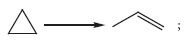 This reaction follows first order kinetics. The rate constant at particular temperature is 2.303 x 10⁻² hour-1. The initial concentration of cyclopropane is 0.25 M. What will be the concentration of cyclopropane after 1806 minutes? (log 2 = 0.3010)
0.125 M
0.215 M
0.25 x 2.303 M
0.05 M
2.
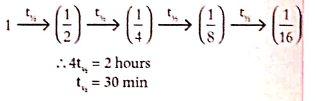
After 2 hours, a radioactive substance becomes \(\left( \frac { 1 }{ 16 } \right) ^{ th }\) of original amount Then the half life (in min) is _______.
60 minutes
120 minutes
30 minutes
15 minutes
3.
The correct difference between first and second order reactions is that________.
A first order reaction can be catalysed; a second order reaction cannot be catalysed.
The half life of a first order reaction does not depend on [A0]; the half life of a second order reaction does depend on [A0].
The rate of a first order reaction does not depend on reactant concentrations; the rate of a second order reaction does depend on reactant concentrations.
The rate of a first order reaction does depend on reactant concentrations; the rate of a second order reaction does not depend on reactant concentrations.
4.
The half life period of a radioactive element is 140 days. After 560 days, 1 g of element will be reduced to
\(\left( \frac { 1 }{ 2 } \right) g\)
\(\left( \frac { 1 }{ 4 } \right) g\)
\(\left( \frac { 1 }{ 8 } \right) g\)
\(\left( \frac { 1 }{ 16 } \right) g\)
5.
If 75% of a first order reaction was completed in 60 minutes, 50% of the same reaction under the same conditions would be completed in_______.
20 minutes
30 minutes
35 minutes
75 minutes
6.
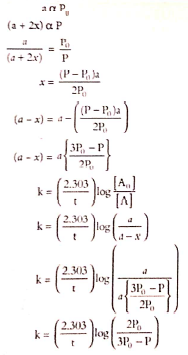
In a homogeneous reaction A⟶B+C+D, the initial pressure was P0 and after time t it was P expression for rate constant in terms of P0, P and t will be _____.
\(k=\left( \frac { 2.303 }{ t } \right) \log\left( \frac { 2{ P }_{ 0 } }{ { 3P }_{ 0 }-P } \right) \)
\(k=\left( \frac { 2.303 }{ t } \right) \log\left( \frac { { 2P }_{ 0 } }{ { P }_{ 0 }-P } \right) \)
\(k=\left( \frac { 2.303 }{ t } \right) \log\left( \frac { 3{ P }_{ 0 }-P }{ 2P_{ 0 } } \right) \)
\(k=\left( \frac { 2.303 }{ t } \right) \log\left( \frac { 2{ P }_{ 0 } }{ { 3P }_{ 0 }-2P } \right) \)
7.
If the initial concentration of the reactant is doubled, the time for half reaction is also doubled. Then the order of the reaction is______.
Zero
one
Fraction
none
8.
9.
For the reaction \({ N }_{ 2 }{ O }_{ 5 }\left( g \right) \longrightarrow { 2NO }_{ 2 }\left( g \right) +\frac { 1 }{ 2 } { O }_{ 2 }\left( g \right) \) value of rate of disappearance of N2O5 is given as 6.5 x 10⁻² mol L-1s-1. The rate of formation of NO2 and O2 is given respectively as_____.
(3.25 x 10⁻² mol L-1s-1) and (1.3 x 10⁻² mol L-1s-1)
(1.3 x 10⁻² mol L-1s-1) and (3.25 x 10⁻² mol L-1s-1)
(1.3 x 10⁻¹ mol L-1s-1) and (3.25 x 10⁻² mol L-1s-1)
None of these
10.
11.
Predict the rate law of the following reaction based on the data given below
2A+B⟶C+3D
| Reaction number | [A] (min) | [B] (min) | Initial rate (M s-1) |
| 1 | 0.1 | 0.1 | x |
| 2 | 0.2 | 0.1 | 2x |
| 3 | 0.1 | 0.2 | 4x |
| 4 | 0.2 | 0.2 | 8x |
rate = k[A]2 [B]
rate = k[A] [B]2
rate = k[A] [B]
rate = k[A]1/2 [B]3/2
12.
In a first order reaction x ⟶ y; if k is the rate constant and the initial concentration of the reactant x is 0.1M, then, the half life is_____.
\(\left( \frac { \log2 }{ k } \right) \)
\(\left( \frac { 0.693 }{ (0.1)k } \right) \)
\(\left( \frac { In2 }{ k } \right) \)
none of these
13.
For a first order reaction, the rate constant is 6.909 min-1 the time taken for 75% conversion in minutes is _______.
\(\left( \frac { 3 }{ 2 } \right) { \log 2 }\)
\(\left( \frac { 2 }{ 3 } \right) \log2\)
\(\left( \frac { 3 }{ 2 } \right) \log\left( \frac { 3 }{ 4 } \right) \)
\(\left( \frac { 2 }{ 3 } \right) \log\left( \frac { 4 }{ 3 } \right) \)
14.
What is the activation energy for a reaction if its rate doubles when the temperature is raised from 200K to 400K? (R = 8.314 JK-1 mol-1)
234.65 kJ mol-1
434.65 kJ mol-1
2.305 kJ mol-1
334.65 J mol-1
15.
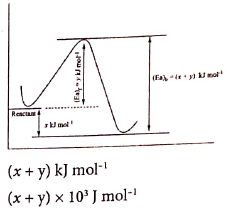
In a reversible reaction, the enthalpy change and the activation energy in the forward direction are respectively −x kJ mol-1 and y kJ mol-1. Therefore, the energy of activation in the backward direction is _______.
(y-x) kJ mol-1
(x+y) J mol-1
(x-y) KJ mol-1
(x+y) x 103J mol-1
16.
Consider the following statements:
(i) increase in concentration of the reactant increases the rate of a zero order reaction.
(ii) rate constant k is equal to collision frequency A if Ea = 0
(iii) rate constant k is equal to collision frequency A if Ea = ∞
(iv) a plot of ln (k) vs T is a straight line.
(v) a plot of ln (k) vs \(\left( \frac { 1 }{ T } \right) \) is a straight line with a positive slope.
Correct statements are
(ii) only
(ii) and (iv)
(ii) and (v)
(i), (ii) and (v)
17.
The addition of a catalyst during a chemical reaction alters which of the following quantities?
Enthalpy
Activation energy
Entropy
Internal energy
18.
For a reaction Rate = k[acetone]3/2 then unit of rate constant and rate of reaction respectively is _______.
(mol L-1 S-1),(mol1/2 L1/2 S-1)
(mol-1/2 L1/2 s-1),(mol L-1 s-1)
(mol1/2 L1/2 s-1),(mol L-1 s-1)
(mol L s-1),(mol1/2 L1/2 s)
19.
The decomposition of phosphine (PH3) on tungsten at low pressure is a first order reaction. It is because the _____.
rate is proportional to the surface coverage
rate is inversely proportional to the surface coverage
rate is independent of the surface coverage
rate of decomposition is slow
20.
For the reaction, 2NH3 ⟶ N2 + 3H2, if \(\frac { -d[NH_{ 3 }] }{ dt } \) = k1[NH3], \(\frac { d[N_{ 2 }] }{ dt } =k_{ 2 }[NH_{ 3 }],\frac { d[{ H }_{ 2 }] }{ dt } \)= k3[NH3] then the relation between k1, k2 and k3 is _________.
k1 = k2 = k3
k1 = 3k2 = 2k3
1.5k1 = 3k2 = k3
2k1 = k2 = 3k3
21.
For a first order reaction A ⟶ product with initial concentration x mol L-1, has a half life period of 2.5 hours. For the same reaction with initial concentration \(\left( \frac { x }{ 2 } \right) \) mol L-1 the half life is
(2.5 x 2) hours
\(\left( \frac { 2.5 }{ 2 } \right) \) hours
2.5 hours
Without knowing the rate constant, t1/2 cannot be determined from the given data
22.
Among the following graphs showing variation of rate constant with temperature (T) for a reaction, the one that exhibits Arrhenius behavior over the entire temperature range is _______.

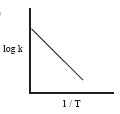
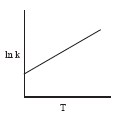
both (b) and (c)
23.
A zero order reaction X ⟶ Product, with an initial concentration 0.02M has a half life of 10 min. if one starts with concentration 0.04M, then the half life is
10 s
5 min
20 min
cannot be predicted using the given information
24.
For a first order reaction A ⟶ B the rate constant is x min−1. If the initial concentration of A is 0.01M, the concentration of A after one hour is given by the expression.
001. e−x
1 x 10⁻²(1-e-60x)
(1 x 10⁻²)e-60x
none of these
1.
\(k=\frac { 2.303 }{ t } log\frac { \left[ { A }_{ 0 } \right] }{ \left[ A \right] } \)
2.303 x 10⁻² hour-1 = \(\frac { 2.303 }{ 1806 min } log\frac { \left[ { 0.25 }_{ } \right] }{ \left[ A \right] } \)
\(=\left(\frac{2.303 \times 10^{-2} hour^{-1 }\times 1806 min}{2.303}\right) = \log \left(\frac{0.25}{A}\right) \)
\(=\left(\frac{ 1806 \times 10 ^{-2}}{60}\right) = \log \left(\frac{0.25}{A}\right) \)
\(= 0.301 = \log \left(\frac{0.25}{A}\right) \)
\(=\log2 = \log \left(\frac{0.25}{A}\right) \)
\(2 = \log \left(\frac{0.25}{A}\right) \)
\([A] = \log \left(\frac{0.25}{2}\right) = 0.125 M\)
2.
3.
\({ t }_{ 1/2 }=\frac { 0.6932 }{ k } \)
For a second order reaction
\(\mathrm{t}_{1 / 2}=\frac{2^{\mathrm{n}-1}-1}{(\mathrm{n}-1) \mathrm{k} \cdot\left[\mathrm{A}_{0}\right]^{\mathrm{n}-1}}\)
n = 2
\(\mathrm{t}_{1 / 2}=\frac{2^{\mathrm{2}-1}-1}{(\mathrm{n}-1) \mathrm{k} \cdot\left[\mathrm{A}_{0}\right]^{\mathrm{2}-1}}\)
\(\mathrm{t}_{1 / 2} =\frac{1}{ \mathrm{k}\left[\mathrm{A}_{0}\right]}\)
4.
In 140days ⇒ initial concentration reduced to (1/2) g
In 280 days ⇒ initial concentration reduced to (1/4) g
In 420 days ⇒ initial concentration reduced to (1/8) g
In 560 days ⇒ initial concentration reduced to (1/16) g
5.
t75% = 2t50%
t50% = (t75%/2) = (60/2) = 30 minutes
6.
| A | ⟶ | B | C | D | |
| Initial rate (M s-1) | a | 0 | 0 | 0 | |
| Reaction number | x | - | - | - | - |
| After time t | (a - x) | x | x | x | |
| Total number of moles | = (a + 2x) |
7.
t1/2 α \(\frac{1}{[A_{0}]^{n-1}}\)...(1)
If [A0 = 2[A0]; then t1/2 = 2t1/2
2t1/2 α \(\frac{1}{[2A_{0}]^{n-1}}\)...(2)
(2)/(1) = \(2= \frac{1}{[2A_{0}]^{n-1}} \times \frac{1}{[A_{0}]^{n-1}}\)
\(2= \frac {[2A_{0}]^{n-1}} {[A_{0}]^{n-1}}\)
\(2= \frac {1} {2}^{n-1}\)
2 = (2-1)n-1
21 = (2-n+1)
n = 0
8.
(d)
9.
Rate \(=\frac { d\left[ { N_2O_5 } \right] }{ dt } =\frac { 1 }{ 2 } =\frac { d\left[ { NO}_{ 2 } \right] }{ dt } =\frac { 2d\left[ { O }_{ 2 } \right] }{ dt } \)
Given that \(=\frac { d\left[ { N_2O_5 } \right] }{ dt } \) =6.5 x 10⁻² mol L-1 s-1
\(=\frac { d\left[ { NO}_{ 2 } \right] }{ dt }\) =2 x 6.5 x 10-2 = 1.3 x 10⁻¹ mol L-1 s-1
\(=\frac { d\left[ { O}_{ 2 } \right] }{ dt }\)\(=\frac{6.5 \times 10^{-2}}{2}\) = 3.25 x 10⁻² mol L-1s-1
10.
(a)
11.
rate1 = k[0.1]n [0.1]m ....(1)
rate2 = k[0.2]n [0.1]m ....(2)
(2) (1)
\(=\frac{2x}{x} = \frac{k[0.2]^n [0.1]^m}{k[0.1]^n [0.1]^m}\)
\(= \frac{2x}{x} = 2^n\)
n = 1
rate3 = k[0.1]n [0.2]m ....(3)
rate4 = k[0.2]n [0.2]m ....(4)
\(=\frac{8x}{2x} = \frac{k[0.2]^n [0.2]^m}{k[0.2]^n [0.1]^m}\)
= 8/2 = 2m
m = 2
rate = k[A] [B]2
12.
\(k=\frac { 1 }{ t } ln \frac { \left[ { A }_{ 0 } \right] }{ \left[ A \right] } \)
[A0] = 0.1: [A] = 0.05
\(k= \left[ \frac { 1 }{ t _{1/2}} \right] ln\left[ \frac { { 0.1 } }{ 0.05 }\right] \)
\(k= \left[ \frac { 1 }{ t _{1/2}} \right] ln (2)\)
t1/2 = In(2)/K
13.
\(k=\frac { 2.303 }{ t } \log\frac { \left[ { A }_{ 0 } \right] }{ \left[ A \right] } \)
[A0] = 100: [A] = 25
\(6.909=\frac { 2.303 }{ t } \log\frac { \left[ {100 } \right] }{ \left[ 25\right] } \)
\(t =\frac { 2.303 }{ 6.909 } \log(4)\)
\(t =\frac { 1 }{ 3 } \log(2^2)\)
\(= \left( \frac { 2 }{ 3 } \right) \log2\)
14.
T1= 200 K ; k = k1
T2 =400 K ; k1 = k2 = 2k1
log\(\frac {{ k }_{ 2 } }{ { k }_{ 1 } } =\frac { { E }_{ a } }{ 2.303R } \left[ \frac { { T }_{ 2 }-{ T }_{ 1 } }{ { T }_{ 1 }{ T }_{ 2 } } \right] \)
log \( [\frac {{2 k }_{ 1 } }{ { k }_{ 1 } }]\)
\(= \left[ \frac { E_{a} }{ 2.303\times 8.314 JK^{-1} mol^{-1} } \right] \)
\(= \left[ \frac { 400 k - 200K }{200 k \times 400 k } \right] \)
\(E_{a} = \frac{ 0.3010 \times 2.303 \times 8.314 JK^{-1}mol^{-1} \times 200K \times 400 K}{200 K}\)
Ea = 2305 J mol-1
Ea = 2.305 kJ mol-1
15.
16.
(rate constant K is equal to collision frequency A if Ea = 0)
In zero order reactions, increase in the concentration of reactant does not alter the rate.
So statement (i) is wrong.
\(k=A{ e }^{ -\left( \frac { { E }_{ a } }{ RT } \right) }\)
if Ea = 0 so, statement (ii) is correct, and statement (iii) is wrong
k = Ae0
k = A
In k = In A - \({ \left( \frac { { E }_{ a } }{ R } \right) }\) \(\left( \frac { 1 }{ T } \right) \)
This equation is of the form of a straight line y = mx+c
A plot of In k Vs \(\left( \frac { 1 }{ T } \right) \) gives a straight line with a negative slope
So statement (iv) and (v) are wrong.
17.
A catalyst provides a new path to the reaction with low activation energy. i.e., it lowers the activation energy.
18.
Rate = k[A]n
Rate = \(\frac{-\mathrm{d}[\mathrm{A}]}{\mathrm{dt}}\)
unit of rate = \(\frac{mol L^{-1}}{s}\)=mol L-1/s-1
unit of rate constant
\(=\frac{ (mol{ L }^{ -1 }{ S }^{ -1 }) }{ ({ mol }{ L }^{ -1 })^n } \)
= mol1-nLn-1s-1
in the case
rate = k [Acetone]3/2
n = 3/2
= mol1-(3/2)L(3/2)-1s-1
(mol-(1/2) L(1/2) s-1).
19.
Given:
At low pressure the reaction follows first order therefore,
Rate α [reactant]1
Rate α (surface area)
At high pressure due to the complete coverage of surface area, the reaction follows zero order.
Rate α [reactant]0
Therefore the rate is independent of surface area.
20.
\(Rate=\frac { -1 }{ 2 } \frac { d[NH_3] }{ dt } \)
\(\frac { -d\left[ { N }_{ 2 } \right] }{ dt } =\frac { 1 }{ 3 } \frac { d\left[ { H}_{ 2 } \right] }{ dt } \)
\(=\frac { 1 }{ 2 } { k_1\left[ { NH}_{ 3 } \right] } = { k_2 \left[ { NH}_{ 3 } \right] }=\frac { 1 }{ 3 } { k_3\left[ { NH}_{ 3 } \right] } \)
[3/2] k1 = 3k2 = k3
1.5k1 = 3k2 = k3
21.
For a first order reaction
t1/2 = \(\frac { 0.693 }{ { k }}\)
t1/2 does not depend on the initial concentration and it remains constant (whatever may be the initial concentration)
t1/2 = 2.5 hrs
22.
\(k=A{ e }^{ -\left( \frac { { E }_{ a } }{ RT } \right) }\)
In k = In A - \({ \left( \frac { { E }_{ a } }{ R } \right) }\) \(\left( \frac { 1 }{ T } \right) \)
This equation is of the form of a straight line y = mx+c
A plot of In k Vs \(\left( \frac { 1 }{ T } \right) \) gives a straight line with a negative slope.
23.
for n ≠ 1 t1/2 = \(\frac{2^{n-1} -1}{(n- 1) k[A_{0}]^{-1}}\)
for n = 0; t1/2 = \(\frac{1}{2 k[A_{0}]^{-1}}\)
t1/2 = \(\frac{[A_{0}]}{2 k}\)
t1/2 α [A0] ...(1)
Given [A0] = 0.002 M; t1/2 = 10 min
[A0] = 0.04M; t1/2 = ?
Substitute in (1)
10 min α 0.02 M...(2)
t1/2 α 0.04M ....(3)
(3)(2)
⇒ t1/2 / 10 min
= 0.04 M/0.02 M
t1/2 = 2 x 10 min = 20 min
24.
\(k=\frac { 2.303 }{ t } log\frac { \left[ { A }_{ 0 } \right] }{ \left[ A \right] } \)
\(k=\frac { 1 }{ t } ln \frac { \left[ { A }_{ 0 } \right] }{ \left[ A \right] } \)
\(e^{kt}=\frac { \left[ { A }_{ 0 } \right] }{ \left[ A \right] }\)
[A] = [A0] ekt
In this case
k = x min-1 and [A0] = 0.01 M = 1 x 10⁻²M
t = 1 hour = 60 min
[A] = (1 x 10⁻²)e-60x

12th Standard Syllabus & Materials
12th Standard
TN 12th Computer Applications வலையமைப்பு வடமிடல் Sample Question Papers Study Material - QB365 Set A
NEW12th Standard
TN 12th Computer Applications களப்பெயர் முறைமை (DNS) Sample Question Papers Study Material - QB365 Set A
NEW12th Standard
TN 12th Computer Applications வலையமைப்பு எடுத்துக்காட்டுகள் மற்றும் நெறிமுறைகள் Sample Question Papers Study Material - QB365 Set A
NEW12th Standard
TN 12th Computer Applications கணினி வலையமைப்பு ஓர் அறிமுகம் Sample Question Papers Study Material - QB365 Set A



Tamilnadu Stateboard 12th Standard Subjects

Maths
Chemistry

Physics

Biology

Computer Science

Business Maths and Statistics

Economics

Commerce

Accountancy

History

Computer Applications
Biology
Computer Technology
Computer Applications
Computer Science
Business Maths and Statistics
Commerce
Economics
Maths
Chemistry
Physics
Computer Technology
History
Accountancy

Tamil

English

French
Tamilnadu Stateboard Standards
