
 100% FREE ACCESS
12th Standard Syllabus & Materials
12th Standard
TN 12th Maths Applications of Matrices and Determinants Sample Question Papers Study Material - QB365 Set A
NEW12th Standard
TN 12th Computer Applications மின்னணு தரவு பரிமாற்றம் Sample Question Papers Study Material - QB365 Set A
NEW12th Standard
TN 12th Computer Applications மின் - வணிக பாதுகாப்பு அமைப்புகள் Sample Question Papers Study Material - QB365 Set A
NEW12th Standard
TN 12th Computer Applications மின்னணு செலுத்தல் முறைகள் Sample Question Papers Study Material - QB365 Set A
NEW12th Standard
TN 12th Computer Applications மின் - வணிகம் Sample Question Papers Study Material - QB365 Set A
NEW12th Standard
TN 12th Computer Applications திறந்த மூல கருத்துருக்கள் Sample Question Papers Study Material - QB365 Set A

Published on: 02/09/2022
QB365 provides a detailed and simple solution for every Possible Book Back Questions in Class 12 Chemistry Subject - Chemical Kinetics, English Medium. It will help Students to get more practice questions, Students can Practice these question papers in addition to score best marks.
Download Tamil Nadu 12th Standard Chemistry question papers, model tests, one-mark questions, important questions, and public exam papers in PDF format. Free study materials and answer keys for TN State Board students.
Questions + Answers key
Take MCQ Chemistry Test
1.
For the reaction 2x+y ⟶ L find the rate law from the following data.
| [x] (min) |
[y] (min) |
rate (ms-1) |
| 0.2 | 0.02 | 0.15 |
| 0.4 | 0.02 | 0.30 |
| 0.4 | 0.08 | 1.20 |
2.
Explain the effect of catalyst on reaction rate with an example.
3.
From the following data, show that the decomposition of hydrogen peroxide is a reaction of the first order:
| t(min) | 0 | 10 | 20 |
| V(ml) | 46.1 | 29.8 | 19.3 |
Where t is the time in minutes and V is the volume of standard KMnO4 solution required for titrating the same volume of the reaction mixture.
4.
Explain briefly the collision theory of bimolecular reactions.
5.
Rate constant k of a reaction varies with temperature T according to the following Arrhenius equation \(\log K=\log A-\frac { { E }_{ a } }{ 2.303R } \left( \frac { 1 }{ T } \right) \)Where Ea is the activation energy. When a graph is plotted for log k Vs \(\frac{1}{T}\) a straight line with a slope of -4000K is obtained. Calculate the activation energy.
6.
The rate of the reaction X + 2y→ product is 4 x 10⁻³ mol L-1S-1, if [X] = [Y] = 0.2M and rate constant at 400K is 2 x 10⁻²s-1, What is the overall order of the reaction.
7.
What is the order with respect to each of the reactant and overall order of the following reactions?
a) 5Br-(aq)+BrO3-(aq)+6H+(aq) ➝3Br2(l)+3H2O(l)
The experimental rate law is Rate = k [Br−][BrO3−][H+]2
b) CH3CHO(g)\(\overset { \Delta }{ \longrightarrow } \) CH4(g)+CO(g) the experimental rate law is
Rate =K[CH3CHO]\(\frac{3}{2}\)
8.
Consider the oxidation of nitric oxide to form NO2
2NO(g) + O2(g) ➝2NO2(g)
(a). Express the rate of the reaction in terms of changes in the concentration of NO,O2 and NO2.
(b). At a particular instant, when [O2] is decreasing at 0.2 mol L−1s−1 at what rate is [NO2] increasing at that instant?
9.
The activation energy of a reaction is 22.5 k Cal mol-1 and the value of rate constant at 40°C is 1.8 x 10⁻⁵s-1. Calculate the frequency factor, A.
10.
A zero order reaction is 20% complete in 20 minutes. Calculate the value of the rate constant. In what time will the reaction be 80% complete?
11.
A gas phase reaction has energy of activation 200 kJ mol-1. If the frequency factor of the reaction is 1.6 x 10¹³s-1. Calculate the rate constant at 600 K.(e-40.09 = 3.8 x 10-48)
12.
The decomposition of Cl2O7 at 500K in the gas phase to Cl2 and O2 is a first order reaction. After 1 minute at 500K, the pressure of Cl2O7 falls from 0.08 to 0.04 atm. Calculate the rate constant in s-1
13.
Write Arrhenius equation and explains the terms involved.
1.
Reaction Rate = k[x]n [y]n
0.15 = k[0.2]n [0.02]m ...(1)
0.30 = k[0.4]n [0.02]m ...(2)
1.20 = k[0.4]n [0.08]m ...(3)
eqn(3) \(\div\) eqn(2)
\(\Rightarrow\)\(\frac { 1.2 }{ 0.3 } =\frac { k{ \left[ 0.4 \right] }^{ n }{ \left[ 0.08 \right] }^{ m } }{ k{ \left[ 0.4 \right] }^{ n }{ \left[ 0.02 \right] }^{ m } } \)
\(4={ \left( \frac { \left[ 0.08 \right] }{ \left[ 0.02 \right] } \right) }^{ m }\)
\(4^1={ \left( 4 \right) }^{ m }\)
\(m=1\)
eqn(2) \(\div\) eqn(1), \(\frac{0.30}{0.15}=\frac{\mathrm{k}[0.4]^{\mathrm{n}}[0.02]^{\mathrm{m}}}{\mathrm{k}[0.2]^{\mathrm{n}}[0.02]^{\mathrm{m}}}\)
\( 2={ \left( \frac { \left[ 0.4 \right] }{ \left[ 0.2 \right] } \right) }^{ n}\)
\(2^1= 2 ^{ n }\)
\(\therefore n=1\)
Rate = \(k{ \left[ x \right] }^{ 1 }{ \left[ y \right] }^{ 1 }\)
\(0.15=k{ \left[ 0.1 \right] }^{ 1 }{ \left[ 0.02 \right] }^{ 1 }\)
\(\frac { 0.15 }{ { \left[ 0.2 \right] }^{ 1 }{ \left[ 0.02 \right] }^{ 1 } } =k\)
k = 37.5 mol−1L s−1
2.
(i) A catalyst is substance which alters the rate of a reaction without itself undergoing any permanent chemical change. They may participate in the reaction, but again regenerated and the end of the reaction. In the presence of a catalyst, the energy of activation is lowered and hence, greater number of molecules can cross the energy barrier and change over to products, thereby increasing the rate of the reaction.
(ii) The reaction between KMnO4 and H2SO4 and oxalic acid is catalysed by MnSO4 and increases the rate of oxidation of C2O42- by MnO4-.
3.
Volume of KMnO4 used is proportional to the amount of H2O2 present. If the reaction is of first order, it must obey the equation.
\(k=\frac { 2.303 }{ t } log\frac { \left[ { A } \right] _{ 0 }}{ \left[ A \right] } \)
(or) \(k=\left( \frac { 2.303 }{ t } \right) log\left( \frac { { V }_{ 0 } }{ { V }_{ 1 } } \right) \)
(i) \( \mathrm{V}_{\mathrm{o}}=46.1 \mathrm{~mL} ; \mathrm{t}=10 \mathrm{mins} ; \mathrm{V}_{\mathrm{t}}=29.8 \mathrm{~mL}\)
\(k =\frac{2.303}{10} \log \left(\frac{46.1}{29.8}\right) \)
\(=0.2303 \log 1.5469 \)
\(=0.2303 \times 0.1894=0.0436 \mathrm{~min}^{-1}\)
\(\mathrm{t}=20 \mathrm{mins} ; \mathrm{V}_{\mathrm{t}}=19.3 ; \mathrm{V}_{\mathrm{o}}=46.1 \mathrm{~mL} \)
\(k =\frac{2.303}{20} \log \left(\frac{46.1}{19.3}\right) \)
\(=0.11515 \times \log 2.388 \)
\(=0.11515 \times 0.3780 \)
\(=0.0435 \mathrm{~min}^{-1}\)
Since the value of k comes out to be almost constant for the reaction, it is of first order. The mean value of k = 0.04355 min-1
4.
(i) Collision theory is based on the kinetic theory of gases. According to this theory, a chemical reaction occurs as a result of collisions between the reacting molecules.
(ii) Let us understand this theory by considering the following reaction.
A2(g) + B2(g) ⟶ 2AB(g)
(iii) If we consider that, the reaction between A2 and B2 molecules proceeds through collisions between them, then the rate would be proportional to the number of collisions per second.
(iv) Rate ∝ number of molecules colliding per litre per second (collision rate).
(v) The number of collisions is directly proportional to the concentration of both A2 and B2.
Collison rate ∝ [A2][B2]
Collision rate = Z [A2][B2]
(vi) Where, Z is a constant
(vii) A fraction of effective collisions (f) is given by the following expression
\(f={ e }^{ \frac { { -E }_{ a } }{ RT } }\)
(xiv) This fraction of collisions is further reduced due to orientation factor i.e., even if the reactant collides with sufficient energy, they will not react unless the orientation of the reactant molecules is suitable for the formation of the transition state.
(viii) The diagram illustrates the importance of proper alignment of molecules which leads to reaction.
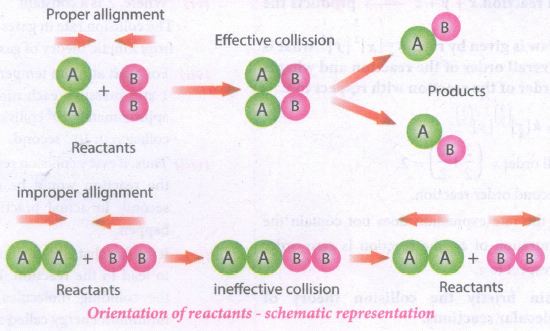
(ix) The fraction of effective collisions (f) having proper orientation is given by the steric factor p.
⇒ Rate = p x f x collision rate
\(\Rightarrow Rate=p\times { e }^{ \frac { -Ea }{ RT } }\times Z\left[ { A }_{ 2 } \right] \left[ { B }_{ 2 } \right] \quad ...(1)\)
As per the rate law,
Rate = \(k=\left[ { A }_{ 2 } \right] \left[ { B }_{ 2 } \right] \quad ...(2)\)
Where k is the rate constant
On comparing equation (1) and (2), the rate constant k is
\(k=pZ{ e }^{ \frac { -Ea }{ RT } }\)
5.
\(\log K=\log A-\frac { { E }_{ a } }{ 2.303R } \left( \frac { 1 }{ T } \right) \)
y = c + mx
\(m=-\frac { { E }_{ a } }{ 2.303R } \)
Ea = -2.303 Rm
Ea = -2.303 x 8.314 x (-4000)
Ea = 76,589J mol-1
Ea = 76.589 KJ mol-1
6.
Rate = K[X]n[y]m
4 x 10⁻³ mol L-1s-1= 2 x 10⁻²s-1(0.2mol L-1)n(0.2mol L-1)m
\(\frac { 4\times { 10 }^{ -3 }mol\quad { L }^{ -1 }{ s }^{ -1 } }{ 2\times { 10 }^{ -2 }{ s }^{ -1 } } =\) (0.2)n+m(mol L-1)n+m
0.2(mol L-1) = (0.2)n+m(mol L-1)n+m
Comparing the powers on both sides
The overall order of the reaction n + m = 1
7.
a) First order with respect to Br−, first order with respect to BrO3− and second order with respect to H+. Hence the overall order of the reaction is equal to 1 + 1 + 2 = 4
b) Order of the reaction with respect to acetaldehyde is \(\frac{3}{2}\) and overall order is also \(\frac{3}{2}\)
8.
a) \(Rate=\frac { -1 }{ 2 } \frac { d[NO] }{ dt } =\frac { -d[{ O }_{ 2 }] }{ dt } =\frac { 1 }{ 2 } \frac { d\left[ { NO }_{ 2 } \right] }{ dt } \)
b) \(\frac { -d\left[ { O }_{ 2 } \right] }{ dt } =\frac { 1 }{ 2 } \frac { d\left[ { NO }_{ 2 } \right] }{ dt } \)
\(\frac { d[{ NO }_{ 2 }] }{ dt } =2 \times\left( \frac { -d\left[ { O }_{ 2 } \right] }{ dt } \right) =2\times 0.2 \ { mol \ L }^{ -1 }{ s }^{ -1 }\)
= 0.4 mol L-1s-1
9.
\(\mathrm{k}=\mathrm{Ae}^{-\mathrm{E}_{\mathrm{a}} / \mathrm{RT}}\)
\(\log \mathrm{k}=\frac{-\mathrm{E}_{\mathrm{a}}}{2.303 \mathrm{RT}}+\log \mathrm{A} \text { (or) } \log \mathrm{A}=\log \mathrm{k}+\frac{\mathrm{E}_{\mathrm{a}}}{2.303 \mathrm{RT}}\)
\(\mathrm{k}=1.8 \times 10^{-5} \mathrm{~s}^{-1} ;\)
\(\mathrm{Ea}=22.5 \mathrm{k} \mathrm{Cal} \mathrm{mol}^{-1}=22500 \mathrm{Cal} \mathrm{mol}^{-1} \)
\(\log A=\log \left(1.8 \times 10^{-5}\right)+\frac{22500}{2.303 \times 1.987 \times 313} \)
\(=\log 1.8-5 \log {10}+15.71 \)
\(=0.2553-5+15.71 \)
\(\log A=10.9653 \)
\(A=\text { Antilog } 10.9653 \)
\(=9.232 \times 10^{10} \text { collisions } \mathrm{s}^{-1} \text {. }\)
10.
(i) Let A = 100M, [A0] - [A] = 20M,
For the zero order reaction
\(k=\left( \frac { \left[ { A }_{ 0 } \right] -\left[ A \right] }{ t } \right) \)
(i) 20% completion \(k=\left( \frac { 20M }{ 20min } \right) \) = 1 mol L-1 min-1
(ii) 80% completion
\(\mathrm{K}=1 \mathrm{~mol} \mathrm{~L}{ }^{-1} \mathrm{~s}^{-1} ;\left[\mathrm{A}_{0}\right]=100 \mathrm{M} ;\left[\mathrm{A}_{0}\right]-[\mathrm{A}]=80 \mathrm{M} ; \mathrm{t}=?\)
\(\therefore t=\left(\frac{\left[A_{O}\right]-[A]}{K}\right)=\frac{80}{1}=80 \mathrm{mins}\)
11.
Ea = 200 kJ mol-1=200 \(\times\) 103J mol-1
A = 1.6 \(\times\) 1013s-1; T = 600 K; R = 8.314 JK mol-1
\(k=A{ e }^{ -\left( \frac { Ea }{ RT } \right) }\)
\(k=1.6\times { 10 }^{ 13 }{ s }^{ -1 }{ e }^{ -\left( \frac { 200\times 10^3}{ 8.314 \times 600 } \right) }\)
\(k=1.6\times { 10 }^{ 13 }{ s }^{ -1 }{ e }^{ -\left( 40.09 \right) }\)
\(k=1.6\times { 10 }^{ 13 }\times 3.8\times { 10 }^{ -18 }{ s }^{ -1 }\)
\(k=6.08\times { 10 }^{ -5 }{ s }^{ -1 }\)
12.
For the first order reaction
\(\mathrm{k}=\frac{2.303}{\mathrm{t}} \log \frac{\mathrm{A}_{\mathrm{o}}}{\mathrm{A}}\) (or)
\(\mathrm{k} =\frac{2.303}{t} \log \frac{P_o}{P_t} \)
Here, Po=0.08 atm (Pt)=0.04 atm; t = 60 s
\(\mathrm{k}=\frac{2.303}{60} \log \frac{[0.08]}{[0.04]}\)
\(=0.0383 \times \log 2 \)
\(=0.0383 \times 0.3010 \)
\(=1.152 \times 10^{-2} \mathrm{~s}^{-1}\)
13.
Arrhenius equation is,
\(k=Ae^\left ({ \frac { -Ea }{ RT } } \right )\)
Here,
A \(\rightarrow\) Frequency factor
Ea \(\rightarrow\) Activation energy of the reaction
R \(\rightarrow\) Gas constant
T \(\rightarrow\) Absolute temperature (in K)

12th Standard Syllabus & Materials
12th Standard
TN 12th Computer Applications வலையமைப்பு வடமிடல் Sample Question Papers Study Material - QB365 Set A
NEW12th Standard
TN 12th Computer Applications களப்பெயர் முறைமை (DNS) Sample Question Papers Study Material - QB365 Set A
NEW12th Standard
TN 12th Computer Applications வலையமைப்பு எடுத்துக்காட்டுகள் மற்றும் நெறிமுறைகள் Sample Question Papers Study Material - QB365 Set A
NEW12th Standard
TN 12th Computer Applications கணினி வலையமைப்பு ஓர் அறிமுகம் Sample Question Papers Study Material - QB365 Set A



Tamilnadu Stateboard 12th Standard Subjects

Maths
Chemistry

Physics

Biology

Computer Science

Business Maths and Statistics

Economics

Commerce

Accountancy

History

Computer Applications
Biology
Computer Technology
Computer Applications
Computer Science
Business Maths and Statistics
Commerce
Economics
Maths
Chemistry
Physics
Computer Technology
History
Accountancy

Tamil

English

French
Tamilnadu Stateboard Standards
