
 100% FREE ACCESS
12th Standard Syllabus & Materials
12th Standard
TN 12th Computer Applications மின்னணு தரவு பரிமாற்றம் Sample Question Papers Study Material - QB365 Set A
NEW12th Standard
TN 12th Computer Applications மின் - வணிக பாதுகாப்பு அமைப்புகள் Sample Question Papers Study Material - QB365 Set A
NEW12th Standard
TN 12th Computer Applications மின்னணு செலுத்தல் முறைகள் Sample Question Papers Study Material - QB365 Set A
NEW12th Standard
TN 12th Computer Applications மின் - வணிகம் Sample Question Papers Study Material - QB365 Set A
NEW12th Standard
TN 12th Computer Applications திறந்த மூல கருத்துருக்கள் Sample Question Papers Study Material - QB365 Set A
NEW12th Standard
TN 12th Computer Applications வலையமைப்பு வடமிடல் Sample Question Papers Study Material - QB365 Set A

Published on: 28/01/2021
12th Standard Chemistry English Medium Chemical Kinetics Reduced Syllabus Important Questions 2021
Download Tamil Nadu 12th Standard Chemistry question papers, model tests, one-mark questions, important questions, and public exam papers in PDF format. Free study materials and answer keys for TN State Board students.
Questions + Answers key
Take MCQ Chemistry Test
1.
If [A] is the concentration of A at any time t and [Ao] is the concentration at t = 0, then for the first order reaction, the rate equation can be written as ______.
\(k=\frac { 2.303 }{ t } \log { \left[ \frac { A }{ { A }_{ 0 } } \right] } \)
\({ k }_{ t }=2.303\log { \left[ \frac { { A }_{ 0 } }{ \left[ A \right] } \right] } \)
\(k=2.303\log { \left[ \frac { { A }_{ 0 } }{ \left[ { A }_{ 0 } \right] -\left[ A \right] } \right] } \)
\(k=\frac { 2.303 }{ t } \log { \left[ \frac { { A }_{ 0 } }{ { A } } \right] } \)
2.
The time required for 50% completion of the reaction is known as _______.
Average life period
Half-life period
Rate
None of these
3.
The minimum energy that all colliding molecules must possess so as to make the collisions more effective and successful is_______.
activation energy
colliding energy
threshold energy
kinetic energy
4.
For a reaction 2A + B ⟶ 3C, express the rate of reaction in terms of formation of the product _______.
\(\frac { 1 }{ 2 } \frac { d\left[ A \right] }{ dt } \)
\(\frac { -1 }{ 3 } \frac { d\left[ C \right] }{ dt } \)
\(\frac { 1 }{ 3 } \frac { d\left[ C \right] }{ dt } \)
\(\frac { -1 }{ 2 } \frac { d\left[ B \right] }{ dt } \)
5.
By the order of reaction we mean _______.
the sum of powers to which the concentration terms are raised in the rate equation
the number of reactants take part in the reaction
the number of concentration terms in the velocity equation for the reaction
the least number of product molecule needed for the reaction
6.
The value of rate constant of a pseudo first order reaction______.
Independent on the concentration of reactants present in small amount
Depends on the concentration of reactants present in excess
Independent of the concentration of reactants
Depends only on temperature.
7.
Rate law cannot be determined from balanced chemical equation if ______.
Reverse reactions is not involved
It is an elementary reaction
It is a sequence of elementary reactions
All of the reactants is in excess. Rate law can be determined from balanced chemical equation if it is an elementary reaction.
8.
If the activation energy is high then the rate of the reaction is _____.
high
moderate
low
cannot be predicted
9.
The half life period of a first order reaction is 10 minutes. Then its rate constant is _____.
6.93 x 10² min-1
0.693 x 10⁻² min-1
6.932 x 10⁻² min-1
69.3 x 10⁻¹ min-1
10.
During a chemical reaction, the concentration of reaction _____.
increases
decreases
remains constant
first increases and then decreases
11.
For an exothermic chemical process occurring in 2 steps as
(i) A +B ⟶ X (slow) ;
(ii) X ⟶ AB (fast)
The progress of the reaction can be best described by (x- intermediate).
.JPG)
.JPG)
.JPG)
None of these
12.
Which of the following statement is not correct?
Molecularity of a reaction cannot be fractional
Molecularity of a reaction cannot be more than three
Molecularity of a reaction can be zero
Molecularity is assigned for each elementary step of mechanism.
13.
Consider the following statements:
(i) increase in concentration of the reactant increases the rate of a zero order reaction.
(ii) rate constant k is equal to collision frequency A if Ea = 0
(iii) rate constant k is equal to collision frequency A if Ea = ∞
(iv) a plot of ln (k) vs T is a straight line.
(v) a plot of ln (k) vs \(\left( \frac { 1 }{ T } \right) \) is a straight line with a positive slope.
Correct statements are
(ii) only
(ii) and (iv)
(ii) and (v)
(i), (ii) and (v)
14.
The addition of a catalyst during a chemical reaction alters which of the following quantities?
Enthalpy
Activation energy
Entropy
Internal energy
15.
For a first order reaction A ⟶ B the rate constant is x min−1. If the initial concentration of A is 0.01M, the concentration of A after one hour is given by the expression.
001. e−x
1 x 10⁻²(1-e-60x)
(1 x 10⁻²)e-60x
none of these
16.
Show that in case of first order reaction, the time required for 99.9% completion is nearly ten times the time required for half completion of the reaction.
17.
Rate constant of a first order reaction is 0.45 sec-1, calculate its half life.
18.
A reaction is first order in A and second order in B.
(i) Write the differential rate equation.
(ii) How is rate affected on increasing the concentration of B three times?
(iii) How is the rate affected when the concentrations of both A and B are doubled?
19.
A reaction is second order with respect to a reactant. How is the rate of reaction affected if the concentration of the reactant is
(i) doubled (ii) reduced to half
20.
A first order reaction is found to have a rate A constant k = 7.39 x 10⁻⁵ S-1. Find the half life of this reaction.
21.
The rate constant, the activation energy and frequency factor of a chemical reaction at 25oC are 3.0 x 10⁻⁴ S-1; 104.4 kJ mol-1 and 6.0 x 10¹⁴ S-1 respectively. What is the value of the rate constant when T ⟶ ∞?
22.
(i) Molecularity of any reaction is not equal to zero. Why?
(ii) For which type of reactions, order, and molecularity have the same value?
23.
The rate law for a reaction of A, B and C has been found to be rate = k[A]2[B][L]3/2 How would the rate of reaction change when
(i) Concentration of [L] is quadrupled
(ii) Concentration of both [A] and [B] are doubled
(iii) Concentration of [A] is halved
(iv) Concentration of [A] is reduced to \(\left(\frac{1}{3}\right)\) and concentration of [L] is quadrupled.
24.
Describe the graphical representation of first order reaction.
25.
Define average rate and instantaneous rate.
26.
The specific reaction rates of a chemical reaction are 2.45 x 10⁻⁵ sec-1 at 273 K and 16.2 x 10⁻⁴ sec-1 at 303 K. Calculate the activation energy.
27.
The conversion of molecules x to y follows second order kinetics. Its concentration of x is increased to three times how will it affect the rate of formation of y?
For the reaction x ➝ y as it follows second order kinetics wherefore the rate of formation of y?
28.
Write an account of the Arrhenius equation for rates of chemical reactions.
29.
In a pseudo first order hydrolysis of ester in water, the following results were obtained.
| 1 | 0 | 30 | 60 | 90 |
|---|---|---|---|---|
| [Ester]mol L-1 | 0.55 | 0.31 | 0.17 | 0.085 |
(i) Calculate the average rate of reaction between the time interval 30 to 60 seconds.
(i) Calculate the pseudo first order rate constant for the hydrolysis of ester.
30.
Explain briefly the collision theory of bimolecular reactions.
31.
What is an elementary reaction? Give the differences between order and molecularity of a reaction.
32.
The rate of the reaction X + 2y→ product is 4 x 10⁻³ mol L-1S-1, if [X] = [Y] = 0.2M and rate constant at 400K is 2 x 10⁻²s-1, What is the overall order of the reaction.
33.
Consider the oxidation of nitric oxide to form NO2
2NO(g) + O2(g) ➝2NO2(g)
(a). Express the rate of the reaction in terms of changes in the concentration of NO,O2 and NO2.
(b). At a particular instant, when [O2] is decreasing at 0.2 mol L−1s−1 at what rate is [NO2] increasing at that instant?
34.
How does the value of rate constant vary with reactant constant.
35.
The decomposition reaction of ammonia gas on platinum surface has a rate constant R = 2.5 x 10⁻⁴mol L-1. What is the order of the reaction.
36.
Why is instantaneous rate preferred over average rate?
37.
What is the study of chemical kinetics used for?
38.
A zero order reaction is 20% complete in 20 minutes. Calculate the value of the rate constant. In what time will the reaction be 80% complete?
39.
40.
Identify the order for the following reactions
(i) Rusting of Iron
(ii) Radioactive disintegration of 92U238
(iii) 2A+3B⟶ products ;rate = k[A]1/2[B]2
41.
The decomposition of Cl2O7 at 500K in the gas phase to Cl2 and O2 is a first order reaction. After 1 minute at 500K, the pressure of Cl2O7 falls from 0.08 to 0.04 atm. Calculate the rate constant in s-1
42.
For a reaction x + y + z\(\longrightarrow \) products the rate law is given by rate =k[x]3/2[y]1/2. What is the overall order of the reaction and what is the order of the reaction with respect to z.
1.
(b)
\({ k }_{ t }=2.303\log { \left[ \frac { { A }_{ 0 } }{ \left[ A \right] } \right] } \)
2.
(b)
Half-life period
3.
(c)
threshold energy
4.
(c)
\(\frac { 1 }{ 3 } \frac { d\left[ C \right] }{ dt } \)
5.
(a)
the sum of powers to which the concentration terms are raised in the rate equation
6.
(b)
Depends on the concentration of reactants present in excess
7.
(c)
It is a sequence of elementary reactions
8.
(c)
low
9.
(c)
6.932 x 10⁻² min-1
10.
(b)
decreases
11.
(c)
12.
(c)
Molecularity of a reaction can be zero
13.
(rate constant K is equal to collision frequency A if Ea = 0)
In zero order reactions, increase in the concentration of reactant does not alter the rate.
So statement (i) is wrong.
\(k=A{ e }^{ -\left( \frac { { E }_{ a } }{ RT } \right) }\)
if Ea = 0 so, statement (ii) is correct, and statement (iii) is wrong
k = Ae0
k = A
In k = In A - \({ \left( \frac { { E }_{ a } }{ R } \right) }\) \(\left( \frac { 1 }{ T } \right) \)
This equation is of the form of a straight line y = mx+c
A plot of In k Vs \(\left( \frac { 1 }{ T } \right) \) gives a straight line with a negative slope
So statement (iv) and (v) are wrong.
14.
A catalyst provides a new path to the reaction with low activation energy. i.e., it lowers the activation energy.
15.
\(k=\frac { 2.303 }{ t } log\frac { \left[ { A }_{ 0 } \right] }{ \left[ A \right] } \)
\(k=\frac { 1 }{ t } ln \frac { \left[ { A }_{ 0 } \right] }{ \left[ A \right] } \)
\(e^{kt}=\frac { \left[ { A }_{ 0 } \right] }{ \left[ A \right] }\)
[A] = [A0] ekt
In this case
k = x min-1 and [A0] = 0.01 M = 1 x 10⁻²M
t = 1 hour = 60 min
[A] = (1 x 10⁻²)e-60x
16.
Let [A0] = 100;
When t = t99.9%; [A] = (100-99.9) = 0.1
\(k=\frac { 2.303 }{ t } \log\left( \frac { [{ A }_{ 0 }] }{ [A] } \right) \)
\({ t }_{ 99.9\% }=\frac { 2.303 }{ K } \log\left( \frac { 100 }{ 0.1 } \right) \)
\({ t }_{ 99.9\% }=\frac { 2.303 }{ K } \log1000\)
\({ t }_{ 99.9\% }=\frac { 2.303 }{ K } (3)\)
\({ t }_{ 99.9\% }=\frac { 6.909 }{ K } \)
\({ t }_{ 99.9\% }=10\times \frac { 0.69 }{ K } \)
\({ t }_{ 99.9\% }={ 10 } t_{ 1/2 }\)
17.
Given data: Rate constant of a first order reaction (k) = 0.45 sec-1
Formula: \({ t }_{ \frac { 1 }{ 2 } }=\frac { 0.693 }{ k } \)
Solution: \({ t }_{ \frac { 1 }{ 2 } }=\frac { 0.693 }{ k } =\frac { 0.693 }{ 0.45 } \)
Half-life period = 1.54 sec.
18.
(i) The differential rate equation will be
\(\frac { -d\left[ R \right] }{ dt } \) = k[A][B]2
(ii) if the concentration of B is increased three times, then
\(\frac { -d\left[ R \right] }{ dt } \) = k[A] [3B]2
= 9.k [A] [3B]2
∴ The rate of reaction will increase 9 times.
(iii) When the concentrations of both A and B are doubled
\(\frac { -d\left[ R \right] }{ dt } \) =k [A] [B]2
= k [2A] [2B]2
= 8.k [A] [B]2
∴ The rate of reaction will increase 8 times.
19.
Let the concentration of the reactant be [A] = a
Rate of reaction R = k [A]2
R=ka2
(i) R = k (2a)2
= 4 ka2
= 4R
∴ The rate of the reaction would increase by 4 times.
(ii) If the concentration of the reactant is reduced to half [A] = \(\frac { 1 }{ 2 } \) a than the rate of reaction would be
\(R=k\left( \frac { 1 }{ 2 } a \right) 2\)
\(=\frac { 1 }{ 4 } k{ a }^{ 2 }\)
\(=\frac { 1 }{ 4 } kR\)
∴ The rate of the reaction would reduced by \({ \frac { 1 }{ 4 } }^{ th }\)
20.
For first order reaction
\(k=\frac { 2.303 }{ t } \log { \frac { a }{ a-x } } \)
For t = t1/2, \(x=\frac { a }{ 2 } \)
\({ t }_{ \frac { 1 }{ 2 } }=\frac { 2.303 }{ k } \log { \frac { a }{ a-\frac { a }{ 2 } } } \)
\(\frac { 2.303 }{ k } \log2=\frac { 2.303\times 0.3010 }{ 7.39\times { 10 }^{ -5 } } \)
= 9.38 x 10³ s.
21.
Formula:
k1 = A.e-Ea/RT
Given:
Rate constant, k1 - 3.0 x 10⁻⁴ s-1
Frequency factor, A = 6.0 x 10¹⁴ s-1
Activation energy, Ea = 104.4 kJ
= 104400 J
Temperatures, T1 = 25o C; T2 =∞
Solution:
\({ k }_{ 2 }=A.{ e }^{ -\frac { { E }_{ a } }{ RT } }\)
k2 = 6.0 x 10¹⁴ x \(\frac { 104400 }{ { e }^{ 8.314\times \infty } } \)
k2 = 6.0 x 1014 x 1 \(\left( \therefore e\frac { -{ { E }_{ a } } }{ R\infty } =1 \right) \)
∴ The rate constant at T ⟶ ∞ is 6.0 x 10¹⁴ s-1
22.
(i) (a) Molecularity of the reaction is the number of molecules taking part in an elementary step.
(b) For this we require at least a single molecule leading to the value of minimum molecularity of one.
(c) Hence, molecularity of any reaction can never be equal to zero.
(ii) For elementary reaction, (i.e) the reaction which proceeds in a single step, order, and molecularity have the same value.
23.
(i) Reaction Rate = \(k{ \left[ A \right] }^{ 2 }{ \left[ B \right] }{ \left[ L \right] }^{ 3/2 }\) ...(1)
When [L] = [4L]
Rate = \(k{ \left[ A \right] }^{ 2 }{ \left[ B \right] }{ \left[ 4L \right] }^{ 3/2 }\)
The Reaction Rate = \(8(k{ \left[ A \right] }^{ 2 }{ \left[ B \right] }{ \left[ L \right] }^{ 3/2 })\) ...(2)
Comparing (1) and (2) rate is increased by 8 times
(ii) [A] = [2A] and [B] = [2B]
Reaction Rate = \(k{ \left[ 2A \right] }^{ 2 }\left[ 2B \right] { \left[ L \right] }^{ 3/2 }\)
Reaction Rate = \(\\ 8(k{ \left[ A \right] }^{ 2 }{ \left[ B \right] }{ \left[ L \right] }^{ 3/2 })\) ...(3)
Comparing (1) and (3) rate is increased by 8 times
(iii) \(\left[ A \right] =\left[ \frac { A }{ 2 } \right] \)
Reaction Rate = \(k{ \left[ \frac { A }{ 2 } \right] }^{ 2 }{ \left[ B \right] }{ \left[ L \right] }^{ 3/2 }\)
Reaction Rate = \(\frac { 1 }{ 4 } \left( k\left[ { A }^{ 2 } \right] { \left[ B \right] }{ \left[ L \right] }^{ 3/2 } \right) \) ...(4)
Comparing (1) and (4); rate is reduced to (1/4) times.
(iv) \(\left[ A \right] =\left[ \frac { 1 }{ 3 }A \right] and\left[ L \right] =\left[ 4L \right] \)
Rate = \(k{ \left[ \frac { 1 }{ 3 }A \right] }^{ 2 }{ \left[ B \right] }{ \left[ 4L \right] }^{ 3/2 }\)
Rate = \(\left( \frac { 8 }{ 9 } \right) \left( k{ \left[ A \right] }^{ 2 }{ \left[ B \right] }{ \left[ L \right] }^{ 3/2 } \right)\) ...(5)
Comparing (1) and (5); rate is reduced to \(\frac { 8 }{ 9 } \) times.
24.
A Reaction whose rate depends on the reactant concentration raised to the first power is called a first order reaction. For a first order reaction,
A ⟶ product
Rate law can be expressed as
Rate = k[A]-1
\(\frac { -d\left[ A \right] }{ \left[ A \right] } =k dt\) ...(1)
Integrate the above equation between the limits of time t = 0 and time equal to t, while the concentration varies from the initial: concentration [Ao] to [A] at the later time.
\(\int _{ { [A }_{ 0 }] }^{ [A] }{ \frac { -d\left[ A \right] }{ \left[ A \right] } } =k\int _{ 0 }^{ t }{ dt } \)
\({ \left( -In\left[ A \right] \right) }_{ \left[ { A }_{ 0 } \right] }^{ \left[ A \right] }=k{ \left( t \right) }_{ 0 }^{ t }\)
\(-In\left[ A \right] -\left( In\left[ { A }_{ 0 } \right] \right) =k\left( t-0 \right) \)
\(-In\left[ A \right] -\left( In\left[ { A }_{ 0 } \right] \right) =kt\)
\(In\left( \frac { \left[ { A }_{ 0 } \right] }{ \left[ A \right] } \right) =kt\) ...(2)
This equation is in natural logarithm. To convert it into usual logarithm with base 10, we have to multiply the term by 2.303.
\(2.303\quad log\left( \frac { \left[ { A }_{ 0 } \right] }{ \left[ A \right] } \right) =kt\)
\(k=\frac { 2.303 }{ t } log\left( \frac { \left[ { A }_{ 0 } \right] }{ \left[ A \right] } \right) \) ...(3)
Equation (2) can be written in the form
y = mx+c as below
In [A0]-In[A] = kt
In[A] = In[A0]-kt
⇒ y = c + mx
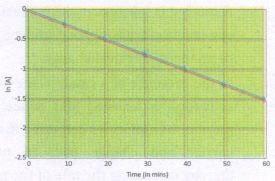
If we follow the reaction by measuring the concentration of the reactants at regular time interval 't' a plot of In[A] against 't' yields a straight line with a negative slope. From this, the rate constant is calculated.
25.
Average rate of reaction:
The average rate is defined as the ratio of change in the final concentration of reactants and the initial concentration of reactants over the entire time period of reaction.
Average rate=\(\frac{-[Final \space concentration \space of \space reactants - Initial \space concentration \space of \space reactants}{(Change \space in \space time)}\)
R \(=\frac{-\left(\left[A_{2}\right]-\left[A_{1}\right]\right)}{\left(t_{2}-t_{1}\right)}=-\left(\frac{\Delta[A]}{\Delta t}\right)\)
[A]1 = Concentration of reactant A1 at time t1
[A]2 = Concentration of reactant A2 at time t2
Instantaneous rate of reaction:
The rate of reaction at any particular instant during the course of reaction is called as instantaneous rate.
Instantaneous rate \(=(\text { Average rate })_{\Delta t \rightarrow 0}\)
Rate of the reaction \(=\left(\frac{-\Delta \mathrm{A}}{\Delta \mathrm{t}}\right)\)
26.
Given data:
k1 = 2.45 x 10⁻⁵ sec-1; T1 = 273 K
k2 = 16.2 x 10⁻⁴ sec-1; T2 = 303 K
R = 8.314 JK-1 mol-1
Formula: \(\log { \frac { { k }_{ 2 } }{ { k }_{ 1 } } } =\frac { { E }_{ a } }{ 2.303R } \left[ \frac { { T }_{ 2 }-{ T }_{ 1 } }{ { T }_{ 1 }{ T }_{ 2 } } \right] \)
Solution:
\(\log { \frac { 16.2\times { 10 }^{ -4 } }{ 2.45\times { 10 }^{ -5 } } } =\frac { { E }_{ a } }{ 2.303\times 8.314 } \left( \frac { 303-273 }{ 273\times 303 } \right) \)
\(1.8203=\frac { { E }_{ a } }{ 2.303\times 8.314 } \times \left[ \frac { 30 }{ 273\times 303 } \right] \)
∴ Ea = 52802.3 x 1.8203
= 96116 J / mol
Ea = 96.116 kJ mol-1.
27.
Rate = k [x]2 = ka2
[x] = a mol-1
If the concentration of x is in cross three time, then
(x) = 3a mol L-1
Rate = R(3a)2 = 9 ka2
Hence, the rate of formation will increase by 9 times.
28.
Arrhenius suggested that the rates of most reactions vary with temperature in such a way that the rate constant is directly proportional to \({ e }^{ -\left( \frac { { E }_{ a } }{ RT } \right) }\) and he proposed a relation between the rate constant and temperature.
\(k=A{ e }^{ -\left( \frac { { E }_{ a } }{ RT } \right) }\) ....(1)
Where A the frequency factor,
R the gas constant,
Ea the activation energy of the reaction and,
T the absolute temperature (in K)
(ii) The frequency factor (A) is related to the frequency of collisions (number of collisions per second) between the reactant molecules. The factor A does not vary significantly with temperature and hence it may be taken as a constant.
(iii) Ea is the activation energy of the reaction, which Arrhenius considered as the minimum energy that a molecule must have to posses to react.
(iv) Taking logarithm on both side of the equation (1)
In k = In A + In \({ e }^{ -\left( \frac { { E }_{ a } }{ RT } \right) }\)
In k = In A -\(\left( \frac { { E }_{ a } }{ RT } \right) \) (∴ In e = 1)
In k = In A - \({ \left( \frac { { E }_{ a } }{ R } \right) }\) \(\left( \frac { 1 }{ T } \right) \)....(2)
y = c = m x
The above equation is of the form of a straight line y = mx+c
(v) A plot of In k Vs \(\left( \frac { 1 }{ T } \right) \) gives a straight line with a negative slope -\(\frac { { E }_{ a } }{ R } \) If the rate constant for a reaction at two different temperatures is known, we can calculate the activation energy as follows.
At temperature T = T1; the rate constant k = k1
In k1 = In A - \(^{ \left( \frac { { E }_{ a } }{ { RT }_{ 1 } } \right) }\) ....(3)
At temperature T = T2; the rate constant k = k2
In k2 = In A - \(\left( \frac { { E }_{ a } }{ { RT }_{ 2 } } \right) \) ......(4)
(4) - (3)
In k2 - In k1 = - \(\left( \frac { { E }_{ a } }{ { RT }_{ 2 } } \right) \) + \(^{ \left( \frac { { E }_{ a } }{ { RT }_{ 1 } } \right) }\)
In \(\left( \frac { { k }_{ 2 } }{ { k }_{ 1 } } \right) \) = \(\frac { { E }_{ a } }{ R } \) \(\left( \frac { 1 }{ T_{ 1 } } -\frac { 1 }{ { T }_{ 2 } } \right) \)
2.303 log \(\left( \frac { { k }_{ 2 } }{ { k }_{ 1 } } \right) \)= \(\frac { { E }_{ a } }{ R } \) \(\left( \frac { { T }_{ 2 }-{ T }_{ 1 } }{ { T }_{ 1 }{ T }_{ 2 } } \right) \)
log \(\left( \frac { { k }_{ 2 } }{ { k }_{ 1 } } \right) \) = \(\frac { { E }_{ a } }{ 2.303R } \) \(\left( \frac { { T }_{ 2 }-{ T }_{ 1 } }{ { T }_{ 1 }{ T }_{ 2 } } \right) \)
In k2 - k1 = - \(\left( \frac { { E }_{ a } }{ R{ T }_{ 2 } } \right) \) + \(\left( \frac { { E }_{ a } }{ R{ T }_{ 1 } } \right) \)
This equation can be used to calculate Ea from rate constants k1 and k2 at temperatures T1 and T2.
29.
(i) Average rate of reaction between the time interval, 30 to 60 seconds
\(=\frac { d\left[ Ester \right] }{ dt } \)
\(=\frac { 0.31-0.17 }{ 60-30 } =\frac { 0.14 }{ 30 } \)
= 4.67 x 10⁻³ mol L-1 s-1.
(ii) For a pseudo first order reaction,
\(k=\frac { 2.303 }{ t } \log { \frac { { \left[ R \right] }_{ 0 } }{ \left[ R \right] } } \)
For, t = 303
\({ k }_{ 1 }=\frac { 2.303 }{ t } \log { \frac { 0.55 }{ 0.31 } } \)
For, t = 60 s
\({ k }_{ 2 }=\frac { 2.303 }{ 60 } \log { \frac { 0.55 }{ 0.17 } } \)
For, t = 90 s
\({ k }_{ 3 }=\frac { 2.303 }{ 90 } \log { \frac { 0.55 }{ 0.085 } } \)
= 2.075 x 10⁻² s-1
The average rate constant,
\(k=\frac { { k }_{ 1 }+{ k }_{ 2 }+{ k }_{ 3 } }{ 3 } \)
\(=\frac { \left( 1.911\times { 10 }^{ -2 } \right) +\left( 1.957\times { 10 }^{ -2 } \right) +\left( 2.075\times { 10 }^{ -2 } \right) }{ 3 } \)
= 1.98 x 10⁻² s-1.
30.
(i) Collision theory is based on the kinetic theory of gases. According to this theory, a chemical reaction occurs as a result of collisions between the reacting molecules.
(ii) Let us understand this theory by considering the following reaction.
A2(g) + B2(g) ⟶ 2AB(g)
(iii) If we consider that, the reaction between A2 and B2 molecules proceeds through collisions between them, then the rate would be proportional to the number of collisions per second.
(iv) Rate ∝ number of molecules colliding per litre per second (collision rate).
(v) The number of collisions is directly proportional to the concentration of both A2 and B2.
Collison rate ∝ [A2][B2]
Collision rate = Z [A2][B2]
(vi) Where, Z is a constant
(vii) A fraction of effective collisions (f) is given by the following expression
\(f={ e }^{ \frac { { -E }_{ a } }{ RT } }\)
(xiv) This fraction of collisions is further reduced due to orientation factor i.e., even if the reactant collides with sufficient energy, they will not react unless the orientation of the reactant molecules is suitable for the formation of the transition state.
(viii) The diagram illustrates the importance of proper alignment of molecules which leads to reaction.
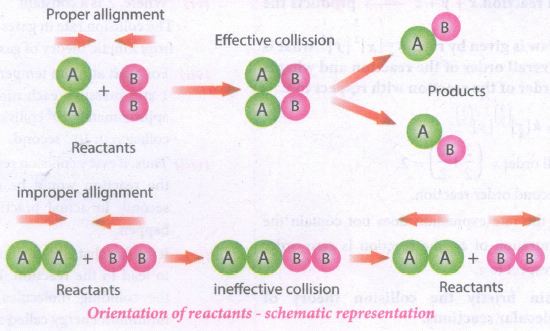
(ix) The fraction of effective collisions (f) having proper orientation is given by the steric factor p.
⇒ Rate = p x f x collision rate
\(\Rightarrow Rate=p\times { e }^{ \frac { -Ea }{ RT } }\times Z\left[ { A }_{ 2 } \right] \left[ { B }_{ 2 } \right] \quad ...(1)\)
As per the rate law,
Rate = \(k=\left[ { A }_{ 2 } \right] \left[ { B }_{ 2 } \right] \quad ...(2)\)
Where k is the rate constant
On comparing equation (1) and (2), the rate constant k is
\(k=pZ{ e }^{ \frac { -Ea }{ RT } }\)
31.
(a) Elementary reaction
Each and Every single step in a reaction mechanism is called an elementary reaction.
Rate = k[A] [B]
(b)
| Order of reaction | Molecularity of a reaction |
|---|---|
| Order of reaction is the sum of the powers of concentration terms involved in the experimentally determined rate law. | Molecularity of a reaction is the total number of reactant species that are involved in an elementary step. |
| It can be zero (or) fractional (or) integer | It is always a whole number, cannot be zero or a fractional number. |
| It is assigned for a overall reaction. | It is assigned for each elementary step of the mechanism. |
32.
Rate = K[X]n[y]m
4 x 10⁻³ mol L-1s-1= 2 x 10⁻²s-1(0.2mol L-1)n(0.2mol L-1)m
\(\frac { 4\times { 10 }^{ -3 }mol\quad { L }^{ -1 }{ s }^{ -1 } }{ 2\times { 10 }^{ -2 }{ s }^{ -1 } } =\) (0.2)n+m(mol L-1)n+m
0.2(mol L-1) = (0.2)n+m(mol L-1)n+m
Comparing the powers on both sides
The overall order of the reaction n + m = 1
33.
a) \(Rate=\frac { -1 }{ 2 } \frac { d[NO] }{ dt } =\frac { -d[{ O }_{ 2 }] }{ dt } =\frac { 1 }{ 2 } \frac { d\left[ { NO }_{ 2 } \right] }{ dt } \)
b) \(\frac { -d\left[ { O }_{ 2 } \right] }{ dt } =\frac { 1 }{ 2 } \frac { d\left[ { NO }_{ 2 } \right] }{ dt } \)
\(\frac { d[{ NO }_{ 2 }] }{ dt } =2 \times\left( \frac { -d\left[ { O }_{ 2 } \right] }{ dt } \right) =2\times 0.2 \ { mol \ L }^{ -1 }{ s }^{ -1 }\)
= 0.4 mol L-1s-1
34.
For nth reaction
\(K\alpha \frac { 1 }{ { C }^{ n-1 } } \)
35.
The order of the reaction is zero.
36.
Rate decreases with time as the reaction proceeds and the average rate cannot be used to predict the rate of the reaction at any instant. The rate of the reaction, at a particular instant during the reaction is called the instantaneous rate. So instantaneous rate in prepared over average rate.
37.
The study of chemical kinetics helps us
(i) To determine the rate of a chemical reaction.
(ii) In optimizing the process conditions of industrial manufacturing processes.
38.
(i) Let A = 100M, [A0] - [A] = 20M,
For the zero order reaction
\(k=\left( \frac { \left[ { A }_{ 0 } \right] -\left[ A \right] }{ t } \right) \)
(i) 20% completion \(k=\left( \frac { 20M }{ 20min } \right) \) = 1 mol L-1 min-1
(ii) 80% completion
\(\mathrm{K}=1 \mathrm{~mol} \mathrm{~L}{ }^{-1} \mathrm{~s}^{-1} ;\left[\mathrm{A}_{0}\right]=100 \mathrm{M} ;\left[\mathrm{A}_{0}\right]-[\mathrm{A}]=80 \mathrm{M} ; \mathrm{t}=?\)
\(\therefore t=\left(\frac{\left[A_{O}\right]-[A]}{K}\right)=\frac{80}{1}=80 \mathrm{mins}\)
39.
40.
(i) First order reaction
(ii) First order reaction
(iii) \(\frac{1}{2}+2=2 \frac{1}{2}\); Pseudo first order reaction
41.
For the first order reaction
\(\mathrm{k}=\frac{2.303}{\mathrm{t}} \log \frac{\mathrm{A}_{\mathrm{o}}}{\mathrm{A}}\) (or)
\(\mathrm{k} =\frac{2.303}{t} \log \frac{P_o}{P_t} \)
Here, Po=0.08 atm (Pt)=0.04 atm; t = 60 s
\(\mathrm{k}=\frac{2.303}{60} \log \frac{[0.08]}{[0.04]}\)
\(=0.0383 \times \log 2 \)
\(=0.0383 \times 0.3010 \)
\(=1.152 \times 10^{-2} \mathrm{~s}^{-1}\)
42.
Reaction rate = k[x]3/2[y]1/2
(i) Over all order of reaction = (3/2 + 1/2)=2
i.e., second order reaction.
(ii) Since the rate expression does not contain the concentration of z, the reaction is zero order with respect to z.

12th Standard Syllabus & Materials
12th Standard
TN 12th Computer Applications களப்பெயர் முறைமை (DNS) Sample Question Papers Study Material - QB365 Set A
NEW12th Standard
TN 12th Computer Applications வலையமைப்பு எடுத்துக்காட்டுகள் மற்றும் நெறிமுறைகள் Sample Question Papers Study Material - QB365 Set A
NEW12th Standard
TN 12th Computer Applications கணினி வலையமைப்பு ஓர் அறிமுகம் Sample Question Papers Study Material - QB365 Set A
NEW12th Standard
TN 12th Computer Applications PHP-உடன் MySQL-ஐ இணைத்தல் Sample Question Papers Study Material - QB365 Set A



Tamilnadu Stateboard 12th Standard Subjects

Maths
Chemistry

Physics

Biology

Computer Science

Business Maths and Statistics

Economics

Commerce

Accountancy

History

Computer Applications
Biology
Computer Technology
Computer Applications
Computer Science
Business Maths and Statistics
Commerce
Economics
Maths
Chemistry
Physics
Computer Technology
History
Accountancy

Tamil

English

French
Tamilnadu Stateboard Standards
