
 100% FREE ACCESS
12th Standard Syllabus & Materials
12th Standard
TN 12th Computer Applications மின்னணு தரவு பரிமாற்றம் Sample Question Papers Study Material - QB365 Set A
NEW12th Standard
TN 12th Computer Applications மின் - வணிக பாதுகாப்பு அமைப்புகள் Sample Question Papers Study Material - QB365 Set A
NEW12th Standard
TN 12th Computer Applications மின்னணு செலுத்தல் முறைகள் Sample Question Papers Study Material - QB365 Set A
NEW12th Standard
TN 12th Computer Applications மின் - வணிகம் Sample Question Papers Study Material - QB365 Set A
NEW12th Standard
TN 12th Computer Applications திறந்த மூல கருத்துருக்கள் Sample Question Papers Study Material - QB365 Set A
NEW12th Standard
TN 12th Computer Applications வலையமைப்பு வடமிடல் Sample Question Papers Study Material - QB365 Set A

Published on: 28/01/2021
12th Standard Chemistry English Medium Chemical Kinetics Reduced Syllabus Important Questions With Answer Key 2021
Download Tamil Nadu 12th Standard Chemistry question papers, model tests, one-mark questions, important questions, and public exam papers in PDF format. Free study materials and answer keys for TN State Board students.
Questions + Answers key
Take MCQ Chemistry Test
1.
The time required for 50% completion of the reaction is known as _______.
Average life period
Half-life period
Rate
None of these
2.
For a general reaction aA + bB ⟶Products, the rate of the reaction is equal to______.
k[A]p [B]q
k [A] [B]
k
\(\frac { 1 }{ k } \)
3.
The magnitude of order of a reaction may be ______.
fractional
zero
integral values
all of these
4.
CH3COOCH3 + H2 OH \(\overset { { H }^{ + } }{ \longrightarrow } \) CH3 COOH + CH3 OH is an example of _______ order reaction.
first
zero
third
pseudo
5.
Rate law cannot be determined from balanced chemical equation if ______.
Reverse reactions is not involved
It is an elementary reaction
It is a sequence of elementary reactions
All of the reactants is in excess. Rate law can be determined from balanced chemical equation if it is an elementary reaction.
6.
In any unimolecular reaction _____.
Only two reacting species is involved in the rate determining step.
The order and the molecularity of slowest step are equal to one.
The molecularity of the reaction is one and order is zero.
Both molecularity and order of the reaction are one.
7.
Which one of the following is an example of pseudo first order reaction?
Acid hydrolysis of ester
Decomposition of HI
Synthesis of NH3
All radioactive transformations
8.
For the second order reaction \({ t }_{ \frac { 1 }{ 2 } }\alpha \) _____.
\(\frac { 1 }{ { a }^{ 2 } } \)
\(\frac { 1 }{ { a } } \)
Constant
a
9.
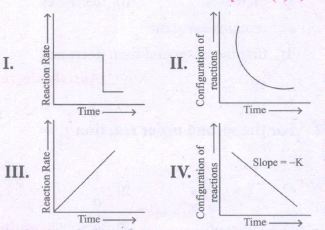
Which of the above graphs is correct for zero order reactions?
I, II
I, III
I, IV
II, III
10.
How much time will be taken for 20 gm to reduce 5 g? [R = 2 x 10⁻³s-1 (I order reaction)]
693.1 s
693.1 s-1
6.931 s
6.931 s-1
11.
Activation energy of a chemical reaction can be determined by ______.
Evaluating rate constants at two different temperatures
Evaluating velocities of reaction at two different temperatures
Evaluating rate constant at standard temperature
Changing concentration of reactants
12.
The given reaction 2 FeCl3 + SnCl2 ⟶ 2FeCl2 + SnCl4 is an example of ______.
I order
II order
III order
None of these
13.
Which of the following statement is not correct?
Molecularity of a reaction cannot be fractional
Molecularity of a reaction cannot be more than three
Molecularity of a reaction can be zero
Molecularity is assigned for each elementary step of mechanism.
14.
What would be the activation energy of a reaction when the temperature is increased from 27oC to 37oC?
534 kJ mol-1
53.4 kJ mol-1
5.34 kJ mol-1
None of these
15.
The addition of a catalyst during a chemical reaction alters which of the following quantities?
Enthalpy
Activation energy
Entropy
Internal energy
16.
Write the differences between rate and rate constant of a reaction.
17.
A reaction is first order in A and second order in B.
(i) Write the differential rate equation.
(ii) How is rate affected on increasing the concentration of B three times?
(iii) How is the rate affected when the concentrations of both A and B are doubled?
18.
The decomposition of NH3 on platinum surface is zero order reaction what are the rates of production of N2 and H2 if k = 2.5 x10⁻⁴ mol + L S-1.
19.
The rate constant k for the first order gas phase decomposition of ethyl iodide, C2H5I ⟶ C2H4 + HI is 1.60 x 10⁻⁵ s-1 at 600k and 6.36 x 10⁻³ s-1 at 700K. Calculate the energy of activation for this reaction.
20.
The rate constant, the activation energy and frequency factor of a chemical reaction at 25oC are 3.0 x 10⁻⁴ S-1; 104.4 kJ mol-1 and 6.0 x 10¹⁴ S-1 respectively. What is the value of the rate constant when T ⟶ ∞?
21.
Give the characteristics of first order reaction.
22.
A reaction is of second order in A and first order in B.
(i) Write the differential rate equation.
(ii) How is the rate affected on increasing the concentration of A three times?
(iii) How is the rate affected when the concentration of both A and B is doubled?
23.
A first order reaction is 40% complete in 50 minutes. Calculate the value of the rate constant. In what time will the reaction be 80% complete?
24.
How do nature of the reactant influence rate of reaction.
25.
For the reaction 2x+y ⟶ L find the rate law from the following data.
| [x] (min) |
[y] (min) |
rate (ms-1) |
| 0.2 | 0.02 | 0.15 |
| 0.4 | 0.02 | 0.30 |
| 0.4 | 0.08 | 1.20 |
26.
The rate of formation of a dimer in a second order reaction is 7.5 x 10⁻³ mol L-1 s-1 at 0.05 mol L-1 monomer concentration. Calculate the rate constant.
27.
Describe the graphical representation of first order reaction.
28.
Define half life of a reaction. Show that for a first order reaction half life is independent of initial concentration.
29.
Consider the oxidation of nitric oxide to form NO2
2NO(g) + O2(g) ➝2NO2(g)
(a). Express the rate of the reaction in terms of changes in the concentration of NO,O2 and NO2.
(b). At a particular instant, when [O2] is decreasing at 0.2 mol L−1s−1 at what rate is [NO2] increasing at that instant?
30.
Mention the factors that affected the rate of a chemical reaction.
31.
If the rate of a reaction gets doubled as the temperature is increased from 27oC to 37oC. Find the activation energy of reaction?
32.
A first order reaction has a specific reaction rate of 10-3 S-1. How much time will it take for 10gm of the reactant to reduce to 2.5 gm?
33.
The decomposition reaction of ammonia gas on platinum surface has a rate constant R = 2.5 x 10⁻⁴mol L-1. What is the order of the reaction.
34.
Why is instantaneous rate preferred over average rate?
35.
Rate of chemical reaction is not uniform throughout. Justify you answer:
36.
Write Arrhenius equation and explains the terms involved.
37.
Write the rate law for the following reactions.
(a) A reaction that is 3/2 order in x and zero order in y.
(b) A reaction that is second order in NO and first order in Br2.
38.
The initial rate of a first order reaction is 5.2 x 10⁻⁶ mol lit-1 S-1 at 298 K. When the initial concentration of reactant is 2.6 x 10⁻³ mol.lit-1, calculate the first order rate constant of the reaction at the same temperature.
39.
The specific reaction rates of a chemical reaction are 2.45 x 10⁻⁵ sec-1 at 273 K and 16.2 x 10⁻⁴ sec-1 at 303 K. Calculate the activation energy.
40.
A first order reaction laws on rate constant 1.15 x 10⁻³ S-1. How long will 5 g of this reactant take to reduce to 3g?
41.
Write an account of the Arrhenius equation for rates of chemical reactions.
42.
The time for half change in a first order decomposition of a substance A is 60 seconds. Calculate the rate constant. How much of A will be left after 180 seconds?
1.
(b)
Half-life period
2.
(a)
k[A]p [B]q
3.
(d)
all of these
4.
(d)
pseudo
5.
(c)
It is a sequence of elementary reactions
6.
(d)
Both molecularity and order of the reaction are one.
7.
(a)
Acid hydrolysis of ester
8.
(b)
\(\frac { 1 }{ { a } } \)
9.
(c)
I, IV
10.
(a)
693.1 s
11.
(a)
Evaluating rate constants at two different temperatures
12.
(c)
III order
13.
(c)
Molecularity of a reaction can be zero
14.
(d)
None of these
15.
A catalyst provides a new path to the reaction with low activation energy. i.e., it lowers the activation energy.
16.
| S.No | Rate of a reaction | Rate constant of a reaction |
|---|---|---|
| 1. | It represents the speed at which the reactants are converted into products at any instant | It is proportionality constant |
| 2. | It is measured as decrease in the concentration of the reactants or increase in the concentration of products. | It is equal to the rate of reaction when the concentration of each of the reactants in unity. |
| 3. | It depends on the initial concentration of reactants. | It does not depend on the initial concentration of reactants. |
17.
(i) The differential rate equation will be
\(\frac { -d\left[ R \right] }{ dt } \) = k[A][B]2
(ii) if the concentration of B is increased three times, then
\(\frac { -d\left[ R \right] }{ dt } \) = k[A] [3B]2
= 9.k [A] [3B]2
∴ The rate of reaction will increase 9 times.
(iii) When the concentrations of both A and B are doubled
\(\frac { -d\left[ R \right] }{ dt } \) =k [A] [B]2
= k [2A] [2B]2
= 8.k [A] [B]2
∴ The rate of reaction will increase 8 times.
18.
\(2{ NH }_{ { 3 }_{ (g) } }\overset { pt }{ \longrightarrow } { N }_{ { 2 }_{ (g) } }+3{ H }_{ { 2 }_{ (g) } }\)
Rate = \(-\frac { 1 }{ 2 } \frac { d\left[ { NH }_{ 3 } \right] }{ dt } =\frac { d\left[ { N }_{ 2 } \right] }{ dt } =\frac { 1 }{ 3 } \frac { d\left[ { N }_{ 2 } \right] }{ dt } \)
However, it is given that the reaction is of zero order. Therefore
\(-\frac { 1 }{ 2 } \frac { d\left[ { NH }_{ 3 } \right] }{ dt } =\frac { d\left[ { N }_{ 2 } \right] }{ dt } =\frac { 1 }{ 3 } \frac { d\left[ { N }_{ 2 } \right] }{ dt } k\)
= 2.5 x 10⁻⁴ mol L-1 S-1
The rate of production of N2 is
\(\frac { d\left[ { N }_{ 2 } \right] }{ dt } \)= 2.5 x 10⁻⁴ mol L-1 S-1
The rate of production of H2 is
\(\frac { d\left[ { N }_{ 2 } \right] }{ dt } \)= 3 x 2.5 x 10-4 mol L-1 s-1
= 7.5 x 10⁻⁴ mol L-1 s-1.
19.
Given:
K1 = 1.60 x 10⁻⁵ S-1; T1 = 600K
K2 = 6.36 x 10⁻³ S-1; T2 = 700K
We know that log \(\frac { { k }_{ 2 } }{ { k }_{ 1 } } =\frac { { E }_{ a } }{ 2.303R } \left[ \frac { 1 }{ { T }_{ 1 } } -\frac { 1 }{ { T }_{ 2 } } \right] \)
Substituting the values of K1, K2, and R= (8.314 JK-1 mol-1), we get,
\(log\frac { 6.36\times { 10 }^{ -3 } }{ 1.60\times { 0 }^{ -5 } } =\frac { { E }_{ a } }{ 2.303\times 8.314 } \left[ \frac { 1 }{ 600 } -\frac { 1 }{ 700 } \right] \)
∴ Ea = 2.6 x 19.15 x 4200 J mol-1
= 2.09 x 10⁵ J mol-1
= 209 kJ mol-1
20.
Formula:
k1 = A.e-Ea/RT
Given:
Rate constant, k1 - 3.0 x 10⁻⁴ s-1
Frequency factor, A = 6.0 x 10¹⁴ s-1
Activation energy, Ea = 104.4 kJ
= 104400 J
Temperatures, T1 = 25o C; T2 =∞
Solution:
\({ k }_{ 2 }=A.{ e }^{ -\frac { { E }_{ a } }{ RT } }\)
k2 = 6.0 x 10¹⁴ x \(\frac { 104400 }{ { e }^{ 8.314\times \infty } } \)
k2 = 6.0 x 1014 x 1 \(\left( \therefore e\frac { -{ { E }_{ a } } }{ R\infty } =1 \right) \)
∴ The rate constant at T ⟶ ∞ is 6.0 x 10¹⁴ s-1
21.
(i) When the concentration of the reactant is increased by 'n' times, the rate of reaction is also increased by n times. That is, if the concentration of the reactant is doubled, the rate is doubled.
(ii) The unit of rate constant of a first order reaction is sec-1 or time-1.
\({ k }_{ 1 }=\frac { rate }{ (a-x) } =\frac { { mol.lit }^{ -1 }{ sec }^{ -1 } }{ { mol.lit }^{ -1 } } \)
(iii) The time required to complete a definite fraction of reaction is independent of the initial concentration, of the reactant if t1/u is the time of one 'u' th fraction of reaction to take place then from equation.
\({ k }_{ 1 }=\frac { 2.303 }{ t } \log { \frac { a }{ a-x } } \)
\(x=\frac { a }{ u } and\quad { t }_{ \frac { 1 }{ u } }=\frac { 2.303 }{ { k }_{ 1 } } \log { \frac { a }{ a-\frac { a }{ u } } } ;\)
\({ t }_{ \frac { 1 }{ u } }=\frac { 2.303 }{ { k }_{ 1 } } \log { \frac { u }{ (u-1) } } \)
since k1 = rate constant, t1/u is independent of initial concentration 'a'.
22.
A reaction is second order in A and first order in B
(i) Differential rate equation,
Rate = \(\frac { -d\left[ R \right] }{ dt } =k{ \left[ A \right] }^{ 2 }\left[ B \right] \)
(ii) When the concentration of A is increased three times, (i.e) 3A, then
Rate = k[3A]2 [B]
= 9k [A]2[B] = 9 (initial rate)
This shows the rate will increase 9 times to the initial time.
(iii) When concentration of both A and B is doubled then,
Rate = k [2A]2 [2B] = 8k [A]2 [B] = 8 (initial rate)
This shows that rate will increase 8 times to the initial rate.
23.
Let \(\left[A_{0}\right]=100 \%\), t = 50 minutes
Then [A]=100 - 40 = 60 %
(1) \(\mathrm{k}=\frac{2.303}{\mathrm{t}} \log \frac{\left[\mathrm{A}_{\mathrm{o}}\right]}{[\mathrm{A}]}\)
\(=\frac{2.303}{50} \log \left(\frac{100}{60}\right) \)
\(=\frac{2.303}{50} \log 1.667 \)
\(=\frac{2.303}{50} \times 0.2219 \)
\(\mathrm{k}=0.010216 \mathrm{~min}^{-1} \)
\(\mathrm{k}=1 \times 10^{-2} \mathrm{~min}^{-1}\)
(2) \( t =\frac{2.303}{0.010216} \log \left(\frac{100}{20}\right) \)
\(t =\frac{2.303}{{0.010216}}\times 0.6990\)
= 225.43 \(\times \) 0.6990
t = 157.58 min.
The time at which the reaction will be 80% complete is 157.58 min.
24.
(i) The chemical reaction involves breaking of certain existing bonds of the reactant and forming new bonds which lead to the product.
(ii) The net energy involved in this process is dependent on the nature of the reactant and hence the rates are different for different reactants.
Example:
Let us compare the following two reactions that you carried out in volumetric analysis.
1) Redox reaction between ferrous Ammonium Sulphate (FAS) and KMnO4.
2) Redox reaction between oxalic acid and KMnO4.
(i) The oxidation of oxalate ion by KMnO4 is relatively slow compared to the reaction between KMnO4 and Fe2+. In fact heating is required for the reaction between KMnO4 and Oxalate ion and is carried out at around 60oC.
(ii) The physical state of the reactant also plays an important role to influence the rate of reactions.
(iii) Gas phase reactions are faster as compared to the reactions involving solid or liquid reactants.
Ex : Na(s) + I2(vap) [Faster]
Na(s) + I2(s) [Slower]
KI(aq) + Pb(NO3)2(aq) → PbI2 (yellow) [Faster]
KI(s) + Pb(NO3)2(s) → PbI2 (yellow) [Slower]
25.
Reaction Rate = k[x]n [y]n
0.15 = k[0.2]n [0.02]m ...(1)
0.30 = k[0.4]n [0.02]m ...(2)
1.20 = k[0.4]n [0.08]m ...(3)
eqn(3) \(\div\) eqn(2)
\(\Rightarrow\)\(\frac { 1.2 }{ 0.3 } =\frac { k{ \left[ 0.4 \right] }^{ n }{ \left[ 0.08 \right] }^{ m } }{ k{ \left[ 0.4 \right] }^{ n }{ \left[ 0.02 \right] }^{ m } } \)
\(4={ \left( \frac { \left[ 0.08 \right] }{ \left[ 0.02 \right] } \right) }^{ m }\)
\(4^1={ \left( 4 \right) }^{ m }\)
\(m=1\)
eqn(2) \(\div\) eqn(1), \(\frac{0.30}{0.15}=\frac{\mathrm{k}[0.4]^{\mathrm{n}}[0.02]^{\mathrm{m}}}{\mathrm{k}[0.2]^{\mathrm{n}}[0.02]^{\mathrm{m}}}\)
\( 2={ \left( \frac { \left[ 0.4 \right] }{ \left[ 0.2 \right] } \right) }^{ n}\)
\(2^1= 2 ^{ n }\)
\(\therefore n=1\)
Rate = \(k{ \left[ x \right] }^{ 1 }{ \left[ y \right] }^{ 1 }\)
\(0.15=k{ \left[ 0.1 \right] }^{ 1 }{ \left[ 0.02 \right] }^{ 1 }\)
\(\frac { 0.15 }{ { \left[ 0.2 \right] }^{ 1 }{ \left[ 0.02 \right] }^{ 1 } } =k\)
k = 37.5 mol−1L s−1
26.
If the monomer is represented by X. Then
\(2 \mathrm{M} \rightarrow(\mathrm{M})_{2}\)
Since the reaction is of second order, the rate of reaction will be given by,
\(\text { Rate }=\mathrm{k}[\mathrm{M}]^{n} \)
\(7.5 \times 10^{-3} \mathrm{~mol} \mathrm{~L}^{-1} \mathrm{~s}^{-1}=\mathrm{k}\left(0.05 \mathrm{~mol} \mathrm{} \mathrm{~L}^{-1}\right)^{2} \)
\(\mathrm{k} =\frac{Rate}{[M]^{n}} \)
\(\mathrm{k} =\frac{7.5 \times 10^{-3}}{(0.05)^{2}} \)
\(=3 \mathrm{~mol}^{-1} \mathrm{~L} \mathrm{~s}^{-1}\)
27.
A Reaction whose rate depends on the reactant concentration raised to the first power is called a first order reaction. For a first order reaction,
A ⟶ product
Rate law can be expressed as
Rate = k[A]-1
\(\frac { -d\left[ A \right] }{ \left[ A \right] } =k dt\) ...(1)
Integrate the above equation between the limits of time t = 0 and time equal to t, while the concentration varies from the initial: concentration [Ao] to [A] at the later time.
\(\int _{ { [A }_{ 0 }] }^{ [A] }{ \frac { -d\left[ A \right] }{ \left[ A \right] } } =k\int _{ 0 }^{ t }{ dt } \)
\({ \left( -In\left[ A \right] \right) }_{ \left[ { A }_{ 0 } \right] }^{ \left[ A \right] }=k{ \left( t \right) }_{ 0 }^{ t }\)
\(-In\left[ A \right] -\left( In\left[ { A }_{ 0 } \right] \right) =k\left( t-0 \right) \)
\(-In\left[ A \right] -\left( In\left[ { A }_{ 0 } \right] \right) =kt\)
\(In\left( \frac { \left[ { A }_{ 0 } \right] }{ \left[ A \right] } \right) =kt\) ...(2)
This equation is in natural logarithm. To convert it into usual logarithm with base 10, we have to multiply the term by 2.303.
\(2.303\quad log\left( \frac { \left[ { A }_{ 0 } \right] }{ \left[ A \right] } \right) =kt\)
\(k=\frac { 2.303 }{ t } log\left( \frac { \left[ { A }_{ 0 } \right] }{ \left[ A \right] } \right) \) ...(3)
Equation (2) can be written in the form
y = mx+c as below
In [A0]-In[A] = kt
In[A] = In[A0]-kt
⇒ y = c + mx
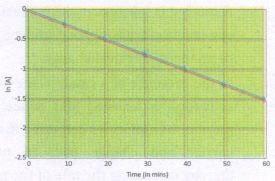
If we follow the reaction by measuring the concentration of the reactants at regular time interval 't' a plot of In[A] against 't' yields a straight line with a negative slope. From this, the rate constant is calculated.
28.
(i) The half life of a reaction is defined as the time required for the reactant concentration to reach one half its initial value.
\(k=\frac { 2.303 }{ t } log\frac { \left[ { A }_{ 0 } \right] }{ \left[ A \right] } \)
\(at\quad t={ t }_{ \frac { 1 }{ 2 } };\left[ A \right] =\frac { \left[ { A }_{ 0 } \right] }{ 2 } \)
\(k=\frac { 2.303 }{ t_{ 1/2 } } log\frac { \left[ { A }_{ 0 } \right] }{ \frac { \left[ { A }_{ 0 } \right] }{ 2 } } \)
\(k=\frac { 2.303 }{ { t }_{ 1/2 } } log2\)
\(k=\frac { 2.303\times 0.3010 }{ { t }_{ 1/2 } } =\frac { 0.6932 }{ { t }_{ 1/2 } } \)
\({ t }_{ 1/2 }=\frac { 0.6932 }{ k } \)
This equation has no concentration term So, the half life of a first order reaction is independent of initial concentration.
29.
a) \(Rate=\frac { -1 }{ 2 } \frac { d[NO] }{ dt } =\frac { -d[{ O }_{ 2 }] }{ dt } =\frac { 1 }{ 2 } \frac { d\left[ { NO }_{ 2 } \right] }{ dt } \)
b) \(\frac { -d\left[ { O }_{ 2 } \right] }{ dt } =\frac { 1 }{ 2 } \frac { d\left[ { NO }_{ 2 } \right] }{ dt } \)
\(\frac { d[{ NO }_{ 2 }] }{ dt } =2 \times\left( \frac { -d\left[ { O }_{ 2 } \right] }{ dt } \right) =2\times 0.2 \ { mol \ L }^{ -1 }{ s }^{ -1 }\)
= 0.4 mol L-1s-1
30.
The rate of a reaction is affected by the following factors.
(i) Nature and state of the reactant
(ii) Concentration of the reactant
(iii) Surface area of the reactant
(iv) Temperature of the reaction
(v) Presence of a catalyst
31.
In \(\frac { { k }_{ 2 } }{ { k }_{ 1 } } =\frac { { E }_{ a } }{ R } \left[ \frac { { T }_{ 2 }-{ T }_{ 1 } }{ { T }_{ 1 }{ T }_{ 2 } } \right] \)
In 2 = \(\frac { { E }_{ a } }{ R } \) \(\left[ \frac { 10 }{ 300\times 310 } \right] \)
Ea = 9300 R In 2
= 53.4 kJ mol-1
32.
\({ k }=2.303\log { \frac { \left[ { A }_{ 0 } \right] }{ \left[ A \right] } } \)
\(t=\frac { 2.303 }{ { 10 }^{ -3 } } \log { \frac { 10 }{ 2.5 } } \)
t = 2303 x 0.301 x 2 = 1386 s.
33.
The order of the reaction is zero.
34.
Rate decreases with time as the reaction proceeds and the average rate cannot be used to predict the rate of the reaction at any instant. The rate of the reaction, at a particular instant during the reaction is called the instantaneous rate. So instantaneous rate in prepared over average rate.
35.
Rate of a reaction at any time depends on the concentration of the reactants which keeps on decreasing with time.
36.
Arrhenius equation is,
\(k=Ae^\left ({ \frac { -Ea }{ RT } } \right )\)
Here,
A \(\rightarrow\) Frequency factor
Ea \(\rightarrow\) Activation energy of the reaction
R \(\rightarrow\) Gas constant
T \(\rightarrow\) Absolute temperature (in K)
37.
(a) Rate = \(k{ \left[ x \right] }^{ 3/2 }{ \left[ y \right] }^{ 0 }=k[x]^{3/2}\)
(b) 2NO + Br2 ⟶ 2NOBr
Rate = k[NO]2[Br2]
38.
Given data: Rate = 5.2 x 10⁻⁶ mol lit-1 sec-1
Initial concentration [A] = 2.6 x 10⁻³
Formula: Rate = k[A]1
Solution: Rate = 5.2 x 10⁻⁶ mol lit-1 sec-1 = k x 2.6 x 10⁻³ lit-1
= \(\frac { 5.26\times { 10 }^{ -6 }mol{ \ lit }^{ -1 }{ sec }^{ -1 } }{ 2.6\times { 10 }^{ -3 }mol \ { lit }^{ -1 } } \)= 2 x 10⁻³
∴ k = 2 x 10⁻³ s-1
39.
Given data:
k1 = 2.45 x 10⁻⁵ sec-1; T1 = 273 K
k2 = 16.2 x 10⁻⁴ sec-1; T2 = 303 K
R = 8.314 JK-1 mol-1
Formula: \(\log { \frac { { k }_{ 2 } }{ { k }_{ 1 } } } =\frac { { E }_{ a } }{ 2.303R } \left[ \frac { { T }_{ 2 }-{ T }_{ 1 } }{ { T }_{ 1 }{ T }_{ 2 } } \right] \)
Solution:
\(\log { \frac { 16.2\times { 10 }^{ -4 } }{ 2.45\times { 10 }^{ -5 } } } =\frac { { E }_{ a } }{ 2.303\times 8.314 } \left( \frac { 303-273 }{ 273\times 303 } \right) \)
\(1.8203=\frac { { E }_{ a } }{ 2.303\times 8.314 } \times \left[ \frac { 30 }{ 273\times 303 } \right] \)
∴ Ea = 52802.3 x 1.8203
= 96116 J / mol
Ea = 96.116 kJ mol-1.
40.
[R]0 = 5g, [R] = 3g
K = 1.15 x 10⁻³ s-1
As the reaction is of first order
K = \(\frac { 2.303 }{ t } \log { \frac { { \left[ R \right] }_{ 0 } }{ \left[ R \right] } } \)
\(t=\frac { 2.303 }{ 1.15\times { 10 }^{ -3 }{ s }^{ -1 } } \log { \frac { 5g }{ 3g } } \)
= 200 x 103 (log 1.667)s
= 20 x 103 x 0.22 19 s
= 443.8 s
= 444 s (approximately)
41.
Arrhenius suggested that the rates of most reactions vary with temperature in such a way that the rate constant is directly proportional to \({ e }^{ -\left( \frac { { E }_{ a } }{ RT } \right) }\) and he proposed a relation between the rate constant and temperature.
\(k=A{ e }^{ -\left( \frac { { E }_{ a } }{ RT } \right) }\) ....(1)
Where A the frequency factor,
R the gas constant,
Ea the activation energy of the reaction and,
T the absolute temperature (in K)
(ii) The frequency factor (A) is related to the frequency of collisions (number of collisions per second) between the reactant molecules. The factor A does not vary significantly with temperature and hence it may be taken as a constant.
(iii) Ea is the activation energy of the reaction, which Arrhenius considered as the minimum energy that a molecule must have to posses to react.
(iv) Taking logarithm on both side of the equation (1)
In k = In A + In \({ e }^{ -\left( \frac { { E }_{ a } }{ RT } \right) }\)
In k = In A -\(\left( \frac { { E }_{ a } }{ RT } \right) \) (∴ In e = 1)
In k = In A - \({ \left( \frac { { E }_{ a } }{ R } \right) }\) \(\left( \frac { 1 }{ T } \right) \)....(2)
y = c = m x
The above equation is of the form of a straight line y = mx+c
(v) A plot of In k Vs \(\left( \frac { 1 }{ T } \right) \) gives a straight line with a negative slope -\(\frac { { E }_{ a } }{ R } \) If the rate constant for a reaction at two different temperatures is known, we can calculate the activation energy as follows.
At temperature T = T1; the rate constant k = k1
In k1 = In A - \(^{ \left( \frac { { E }_{ a } }{ { RT }_{ 1 } } \right) }\) ....(3)
At temperature T = T2; the rate constant k = k2
In k2 = In A - \(\left( \frac { { E }_{ a } }{ { RT }_{ 2 } } \right) \) ......(4)
(4) - (3)
In k2 - In k1 = - \(\left( \frac { { E }_{ a } }{ { RT }_{ 2 } } \right) \) + \(^{ \left( \frac { { E }_{ a } }{ { RT }_{ 1 } } \right) }\)
In \(\left( \frac { { k }_{ 2 } }{ { k }_{ 1 } } \right) \) = \(\frac { { E }_{ a } }{ R } \) \(\left( \frac { 1 }{ T_{ 1 } } -\frac { 1 }{ { T }_{ 2 } } \right) \)
2.303 log \(\left( \frac { { k }_{ 2 } }{ { k }_{ 1 } } \right) \)= \(\frac { { E }_{ a } }{ R } \) \(\left( \frac { { T }_{ 2 }-{ T }_{ 1 } }{ { T }_{ 1 }{ T }_{ 2 } } \right) \)
log \(\left( \frac { { k }_{ 2 } }{ { k }_{ 1 } } \right) \) = \(\frac { { E }_{ a } }{ 2.303R } \) \(\left( \frac { { T }_{ 2 }-{ T }_{ 1 } }{ { T }_{ 1 }{ T }_{ 2 } } \right) \)
In k2 - k1 = - \(\left( \frac { { E }_{ a } }{ R{ T }_{ 2 } } \right) \) + \(\left( \frac { { E }_{ a } }{ R{ T }_{ 1 } } \right) \)
This equation can be used to calculate Ea from rate constants k1 and k2 at temperatures T1 and T2.
42.
(i) Order of the reaction =1; \(\mathrm{t}_{1 / 2}=60 \mathrm{~s} ; \mathrm{k}=?\)
\(\mathrm{k}=\frac{0.6932}{\mathrm{t}_{\frac{1}{2}}} \)
\(=\frac{0.6932}{60} \)
\(k =1.155 \times 10^{-2} \mathrm{~s}^{-1}\)
(ii) \(\left[\mathrm{A}_{0}\right]=100 \% ; \mathrm{t}=180 \mathrm{~s} ;[\mathrm{A}]=? ; \mathrm{k}=1.155 \times 10^{-2} \mathrm{~s}^{-1}\)
For first order reaction
\(\mathrm{k}=\frac{2.303}{\mathrm{t}} \log \frac{\left[\mathrm{A}_{0}\right]}{[\mathrm{A}]} \)
\(1.155 \times 10^{-2} =\frac{2.303}{180} \log \left(\frac{100}{[A]}\right) \)
\(\frac{0.01155 \times 180}{2.303} =\log \left(\frac{100}{[A]}\right) \)
\(0.9027 =\log 100-\log [\mathrm{A}] \)
\(\log [\mathrm{A}] =\log 100-0.9027 \)
\(\log [A]=2-0.9027 \)
\(\log [A]=1.0972 \)
[A] = antilog of (1.0972)
[A] =12.51 %

12th Standard Syllabus & Materials
12th Standard
TN 12th Computer Applications களப்பெயர் முறைமை (DNS) Sample Question Papers Study Material - QB365 Set A
NEW12th Standard
TN 12th Computer Applications வலையமைப்பு எடுத்துக்காட்டுகள் மற்றும் நெறிமுறைகள் Sample Question Papers Study Material - QB365 Set A
NEW12th Standard
TN 12th Computer Applications கணினி வலையமைப்பு ஓர் அறிமுகம் Sample Question Papers Study Material - QB365 Set A
NEW12th Standard
TN 12th Computer Applications PHP-உடன் MySQL-ஐ இணைத்தல் Sample Question Papers Study Material - QB365 Set A



Tamilnadu Stateboard 12th Standard Subjects

Maths
Chemistry

Physics

Biology

Computer Science

Business Maths and Statistics

Economics

Commerce

Accountancy

History

Computer Applications
Biology
Computer Technology
Computer Applications
Computer Science
Business Maths and Statistics
Commerce
Economics
Maths
Chemistry
Physics
Computer Technology
History
Accountancy

Tamil

English

French
Tamilnadu Stateboard Standards
