
 100% FREE ACCESS
12th Standard Syllabus & Materials
12th Standard
TN 12th Maths Applications of Matrices and Determinants Sample Question Papers Study Material - QB365 Set A
NEW12th Standard
TN 12th Computer Applications மின்னணு தரவு பரிமாற்றம் Sample Question Papers Study Material - QB365 Set A
NEW12th Standard
TN 12th Computer Applications மின் - வணிக பாதுகாப்பு அமைப்புகள் Sample Question Papers Study Material - QB365 Set A
NEW12th Standard
TN 12th Computer Applications மின்னணு செலுத்தல் முறைகள் Sample Question Papers Study Material - QB365 Set A
NEW12th Standard
TN 12th Computer Applications மின் - வணிகம் Sample Question Papers Study Material - QB365 Set A
NEW12th Standard
TN 12th Computer Applications திறந்த மூல கருத்துருக்கள் Sample Question Papers Study Material - QB365 Set A

Published on: 01/09/2022
QB365 provides a detailed and simple solution for every Possible Book Back Questions in Class 12 Chemistry Subject - Coordination Chemistry, English Medium. It will help Students to get more practice questions, Students can Practice these question papers in addition to score best marks.
Download Tamil Nadu 12th Standard Chemistry question papers, model tests, one-mark questions, important questions, and public exam papers in PDF format. Free study materials and answer keys for TN State Board students.
Questions + Answers key
Take MCQ Chemistry Test
1.
2.
Give one test to differentiate [Co(NH3)5Cl]SO4 and [Co(NH3)5SO4]Cl.
3.
Draw all possible geometrical isomers of the complex [Co(en)2Cl2]+ and identify the optically active isomer.
4.
Based on VB theory explain why [Cr(NH3)6]3+ is paramagnetic, while [Ni(CN)4]2- is diamagnetic.
5.
Give the difference between double salts and coordination compounds.
6.
What is the coordination entity formed when excess of liquid ammonia is added to an aqueous solution of copper sulphate?
1.
2.
These two are ionisation isomers. [Co(NH3)5Cl]SO4 gives white precipitate with BaCl2 solution, but not with AgNO3 solution. [Co(NH3)5SO4]Cl gives curdy white precipitate with AgNO3 solution but not with BaCl2 solution.
3.
[Co (en)2 Cl2]+ This is an octahedral complex
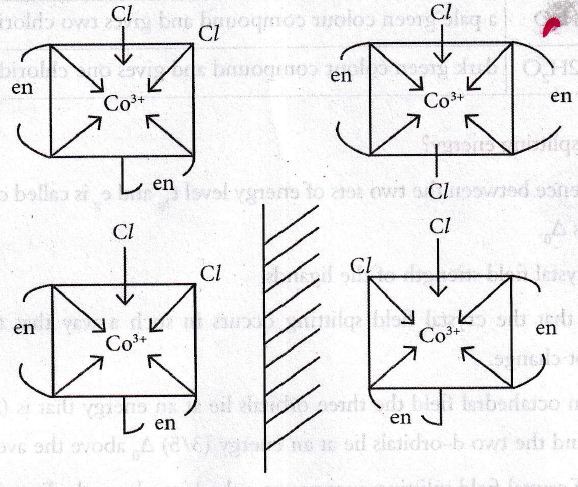
4.
\(\text {(a) }\left[\mathrm{Cr}\left(\mathrm{NH}_{3}\right)_{6}\right]^{3+}:{ }_{24} \mathrm{Cr} \Rightarrow{ }_{18}[\mathrm{Ar}] 4 \mathrm{~s}^{2} 3 \mathrm{~d}^{4} \)
\({ }_{21} \mathrm{Cr}^{3+} \Rightarrow{ }_{18}[\mathrm{Ar}] 3 \mathrm{~d}^{3}\)
.JPG)
(i) d2sp3 hybridisation (octahedral)
(ii) It has three unpaired electrons (n = 3)
(iii) So it is paramagnetic
(iv) Magnetic moment \(\left(\mu_{\mathrm{s}}\right)=\sqrt{\mathrm{n}(\mathrm{n}+2)} \mathrm{BM}\)
\(=\sqrt{3(3+2)}=\sqrt{15}=3.87 \mathrm{BM}\)
\((b) \ \left[\mathrm{Ni}(\mathrm{CN})_{4}\right]^{2-:}{ }_{28} \mathrm{Ni} \Rightarrow[\mathrm{Ar}] 4 \mathrm{~s}^{2} 3 \mathrm{~d}^{8} ;{ }_{26} \mathrm{Ni}^{2+} \Rightarrow{ }_{18}[\mathrm{Ar}] 3 \mathrm{~d}^{8}\)
.JPG)
(i) dsp2 hybridisation
(ii) Geometry - square planar
(iii) No unpaired electrons- It is Diamagnetic
(iv) Magnetic moment (μs) = 0.
5.
| S. No | Double salts | Co-ordination compound |
|---|---|---|
| 1. | They usually contain two simple salt in equimolar proportions | The simple salts from which they are formed may or may not be in equimolar proportion. |
| 2. | They exists only in the solid state. In aqueous solution they dissociate completely into ions. | They exist in the solid state as well as in aqueous solution. This is because even in solution, the complex ion does not dissociate into ions. |
| 3. | They are ionic compounds and do not contain any co-ordinate bond. | They may or may not be ion but the complex part always contain coordinate bonds |
| 4. | The properties of the double salts are same as those of its constituent compounds. | The properties of the coordination compounds are different for its constituent bonds. |
| 5. | In a double salt, the metal ion show their normal valency. | In a coordinate compound the metal ion satisfies its two types of valence called primary & secondary valenices. |
| 6. | A double salt loses its identity and dissociates into its constitute simple ions in solution. | The complex ion does not lose its identity and never dissociate to give simple ions. |
| Example: FeSO4 (NH4)2 SO4.6H2O | Example: K4[Fe(CN)6), K3[Fe(SCN)6) |
6.
(i) When excess of liquid ammonia is added to an aqueous solution of copper sulphate gives tetra ammine copper (II) sulphate is formed.
CUso4 + 4NH3 \(\rightarrow\) [Cu(NH3)4]SO4
(ii) The co-ordination entity is [Cu(NH3)4]2+

12th Standard Syllabus & Materials
12th Standard
TN 12th Computer Applications வலையமைப்பு வடமிடல் Sample Question Papers Study Material - QB365 Set A
NEW12th Standard
TN 12th Computer Applications களப்பெயர் முறைமை (DNS) Sample Question Papers Study Material - QB365 Set A
NEW12th Standard
TN 12th Computer Applications வலையமைப்பு எடுத்துக்காட்டுகள் மற்றும் நெறிமுறைகள் Sample Question Papers Study Material - QB365 Set A
NEW12th Standard
TN 12th Computer Applications கணினி வலையமைப்பு ஓர் அறிமுகம் Sample Question Papers Study Material - QB365 Set A



Tamilnadu Stateboard 12th Standard Subjects

Maths
Chemistry

Physics

Biology

Computer Science

Business Maths and Statistics

Economics

Commerce

Accountancy

History

Computer Applications
Biology
Computer Technology
Computer Applications
Computer Science
Business Maths and Statistics
Commerce
Economics
Maths
Chemistry
Physics
Computer Technology
History
Accountancy

Tamil

English

French
Tamilnadu Stateboard Standards
