
 100% FREE ACCESS
12th Standard Syllabus & Materials
12th Standard
TN 12th Maths Applications of Matrices and Determinants Sample Question Papers Study Material - QB365 Set A
NEW12th Standard
TN 12th Computer Applications மின்னணு தரவு பரிமாற்றம் Sample Question Papers Study Material - QB365 Set A
NEW12th Standard
TN 12th Computer Applications மின் - வணிக பாதுகாப்பு அமைப்புகள் Sample Question Papers Study Material - QB365 Set A
NEW12th Standard
TN 12th Computer Applications மின்னணு செலுத்தல் முறைகள் Sample Question Papers Study Material - QB365 Set A
NEW12th Standard
TN 12th Computer Applications மின் - வணிகம் Sample Question Papers Study Material - QB365 Set A
NEW12th Standard
TN 12th Computer Applications திறந்த மூல கருத்துருக்கள் Sample Question Papers Study Material - QB365 Set A

Published on: 02/09/2022
QB365 provides a detailed and simple solution for every Possible Creative Questions in Class 12 Chemistry Subject - Chemistry In Everyday Life Biomolecules , English Medium. It will help Students to get more practice questions, Students can Practice these question papers in addition to score best marks.
Download Tamil Nadu 12th Standard Chemistry question papers, model tests, one-mark questions, important questions, and public exam papers in PDF format. Free study materials and answer keys for TN State Board students.
Questions + Answers key
Take MCQ Chemistry Test
1.
State any three advantages of food additives.
2.
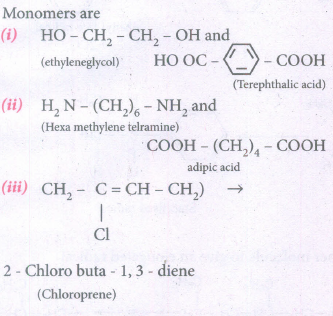
Identify the monomers of the following polymers.
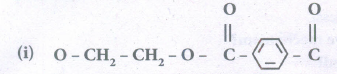
(ii) (NH(CH2)6 NHCO (CH2)4 CO)n
(iii) \({ CH }_{ 2 }-\underset { \overset { | }{ Cl } }{ C } =CH-{ CH }_{ 2 })_{ n }\)
3.
4.
Identify the polymer and write the reaction involved.
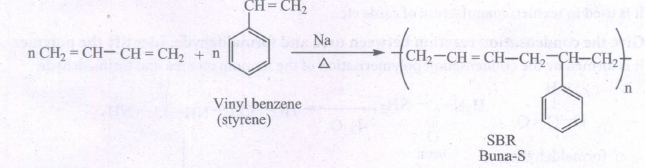
(i) Buta-1,3-diene and styrene in the presence of sodium.
(ii) 3 - hydroxy butanoic acid and 3-hydroxy pentanoic acid.
5.
How is Buna - N prepared? Give its use.
6.
Write the preparation of neoprene and give its use.
7.
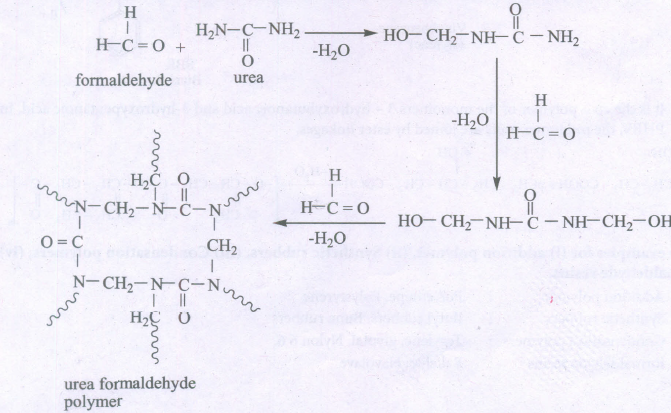
Give the condensation reaction between urea and formaldehyde. Identify the polymer.
8.
How is Nylon - 6,6 prepared? Give it use.
9.
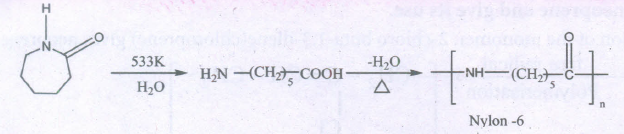
The monomer is capro lactam 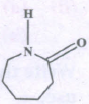 Identify the polymer when the monomer is heated at 533K.
10.
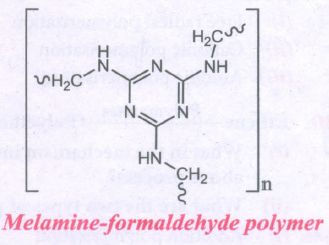
Give the structure of melamine formaldehyde resin.
11.
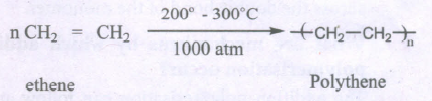
How is Low density polyethene prepared?
12.
Write a short note on Antioxidants.
13.
Give some of the advantages of using food additives.
14.
Name some important categories of food additives.
15.
Who do soaps not work in hard water?
1.
Advantages of food additives:
1. Uses of preservatives reduce the product spoilage and extend the shelf-life of food
2. Addition of vitamins and minerals reduces the mall nutrient
3. Flavouring agents enhance the aroma of the food
4. Antioxidants prevent the formation of potentially toxic oxidation products of lipids and other food constituents
2.
3.
4.
(i) It is a co-polymer It is obtained by the polymerisation of buta-Ls-diene and styrene in the ratio 3:1 in the presence of sodium.
(ii) It is the co - polymer of the monomers 3 - hydroxybutanoic acid and 3-hydroxypentanoic acid. In PHBV, the monomer units are joined by ester linkages.

5.
It is a co-polymer of acrylonitrile and buta-1,3-diene.

It is used in the manufacture of hoses and tank linings.
6.
The free radical polymeristion of the monomer, 2-c Woro buta -1,3-diene( chloroprene) gives neoprene.

It is superior to rubber and resistant to chemical action.
Uses: It is used in the manufacture of chemical containers, conveyer belts
7.
It is formed by the condensation polymerisation of the monomers urea and formaldehyde.
8.
Nylon - 6,6 can be prepared by mixing equimolar adipic acid and hexamethylene - diamine to form a nylon salt which on heating eliminate a water molecule to form amide bonds.
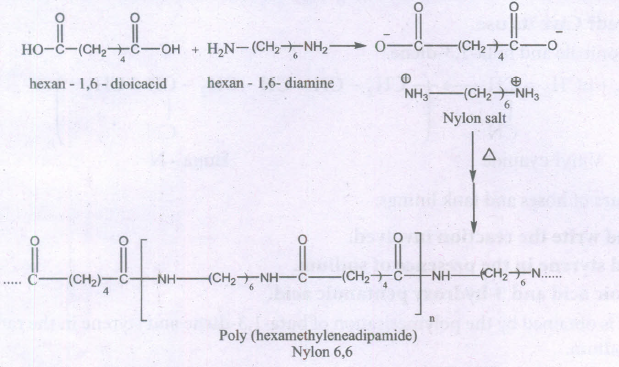
It is used in textiles, manufacture of cards etc ...
9.
Capro lactam (monomer) on heating at 533K in an inert atmosphere with traces of water gives \(\in \) amino carproic acid which polymerises to give nylon - 6
10.
11.
LDPE is formed by heating ethene at 200° to 300°C under oxygen as a catalyst. The reaction follows free radical mechanism. The peroxides formed from oxygen acts as a free radical initiator.
12.
(i) Antioxidants are substances which retard the oxidative deteriorations of food.
(ii) Food containing fats and oils is easily oxidised and turn rancid.
(iii) To prevent the oxidation of the fats and oils, chemical BHT(butylhydroxy toluene), BHA(Butylated hydroxy anisole) are added as food additives.
(iv) They are generally called antioxidants. These materials readily undergo oxidation by reacting with free radicals generated by the oxidation of oils, thereby stop the chain reaction of oxidation of food.
13.
Advantages of food additives :
(i) Uses of preservatives reduce the product spoilage and extend the shelf-life of food.
(ii) Addition of vitamins and minerals reduces the mall nutrient.
(iii) Flavouring agents enhance the aroma of the food.
(iv) Antioxidants prevent the formation of potentially toxic oxidation products of lipids and other food constituents.
14.
(i) Aroma compounds
(ii) Food colours
(iii) Preservatives
(iv) Stabilizers
(v) Artificial Sweeteners
(vi) Antioxidants
(vii) Buffering substances
(viii) Vitamins and minerals
15.
Hard water contains salts of calcium and magnesium. When soaps are dissolved in hard water, these ions displace sodium and potassium from their salts and form insoluble calcium and magnesium salts of fatty acids. These insoluble salts separate as scum, Thus soaps do not work in hard water.

12th Standard Syllabus & Materials
12th Standard
TN 12th Computer Applications வலையமைப்பு வடமிடல் Sample Question Papers Study Material - QB365 Set A
NEW12th Standard
TN 12th Computer Applications களப்பெயர் முறைமை (DNS) Sample Question Papers Study Material - QB365 Set A
NEW12th Standard
TN 12th Computer Applications வலையமைப்பு எடுத்துக்காட்டுகள் மற்றும் நெறிமுறைகள் Sample Question Papers Study Material - QB365 Set A
NEW12th Standard
TN 12th Computer Applications கணினி வலையமைப்பு ஓர் அறிமுகம் Sample Question Papers Study Material - QB365 Set A



Tamilnadu Stateboard 12th Standard Subjects

Maths
Chemistry

Physics

Biology

Computer Science

Business Maths and Statistics

Economics

Commerce

Accountancy

History

Computer Applications
Biology
Computer Technology
Computer Applications
Computer Science
Business Maths and Statistics
Commerce
Economics
Maths
Chemistry
Physics
Computer Technology
History
Accountancy

Tamil

English

French
Tamilnadu Stateboard Standards
