
 100% FREE ACCESS
12th Standard Syllabus & Materials
12th Standard
TN 12th Computer Applications மின்னணு தரவு பரிமாற்றம் Sample Question Papers Study Material - QB365 Set A
NEW12th Standard
TN 12th Computer Applications மின் - வணிக பாதுகாப்பு அமைப்புகள் Sample Question Papers Study Material - QB365 Set A
NEW12th Standard
TN 12th Computer Applications மின்னணு செலுத்தல் முறைகள் Sample Question Papers Study Material - QB365 Set A
NEW12th Standard
TN 12th Computer Applications மின் - வணிகம் Sample Question Papers Study Material - QB365 Set A
NEW12th Standard
TN 12th Computer Applications திறந்த மூல கருத்துருக்கள் Sample Question Papers Study Material - QB365 Set A
NEW12th Standard
TN 12th Computer Applications வலையமைப்பு வடமிடல் Sample Question Papers Study Material - QB365 Set A

Published on: 02/09/2022
QB365 provides a detailed and simple solution for every Possible Creative Questions in Class 12 Chemistry Subject - Chemistry In Everyday Life Biomolecules , English Medium. It will help Students to get more practice questions, Students can Practice these question papers in addition to score best marks.
Download Tamil Nadu 12th Standard Chemistry question papers, model tests, one-mark questions, important questions, and public exam papers in PDF format. Free study materials and answer keys for TN State Board students.
Questions + Answers key
Take MCQ Chemistry Test
1.
Explain the mechanism of free radical polymerisation with an example.
2.
Explain Receptor as drug targets.
3.
Explain: Enzymes as drug targets or Explain lock and key model synthesis
4.
How are polymers are classified on the basis of structure and molecular forces, give examples of each one?
5.
Explain the prepareation of Bakelite and Give its use.
6.
Styrene polymerises to polystyrene when heated in the presence of peroxide initiator.
(i) What is the mechanism involved?
(ii) Give the initiation step for the above process.
(iii) How does the chain propogate in the above mechanism?
(iv) How is the above chain reaction terminated?
7.
Explain the classification of polymers based on their structure and mode of synthesis.
8.
Explain Receptor as drug targets.
9.
Write a note on drug target interaction.
10.
Differentiate thermoplastic and thermosetting.
1.
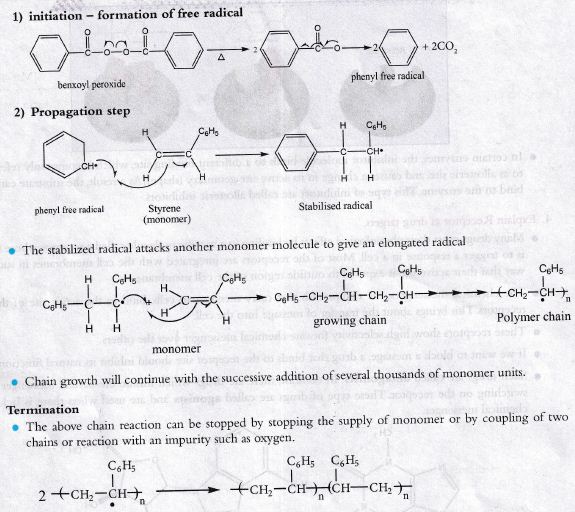
When alkenes are heated with free radical initiator such as benzyl peroxide, they undergo polymerisation reaction. For example styrene polymerises to polystyrene when it is heated to ionic with a peroxide initiator. The mechanism involves the following steps.
2.
(i) Many drugs exert their physiological effects by binding to a specific molecule called a receptor whose role is to trigger a response in a cell. Most of the receptors are integrated with the cell membranes in such a way that their active site is exposed to outside region of the cell membrane.
(ii) The chemical messengers, the compounds that carry messages to cells, bind to the active site of these receptors. This brings about the transfer of message into the cell.
(iii) These receptors show high selectivity for one chemical messenger over the others.
(iv) If we want to block a message, a drug that binds to the receptor site should inhibit its natural function.
(v) Such drugs are called antagonists. In contrast, there are drugs which mimic the natural messenger by switching on the receptor. These type of drugs are called agonists and are used when there is lack of chemical messenger.
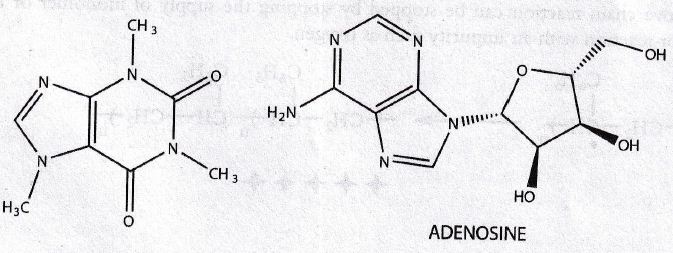
(vi) For example, when adenosine binds to the adenosine receptors, it induces sleepiness. On the other hand, the antagonist drug caffeine binds to the adenosine receptor and makes it inactive. This results in the reduced sleepiness (wakefulness).
(vii) The agonist drug, morphine, which is used as a pain killer binds to the opioid receptors and activates them. This supress the neuro transmitters that causes pain.
(viii) Most receptors are chiral and hence different enantiomers of a drug can have different effect.
3.
(i) In all living systems, the biochemical reactions are catalysed by enzymes. Hence, these enzyme actions are highly essential for the normal functioning of the system. If their normal enzyme activity is inhibited, then the system will be affected. This principle is usually applied to kill many pathogens.
(ii) We have already learnt that in enzyme catalysed reactions, the substrate molecule binds to the active site of the enzyme by means of the weak interaction such as hydrogen bonding, van der Waals force etc... between the amino acids present in the active site and the substrate.
(iii) When a drug molecule that has a similar geometry (shape)as the substrate is administered, it can also bind to the enzyme and inhibit its activity. In other words, the drug acts as an inhibitor to the enzyme catalyst. These type of inhibitors are often called competitive inhibitors. For example the antibiotic sulphanilamide, which is structurally similar to p-aminobenzoic acid (PABA) inhibits the bacterial growth. Many bacteria need PABA in order to produce an important coenzyme, folic acid. When the antibiotic sulphanilamide is administered, it acts as a competitive inhibitor to the enzyme dihydropteroate synthase (DHPS) in the biosynthetic pathway of converting PABA into folic acid in the bacteria. It leads to the folic acid deficiency which retards the growth of the bacteria and can eventually kill them.
.JPG)
.JPG)
In certain enzymes, the inhibitor molecule binds to a different binding site, which is commonly referred to as allosteric site, and causes a change in its active site geometry (shape). As a result, the substrate cannot bind to the enzyme. This type of inhibitors are called allosteric inhibitors.
4.
A) Classification Based on Structure of Polymers
(i) Linear polymers:
The monomers in these are linked together to form a long chain. eg) HDPE, PVC
(ii) Branch chain polymers:
One main chain with small chains as branches eg) polypropylene, LDPE.
(iii) Cross-linked or Network polymers:
Monomers are linked together to form a three dimensional network. The monomers contain strong covalent bonds as they are composed of bi - functional and tri - functional in nature. These polymers are brittle and hard.
Ex: Bakelite (used in electrical insulators), Melamine formaldehyde etc.
B) Classification based on Molecular Forces:
Intra molecular forces are the forces that hold atoms together within a molecule. In polymers, strong covalent bonds join atoms to each other in individual polymer molecules, Intermolecular forces (between the molecules) attract polymer molecules towards each other.
Polymers can be classified into 4 types:
(i) Elastomers: (soft and stretched)
Elastomer are rubber - like solid polymers, that are elastic in nature
The polymers chains are held by the weakest intermolecular forces, hence allowing the polymer to be stretched. But as you notice removing that stress also results in the rubber band taking up its original form.
(E.g) Buna - S, Buna - N, Neoprene
(ii) Thermoplastics:
They become soft on heating and hard cooling. They can be remolded (E.g) Polythene, PVC, polythene
(iii) Thermosetting:
Do not become soft on heating but set to an infusible mass upon heating (E.g) Bakelite, Melamine formaldehyde resin
(iv) Fibres:
They have strong inter - molecular forces between the chains giving them less elasticity and high
The intermolecular forces may be hydrogen bonds or dipole - dipole interaction E.g: Nylon - 6, 6, Terylene (polyester)
5.
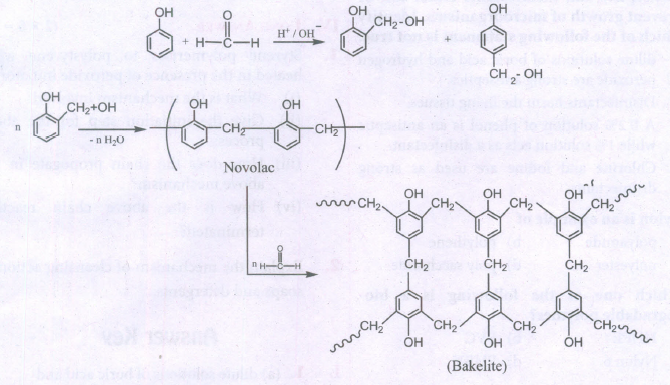
The monomers are phenol and formaldehyde. The polymer is obtained by the condensation polymerization of these monomers in presence of either an acid or a base catalyst.
Phenol reacts with methanal to form ortho or para hydroxyl methylphenols which on further reaction with phenol gives linear polymer called novolac. Novalac on further heating with formaldehyde undergo cross linkages to form Bakelite.
Uses:
Navolac is used in paints. Soft bakelites are used for making glue for binding laminated wooden planks and in varinishes, Hard bakelites are used to prepare combs, pens etc...
6.
(i) Free radical polymerisation.
(ii) Styrene polymerises to polystyrene when it is heated to ionic with a peroxide initiator. The mechanism involves the following steps.

(iii) Propagation step
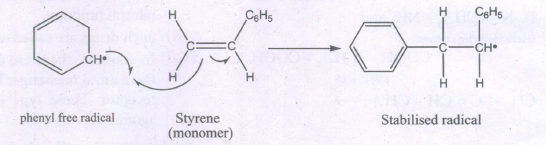
The stabilized radical attacks another monomer molecule to give an elongated radical.

Chain growth will continue with the successive addition of several thousands of monomer units.
(iv) The above chain reaction can be stopped by stopping the supply of monomer or by coupling of two chains or reaction with an impurity such as oxygen.

7.
(i) Structure:
(a) Linear polymers (long continuous chain) E.g. HDPE, PVC
(b) Branched polymers (one main chain with small chains as branches) E.g. polypropylene, LDPE.
(c) Cross linked polymers (linking of chain polymers) E.g. bakelite, melamine, formaldehyde
(ii) Mode of synthesis:
(a) Addition polymers. Formed by polymerisation of monomers without the elimination of byproduct. E.g. polyethylene, PVC, teflon.
(b) Condensation Polymer formed by the condensation of two or more monomers with the elimination of simple molecules like H2O, NH3, etc., E.g. Nylon:6-6, polyester.
8.
(i) Many drugs exert their physiological effects by binding to a specific molecule called a receptor whose role is to trigger a response in a cell.
(ii) The chemical messengers, bind to the active site of these receptors. This brings about the transfer of message into the cell.
(iii) The chemical messengers bind to the active site of these receptors.
(iv) This brings about the transfer of message into the cell
(v) These receptors show high selectivity.
(vi) If we want to block a message, a drug that binds to the receptor site should inhibit its natural function.
(vii) Such drugs are called antagonists.
(viii) In contrast, there are drugs which mimic the natural messenger by switching on the receptor. These type of drugs are called agonists.
9.
(i) The biochemical processes such as metabolism, cell-signaling etc... are essential for the normal functioning of our body.
(ii) These routine processes may be disturbed by any external factors such as microorganism, chemicals etc ..
(iii) Under such conditions medicines restore the normal functioning of the body.
(iv) These drug molecules interact with biomolecules such as proteins, lipids, etc .. that are responsible for different functions of the body.
(v) The drug interacts with these molecules and modify the normal biochemical reactions either by modifying the enzyme activity or by stimulating/suppressing certain receptors.
10.
(i) Thermoplastic: They become soft on heating and hard on cooling. They can be remolded
E.g. polythene, PVC, polystrene
(ii) Thermo setting : Do not be come soft on heating set to an infusible mass upon heating.
E.g. bakelite, melamine, formaldehyde

12th Standard Syllabus & Materials
12th Standard
TN 12th Computer Applications களப்பெயர் முறைமை (DNS) Sample Question Papers Study Material - QB365 Set A
NEW12th Standard
TN 12th Computer Applications வலையமைப்பு எடுத்துக்காட்டுகள் மற்றும் நெறிமுறைகள் Sample Question Papers Study Material - QB365 Set A
NEW12th Standard
TN 12th Computer Applications கணினி வலையமைப்பு ஓர் அறிமுகம் Sample Question Papers Study Material - QB365 Set A
NEW12th Standard
TN 12th Computer Applications PHP-உடன் MySQL-ஐ இணைத்தல் Sample Question Papers Study Material - QB365 Set A



Tamilnadu Stateboard 12th Standard Subjects

Maths
Chemistry

Physics

Biology

Computer Science

Business Maths and Statistics

Economics

Commerce

Accountancy

History

Computer Applications
Biology
Computer Technology
Computer Applications
Computer Science
Business Maths and Statistics
Commerce
Economics
Maths
Chemistry
Physics
Computer Technology
History
Accountancy

Tamil

English

French
Tamilnadu Stateboard Standards
