
 100% FREE ACCESS
12th Standard Syllabus & Materials
12th Standard
TN 12th Maths Applications of Matrices and Determinants Sample Question Papers Study Material - QB365 Set A
NEW12th Standard
TN 12th Computer Applications மின்னணு தரவு பரிமாற்றம் Sample Question Papers Study Material - QB365 Set A
NEW12th Standard
TN 12th Computer Applications மின் - வணிக பாதுகாப்பு அமைப்புகள் Sample Question Papers Study Material - QB365 Set A
NEW12th Standard
TN 12th Computer Applications மின்னணு செலுத்தல் முறைகள் Sample Question Papers Study Material - QB365 Set A
NEW12th Standard
TN 12th Computer Applications மின் - வணிகம் Sample Question Papers Study Material - QB365 Set A
NEW12th Standard
TN 12th Computer Applications திறந்த மூல கருத்துருக்கள் Sample Question Papers Study Material - QB365 Set A

Published on: 02/09/2022
QB365 provides a detailed and simple solution for every Possible Book Back Questions in Class 12 Chemistry Subject - Solid State, English Medium. It will help Students to get more practice questions, Students can Practice these question papers in addition to score best marks.
Download Tamil Nadu 12th Standard Chemistry question papers, model tests, one-mark questions, important questions, and public exam papers in PDF format. Free study materials and answer keys for TN State Board students.
Questions + Answers key
Take MCQ Chemistry Test
1.
Barium has a body centered cubic unit cell with a length of 508pm along an edge. What is the density of barium in g cm-3?
2.
Write a note on Frenkel defect.
3.
If NaCl is doped with 10-2 mol percentage of strontium chloride, what is the concentration of cation vacancy?
4.
Aluminium crystallizes in a cubic close packed structure. Its metallic radius is 125pm. calculate the edge length of unit cell.
5.
An element has bcc structure with a cell edge of 288 pm. The density of the element is 7.2 g cm-3. How many atoms are present in 208 g of the element.
6.
What is meant by the term “coordination number”? What is the coordination number of atoms in a bcc structure?
7.
Explain Schottky defect.
8.
9.
Distinguish between hexagonal close packing and cubic close packing.
10.
Explain briefly seven types of unit cell.
11.
Give any three characteristics of ionic crystals.
12.
Sodium metal crystallizes in bcc structure with the edge length of the unit cell 4.3 x 10⁻⁸ cm. Calculate the radius of sodium atom.
13.
Atoms X and Y form bcc crystalline structure. Atom X is present at the corners of the cube and Y is at the centre of the cube. What is the formula of the compound?
1.
Density \(\rho=\frac{\mathrm{n} \mathrm{M}}{\mathrm{a}^{3} \mathrm{~N}_{\mathrm{A}}}\)
Here, n = 2 ; M = 137.3 gmol-1 ;
a = 5.08pm = 5.08 x 10⁻⁸cm
\(p=\frac{2\times 137.3}{(5.03\times10^{-8})(6.023\times 10^{23})}\)
\(=\frac{274.6}{(5.08)^{3}\times 10^{-24}\times 6.023\times 10^{23}}\)
\(=\frac{274.6}{(131.09)(6.023)}\times 10\)
\(=\frac{2746}{789.6}\)=3.5 g cm-3
2.
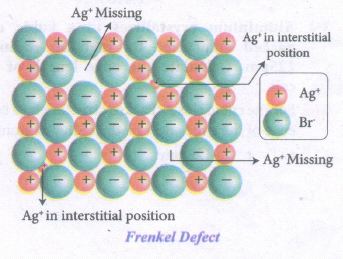
(i) Frenkel defect arises due to the dislocation of ions from its crystal lattice.
(ii) The ion which is missing from the lattice point occupies an interstitial position.
(iii) This defect is shown by ionic solids in which cation and anion differ in size.
(iv) Unlike Schottky defect, this defect does not affect the density of the crystal.
For example AgBr, in this case, small Ag+ ion leaves its normal site and occupies an interstitial position.
3.
Given: NaCl is doped with 10-2 mole % of SrCl2
(i.e.) 100 moles of NaCl doped with 10-2 moles of SrCl2
\(\therefore \) 1 mole of NaCl is doped with 10-4 moles of SrCl2
1 Sr2+ ion creates 1 cation vacancy
The number of cation vacancies created by 10-4 mole SrCl2 = 10-4 \(\times\) 6.023 \(\times\) 1023
= 6.023 \(\times\) 1019 vacancies
4.
For cubic closed packed structure
\(r =\frac{a \sqrt{2}}{4} \)
\(\therefore a =\frac{4 r}{\sqrt{2}} \)
\(=\frac{4 \times 1.25 \times 10^{-8}}{1.414}=3.53 \times 10^{-8} \mathrm{~cm} \)
= 353 pm
5.
\(\operatorname{Density}(\rho)=\frac{\mathrm{nM}}{\mathrm{a}^{3} \mathrm{~N}_{\mathrm{A}}} \)
\(\mathrm{n}=2, \mathrm{~N}_{\mathrm{A}}=6.023 \times 10^{23} ; \mathrm{a}=288 \mathrm{pm}=2.88 \times 10^{-8} \mathrm{~cm}, \rho=7.2 \mathrm{~g} \mathrm{~cm}^{-3} \)
\(\therefore M=\frac{\rho \times a^{3} \times N_{A}}{n} \)
\(=\frac{7.2 \times\left(2.88 \times 10^{-8}\right)^{3} \times 6.023 \times 10^{23}}{2} \)
\(=517.95 \times 10^{-1} \)
\(=51.795 \mathrm{~g} \mathrm{~mol}^{-1} \)
Number of moles (n) \(=\frac{\text { Mass }}{\text { Molar mass }}=\frac{208}{51.795}\)=4.02 moles
No. of atoms = No. of moles \(\times\) Avogadro number
=n \(\times\) NA
\(=4.01 \times 6.023 \times 10^{23} \)
\(=24.15 \times 10^{23} \text { atoms }\)
6.
1. The number of nearest neighbours that surrounding a particle in a crystal is called the coordination number of that particle.
2. The coordination number of atoms in a bcc structure is '8'.
7.
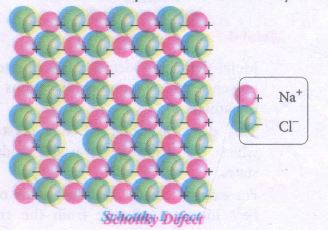
(i) Schottky defect arises due to the missing of equal number of cations and anions from the crystal lattice. This effect does not change the stoichiometry of the crystal.
(ii) Ionic solids in which the cation and anion are of almost of similar size show schottky defect.
Example: NaCl.
(iii) Presence of large number of schottky defects in a crystal, lowers its density.
(iv) Presence of Schottky defect in the crystal provides a simple way by which atoms or ions can move within the crystal lattice.
8.
9.
| hcp structure | ccp structure | |
| 1. | This is 'aba' pattern of arrangement. | This is 'abc' pattern of arrangement. |
| 2. | The spheres can be arranged so as to fit into the depression in such a way that the third layer is directly over a first layer. | The third layer may be placed over the second layer in such a way that all the spheres of the third layer fit in octahedral voids. |
| 3. | The tetrahedral voids of the second layer are covered by the spheres of the third layer. | This arrangement of the third layer is different from other two layers and the stacking of layers continued. |
| 4. | 6 spheres are present | 4 spheres are present |
10.
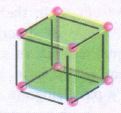
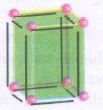
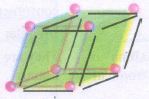
There are seven types of unit cell, Cubic, tetragonal, orthorhombic, hexagonal, monoclinic, triclinic and rhombohedral. They differ in the arrangement of their crystallographic axes and angles.
i) Cubic: a = b = c; α = β = ૪ = 90o.
ii) Tetragonal: a = b ≠ c; α = β = ૪ = 90°.
iii) Orthorhombic: a ≠ b ≠ c; α = β = ૪ = 90°.
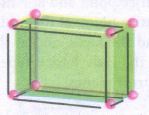
iv) Hexagonal: a = b ≠ c; α = β = 90o, ૪ = 120o.
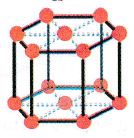
v) Monoclinic: a ≠ b ≠ c; α = ૪ = 90o, β ≠ 90o,
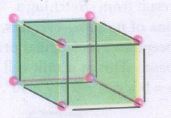
vi) Triclinic: a ≠ b ≠ c; α ≠ β ≠ ૪ ≠ 90o.
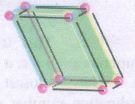
vii) Rhombohedral: a = b = c; α = β = ૪ ≠ 90o.
11.
(i) Ionic solids have high melting points.
(ii) These solids do not conduct electricity, because the ions are fixed in their lattice positions.
(iii) They are hard so strong external force can change the relative positions of ions.
12.
For bcc structure \((r)=\frac{\sqrt{3}}{4} a\)
a = 4.3 \(\times\) 10-8 cm, r = ?
\(=\frac{1.732 \times 4.3 \times 10^{-8}}{4}\)
\(r=1.86 \times 10^{-8} \mathrm{~cm}\)
13.
Number of X type atoms in the unit cell \(=8 \times \frac{1}{8}=1\)
Number of Y type atoms in the unit cell \(=1 \times \frac{1}{1}=1\)
Hence the formula is XY (or) X1Y1

12th Standard Syllabus & Materials
12th Standard
TN 12th Computer Applications வலையமைப்பு வடமிடல் Sample Question Papers Study Material - QB365 Set A
NEW12th Standard
TN 12th Computer Applications களப்பெயர் முறைமை (DNS) Sample Question Papers Study Material - QB365 Set A
NEW12th Standard
TN 12th Computer Applications வலையமைப்பு எடுத்துக்காட்டுகள் மற்றும் நெறிமுறைகள் Sample Question Papers Study Material - QB365 Set A
NEW12th Standard
TN 12th Computer Applications கணினி வலையமைப்பு ஓர் அறிமுகம் Sample Question Papers Study Material - QB365 Set A



Tamilnadu Stateboard 12th Standard Subjects

Maths
Chemistry

Physics

Biology

Computer Science

Business Maths and Statistics

Economics

Commerce

Accountancy

History

Computer Applications
Biology
Computer Technology
Computer Applications
Computer Science
Business Maths and Statistics
Commerce
Economics
Maths
Chemistry
Physics
Computer Technology
History
Accountancy

Tamil

English

French
Tamilnadu Stateboard Standards
