
 100% FREE ACCESS
12th Standard Syllabus & Materials
12th Standard
TN 12th Maths Applications of Matrices and Determinants Sample Question Papers Study Material - QB365 Set A
NEW12th Standard
TN 12th Computer Applications மின்னணு தரவு பரிமாற்றம் Sample Question Papers Study Material - QB365 Set A
NEW12th Standard
TN 12th Computer Applications மின் - வணிக பாதுகாப்பு அமைப்புகள் Sample Question Papers Study Material - QB365 Set A
NEW12th Standard
TN 12th Computer Applications மின்னணு செலுத்தல் முறைகள் Sample Question Papers Study Material - QB365 Set A
NEW12th Standard
TN 12th Computer Applications மின் - வணிகம் Sample Question Papers Study Material - QB365 Set A
NEW12th Standard
TN 12th Computer Applications திறந்த மூல கருத்துருக்கள் Sample Question Papers Study Material - QB365 Set A

Published on: 01/09/2022
QB365 provides a detailed and simple solution for every Possible Creative Questions in Class 12 Chemistry Subject - Coordination Chemistry, English Medium. It will help Students to get more practice questions, Students can Practice these question papers in addition to score best marks.
Download Tamil Nadu 12th Standard Chemistry question papers, model tests, one-mark questions, important questions, and public exam papers in PDF format. Free study materials and answer keys for TN State Board students.
Questions + Answers key
Take MCQ Chemistry Test
1.
Name some metal complexes, that are present in our biological system and their role in it.
2.
What is the significance of stability constants?
3.
What is stability constant?
4.
What is \(\pi \) back bonding?
5.
Explain Bonding is metal carbonyls.
6.
What are the limitations of VBT?
7.
Explain optical isomerism.
8.
Match the common name with formula and the IUPAC ligand name.
| Common name | Formula | IUPAC ligand name |
|---|---|---|
| Bromide | C2O42- | Carbonato |
| Nitrate | Br- | Oxalato |
| hydroxide | NO3- | hydroxido |
| Carbonate | OH- | bromido |
| Oxalate | CO32- | nitrato |
9.
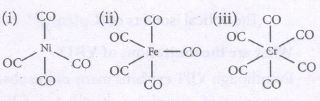
Draw the structure of the following homoleptic metal carbonyl.
(i) [Ni(CO)4]
(ii) [Fe(CO)5]
(iii) [Cr(CO)6]
10.
What is meant by unidentate, didentate and ambidentate Iigands Give two examples for each.
11.
Aqueous copper sulphate solution (blue) gives
(i) a green precipitate with aqueous potassium fluoride.
(ii) a bright green solution with aqueous potassium chloride. Explain these experimental results.
12.
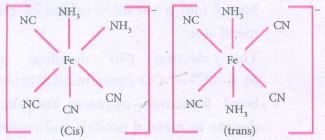
Draw the structures of geometrical isomers of [Fe(NH3)2 (CN)4]-
13.
How is magnitude of \({ \triangle }_{ 0 }\) affected by (i) nature of ligands (ii) oxidation state of metal ion.
14.
[Ni(CN)4]2- is diamagnetic, while [NiCl4]2- is paramagnetic, explain using crystal field theory.
15.
Write briefly about the applications of coordination compounds in volumetric analysis
1.
(i) A red blood corpuscle (RBC) is composed of heme group, which is Fe2+- Porphyrin complex. it plays an important role in carrying oxygen from lungs to tissues and carbon dioxide from tissues to lungs.
(ii) Chlorophyll, a green pigment present in green plants and algae, is a coordination complex containing Mg2+ as central metal ion surrounded by a modified Porphyrin ligand called corrin ring. It plays an important role in photosynthesis, by which plants converts CO2 and water into carbohydrates and oxygen.
(iii) Vitamin B12 (cyanocobalamin) is the only vitamin consist of metal ion. it is a coordination complex in which the central, metal ion is Co+ surrounded by Porphyrin like ligand.
(iv) Many enzymes are known to be metal complexes, they regulate biological processes. For example, Carboxypeptidase is a protease enzyme that hydrolytic enzyme important in digestion contains a zinc ion coordinated to the protein.
2.
The stability of coordination complex is measured in terms of its stability constant (β). Higher the value of stability constant for a complex ion, greater is the stability of the complex ion.
3.
(i) The stability of a coordination complex is a measure of its resistance to the replacement of one ligand by another.
(ii) The stability of a complex refers to the degree of association between two species involved in an equilibrium.
(iii) Let us consider the following complex formation reaction
Cu2+ +4NH3 ⇌ [Cu(NH3)4]2+
\(\beta =\frac { { \left[ { Cu\left( { NH }_{ 3 } \right) }_{ 4 } \right] }^{ 2+ } }{ \left[ { Cu }^{ 2+ } \right] { { \left[ { NH }_{ 3 } \right] }^{ 4 } } } \)
(iv) So, as the concentration of [Cu (NH3)4]2+ increases the value of stability complexes also increases.
(v) Therefore the greater the value of stability constant greater is the stability of the complex.
4.
(i) In metal carbonyls, the bond between metal atom and the carbonyl ligand consists of two components.
(ii) The first component is an electron pair donation from the carbon atom of carbonyl ligand into a vacant d-orbital of central metal atom.
(iii) This electron pair donation forms M \(\overset { \sigma \quad bond }{ \longleftarrow } \) CO sigma bond. This sigma bond formation increases the electron density in metal d orbitals and makes the metal electron rich.
(iv) In order to compensate for this increased electron density, a filled metal d-orbital interacts with the empty \(\pi \) * orbital on the carbonyl ligand and transfers the added electron density back to the ligand.
5.
Thus in metal carbonyls, electron density moves from ligand to metal through sigma bonding and from metal to ligand through pi bonding, this synergic effect accounts for strong M \(\longleftarrow \) CO bond in metal carbonyls.
6.
Even though VBT explains many of the observed properties of complexes, it still has following limitations.
(i) It does not explain the colour of the complex.
(ii) It considers only the spin only magnetic moments and does not consider the other components of magnetic moments.
(iii) It does not provide a quantitative explanation as to why certain complexes are inner orbital complexes and the: others are outer orbital complexes for the same metal. For example, [Fe(CN)6]4- is diamagnetic (low spin) whereas [FeF6]4-is paramagnetic (high spin).
7.
(i) Coordination compounds which possess chirality exhibit optical isomerism similar to organic compounds.
(ii) The pair of two optically active isomers which are mirror images of each other are called enantiomers.
(iii) Their solutions rotate the plane of the plane polarised light either clockwise or anticlockwise and the corresponding isomers are called 'd' (dextrorotatory) and 'I'(levorotatory) forms respectively.
(iv) The octahedral complexes of type I [M(xx)3]n±, [M(xx)2AB]n± and [M(xx)2B2]n± exhibit optical isomerism.
(v) Examples:
The optical isomers of [Co(en)3]3+
8.
| Common name | Formula | IUPAC ligand name |
|---|---|---|
| Bromide | Br- | bromido |
| Nitrate | NO3- | nitrato |
| hydroxide | OH- | hydroxido |
| Carbonate | CO32- | Carbonato |
| Oxalate | C2O42- | Oxalato |
9.
10.
(i) UNIDENTATE LIGAND: (or) Monodentate
When a ligand is bonded through one donor site to central metal atom/ion it is said to be unidentate ligand.
Eg: Cl-, CO, NH3, H2O, etc.
(ii) DIDENTATE LIGAND: (or) Bidentate
When a ligand is bonded through two donor sites to central metal atom/ion, it is said to be didentate ligand.
Eg: Oxalate, 1,2 - ethanediamine.
(iii) AMBIDENTATE LIGAND:
When a ligand i.s bonded through two different atoms, it is said to be ambidentate ligand.
Eg: NO2-, SCN-, CN-
11.
Aqueous copper sulphate (blue) is [Cu(H2O)4] SO4.
[Cu(H2O)4]SO4 ⟶ [Cu(H2O)4]2+ + SO42-
[Cu(H2O4)]2+ is a liable complex in which H2O ligand get easily replaced by F- ions of KF and by Cl- ions of KCI.
(i) [Cu(H2O)4]2+(aq) + 4F- ⟶ \(\underset { Green \ ppt }{ { \left[ Cu{ F }_{ 4 } \right] }^{ 2- } } +4{ H }_{ 2 }O\)
(ii) [Cu(H2O)4]2+(aq) +4Cl-(aq) ⟶ \(\underset { Bright \ green\ ppt }{ { \left[ Cu{ F }_{ 4 } \right] }^{ 2- } } +4{ H }_{ 2 }O\)
12.
13.
(i) Greater the strength of the ligands greater is the value of \({ \triangle }_{ 0 }\)
(ii) Higher the ionic charge on the central metal ion. Greater will be value of \({ \triangle }_{ 0 }\)
14.
1. [Ni(CN)4]2- is a low spin square planar complex as it contains strong field CN- ligand in it.
2. Oxidation state of Ni in complex is +2 Electronic Configuration of Ni2+ is 3d8 4s0
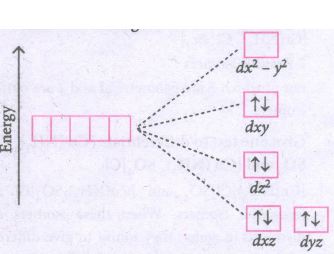
Crystal field splitting in square planar complex.
1. No unpaired electrons, so the complex is diamagnetic.
2. [NiCl4]2- is a high spin tetrahedral complex as it contains weak field Cl- ligand in it.
3. Oxidation state of Ni in complex in +2
4. Electronic Configuration of Ni2+ is 3d8 4s6.
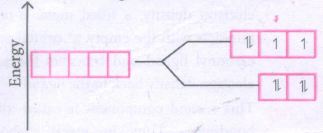
It has two unpaired electrons, so the complex is paramagnetic.
15.
(i) EDTA is used in the volumetric determination of a wide variety of metal ions in solution.
Eg. Zn2+, Pb2+, Ca2+, CO2+, Ni2+,Cu2+, etc.
(ii) By careful adjustment of the pH and using suitable indication, mixtures of metals can v be analyzed.
Eg. Bi3+in the presence of Pb2+
(iii) Hardness of water due to the presence of Ca2+ and Mg2+ ions is estimated by complexometric titrations using EDTA.

12th Standard Syllabus & Materials
12th Standard
TN 12th Computer Applications வலையமைப்பு வடமிடல் Sample Question Papers Study Material - QB365 Set A
NEW12th Standard
TN 12th Computer Applications களப்பெயர் முறைமை (DNS) Sample Question Papers Study Material - QB365 Set A
NEW12th Standard
TN 12th Computer Applications வலையமைப்பு எடுத்துக்காட்டுகள் மற்றும் நெறிமுறைகள் Sample Question Papers Study Material - QB365 Set A
NEW12th Standard
TN 12th Computer Applications கணினி வலையமைப்பு ஓர் அறிமுகம் Sample Question Papers Study Material - QB365 Set A



Tamilnadu Stateboard 12th Standard Subjects

Maths
Chemistry

Physics

Biology

Computer Science

Business Maths and Statistics

Economics

Commerce

Accountancy

History

Computer Applications
Biology
Computer Technology
Computer Applications
Computer Science
Business Maths and Statistics
Commerce
Economics
Maths
Chemistry
Physics
Computer Technology
History
Accountancy

Tamil

English

French
Tamilnadu Stateboard Standards
