
 100% FREE ACCESS
12th Standard Syllabus & Materials
12th Standard
TN 12th Maths Applications of Matrices and Determinants Sample Question Papers Study Material - QB365 Set A
NEW12th Standard
TN 12th Computer Applications மின்னணு தரவு பரிமாற்றம் Sample Question Papers Study Material - QB365 Set A
NEW12th Standard
TN 12th Computer Applications மின் - வணிக பாதுகாப்பு அமைப்புகள் Sample Question Papers Study Material - QB365 Set A
NEW12th Standard
TN 12th Computer Applications மின்னணு செலுத்தல் முறைகள் Sample Question Papers Study Material - QB365 Set A
NEW12th Standard
TN 12th Computer Applications மின் - வணிகம் Sample Question Papers Study Material - QB365 Set A
NEW12th Standard
TN 12th Computer Applications திறந்த மூல கருத்துருக்கள் Sample Question Papers Study Material - QB365 Set A

Published on: 01/09/2022
QB365 provides a detailed and simple solution for every Possible Book Back Questions in Class 12 Chemistry Subject - Coordination Chemistry, English Medium. It will help Students to get more practice questions, Students can Practice these question papers in addition to score best marks.
Download Tamil Nadu 12th Standard Chemistry question papers, model tests, one-mark questions, important questions, and public exam papers in PDF format. Free study materials and answer keys for TN State Board students.
Questions + Answers key
Take MCQ Chemistry Test
1.
What are the limitations of VB theory?
2.
On the basis of VB theory explain the nature of bonding in [Co(C2O4)3]3-
3.
A solution of [Ni(H2O)6]2+ is green, whereas a solution of [Ni(CN)4]2- is colorless -Explain
4.
Write the postulates of Werner’s theory.
1.
(i) It does not explain the colour of the complex.
(ii) It considers only the spin only magnetic moments and does not consider the other components of magnetic moments.
(iii) It does not provide a quantitative explanation as to why certain complexes are inner orbital complexes and the others are outer orbital complexes for the same metal. For example, [Fe(CN)6]4- is diamagnetic (low spin) whereas [FeF6]4- is paramagnetic (high spin).
2.
In \(\left[\mathrm{Co}\left(\mathrm{C}_{2} \mathrm{O}_{4}\right)_{3}\right]^{3-}\) Cobalt is in +3 oxidation state
\(\mathrm{Co}=[\mathrm{Ar}] 3 \mathrm{~d}^{7} 4 \mathrm{~s}^{2} \)
\(\mathrm{Co}^{3+}=3 \mathrm{~d}^{6} 4 \mathrm{~s}^{\circ}\)
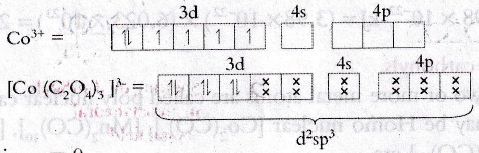
It is diamagnetic; n = 0
d2sp3 hybridisation; μs = 0
3.
[Ni (H2O)6]2+
.JPG)
It has two unpaired electrons. So there is d-d transition. Hence it is green coloured.
[Ni(CN)4]2-
.JPG)
There is no unpaired electrons. So it is colourless, as there is no d-d transition.
4.
Most of the elements exhibit, two types of valence namely primary valence and secondary valence and each element tend to satisfy both the valences.
The primary valence is referred the oxidation state of the metal atom.
The secondary valence as the coordination number. For example, according to Werner, the primary and secondary valences of cobalt are 3 and 6 respectively.
The primary valence of a metal ions ae always satisfied by negative ions.
For example in the complex CoCI3.6NH3. The primary valence of Co is +3 and is satisfied by 3CI- ions.
The secondary valence is satisfied by negative ions, neutral molecules, positive ions or the combination of these.
For example, in CoCl3.6NH3 complex primary valence of cobalt +3 and it is satisfied by 3 CI-.
The secondary valence of cobalt is 6 and is satisfied by six neutral ammonia molecules. where as in CoCI6.NH3.
Secondary valence of Co = 5{It is satisfied five neutral molecules and a Cl- ion}
According to Werner, there are two spheres of attraction around a metal atom/ion in a complex.
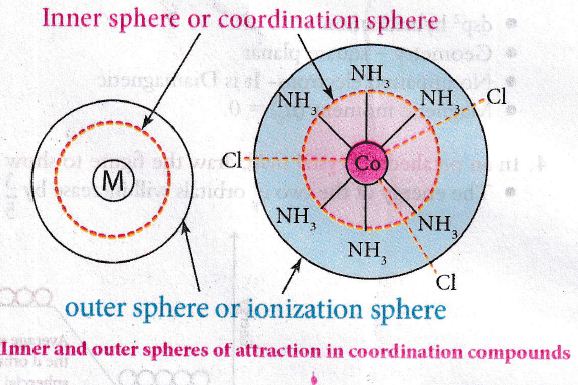
The inner /coordination sphere:
The groups present in this sphere are firmly attached to the metal.
The outer sphere / ionisation sphere:
The groups present in this sphere are loosely bound to the central metal ion and hence can be separated into ions upon dissolving the complex in a suitable solvent.
The primary valencies are non-directional. while the secondary valencies are directional.
The geometry of the complex is determined by the special arrangement of the groups which satisfy the secondary valence.
| Secondary valence | Geometry |
| 4 | Tetrahedral / Square planar |
| 6 | Octahedral |

12th Standard Syllabus & Materials
12th Standard
TN 12th Computer Applications வலையமைப்பு வடமிடல் Sample Question Papers Study Material - QB365 Set A
NEW12th Standard
TN 12th Computer Applications களப்பெயர் முறைமை (DNS) Sample Question Papers Study Material - QB365 Set A
NEW12th Standard
TN 12th Computer Applications வலையமைப்பு எடுத்துக்காட்டுகள் மற்றும் நெறிமுறைகள் Sample Question Papers Study Material - QB365 Set A
NEW12th Standard
TN 12th Computer Applications கணினி வலையமைப்பு ஓர் அறிமுகம் Sample Question Papers Study Material - QB365 Set A



Tamilnadu Stateboard 12th Standard Subjects

Maths
Chemistry

Physics

Biology

Computer Science

Business Maths and Statistics

Economics

Commerce

Accountancy

History

Computer Applications
Biology
Computer Technology
Computer Applications
Computer Science
Business Maths and Statistics
Commerce
Economics
Maths
Chemistry
Physics
Computer Technology
History
Accountancy

Tamil

English

French
Tamilnadu Stateboard Standards
