
 100% FREE ACCESS
12th Standard Syllabus & Materials
12th Standard
TN 12th Maths Applications of Matrices and Determinants Sample Question Papers Study Material - QB365 Set A
NEW12th Standard
TN 12th Computer Applications மின்னணு தரவு பரிமாற்றம் Sample Question Papers Study Material - QB365 Set A
NEW12th Standard
TN 12th Computer Applications மின் - வணிக பாதுகாப்பு அமைப்புகள் Sample Question Papers Study Material - QB365 Set A
NEW12th Standard
TN 12th Computer Applications மின்னணு செலுத்தல் முறைகள் Sample Question Papers Study Material - QB365 Set A
NEW12th Standard
TN 12th Computer Applications மின் - வணிகம் Sample Question Papers Study Material - QB365 Set A
NEW12th Standard
TN 12th Computer Applications திறந்த மூல கருத்துருக்கள் Sample Question Papers Study Material - QB365 Set A

Published on: 01/09/2022
QB365 provides a detailed and simple solution for every Possible Creative Questions in Class 12 Chemistry Subject - Coordination Chemistry, English Medium. It will help Students to get more practice questions, Students can Practice these question papers in addition to score best marks.
Download Tamil Nadu 12th Standard Chemistry question papers, model tests, one-mark questions, important questions, and public exam papers in PDF format. Free study materials and answer keys for TN State Board students.
Questions + Answers key
Take MCQ Chemistry Test
1.
Mention the main assumption of valence bond theory of coordination compounds.
2.
In an tetrahedral crystal field, draw the figure to show splitting of d-orbitals.
3.
Give the structure for the following compounds.
(i) pentaamminechlorocobalt (III) ion
(ii) Triamminetrinitrito- k N cobalt (III)
(ill) tetraammineaquabromidooobalt(III)nitrate
(iv) Dichloridobisethane-(1,2-diamine) cobalt (lIl) chloride
(v) Tetraamminecopper (lI) sulphate
4.
Give the IUPAC name for the following compounds.
(i) [Ag(NH3)2]CI
(ii) K3[Fe(CN)5NO]
(ill) [Cr(PPh3)(CO)3]
(iv) [Ag(NH3)2]+
(v) [FeF6]4-
5.
How are metal carbonyls classified based on the structure?
6.
How are metal carbonyls classified depending on the number of metal atoms?
7.
What are the salient feature of crystal field theory?
8.
What are the main assumptions of Valence Bond Theory? Explain.
9.
How are Co-ordination compounds classified?
10.
What is meant by stability of a co-ordination compound in solution? State the factors which govern stability of complexes.
11.
For the complex [NiCI4]2- write (i) the IUPAC name (ii) The hybridisation type (iii) The shape of the complex
12.
Indicate the types of isomerism exhibited by the following complexes and draw the structures for these isomers.
(i) K[Cr(H2O)2 (C2O4)2]
(ii) [Co(en)3]CI3
(iii) [Co(NH3)5(NO2)](NO3)2
(iv) [Pt (NH3)(H2O)CI2]
13.
What are the postulates of valance bond theory? Give its limitations.
14.
Give the postulates and limitation of Werner's theory of co-ordination compounds.
15.
Mention the type of hybridisation and magnetic property of the following complexes using VB theory a) [FeF6]4- b) [Fe(CN)6]4-
1.
(i) The ligand metal bond in a coordination complex is covalent in nature. It is formed by sharing of electrons (provided by the ligands) between the central metal atom and the ligand.
(ii) Each ligand should have at least one filled orbital containing a lone pair of electrons.
(iii) In order to accommodate the electron pairs donated by the ligands, the central metal ion present in a complex provides required number ( coordination number) of vacant orbitals.
(iv) These vacant orbitals of central metal atom undergo hybridisation, the process of mixing of atomic orbitals of comparable energy to form equal number of new orbitals called hybridised orbitals with same energy.
(v) The vacant hybridised orbitals of the central metal ion, linearly overlap with filled orbitals of the ligands to form coordinate covalent sigma bonds between the metal and the ligand.
(vi) The hybridised orbitals are directional and their orientation in space gives a definite geometry to the complex ion.
\(s p-\text { Linear } \)
\(s p^{2}-\text { Trigonal planar } \)
\(\mathrm{sp}^{3}-\text { Tetrahedral } \)
\( \mathrm{dsp}^{2}-\text { Square planar } \)
\(\mathrm{dsp} ^{3}-\text { Trigonal bipyramidal } \)
\(s p^{3} \mathrm{~d}^{2}-\text { Octahedral }\)
2.
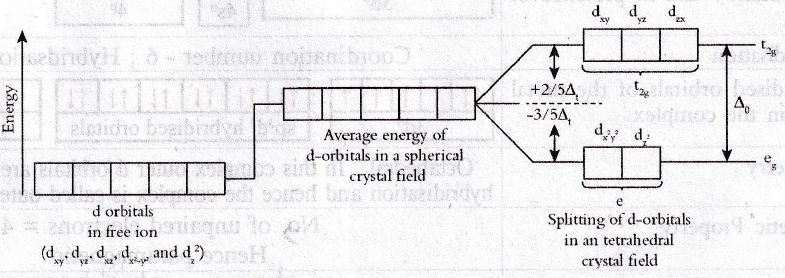
The actual configuration adopted by the complex decided by the relative values of Δ and P, where P represents the energy required for e- pairing in a single orbital and Δ is crystal field splitting energy.
3.
(i) [Co(NH3)5 CI]2+
(ii) [CO(NO2)3(NH3)3]
(iii) [Co(NH3)4H2OBr](NO3)2
(iv) [Co(en)2CI2]CI
(v) [Cu(NH3)4]SO4
4.
(i) Diamminesilver(I) chloride
(ii) Potassiumpentacyanidonitrosylferrate(II)
(iii) Ptricarbonyltriphenylphosphanechromium(O)
(iv) diamminesilver(I) ion
(v) Hexafluoridoferrate(II) ion.
5.
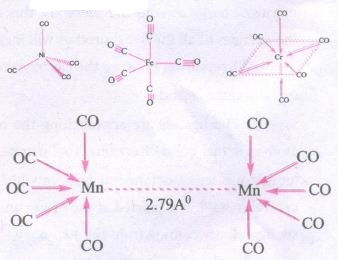
The structures of the binuclear metal carbonyls involve either metal-metal bonds or bridging CO groups, or both. The carbonyl ligands that are attached to only one metal atom are referred to as terminal carbonyl groups, whereas those attached to two metal atoms simultaneously are called bridging carbonyls. Depending upon the structures, metal carbonyls are classified as follows.
Non-bridged metal carbonyls:
These metal carbonyls do not contain any bridging carbonyl ligands. They may be of two types.
(i) Non- bridged metal carbonyls which contain only terminal carbonyls. Examples: [Ni (CO)4], [Fe (CO)5] and [Cr (CO)6]
(ii) Non- bridged metal carbonyls which contain terminal carbonyls as well as Metal- Metal bonds. For examples, The structure of Mn2(CO)10 actually involve only a metal-metal bond, so the formula is more correctly represented as (CO)5Mn-Mn(CO)5
Other examples of this type are, Tc2(CO) 10, and Re2(CO)10.
6.
Metal carbonyls are classified in two different ways as described below Classification based on the number of metal atoms present.
a. Mononuclear carbonyls
These compounds contain only one metal atom. For example, [Ni(CO)4] - nickel tetracarbonyl is tetrahedral, [Fe(CO)5] - Iron pentacarbonyl is trigonal bipyramidal, and [Cr(CO)6] - Chromium hexacarbonyl is octahedral.
b. Polynuclear carbonyls
Metallic carbonyls containing two or more metal atoms are called polynuclear carbonyls. Polynuclear metal carbonyls may be Homonuclear [Co2(CO)8], [Mn2(CO)10], [Fe3 (CO)12] or heteronuclear [MnCo(CO)9], [MnRe(CO)10] etc.
7.
Valance bond theory helps us to visualize the bonding in complexes. However, it has limitations as mentioned above. Hence Crystal Field Theory to explain some of the properties, like colour, magnetic behavior, etc., This theory I was originally used to explain the nature of bonding in ionic crystals. Later on, it is used to explain the properties of transition metals and their complexes. The salient features of this theory are as follows.
(i) Crystal Field Theory (CFT) assumes that the bond between the ligand and the central metal atom is purely ionic. i.e. the bond is formed due to the electrostatic attraction between the electron rich ligand and the electron deficient metal.
(ii) In the coordination compounds, the central metal atom/ion and the ligands are considered as point charges (in case of I charged metal ions or ligands) or electric dipoles (in case of neutral metal atoms or ligands).
(iii) According to crystal field theory, the complex formation is considered as the following series of hypothetical steps.
Step 1: In an isolated gaseous state, all the five d orbitals of the central metal ion are degenerate. Initially, the ligands form a spherical field of negative charge around the metal. In this filed, the energies of all the five d orbitals will increase due to the repulsion between the electrons of the metal and the ligand.
Step 2: The ligands are approaching the metal atom in actual bond directions. To illustrate this let us consider an octahedral field, in which the I central metal ion is located at the origin and the six ligands are coming from the +x, -x, +y, -y, +z and -z directions as shown below.
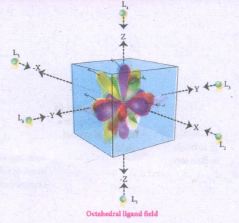
As shown in the figure, the orbitals lying along the axes dx2-y2 and dz2 orbitals will experience strong repulsion and raise in energy to a greater extent than the orbitals with lobes directed between the axes (dxy, dyz, and dzx). Thus the degenerate d orbitals now split into two sets and the process is called crystal field splitting.
Step 3: Up to this point the complex formation would not be favored. However, when the ligands approach further, there will be an attraction between the negatively charged electron and the positively charged metal ion, that results in a net decrease in energy. This decrease in energy is the driving force for the complex formation.
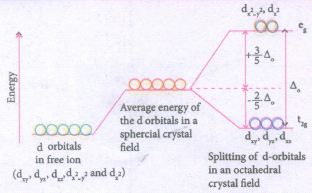
Crystal field splitting in octahedral complexes: During crystal field splitting in octahedral field, in order to maintain the average energy of the orbitals (barycentre) constant, the energy of the orbitals dx2-y2 and d z2 (represented as eg orbitals) will increase by 3/5 \({ \triangle }_{ o }\) while that of the other three orbitals dxy ' dyz and dzx (represented as t2g orbitals) decrease by 2/5 \({ \triangle }_{ o }\) , Here, \({ \triangle }_{ o }\) represents the crystal field splitting energy in the octahedral field.
8.
(i) The ligand ➝ metal bond in a coordination complex is covalent in nature. It is formed by sharing of electrons (provided by the ligands) between the central metal atom and the ligand.
(ii) Each ligand should have at least one filled orbital containing a lone pair of electrons.
(iii) In order to accommodate the electron pairs donated by the ligands, the central metal ion present in a complex provides required number (coordination number) of vacant orbitals.
(iv) These vacant orbitals of central metal atom undergo hybridisation, the process of mixing of atomic orbitals of comparable energy to form equal number of new orbitals called hybridised orbitals with same energy.
(v) The vacant hybridised orbitals of the central metal ion, linearly overlap with filled orbitals of the ligands to form coordinate covalent sigma bonds between the metal and the ligand.
(vi) The hybridised orbitals are directional and their orientation in space gives a definite geometry to the complex ion.
(vii) In the octahedral complexes, if the (n-1) d orbitals are involved in hybridisation, then they are called inner orbital complexes or low spin complexes or spin paired complexes. If the nd orbitals are involved in hybridisation, then such complexes are called outer orbital or high spin or spin free complexes. Here n represents the principle quantum number of the outermost shell.
(viii) The complexes containing a central metal atom with unpaired electron(s) are paramagnetic. If all the electrons are paired, then the complexes will be diamagnetic.
(ix) Ligands such as CO, CN·, en, and NH3 present in the complexes cause pairing of electrons present in the central metal atom. Such ligands are called strong field ligands.
(x) Greater the overlapping between the ligand orbitals and the hybridised metal orbital, greater is the bond strength.
9.
The coordination compounds can be classified into the following types based on (i) the net charge of the complex ion, (ii) kinds of ligands present in the coordination entity.
Classification based on the net charge on the complex:
A coordination compound in which the complex ion.
(i) carries a net positive charge is called a cationic complex. Examples: [Ag(NH3)2]+, [Co(NH3)6]3+, [Fe(H2O)6]2+, etc.
(ii) carries a net negative charge is called an anionic complex. Examples: [Ag(CN)2]-, [Co(CN)6]3-, [Fe(CN)6]4-, etc.
(iii) bears no net charge, is called a neutral complex. Examples: [Ni(CO)4],[Fe(CO)5] [Co(NH3)3(CI)3].
Classification based on kind of ligands:
A coordination compound in which
(i) the central metal ion/atom is coordinated to only one kind of ligands is called a homoleptic complex. Examples: [Co(NH3)6]3+ +, [Fe(H2O)6]2+,
(ii) the central metal ion/atom is coordinated to more than one kind of ligands is called a heteroleptic complex. Example, [Co(NH3)5CI]2+, [Pt(NH3)2CI2)]
10.
The stability of a complex or co-ordination compound refers to the extent up to which it exists in a solution as co-ordination sphere.
(i) Change on the central metal ion: Greater the charge on the central metal ion, greater the stability of complex.
(ii) Nature of the metal ion: Group 3 and 6 and inner transition elements form stable complexes when donor atoms of the ligands are N, O and F. The elements after group 6 of the transition metals form stable complex when the donor atoms of the ligands are the heavier members of N, O and F family.
(iii) Basic nature of the ligands: Greater the basic strength, greater is the stability of the complex.
(iv) Presence of chelate rings: Its presence increases the stability of the complex. it is called chelate effect. It is maximum for the 5 and 6 membered rings.
(v) Effect of multidentate cyclic ligand: If the ligands are IT multidentate and cyclic without any steric effect the stability of the complex get increased.
11.
(i) [NiCI4]2-
IUPAC name - Tetrachloridonickelate (II) ion
(ii) Ni2+ = 3d8,4s0
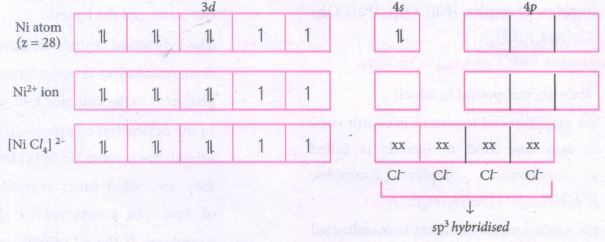
Cl- being a weak field ligand cannot pair up the unpaired electron. So, it is sp3 hybridised, and it has tetrahedral geometry.
12.
(i) It exhibits both geometrical and optical isomerism
(a) Geometrical isomers:
.JPG)
(b) Optical isomers:
.JPG)
(ii) It shows two optical isomers
.JPG)
(iii) Ionisation isomers
Linkage isomers
[Co(NH3)5(NO2)(NO3)2], [CO(NH3)5 (ONO)](NO3)2
(iv) Geometrical isomers
.JPG)
13.
The postulates of valence bond theory
(i) The central metal atom/ion makes available a number of vacant orbitals equal to its coordination number.
(ii) These vacant orbitals form covalent bonds with the ligand orbitals.
(iii) A covalent bond is formed by the overlap of a vacant metal orbital and filled ligand orbitals. This complete overlap leads to the formation of a metal ligand, σ (sigma) bond.
(iv) A strong covalent bond is formed only when the orbitals overlap to the maximum extent.
(v) This maximum overlapping is possible only when the metal vacant orbitals undergo a process called 'hybridisation'.
(vi) A hybridised orbital has a better directional characteristic than an unhybridized one. The following table gives the coordination number, orbital hybridisation, and geometry of the complexes.
| Coordination number | Types of hybridisation | Geometry |
|---|---|---|
| 2 | sp | linear |
| 4 | sp3 | tetrahedral |
| 4 | dsp3 | square planer |
| 6 | d2sp3 | octahedral |
| 6 | sp3d2 | octahedral |
Magnetic moment
The paramagnetic moment is given by the following spin-only formula.
\({ \mu }_{ s }=\sqrt { n(n+2) } \) BM
BM = Bohr magneton
\({ \mu }_{ s }\) = spin -only magnetic moment
n = number of unpaired electrons.
14.
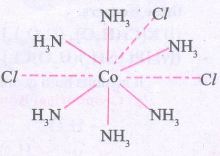
(i) Every metal atom has two types of valencies Primary valency or ionisable valency Secondary valency or non ionisable valency
(ii) The primary valency corresponds to the oxidation state of the metal ion. It is always satisfied by negative ions.
(iii) Secondary valency corresponds to the coordination number of the metal ion or atom. It is satisfied by either negative ions or neutral molecules.
(iv) The molecules or ions that satisfy secondary valencies are called ligands.
(v) The ligands which satisfy secondary valencies must project in definite directions in space. So the secondary valencies are directional in nature whereas the primary valencies are non - directional in nature.
(vi) The ligands have unshared pair of electrons. These unshared pair of electrons are donated to central metal ion or atom in a compound. Such compounds are called coordination compounds.
Werner's representation
Eg: [Co(NH)6]Cl3
Cl: primary valency (dotted lines)
NH3: secondary valency (solid lines).
Defects of Werner's theory
Werner's theory describes the structures of many co-ordination compounds successfully. However, it does not explain the magnetic and spectral properties.
15.
a) [FeF6]4-: Fe atom - outer electronic configuration 3d6 4s2
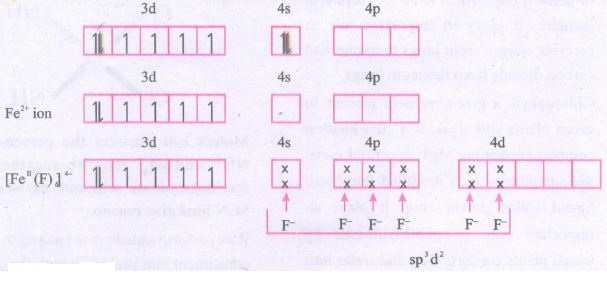
F- is weak field ligand
In [FeF6]4-the hybridisation takes place is sp3d2
The number of unpaired electrons = 4.
\(\therefore \mu =\sqrt { 4(4+2) } =\sqrt { 24 } \)
The molecule is paramagnetic due to the presence of unpaired electrons.
The geometry of the molecule is octahedral.
b) [Fe(CN)6]4-
.JPG)
In [Fe(CN)6]4- complex, the CN- ligand is a powerful ligand, it forces the unpaired electrons in the 3d level to pair up inside.
Hence the species has no unpaired electron after hybridisation So the molecule is diamagnetic.
.JPG)
The geometry of the molecule is octahedral.

12th Standard Syllabus & Materials
12th Standard
TN 12th Computer Applications வலையமைப்பு வடமிடல் Sample Question Papers Study Material - QB365 Set A
NEW12th Standard
TN 12th Computer Applications களப்பெயர் முறைமை (DNS) Sample Question Papers Study Material - QB365 Set A
NEW12th Standard
TN 12th Computer Applications வலையமைப்பு எடுத்துக்காட்டுகள் மற்றும் நெறிமுறைகள் Sample Question Papers Study Material - QB365 Set A
NEW12th Standard
TN 12th Computer Applications கணினி வலையமைப்பு ஓர் அறிமுகம் Sample Question Papers Study Material - QB365 Set A



Tamilnadu Stateboard 12th Standard Subjects

Maths
Chemistry

Physics

Biology

Computer Science

Business Maths and Statistics

Economics

Commerce

Accountancy

History

Computer Applications
Biology
Computer Technology
Computer Applications
Computer Science
Business Maths and Statistics
Commerce
Economics
Maths
Chemistry
Physics
Computer Technology
History
Accountancy

Tamil

English

French
Tamilnadu Stateboard Standards
