
 100% FREE ACCESS
12th Standard Syllabus & Materials
12th Standard
TN 12th Computer Applications மின்னணு தரவு பரிமாற்றம் Sample Question Papers Study Material - QB365 Set A
NEW12th Standard
TN 12th Computer Applications மின் - வணிக பாதுகாப்பு அமைப்புகள் Sample Question Papers Study Material - QB365 Set A
NEW12th Standard
TN 12th Computer Applications மின்னணு செலுத்தல் முறைகள் Sample Question Papers Study Material - QB365 Set A
NEW12th Standard
TN 12th Computer Applications மின் - வணிகம் Sample Question Papers Study Material - QB365 Set A
NEW12th Standard
TN 12th Computer Applications திறந்த மூல கருத்துருக்கள் Sample Question Papers Study Material - QB365 Set A
NEW12th Standard
TN 12th Computer Applications வலையமைப்பு வடமிடல் Sample Question Papers Study Material - QB365 Set A

Published on: 28/01/2021
12th Standard Chemistry English Medium Coordination Chemistry Reduced Syllabus Important Questions With Answer Key 2021
Download Tamil Nadu 12th Standard Chemistry question papers, model tests, one-mark questions, important questions, and public exam papers in PDF format. Free study materials and answer keys for TN State Board students.
Questions + Answers key
Take MCQ Chemistry Test
1.
Identify the ligand and the central metal in the Co-ordination compound. [Co(NH3)4Cl6]CI
2.
Calculate the Oxidation number of
(i) Iron in [Fe(CN)6]4-.
(ii) Cobalt in [Co(NH3)5CI)]2+.
3.
What are ligands?
4.
What is a central atom or ion?
5.
Calculate the magnetic moment of [Fe(H2O)6]2+, if atomic number of Fe is 26.
6.
Write a neutral molecule in which the central atom is Sp3d2 hybridised.
7.
Write the oxidation state, coordination number , nature of ligand, magnetic property and electronic configuration in octahedral crystal field for the complex K4[Mn(CN)6]
8.
Classify the following ligands based on the number of donor atoms.
a) NH3
b) en
c) ox2-
d) pyridine
9.
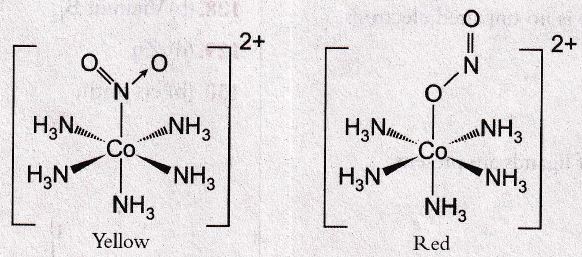
What is linkage isomerism? Explain with an example.
10.
Give an example for complex of the type [Ma2b2c2] where a, b, c are monodentate ligands and give the possible isomers.
11.
Give an example of coordination compound used in medicine and two examples of biologically important coordination compounds.
12.
Arrange the following in order of increasing molar conductivity
(i) Mg[Cr(NH3)(Cl)5]
(ii) Cr(NH3)5Cl]3[CoF6]2
(iii) [Cr(NH3)3Cl3]
13.
Write the formula for the co-ordination compounds.
14.
What are the limitations of VBT?
15.
Match the common name with formula and the IUPAC ligand name.
| Common name | Formula | IUPAC ligand name |
|---|---|---|
| Bromide | C2O42- | Carbonato |
| Nitrate | Br- | Oxalato |
| hydroxide | NO3- | hydroxido |
| Carbonate | OH- | bromido |
| Oxalate | CO32- | nitrato |
16.
What is meant by unidentate, didentate and ambidentate Iigands Give two examples for each.
17.
Aqueous copper sulphate solution (blue) gives
(i) a green precipitate with aqueous potassium fluoride.
(ii) a bright green solution with aqueous potassium chloride. Explain these experimental results.
18.
How is magnitude of \({ \triangle }_{ 0 }\) affected by (i) nature of ligands (ii) oxidation state of metal ion.
19.
Write briefly about the applications of coordination compounds in volumetric analysis
20.
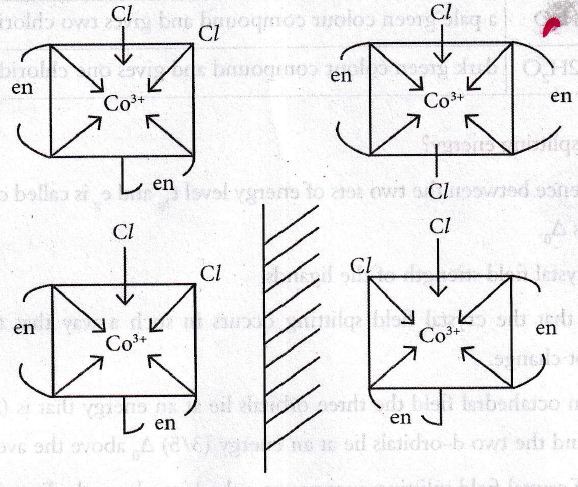
Draw all possible geometrical isomers of the complex [Co(en)2Cl2]+ and identify the optically active isomer.
21.
Give the structure for the following compounds.
(i) pentaamminechlorocobalt (III) ion
(ii) Triamminetrinitrito- k N cobalt (III)
(ill) tetraammineaquabromidooobalt(III)nitrate
(iv) Dichloridobisethane-(1,2-diamine) cobalt (lIl) chloride
(v) Tetraamminecopper (lI) sulphate
22.
Give the IUPAC name for the following compounds.
(i) [Ag(NH3)2]CI
(ii) K3[Fe(CN)5NO]
(ill) [Cr(PPh3)(CO)3]
(iv) [Ag(NH3)2]+
(v) [FeF6]4-
23.
How are metal carbonyls classified depending on the number of metal atoms?
24.
What are the salient feature of crystal field theory?
25.
What is meant by stability of a co-ordination compound in solution? State the factors which govern stability of complexes.
26.
What are the postulates of valance bond theory? Give its limitations.
27.
Give the difference between double salts and coordination compounds.
28.
Primary valency corresponds to the _______.
oxidation state of the metal
co-ordination number
number of ligands
charge on the complex
29.
According to crystal field theory, the bond between the ligand and central metal atom is_______.
Purely ionic
Purely covalent
Coordinate
50% ionic and 50% covalent
30.
The ligand capable of coordinating in two or more ways with the central metal ion are called _______ ligands.
didentate
tridentate
ambidentate
none of the above
31.
A 'd' block metal ion has a magnetic moment of 1.732 BM. The number of unpaired electrons are _______.
1
2
3
4
32.
Which of the following is not true about secondary valency?
It corresponds to the co-ordination number of metal
It is satisfied by negative ions or neutral molecule
They are non directional in nature
both (a) and (b)
33.
The coordination number of Ni(II) in [Ni(CN)4]2- is _______.
2
4
5
0
34.
In [Fe11(CN)6]4-, the central metal ion is _______.
Fe
Fe2+
Fe3+
CN-
35.
The oxidation number of nickel in complex ion, [NiCI4]2- is _______.
+1
-1
+2
-2
36.
Coordination compounds are stabilised by Chelate effect. Which among the following is the most stable complex?
[Fe(CN)6]3-
[Fe(Co)5]
[Fe(NH3)6]3+
[Fe(C2O4)3]3-
37.
Which of the following co-ordination compounds would exhibit optical isomerism?
Pemtaamminenitrocobalt (III) iodide
Diamminedichloropaltinum (II)
Tris-(ethylenediamine) cobalt (III) bromide
Transdicyanobis( ethylenediamine) chromium (III) chloride
38.
The total number of electrons donated by ligands to platinum ion in [Pt(en)2CI2] is _______.
8
10
12
14
39.
A complex in which the oxidation number of the metal is zero is_______.
K4[Fe(CN)6]
[Fe(CN)3(NH3)3]
[Fe(CO)5]
both (b) and (c)
40.
Crystal field stabilization energy for high spin d5 octahedral complex is _______.
-0.6\({ \Delta }_{ 0 }\)
0
2(P-\({ \Delta }_{ 0 }\))
2(P+\({ \Delta }_{ 0 }\))
41.
An excess of silver nitrate is added to 100ml of a 0.01M solution of Pentaaquachlorochromium (III)chloride. The number of moles of AgCl precipitated would be _______.
0.02
0.002
0.01
0.2
42.
The sum of primary valence and secondary valence of the metal M in the complex [M(en)2(Ox)]Cl is________.
3
6
-3
9
1.
Ligands NH3 AND Cl-
Central metal Co (in cationic complex).
2.
(i) In [Fe(CN)6]4-, Let the oxidation number of iron is x:
The net charge: -4 = x + 6 (-1) => x = +2
(ii) In [Co(NH3)5]2+, let the oxidation number of cobalt is x:
The net charge: +2 = x + 5(0) + 1 (-1) => x = +3
3.
(i) The ligands are the atoms or groups of atoms bound to the central atom/ion. The atom in a ligand that is bound directly to the central metal atom is known as a donor atom.
(ii) For example, in K4[Fe(CN)6], the ligand is CN- ion, but the donor atom is carbon.
4.
(i) The central atom or ion is the one that occupies the central position in a coordination entity and binds other atoms or groups of atoms (ligands) to itself, through a coordinate covalent bond.
(ii) For example, in K4[Fe(CN)6], the central metal ion is Fe2+. In the coordination entity [Fe(CN)6]4-, the Fe2+ accepts an electron pair from each ligand, CN- and thereby forming six coordinate covalent bonds with them.
(iii) It is referred to as a Lewis acid.
5.
Magnetic moment (μ) = \(\sqrt { n(n+2) } \) BM
Fe (z = 26) = 1s2 2s2 2p6 3s2 3p6 4s2 3d6
Fe2+ = 1s2 2s2 2p6 3s2 3p6 3d6 4s0

∴μ = \(\sqrt { n(n+2) } \) = \(\sqrt { 4(4+2) } =\sqrt { 24 } \)
= 4. 89 BM
6.
K3[CoF6]
7.
(i) Oxidation state of the central metal ion : +2 (i.e) Mn2+
(ii) Co-ordination number : 6
(iii) Nature of ligand: CN- (Negative ligand)
(iv) Magnetic property: Paramagnetic nature
(v) Electronic configuration:
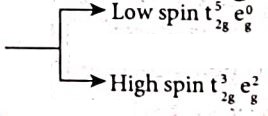
(vi) Oxidation state: +2 (or) Mn2+ of central metal ion
8.
| Ligand | Type of Ligand | Number of donor atoms |
| NH3 | monodentate ligand | 1 |
| en | bidentate ligand | 2 |
| ox2- | bidentate ligand | 2 |
| pyridine | monodentate ligand | 1 |
9.
(i) This is also called as salt isomerism.
(ii) This type of isomers arises when an ambidentate ligand is bonded to the central metal atom/ion through either of its two different donor atoms. In the below mentioned examples, the nitrite ion is bound to the central metal ion Co3+ through a nitrogen atom in one complex and through oxygen atom in other complex.
\(\left[\mathrm{Co}\left(\mathrm{NH}_{3}\right)_{5}\left(\mathrm{NO}_{2}\right)\right]^{2+}\)
10.
[Ma2b2C2]\(\pm\)n where a, b, c are monodentate ligands.
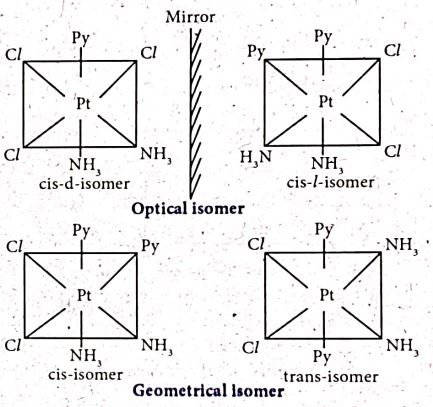
[Pt(py2)(NH3)2Cl2]2+. It exhibits both optical and geometrical isomerism. c is isomer exhibit optical isomerism also. While trans isomer exhibits geometrical isomerism only.
11.
Medicinal uses
(i) Ca-EDTA chelate, is used in the treatment of lead and radioactive poisoning.
(ii) That is for removing lead and radioactive metal ions from the body.
(iii) Cis-platin is used as an antitumor drug in cancer treatment.
Biological Importance compounds:-
(i) Fe2+ - porphyrin complex: It plays an important role in carrying oxygen from lungs to tissues and tissue carbon dioxide from to lungs.
(ii) Chlorophyll - useful in photosynthesis in plants.
12.
(i) \(\mathrm{Mg}\left[\mathrm{Cr}\left(\mathrm{NH}_{3}\right) \mathrm{Cl}_{5}\right]^{2-} \rightleftharpoons \mathrm{Mg}^{2+}+\left[\mathrm{Cr}\left(\mathrm{NH}_{3}\right) \mathrm{Cl}_{5}\right]^{2-} (2 ions)\)
(ii) \(\begin{aligned}
{\left[\mathrm{Cr}\left(\mathrm{NH}_3\right)_5 \mathrm{Cl}_3\left[\mathrm{CoF}_6\right]_2 \rightleftharpoons 3\right.} & {\left[\mathrm{Cr}\left(\mathrm{NH}_3\right)_5 \mathrm{Cl}\right]^{2+} } \\
& (5 \text { ions })
\end{aligned}\)\(+2\left[\mathrm{CoF}_6\right]^{3-}\)
(iii) \(\left[\mathrm{Cr}\left(\mathrm{NH}_{3}\right)_{3} \mathrm{Cl}_{3}\right]= \text{ No ions}\)
If no of ions increases, molar conductivity increases molar conductivity of the complex also INCREASES.
\(\therefore\) The order of the given compound is
[Cr(NH3)3Cl3]<Mg[Cr(NH3)3Cl3] < [Cr(NH3)5Cl3] [CoF6]2
(No ion) (2 ions) (5 ions)
13.
a) potassiumhexacyanidoferrate(II) - Potassiumhexacyanidoferrate(II) - K4[Fe(CN)6]
b) Pentacarbonyliron(0) - [Fe(CO)5]
c) Pentaamminenitrito −kNcobalt(III)ion - [Co(NH3)5(NO2)]2+
d) Hexaamminecobalt(III) Sulphate - [CO(NH3)6](SO4)3
e) Sodiumtetrafluoridodihydroxidochromate(III) - Na2[CrF4(OH)2]
14.
Even though VBT explains many of the observed properties of complexes, it still has following limitations.
(i) It does not explain the colour of the complex.
(ii) It considers only the spin only magnetic moments and does not consider the other components of magnetic moments.
(iii) It does not provide a quantitative explanation as to why certain complexes are inner orbital complexes and the: others are outer orbital complexes for the same metal. For example, [Fe(CN)6]4- is diamagnetic (low spin) whereas [FeF6]4-is paramagnetic (high spin).
15.
| Common name | Formula | IUPAC ligand name |
|---|---|---|
| Bromide | Br- | bromido |
| Nitrate | NO3- | nitrato |
| hydroxide | OH- | hydroxido |
| Carbonate | CO32- | Carbonato |
| Oxalate | C2O42- | Oxalato |
16.
(i) UNIDENTATE LIGAND: (or) Monodentate
When a ligand is bonded through one donor site to central metal atom/ion it is said to be unidentate ligand.
Eg: Cl-, CO, NH3, H2O, etc.
(ii) DIDENTATE LIGAND: (or) Bidentate
When a ligand is bonded through two donor sites to central metal atom/ion, it is said to be didentate ligand.
Eg: Oxalate, 1,2 - ethanediamine.
(iii) AMBIDENTATE LIGAND:
When a ligand i.s bonded through two different atoms, it is said to be ambidentate ligand.
Eg: NO2-, SCN-, CN-
17.
Aqueous copper sulphate (blue) is [Cu(H2O)4] SO4.
[Cu(H2O)4]SO4 ⟶ [Cu(H2O)4]2+ + SO42-
[Cu(H2O4)]2+ is a liable complex in which H2O ligand get easily replaced by F- ions of KF and by Cl- ions of KCI.
(i) [Cu(H2O)4]2+(aq) + 4F- ⟶ \(\underset { Green \ ppt }{ { \left[ Cu{ F }_{ 4 } \right] }^{ 2- } } +4{ H }_{ 2 }O\)
(ii) [Cu(H2O)4]2+(aq) +4Cl-(aq) ⟶ \(\underset { Bright \ green\ ppt }{ { \left[ Cu{ F }_{ 4 } \right] }^{ 2- } } +4{ H }_{ 2 }O\)
18.
(i) Greater the strength of the ligands greater is the value of \({ \triangle }_{ 0 }\)
(ii) Higher the ionic charge on the central metal ion. Greater will be value of \({ \triangle }_{ 0 }\)
19.
(i) EDTA is used in the volumetric determination of a wide variety of metal ions in solution.
Eg. Zn2+, Pb2+, Ca2+, CO2+, Ni2+,Cu2+, etc.
(ii) By careful adjustment of the pH and using suitable indication, mixtures of metals can v be analyzed.
Eg. Bi3+in the presence of Pb2+
(iii) Hardness of water due to the presence of Ca2+ and Mg2+ ions is estimated by complexometric titrations using EDTA.
20.
[Co (en)2 Cl2]+ This is an octahedral complex
21.
(i) [Co(NH3)5 CI]2+
(ii) [CO(NO2)3(NH3)3]
(iii) [Co(NH3)4H2OBr](NO3)2
(iv) [Co(en)2CI2]CI
(v) [Cu(NH3)4]SO4
22.
(i) Diamminesilver(I) chloride
(ii) Potassiumpentacyanidonitrosylferrate(II)
(iii) Ptricarbonyltriphenylphosphanechromium(O)
(iv) diamminesilver(I) ion
(v) Hexafluoridoferrate(II) ion.
23.
Metal carbonyls are classified in two different ways as described below Classification based on the number of metal atoms present.
a. Mononuclear carbonyls
These compounds contain only one metal atom. For example, [Ni(CO)4] - nickel tetracarbonyl is tetrahedral, [Fe(CO)5] - Iron pentacarbonyl is trigonal bipyramidal, and [Cr(CO)6] - Chromium hexacarbonyl is octahedral.
b. Polynuclear carbonyls
Metallic carbonyls containing two or more metal atoms are called polynuclear carbonyls. Polynuclear metal carbonyls may be Homonuclear [Co2(CO)8], [Mn2(CO)10], [Fe3 (CO)12] or heteronuclear [MnCo(CO)9], [MnRe(CO)10] etc.
24.
Valance bond theory helps us to visualize the bonding in complexes. However, it has limitations as mentioned above. Hence Crystal Field Theory to explain some of the properties, like colour, magnetic behavior, etc., This theory I was originally used to explain the nature of bonding in ionic crystals. Later on, it is used to explain the properties of transition metals and their complexes. The salient features of this theory are as follows.
(i) Crystal Field Theory (CFT) assumes that the bond between the ligand and the central metal atom is purely ionic. i.e. the bond is formed due to the electrostatic attraction between the electron rich ligand and the electron deficient metal.
(ii) In the coordination compounds, the central metal atom/ion and the ligands are considered as point charges (in case of I charged metal ions or ligands) or electric dipoles (in case of neutral metal atoms or ligands).
(iii) According to crystal field theory, the complex formation is considered as the following series of hypothetical steps.
Step 1: In an isolated gaseous state, all the five d orbitals of the central metal ion are degenerate. Initially, the ligands form a spherical field of negative charge around the metal. In this filed, the energies of all the five d orbitals will increase due to the repulsion between the electrons of the metal and the ligand.
Step 2: The ligands are approaching the metal atom in actual bond directions. To illustrate this let us consider an octahedral field, in which the I central metal ion is located at the origin and the six ligands are coming from the +x, -x, +y, -y, +z and -z directions as shown below.
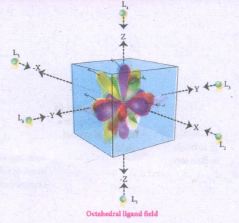
As shown in the figure, the orbitals lying along the axes dx2-y2 and dz2 orbitals will experience strong repulsion and raise in energy to a greater extent than the orbitals with lobes directed between the axes (dxy, dyz, and dzx). Thus the degenerate d orbitals now split into two sets and the process is called crystal field splitting.
Step 3: Up to this point the complex formation would not be favored. However, when the ligands approach further, there will be an attraction between the negatively charged electron and the positively charged metal ion, that results in a net decrease in energy. This decrease in energy is the driving force for the complex formation.
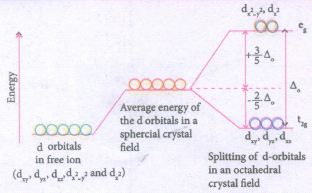
Crystal field splitting in octahedral complexes: During crystal field splitting in octahedral field, in order to maintain the average energy of the orbitals (barycentre) constant, the energy of the orbitals dx2-y2 and d z2 (represented as eg orbitals) will increase by 3/5 \({ \triangle }_{ o }\) while that of the other three orbitals dxy ' dyz and dzx (represented as t2g orbitals) decrease by 2/5 \({ \triangle }_{ o }\) , Here, \({ \triangle }_{ o }\) represents the crystal field splitting energy in the octahedral field.
25.
The stability of a complex or co-ordination compound refers to the extent up to which it exists in a solution as co-ordination sphere.
(i) Change on the central metal ion: Greater the charge on the central metal ion, greater the stability of complex.
(ii) Nature of the metal ion: Group 3 and 6 and inner transition elements form stable complexes when donor atoms of the ligands are N, O and F. The elements after group 6 of the transition metals form stable complex when the donor atoms of the ligands are the heavier members of N, O and F family.
(iii) Basic nature of the ligands: Greater the basic strength, greater is the stability of the complex.
(iv) Presence of chelate rings: Its presence increases the stability of the complex. it is called chelate effect. It is maximum for the 5 and 6 membered rings.
(v) Effect of multidentate cyclic ligand: If the ligands are IT multidentate and cyclic without any steric effect the stability of the complex get increased.
26.
The postulates of valence bond theory
(i) The central metal atom/ion makes available a number of vacant orbitals equal to its coordination number.
(ii) These vacant orbitals form covalent bonds with the ligand orbitals.
(iii) A covalent bond is formed by the overlap of a vacant metal orbital and filled ligand orbitals. This complete overlap leads to the formation of a metal ligand, σ (sigma) bond.
(iv) A strong covalent bond is formed only when the orbitals overlap to the maximum extent.
(v) This maximum overlapping is possible only when the metal vacant orbitals undergo a process called 'hybridisation'.
(vi) A hybridised orbital has a better directional characteristic than an unhybridized one. The following table gives the coordination number, orbital hybridisation, and geometry of the complexes.
| Coordination number | Types of hybridisation | Geometry |
|---|---|---|
| 2 | sp | linear |
| 4 | sp3 | tetrahedral |
| 4 | dsp3 | square planer |
| 6 | d2sp3 | octahedral |
| 6 | sp3d2 | octahedral |
Magnetic moment
The paramagnetic moment is given by the following spin-only formula.
\({ \mu }_{ s }=\sqrt { n(n+2) } \) BM
BM = Bohr magneton
\({ \mu }_{ s }\) = spin -only magnetic moment
n = number of unpaired electrons.
27.
| S. No | Double salts | Co-ordination compound |
|---|---|---|
| 1. | They usually contain two simple salt in equimolar proportions | The simple salts from which they are formed may or may not be in equimolar proportion. |
| 2. | They exists only in the solid state. In aqueous solution they dissociate completely into ions. | They exist in the solid state as well as in aqueous solution. This is because even in solution, the complex ion does not dissociate into ions. |
| 3. | They are ionic compounds and do not contain any co-ordinate bond. | They may or may not be ion but the complex part always contain coordinate bonds |
| 4. | The properties of the double salts are same as those of its constituent compounds. | The properties of the coordination compounds are different for its constituent bonds. |
| 5. | In a double salt, the metal ion show their normal valency. | In a coordinate compound the metal ion satisfies its two types of valence called primary & secondary valenices. |
| 6. | A double salt loses its identity and dissociates into its constitute simple ions in solution. | The complex ion does not lose its identity and never dissociate to give simple ions. |
| Example: FeSO4 (NH4)2 SO4.6H2O | Example: K4[Fe(CN)6), K3[Fe(SCN)6) |
28.
(a)
oxidation state of the metal
29.
(a)
Purely ionic
30.
(c)
ambidentate
31.
(a)
1
32.
(c)
They are non directional in nature
33.
(b)
4
34.
(b)
Fe2+
35.
(c)
+2
36.
(d)
[Fe(C2O4)3]3-
37.
(c)
Tris-(ethylenediamine) cobalt (III) bromide
38.
(c)
12
39.
a) Fe2+ b) Fe3+ c) Fe0
40.
The electronic configuration t2g3, e2g
[ 3 x (-0.4)+ 2(0.6)]Δ0
[-1.2 + 1.2] Δ0 = 0
41.
The complex is [M(H2O)5Cl]Cl2
1000 ml of 1 M solution of the complex gives 2 moles of Cl- ions 1000 ml of 0.01 M solution of the complex will give
\(\frac{100 ml \times 0.01M \times 2Cl^-}{1000 ml \times 1M}\)
= 0.002 moles of Cl- ions
42.
In the complex [M(en)2(Ox)]Cl For the central metal ion M3+
The primary valence is = +3
The secondary valence = 6
sum of primary valence and secondary valence = 3 + 6 = 9

12th Standard Syllabus & Materials
12th Standard
TN 12th Computer Applications களப்பெயர் முறைமை (DNS) Sample Question Papers Study Material - QB365 Set A
NEW12th Standard
TN 12th Computer Applications வலையமைப்பு எடுத்துக்காட்டுகள் மற்றும் நெறிமுறைகள் Sample Question Papers Study Material - QB365 Set A
NEW12th Standard
TN 12th Computer Applications கணினி வலையமைப்பு ஓர் அறிமுகம் Sample Question Papers Study Material - QB365 Set A
NEW12th Standard
TN 12th Computer Applications PHP-உடன் MySQL-ஐ இணைத்தல் Sample Question Papers Study Material - QB365 Set A



Tamilnadu Stateboard 12th Standard Subjects

Maths
Chemistry

Physics

Biology

Computer Science

Business Maths and Statistics

Economics

Commerce

Accountancy

History

Computer Applications
Biology
Computer Technology
Computer Applications
Computer Science
Business Maths and Statistics
Commerce
Economics
Maths
Chemistry
Physics
Computer Technology
History
Accountancy

Tamil

English

French
Tamilnadu Stateboard Standards
