
 100% FREE ACCESS
12th Standard Syllabus & Materials
12th Standard
TN 12th Computer Applications மின்னணு தரவு பரிமாற்றம் Sample Question Papers Study Material - QB365 Set A
NEW12th Standard
TN 12th Computer Applications மின் - வணிக பாதுகாப்பு அமைப்புகள் Sample Question Papers Study Material - QB365 Set A
NEW12th Standard
TN 12th Computer Applications மின்னணு செலுத்தல் முறைகள் Sample Question Papers Study Material - QB365 Set A
NEW12th Standard
TN 12th Computer Applications மின் - வணிகம் Sample Question Papers Study Material - QB365 Set A
NEW12th Standard
TN 12th Computer Applications திறந்த மூல கருத்துருக்கள் Sample Question Papers Study Material - QB365 Set A
NEW12th Standard
TN 12th Computer Applications வலையமைப்பு வடமிடல் Sample Question Papers Study Material - QB365 Set A

Published on: 02/09/2022
QB365 provides a detailed and simple solution for every Possible Book Back Questions in Class 12 Chemistry Subject - Electro Chemistry, English Medium. It will help Students to get more practice questions, Students can Practice these question papers in addition to score best marks.
Download Tamil Nadu 12th Standard Chemistry question papers, model tests, one-mark questions, important questions, and public exam papers in PDF format. Free study materials and answer keys for TN State Board students.
Questions + Answers key
Take MCQ Chemistry Test
1.
The resistance of a conductivity cell is measured as 190 Ω using 0.1M KCl solution (specific conductance of 0.1M KCl is 1.3 Sm-1). When the same cell is filled with 0.003 M sodium chloride solution, the measured resistance is 6.3KΩ. Both these measurements are made at a particular temperature. Calculate the specific and molar conductance of NaCl solution.
2.
Calculate the molar conductance of 0.025M aqueous solution of calcium chloride at 25°C. The specific conductance of calcium chloride is 12.04 x 10⁻² Sm-1.
3.
A conductivity cell has two platinum electrodes separated by a distance 1.5 cm and the cross sectional area of each electrode is 4.5 sq cm. Using this cell, the resistance of 0.5 N electrolytic solution was measured as 15 Ω. Find the specific conductance of the solution.
4.
A solution of silver nitrate is electrolysed for 20 minutes with a current of 2 amperes. Calculate the mass of silver deposited at the cathode.
5.
Why does conductivity of a solution decrease on dilution of the solution.
6.
Define anode and cathode
7.
Explain the function of H2 - O2 fuel cell.
8.
Describe the electrolysis of molten NaCl using inert electrodes
1.
Given that
κ = 1.3 Sm-1 (for 0.1M KCl solution)
R = 190 Ω
\(\kappa = \frac{1}{R}(\frac{l}{A})\)
κ . R =\((\frac{l}{A})\) = (1.3 Sm-1) (190Ω)
= 247 m-1
\(\kappa_{(NaCl)} = \frac{1}{R_{(NaCl)}} (\frac{l}{A})\)
\(= \frac{1}{6.3 K\Omega}(247 m^{-1})\) (6.3KΩ = 6.3 x 10³Ω)
= 39.2 x 10⁻³ Sm-1
\(\Lambda_m = \frac{\kappa \times 10^{-3} mol^{-1} m^3}{M}\)
\(=\frac{39.2 \times 10 ^{-3}(Sm^{-1})10^-3 (mol^{-1} m^3)}{0.003}\)
\(\Lambda_m\) = 13.04 \(\times\) 10-3 Sm2 mol-1
2.
Molar conductance = Λm = \( \frac{k\ (Sm^{-1})\times10^{-3}}{M} mol^{-1}m^{3} \)
\(= \frac{(12.04 \times 10^{-2} Sm^{-1}) \times 10^{-3} (mol^{-1}m^{3})} {0.025}\)
= 481.6 x 10⁻⁵ Sm2mol-1
3.
l = 1.5 cm = 1.5 × 10⁻²m
A = 4.5 cm2 = 4.5 × (10-4)m2
R = 15Ω
\(\kappa = \frac{1}{R}(\frac{l}{A})\)
\(\kappa = \frac{1}{15\Omega}\times\frac{1.5\times10^{-2}m}{4.5\times10^{-4}m^2}\)
= 2.22 ohm-1 m-1
= 2.22 Sm-1
4.
Electrochemical reaction at cathode is Ag+ + e- → Ag (reduction)
m = ZIT
Z = \(\frac{\text {molar mass of Ag}}{(96500)}\) = \(\frac{108}{1 \times 96500} \)
I = 2A
t = 20 x 60S = 1200 S
It = 2A x 1200S = 2400C
m = \(\frac{108 gmol^{-1}}{96500 C mol^{-1}} \times\) 2400C
m = 2.68g
5.
On dilution the concentration decreases. Conductivity decreases with decrease in concentration (or dilution) as the number of ions per unit volume that carry the current in a solution decrease on dilution.
6.
(i) Anode: The electrode at which the oxidation occurs is called anode. (loss of electrons)
(ii) Cathode: The electrode at which the reduction occurs is called cathode. (gain of electrons)
7.
(i) In this case, hydrogen act as a fuel and oxygen as an oxidant and the electrolyte is aqueous KOH maintained at 200oC and 20-40 atm. Porous graphite electrode containing Ni and NiO serves as the inert electrodes.
(ii) Hydrogen and oxygen gases are bubbled through the anode and cathode, respectively.
Oxidation occurs at the anode:
\(2 \mathrm{H}_{2(\mathrm{~g})}+4 \mathrm{OH}_{(a q)}^{-} \rightarrow 4 \mathrm{H}_{2} \mathrm{O}_{(l)}+4 \mathrm{e}^{-}\)
Reduction occurs at the cathode:
\(\mathrm{O}_{2(\mathrm{~g})}+2 \mathrm{H}_{2} \mathrm{O}_{(t)}+4 \mathrm{e}^{-} \rightarrow 4 \mathrm{OH}_{(\mathrm{aq})}^{-}\)
(iii) The overall reaction is \(2 \mathrm{H}_{2(\mathrm{~g})}+\mathrm{O}_{2(\mathrm{~g})} \rightarrow 2 \mathrm{H}_{2} \mathrm{O}_{(1)}\)
(iv) The above reaction is the same as the hydrogen combustion reaction, however, they do not react directly ie., the oxidation and reduction reactions take place separately at the anode and cathode respectively like H2-O2 fuel cell. Other fuel cells like propane -O2 and methane O2 have also been developed.
8.
(i) The electrolytic cell consists of two iron electrodes dipped in molten sodium chloride and they are connected to an external DC power supply via a key as shown in the figure. The electrode which is attached to the negative end of the power supply is called the cathode, and the one which attached to the positive end is called the anode. Once the key is closed, the external DC power supply drives the electrons to the cathode and at the same time pull the electrons from the anode.
Cell reactions:
Na+ ions are attracted towards cathode, where they combines with the electrons and reduced to liquid sodium.
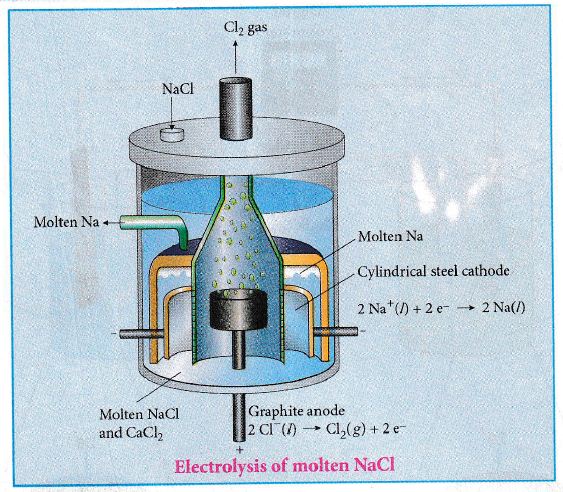
Cathode (reduction)
\(N a_{(l)}^{+}+e^{-} \rightarrow N a_{(l)} \quad ; \quad E^{0}=-2.71 V\)
Similarly, Cl- ions are attracted towards anode where they lose their electrons and oxidised to chlorine gas.
Anode (oxidation)
2CI-(l) ⟶ CI2(g) + 2e- E0 = -1.36V
The overall reaction is
2Na+(l) + 2Cl-(l)➝ 2Na(l) + Cl2(g) ; E° = - 4.07V
(ii) The negative E° value shows that the above reaction is a non-spontaneous one.
(iii) Hence, we have to supply a voltage greater than 4.07V to cause the electrolysis of molten NaCI.
(iv) In electrolytic cell, oxidation occurs at the anode and reduction occur at the cathode as in a galvanic cell.
(v) But the sign of the electrodes is the reverse i.e., in the electrolytic cell cathode is -ve and anode is +ve.

12th Standard Syllabus & Materials
12th Standard
TN 12th Computer Applications களப்பெயர் முறைமை (DNS) Sample Question Papers Study Material - QB365 Set A
NEW12th Standard
TN 12th Computer Applications வலையமைப்பு எடுத்துக்காட்டுகள் மற்றும் நெறிமுறைகள் Sample Question Papers Study Material - QB365 Set A
NEW12th Standard
TN 12th Computer Applications கணினி வலையமைப்பு ஓர் அறிமுகம் Sample Question Papers Study Material - QB365 Set A
NEW12th Standard
TN 12th Computer Applications PHP-உடன் MySQL-ஐ இணைத்தல் Sample Question Papers Study Material - QB365 Set A



Tamilnadu Stateboard 12th Standard Subjects

Maths
Chemistry

Physics

Biology

Computer Science

Business Maths and Statistics

Economics

Commerce

Accountancy

History

Computer Applications
Biology
Computer Technology
Computer Applications
Computer Science
Business Maths and Statistics
Commerce
Economics
Maths
Chemistry
Physics
Computer Technology
History
Accountancy

Tamil

English

French
Tamilnadu Stateboard Standards
