
 100% FREE ACCESS
12th Standard Syllabus & Materials
12th Standard
TN 12th Maths Applications of Matrices and Determinants Sample Question Papers Study Material - QB365 Set A
NEW12th Standard
TN 12th Computer Applications மின்னணு தரவு பரிமாற்றம் Sample Question Papers Study Material - QB365 Set A
NEW12th Standard
TN 12th Computer Applications மின் - வணிக பாதுகாப்பு அமைப்புகள் Sample Question Papers Study Material - QB365 Set A
NEW12th Standard
TN 12th Computer Applications மின்னணு செலுத்தல் முறைகள் Sample Question Papers Study Material - QB365 Set A
NEW12th Standard
TN 12th Computer Applications மின் - வணிகம் Sample Question Papers Study Material - QB365 Set A
NEW12th Standard
TN 12th Computer Applications திறந்த மூல கருத்துருக்கள் Sample Question Papers Study Material - QB365 Set A

Published on: 02/09/2022
QB365 provides a detailed and simple solution for every Possible Creative Questions in Class 12 Chemistry Subject - Electro Chemistry, English Medium. It will help Students to get more practice questions, Students can Practice these question papers in addition to score best marks.
Download Tamil Nadu 12th Standard Chemistry question papers, model tests, one-mark questions, important questions, and public exam papers in PDF format. Free study materials and answer keys for TN State Board students.
Questions + Answers key
Take MCQ Chemistry Test
1.
Explain the reactions taking place in the anode and cathode of a lead storage battery.
2.
Write the reactions taking place in anode and cathode of a mercury button cell. Give the over all redox reaction of the cell with the emf generation
3.
Why does the emf of Leclanche cell decrease?
4.
Leclanche cell is a non-rechargeable cell. Answer the questions below with respect to Leclanche cell.
(i) Anode
(ii) Cathode
(iii) Electrolyte
(iv) Oxidation half cell reaction
(v) Reduction half cell reaction.
5.
Explain the relationship between free energy of the cell and its emf.
6.
Explain the IUPAC convention of representing a Galvanic cell.
7.
Write the cell representation of the galvanic cell in which the following reaction take place
\({ Zn }_{ (s) }+Cu{ SO }_{ 4 }\rightarrow { ZnSO }_{ 4 }+{ Cu }_{ (s) }\)
For the above cell. Identify the anode and cathode half cell.
8.
Give the oxidation and reduction half cell reaction taking place in the Daniel cell.
9.
How are electro chemical cells classified? Explain.
10.
From the below graph. Explain the variation of molar conductance of a weak electrolyte with decrease in concentration.
11.
What is the oxidation and reduction half cell in a Daniel cell?
12.
0.1 M solution of two electrolytes P and Q have specific conductance 4 x 10⁻⁴ S cm-1 and 6 x 10⁻⁶ S cm-1 respectively. Which among the following will have greater resistance to the flow of current? Give reason.
13.
14.
Define molar conductance.
15.
Answer the following question with regard to specific resistance.
(i) How is specific resistance represented?
(ii) What does specific resistance depend on?
(iii) What is the reciprocal of specific resistance? How is it denoted.
(iv) What is the unit of resitivity?
1.
Oxidation occurs at the anode
\({ Pb }_{ (s) }\rightarrow { Pb }_{ (aq) }^{ 2+ }+{ 2e }^{ - }\)
The Pb2+ions combine with \({ SO }_{ 4(aq) }^{2-}\) to from PbSO4 precipitate.
\({ Pb }_{ (aq) }^{ 2+ }+{ SO }_{ 4(aq) }^{ 2- }\rightarrow { PbSO }_{ 4(s) }\)
Reduction occurs at the cathode
\({ PbO }_{ 2(s) }+{ 4H }_{ (aq) }^{ + }+{ 2e }^{ - }\rightarrow { Pb }_{ (aq) }^{ 2+ }+{ 2H }_{ 2 }O(l)\)
The Pb2+ ions also combine with \({ SO }_{ 4(aq) }^{2-}\) ions from sulphuric acid to form PbSO4 precipitate.
\({ Pb }_{ (aq) }^{ 2+ }+{ SO }_{ 4(aq) }^{ -2 }\rightarrow { PbSO }_{ 4 }\)
2.
(i) Oxidation occurs at anode:
.JPG)
(ii) Reduction occurs at cathode:
.JPG)
(iii) Overall reaction:
\({ Zn }_{ (s) }+{ HgO }_{ (s) }\rightarrow { ZnO }_{ (s) }+Hg(l)\)
(iv) Cell emf: about 1.35V.
3.
The overall redox reaction in Leclanche cell is
\( \mathrm{Zn}_{(\mathrm{s})}+2 \mathrm{NH}_{4 \text { (aq) }}^{+}+2 \mathrm{MnO}_{2(\mathrm{~s})} \longrightarrow \mathrm{Zn}_{(\mathrm{aq})}^{2+}+\mathrm{MnO}_{2} \mathrm{O}_{3(\mathrm{~s})}+\mathrm{H}_{2} \mathrm{O}(l)+2 \mathrm{NH}_{3} \)
The ammonia produced at the cathode combines with Zn2+ to form a complex ion [Zn (NH3)4]2+(aq). As the reaction proceeds the concentration of NH3 will decrease and the aqueous NH3 will increase which lead to the decrease in the emf of cell.
4.
(i) Anode: Zinc container
(ii) Cathode: Graphite rod in contact with MnO2
(iii) Electrolyte: Ammonium chloride and zinc chloride in water
(iv) Oxidation at anode:
\( { Zn }_{ (s) }\rightarrow { Zn }_{ (aq) }^{ 2+ }+2e^{ - }\)
(v) Reduction at cathode:
\({ 2NH }_{ 4(aq) }^{ + }+{ 2e }^{ - }\rightarrow { 2NH }_{ 3(aq) }+{ H }_{ 2(g) }\)
5.
The maximum work that can be obtained from a galvanic cell is
(Wmax)cell = - nFEcell ...(1)
Here the (-) sign is introduced to indicate that the work is done by the system on the surroundings. According to Second Law of thermodynamics, the maximum work done by the system is equal to the change in the Gibbs free energy of the system.
i,e, Wmax= ∆G .......(2)
From (1) and (2),
∆G = - nFEcell ....(3)
For a spontaneous cell reactions, the ∆G should be negative. The above expression (3) indicates that Ecell should be positive to get a negative ∆G value.
When all the cell components are in their standard state, the equation becomes
∆Go = -nFEocell
6.
The galvanic cell is represented by a cell diagram, for example, Daniel cell is represented as
\({ Zn }_{ (s) }|{ Zn }_{ (aq) }^{ 2+ }||{ Cu }_{ (aq) }^{ 2+ }|{ Cu }_{ (s) }\)
(i) A single vertical bar (|) represents a phase boundary
(ii) The double vertical bar (||) represents the salt bridge.
(iii) The anode half cell is written on the left side of the salt bridge and the cathode half cell on the right side.
(iv) The anode and cathode are written on the extreme left and extreme right, respectively.
(v) The emf of the cell is written on the right side after cell diagram.
7.
The galvanic cell is represented as
\({ Zn }_{ (s) }|{ Zn }_{ (aq) }^{ 2+ }||{ Cu }_{ (aq) }^{ 2+ }|{ Cu }_{ (s) }\)
The anode half cell is \({ Zn }_{ (s) }|{ Zn }_{ (aq) }^{ 2+ }\)
The cathode half cell is \({ C }u_{ (Aq) }^{ 2+ }|{ Cu }_{ (s) }\)
8.
Zinc is oxidised to Zn2+ ions and the Cu2+ ions are reduced to metallic copper. The half reactions are represented as below.
\( { Zn }_{ (s) }\rightarrow { Zn }_{ (aq) }^{ + }+2e^{ - }\) (oxiation)
Loss of election oxidation
\({ Cu }_{ (aq) }^{ 2+ }+{ 2e }^{ - }\rightarrow { Cu }_{ (s) }\) (reduction)
Gain of electron oxidation.
9.
Electrochemical cells are mainly classified into the following two types.
(i) Galvanic Cell ( Voltaic cell) : It is a device in which a spontaneous chemical reaction generates an electric current i.e., it converts chemical energy into electrical energy. It is commonly known as a battery.
(ii) Electrolytic cell : It is a device in which an electric current from an external source drives a nonspontaneous reaction i.e., it converts electrical energy into chemical energy.
10.
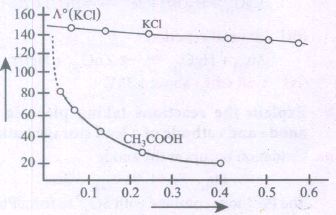
For a weak electrolyte, at high concentration, the plot is almost parallel to concentration axis with slight increase in conductivity as the dilution increases. When the concentration approaches zero, there is a sudden increase in the molar conductance and the curve is almost parallel to \(\Lambda \)m axis. This is due to the fact that the dissociation of the weak electrolyte increases with the increase in dilution (Ostwald dilution law)
11.
Oxidation half cell : A metallic zinc strip that dips into an aqueous solution of zinc sulphate taken in a beaker.
Reduction half cell : A copper strip that dips into an aqueous solution of copper sulphate taken in a beaker.
12.
Specific conductance k = \(C(\frac{l}{a})\)
k = \(\frac{1}{R}(\frac{l}{a})\)
That is k α \(\frac{1}{R}\)
13.
14.
The conductivity cell in which the electrodes are separated by 1m and having V m3 of electrolytic solution which contains 1 mole of electrolyte. The conductance of such a system is called the molar conductance (\({ \Lambda }_{ m }\))
\({ \Lambda }_{ m }=\frac { k({ Sm }^{ -1 })\times { 10 }^{ -3 } }{ M } { mol }^{ -1 }{ m }^{ 3 }\)
15.
(i) Specific resistance is denoted by ρ(rho).
(ii) Specific resistance depends on the nature of the electrolyte.
(iii) Reciprocal is specific resistance \(\frac{1}{ρ}\) is specific conductance or conductivity denoted by K (Kappa).
(iv) ohm metre.

12th Standard Syllabus & Materials
12th Standard
TN 12th Computer Applications வலையமைப்பு வடமிடல் Sample Question Papers Study Material - QB365 Set A
NEW12th Standard
TN 12th Computer Applications களப்பெயர் முறைமை (DNS) Sample Question Papers Study Material - QB365 Set A
NEW12th Standard
TN 12th Computer Applications வலையமைப்பு எடுத்துக்காட்டுகள் மற்றும் நெறிமுறைகள் Sample Question Papers Study Material - QB365 Set A
NEW12th Standard
TN 12th Computer Applications கணினி வலையமைப்பு ஓர் அறிமுகம் Sample Question Papers Study Material - QB365 Set A



Tamilnadu Stateboard 12th Standard Subjects

Maths
Chemistry

Physics

Biology

Computer Science

Business Maths and Statistics

Economics

Commerce

Accountancy

History

Computer Applications
Biology
Computer Technology
Computer Applications
Computer Science
Business Maths and Statistics
Commerce
Economics
Maths
Chemistry
Physics
Computer Technology
History
Accountancy

Tamil

English

French
Tamilnadu Stateboard Standards
