
 100% FREE ACCESS
12th Standard Syllabus & Materials
12th Standard
TN 12th Computer Applications மின்னணு தரவு பரிமாற்றம் Sample Question Papers Study Material - QB365 Set A
NEW12th Standard
TN 12th Computer Applications மின் - வணிக பாதுகாப்பு அமைப்புகள் Sample Question Papers Study Material - QB365 Set A
NEW12th Standard
TN 12th Computer Applications மின்னணு செலுத்தல் முறைகள் Sample Question Papers Study Material - QB365 Set A
NEW12th Standard
TN 12th Computer Applications மின் - வணிகம் Sample Question Papers Study Material - QB365 Set A
NEW12th Standard
TN 12th Computer Applications திறந்த மூல கருத்துருக்கள் Sample Question Papers Study Material - QB365 Set A
NEW12th Standard
TN 12th Computer Applications வலையமைப்பு வடமிடல் Sample Question Papers Study Material - QB365 Set A

Published on: 28/01/2021
12th Standard Chemistry English Medium Electro Chemistry Reduced Syllabus Important Questions 2021
Download Tamil Nadu 12th Standard Chemistry question papers, model tests, one-mark questions, important questions, and public exam papers in PDF format. Free study materials and answer keys for TN State Board students.
Questions + Answers key
Take MCQ Chemistry Test
1.
The feasibility of a redox reaction can be predicted with the help of ________.
reduction potential
oxidation potential
electrochemical series
standard emf
2.
The cell in which electrical energy is used to bring about chemical change is known as _______.
electrolytic cell
galvanic cell
voltaic cell
dynamo
3.
Standard electrode potential of Sn4+ / Sn2+ couple is +0.15 V and that of Cr3+ / Cr is 0.85 V. When connected, the cell potential will be ______.
1.10 V
1.00 V
0.70 V
0.30 V
4.
Which of the following statement is wrong with regard to galvanic cell?
Reduction takes place at cathode
Reduction takes place at anode
Oxidation takes place at anode
Cathode is positively charged
5.
Ionic conductance at infinite dilution of Al3+ and SO2-4 are 1890 ohm-1 cm2 gm equiv-1 and 1600 ohm-1 cm-2 gm equiv-1 respectively. The equivalent conductance is ______.
143 mho cm2 gm equiv-1
850 mho cm2 gm equir-1
153 mho cm2 gm equiv-1
314 mho cm2 gm equir-1
6.
Which among the following has same equivalent and molar conductance?
H2SO4
CH3COOH
NaCI
Na2SO4
7.
According to Faraday's first law m = ZIt, where Z is ______.
reaction quotient
effective nuclear charge
atomic number
electrochemical equivalent
8.
The important use of Kohlrausch's law is deducing the ______.
λ∞ value of weak electrolyte.
λ∞ value of strong electrolyte.
λ∞ value of weak electrolyte.
λ∞ value of weak electrolyte
9.
The equivalent conductivity of CH3COOH at 25°C is 80 ohm-1 cm2 eq-1 and at infinite dilution 400 ohm-1 cm-1 eq-1. The degree of dissociation of CH3COOH is ______.
1
0.2
0.1
0.3
10.
The specific conductance of a 0.01 M solution of KCI is 0.0014 ohm-1 em-1 at 25°C. Its equivalent conductance is ______.
14 ohm-1 cm2eq-1
140 ohm-1 cm2eq-1
1.4 ohm-1 cm2eq-1
0.14 ohm-1 cm2eq-1
11.
Kohlrausch's law is applied to calculate ________.
molar conductance at infinite dilution of a weak electrolyte
degree of dissociation of weak electrolyte
solubility of a sparingly soluble salt
all the above
12.
A conductivity cell has been calibrated with a 0.01M, 1:1 electrolytic solution (specific conductance (k = 1.25 x 10⁻³cm-1) in the cell and the measured resistance was 800 Ω at 25oC. The cell constant is ______.
10−1 cm−1
101 cm−1
1 cm−1
5.7 x 10⁻¹²
13.
The equivalent conductance of M/36 solution of a weak monobasic acid is 6 mho cm2 equivalent-1 and at infinite dilution is 400 mho cm2 equivalent-1. The dissociation constant of this acid is ______.
1.25 x 10⁻⁶
6.25 x 10⁻⁶
1.25 x 10⁻⁴
6.25 x 10 -5
14.
Zinc can be coated on iron to produce galvanized iron but the reverse is not possible. It is because _______.
Zinc is lighter than iron
Zinc has lower melting point than iron
Zinc has lower negative electrode potential than iron
Zinc has higher negative electrode potential than iron
15.
Which of the following electrolytic solution has the least specific conductance?
2N
0.002N
0.02N
0.2N
16.
How will you determine the conductivity of an electrolytic solution using a wheatstone, bridge?
17.
The standard reduction potential for the reaction Sn4+ + 2e- ⟶ Sn2+ is + 0.15v. Calcuate the free energy change of the reaction.
18.
Specific conductance of 1M KNO3 solution is oberved to be 5.55 x 10⁻³ mho cm2. What is the equivalent conductance of KNO3 when one litre of the solution is used?
19.
The electrochemical equivalent of an electrolyte is 2.35 gm amp-1 sec-1. Calculate I the amount of the substance deposited when 5 ampere is passed for 10 sec.
20.
21.
State Kohlrausch Law. How is it useful to determine the molar conductivity of weak electrolyte at infinite dilution.
22.
Define Faraday.
23.
Leclanche cell is a non-rechargeable cell. Answer the questions below with respect to Leclanche cell.
(i) Anode
(ii) Cathode
(iii) Electrolyte
(iv) Oxidation half cell reaction
(v) Reduction half cell reaction.
24.
Explain the IUPAC convention of representing a Galvanic cell.
25.
Write the cell representation of the galvanic cell in which the following reaction take place
\({ Zn }_{ (s) }+Cu{ SO }_{ 4 }\rightarrow { ZnSO }_{ 4 }+{ Cu }_{ (s) }\)
For the above cell. Identify the anode and cathode half cell.
26.
Give the oxidation and reduction half cell reaction taking place in the Daniel cell.
27.
How are electro chemical cells classified? Explain.
28.
29.
Answer the following question with regard to specific resistance.
(i) How is specific resistance represented?
(ii) What does specific resistance depend on?
(iii) What is the reciprocal of specific resistance? How is it denoted.
(iv) What is the unit of resitivity?
30.
Write the Nernst equation for the half cell Zn2+(aq)/ Zn(s)
31.
Calculate the standard emf of the cell: Cd|Cd2+||Cu2+|Cu and determine the cell reaction. The standard reduction potentials of Cu2+|Cu and Cd2+|Cd are 0.34V and -0.40 volts respectively. Predict the feasibility of the cell reaction.
32.
0.1M NaCl solution is placed in two different cells having cell constant 0.5 and 0.25 cm-1 respectively. Which of the two will have greater value of specific conductance.
33.
Why is anode in galvanic cell considered to be negative and cathode positive electrode?
34.
Write the Nernst equation.
35.
What is single electrode potential?
36.
Define electrochemical equivalent.
37.
Higher the standard reduction potential lesser is corrosion. Give reason.
38.
What are the factors on which cell potential depends?
39.
Apply Kohlrausch's law and determine the limiting molar conductivity of
(i) BaCl2
(ii) AI2(SO4)3
40.
On dilution of 0.1 M of Na2SO4, what will happen to its
(a) Conductance (C)
(b) Conductivity K
(c) Molar conductance \({ \Lambda }_{ m }\)
(d) Equivalent conductance \({ \Lambda }\)
41.
A conductivity cell has two platinum electrodes separated by a distance 1.5 cm and the cross sectional area of each electrode is 4.5 sq cm. Using this cell, the resistance of 0.5 N electrolytic solution was measured as 15 Ω. Find the specific conductance of the solution.
42.
Reduction potential of two metals M1 and M2 are \(E^{0}_{M^{2+}_{1}|M_{1}} = -2.3V\) and \(E^{0}_{M^{2+}_{1}|M_{1}} = 0.2V\) Predict which one is better for coating the surface of iron. Given : \(\mathrm{E}_{\mathrm{Fe}^{2+} \mid \mathrm{Fe}}^{\circ}=-0.44 \mathrm{~V}\)
1.
(c)
electrochemical series
2.
(a)
electrolytic cell
3.
(b)
1.00 V
4.
(b)
Reduction takes place at anode
5.
(a)
143 mho cm2 gm equiv-1
6.
(c)
NaCI
7.
(d)
electrochemical equivalent
8.
(a)
λ∞ value of weak electrolyte.
9.
(b)
0.2
10.
(a)
14 ohm-1 cm2eq-1
11.
(d)
all the above
12.
R = ρ.l/A
Cell constant = R/ρ
\(= k.R (l/ \rho = K)\)
= 1.25 x 10⁻³ Ω-1 cm-1 x 800Ω
= 1 cm-1
13.
α = Λ/Λo
= 6/400
Ka = α2C
\(= \frac{6}{400} \times \frac{6}{400} \times \frac{1}{36}\)
= 6.25 x 10⁻⁶
14.
EoZn2+[Zn] = 0.76V and EoFe2+[Fe] = -0.44V
Zinc has higher negative electrode potential than iron, iron cannot be coated on zinc
15.
In general, specific conductance of an electrolyte decreases with dilution.So,0.002N solution has least specific conductance.
16.
(i) The conductivity of an electrolytic solution is determined by using a wheatstone bridge arrangement in which one resistance is replaced by a conductivity cell filled with the electrolytic solution of unknown conductivity.
(ii) In the measurement of specific resistance of a metallic wire, a DC power supply is used. Here, if we apply DC current through the conductivity cell, it will lead to the electrolysis of the solution taken in the cell. So, AC current is used for this measurement to prevent electrolysis
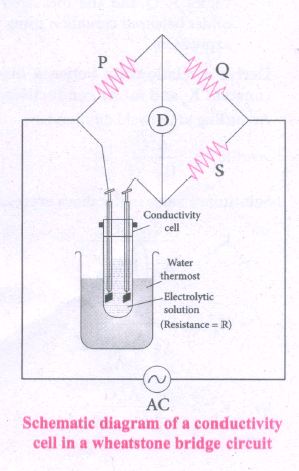
(iii) A wheatstone bridge is constituted using known resistances P, Q, a variable resistance S and conductivity cell (Let the resistance of the electrolytic solution taken in it be R) as shown in the figure. An AC source (550 Hz to 5 KHz) is connected between the junctions A and C. Connect a suitable detector (Such as the telephone ear piece detector) between the junctions 'B' and 'D'.
(iv) The variable resistance (S) is adjusted until the bridge is balanced and in this conditions there is no current flow through the detector.
Under balanced condition,
\(\frac { P }{ Q } =\frac { R }{ S } \)
\(\therefore R=\frac { P }{ Q } \times S\)
(v) The resistance of the electrolytic solution (R) is calculated from the known resistance values P, Q and the measured 'S' value under balanced condition using the above expression
17.
Sn4+ + 2e- ⟶ Sn2+ E0 = 0.15V
Given: n = 2 electrons
F = 96495 coulombs
Formula: ΔG = - nFEO
Solutlon: ∴ ΔG = - 2 x 96495 x 0.15
= 28.948
Free energy = -28.948 kJ.
18.
Given:
Specific conductance = K = 5.55 x 10⁻³ mho cm-1
Concentration C = 1M
Volume = 1 litre.
Formula: Equivalent conductance = K x V
= \(\frac { k\times 1000 }{ C } \)
Solution:
\(\frac { { 5.55\times 10 }^{ -3 }\times 1000 }{ 1 } =5.55\times { 10 }^{ -3 }\times { 10 }^{ -3 }\)
19.
Given: Electrochemical
equivalent = Z = 2.35 g amp-1 sec-1
Time = t = 10 sec.
Current strength = 1 = 5 ampere
Formula: m = Zlt
Solution: 2.35 x 10 x 5 = 117.5 gm
The amount of the substance deposited
= 117.5 g
20.
21.
Kohlraush's law:
(i) At infinite dilution, the limiting molar conductivity of an electrolyte is equal to the sum of the limiting molar conductivities of its constituent ions. i.e., the molar conductivity is due to the independent migration of cations in one direction and anions in the opposite direction.
(ii) For a uni - univalent electrolyte such as NaCl, the Kohlraush's law is expressed as
\(\left(\Lambda_{\mathrm{m}}^{0}\right)_{\mathrm{NaCl}}=\left(\lambda_{\mathrm{m}}^{0}\right)_{\mathrm{Na}^{+}}+\left(\lambda_{\mathrm{m}}^{0}\right)_{\mathrm{Cl}}^{-}\)
(iii) In general, according to Kohlraush's law, the molar conductivity at infinite dilution for a electrolyte represented by the formula Ax By, is given below.
\(\left(\Lambda_{m}^{0}\right)_{A_{x} B_{y}}=x\left(\lambda_{m}^{0}\right)_{A^{y+}}+y\left(\lambda_{m}^{0}\right)_{B^{x-}}\)
b) Calculation of molar conductance at infinite dilution for weak electrolytes experimentally.
(i) However, the same can be calculated using Kohlraush's Law. For example, the molar conductance of CH3COOH, can be calculated using the experimentally determined molar conductivities of strong electrolytes HCl, NaCl and CH3COONa.
\(\Lambda_{\mathrm{CH}_{3} \mathrm{COONa}}^{0}=\lambda_{\mathrm{Na}^{+}}^{0}+\lambda_{\mathrm{CH}_{3} \mathrm{COO}^{-}}^{0} \) ..........(1)
\(\Lambda_{\mathrm{HCl}}^{0}=\lambda_{\mathrm{H}+}^{0}+\lambda_{\mathrm{Cl}^{-}}^{0} \) .........(2)
\(\Lambda_{\mathrm{NaCl}}^{0}=\lambda_{\mathrm{Na}^{+}}^{0}+\lambda_{\mathrm{Cl}^{-}}^{0}\) ...........(3)
(ii) Equation (1) + Equation (2) - Equation (3) gives,
\(\left(\Lambda_{\mathrm{CH}_{3} \mathrm{COONa}}^{0}\right)+\left(\Lambda_{\mathrm{HCl}}^{0}\right)-\left(\Lambda_{\mathrm{NaCl}}^{0}\right)=\lambda_{\mathrm{H}+}^{0}+\lambda_{\mathrm{CH}_{3} \mathrm{COO}-}^{0} \)
\(=\Lambda_{\mathrm{CH}_{2} \mathrm{COOH}}^{0}\)
22.
(i) Faraday is defined as the quantity of electricity required to liberate one gram equivalent of a substance and it is equal to 96,495 coulombs.
(ii) It is denoted by the symbol F Faraday is the quantity of electricity that contains 1 mole of electrons.
(iii) 1 Faraday = 96,495 coulombs = 1 Mole electron.
23.
(i) Anode: Zinc container
(ii) Cathode: Graphite rod in contact with MnO2
(iii) Electrolyte: Ammonium chloride and zinc chloride in water
(iv) Oxidation at anode:
\( { Zn }_{ (s) }\rightarrow { Zn }_{ (aq) }^{ 2+ }+2e^{ - }\)
(v) Reduction at cathode:
\({ 2NH }_{ 4(aq) }^{ + }+{ 2e }^{ - }\rightarrow { 2NH }_{ 3(aq) }+{ H }_{ 2(g) }\)
24.
The galvanic cell is represented by a cell diagram, for example, Daniel cell is represented as
\({ Zn }_{ (s) }|{ Zn }_{ (aq) }^{ 2+ }||{ Cu }_{ (aq) }^{ 2+ }|{ Cu }_{ (s) }\)
(i) A single vertical bar (|) represents a phase boundary
(ii) The double vertical bar (||) represents the salt bridge.
(iii) The anode half cell is written on the left side of the salt bridge and the cathode half cell on the right side.
(iv) The anode and cathode are written on the extreme left and extreme right, respectively.
(v) The emf of the cell is written on the right side after cell diagram.
25.
The galvanic cell is represented as
\({ Zn }_{ (s) }|{ Zn }_{ (aq) }^{ 2+ }||{ Cu }_{ (aq) }^{ 2+ }|{ Cu }_{ (s) }\)
The anode half cell is \({ Zn }_{ (s) }|{ Zn }_{ (aq) }^{ 2+ }\)
The cathode half cell is \({ C }u_{ (Aq) }^{ 2+ }|{ Cu }_{ (s) }\)
26.
Zinc is oxidised to Zn2+ ions and the Cu2+ ions are reduced to metallic copper. The half reactions are represented as below.
\( { Zn }_{ (s) }\rightarrow { Zn }_{ (aq) }^{ + }+2e^{ - }\) (oxiation)
Loss of election oxidation
\({ Cu }_{ (aq) }^{ 2+ }+{ 2e }^{ - }\rightarrow { Cu }_{ (s) }\) (reduction)
Gain of electron oxidation.
27.
Electrochemical cells are mainly classified into the following two types.
(i) Galvanic Cell ( Voltaic cell) : It is a device in which a spontaneous chemical reaction generates an electric current i.e., it converts chemical energy into electrical energy. It is commonly known as a battery.
(ii) Electrolytic cell : It is a device in which an electric current from an external source drives a nonspontaneous reaction i.e., it converts electrical energy into chemical energy.
28.
29.
(i) Specific resistance is denoted by ρ(rho).
(ii) Specific resistance depends on the nature of the electrolyte.
(iii) Reciprocal is specific resistance \(\frac{1}{ρ}\) is specific conductance or conductivity denoted by K (Kappa).
(iv) ohm metre.
30.
E = EO- 2.303 \(\frac { RT }{ 2F } \) log Zn2+
EZn2+/Zn = EZn2+/ Zn- 2.303 \(\frac { RT }{ 2F } \) log [Zn2+]
31.
Cell reactions:
Oxidation at anode: \(Cd_{(s)}\rightarrow Cd^{2+}_{(aq)}+2e^{-}\); (E0ox)cd|cd2+ = 0.40V ; (E0)cd|cd2+ = -0.40V
Reduction at cathode: \(Cu^{2+}_{(aq)}+2e^{-}\rightarrow Cu_{(s)} \); (E0red)cu2+|Cu = +0.34V
Adding: \(Cd_{(s)}+Cu^{2+}_{(aq)}\rightarrow Cd^{2+}_{(aq)}+Cu_{(s)}\)
E0cell=(E0ox)+(E0red)
=(-0.4) + 0.34V
= 0.74V.
Emf is +ve, so \(\Delta G\) is -ve, the cell reaction is feasible.
32.
\(\kappa=\mathrm{C}\left(\frac{l}{\mathrm{~A}}\right)\) (or) k = 1/R.l/A
Where, C - Conductance
\(\frac{l}{A} \Rightarrow\) Cell constant (or)
Sp. Conductance \(\propto\) Cell constant
Sp. Conductance \(\propto\) Concentration
1. Sp. Conductance = concentration x cell constant
i) \(\kappa=0.1 \times 0.5=0.05=5 \times 10^{-2} \mathrm{Scm}^{-1}\)
ii) \(\kappa=0.1 \times 0.25=0.025=2.5 \times 10^{-2} \mathrm{Scm}^{-1}\)
2. So the first case will have greater specific conductance with cell constant 0.05.
33.
Anodic oxidation:
The electrode at which the oxidation occurs is called the anode. In Daniel cell, the oxidation take place at zinc electrode, i.e., zinc is oxidised to Zn2+ ions and the electrons. The Zn2+ ions enters the solution and the electrons enter the zinc metal, then flow through the external wire and then enter the copper strip. Electrons are liberated at zinc electrode and hence it is negative (-ve).
\({ Zn }_{ (s) }\longrightarrow { Zn }^{ 2+ }{ _{ (aq) } }+ 2{ e }^{ - } \) (loss of electron-oxidation)
Cathodic reduction:
The electrons flow through the circuit from zinc to copper, where the Cu2+ ions in the solution accept the electrons, get reduced to copper and the same get deposited on the electrode. Here, the electrons are consumed and hence it is positive (+ve).
\({ Cu }^{ 2+ }_{ (aq) }+{ 2e }^{ - }\longrightarrow { Cu }_{ (s) } \)(gain of electron-reduction)
34.
\({ E }_{ cell }={ E }_{ cell }^{ o }-\frac { Rt }{ nF } In\frac { [{ C] }^{ l }[{ D] }^{ m } }{ [{ A] }^{ x }{ [B] }^{ y } } \) (or)
\({ E }_{ cell }={ E }_{ cell }^{ o }-\frac { 2.303RT }{ nF } \log\frac { [{ C] }^{ l }[{ D] }^{ m } }{ [{ A }]^{ x }[{ B }]^{ y } } \)
35.
(i) An electrochemical cell consists of two half cells. With an open circuit, the metal electrode in each half cell transfers its ions into solution.
(ii) Thus, an individual electrode develops a potential with respect to the solution
(iii) The potential of a single electrode in a half cell is called single electrode potential
36.
The electrochemical equivalent is defined as the amount of substance deposited or liberated at the electrode by a charge of 1 coulomb.
m = z (If I = 1 ampere and t = second).
37.
The greater the Eo value means greater is the tendency shown by the species to accepts I electrons and undergo reduction. So higher the (Eo) values lesser is the tendency to undergo corrosion.
38.
The cell voltage depends on the nature of the electrodes, the concentration of the electrolytes and the temperature at which the cell is operated.
39.
(i) \({ \Lambda }_{ m }^{ o }{ BaCl }_{ 2 }={ \lambda }_{ { Ba }^{ 2+ } }^{ o }+2{ \lambda }_{ { Cl }^{ - } }^{ o }\)
(ii) \({ \Lambda }_{ m }^{ o }{ Al }_{ 2 }{ { (SO }_{ 4 }) }_{ 3 }=2{ \lambda }_{ { Al }^{ 3+ } }^{ o }+2{ \lambda }_{ { { So }_{ 4 }^{ 2- } } }^{ o }\)
40.
Conductivity, molar conductance and equivalent conductance increases with dilution whereas Conductance (C) decreases.
41.
l = 1.5 cm = 1.5 × 10⁻²m
A = 4.5 cm2 = 4.5 × (10-4)m2
R = 15Ω
\(\kappa = \frac{1}{R}(\frac{l}{A})\)
\(\kappa = \frac{1}{15\Omega}\times\frac{1.5\times10^{-2}m}{4.5\times10^{-4}m^2}\)
= 2.22 ohm-1 m-1
= 2.22 Sm-1
42.
The oxidation potential of M1 is more +ve than the oxidation potential of Fe which indicates that it will prevent iron from rusting.

12th Standard Syllabus & Materials
12th Standard
TN 12th Computer Applications களப்பெயர் முறைமை (DNS) Sample Question Papers Study Material - QB365 Set A
NEW12th Standard
TN 12th Computer Applications வலையமைப்பு எடுத்துக்காட்டுகள் மற்றும் நெறிமுறைகள் Sample Question Papers Study Material - QB365 Set A
NEW12th Standard
TN 12th Computer Applications கணினி வலையமைப்பு ஓர் அறிமுகம் Sample Question Papers Study Material - QB365 Set A
NEW12th Standard
TN 12th Computer Applications PHP-உடன் MySQL-ஐ இணைத்தல் Sample Question Papers Study Material - QB365 Set A



Tamilnadu Stateboard 12th Standard Subjects

Maths
Chemistry

Physics

Biology

Computer Science

Business Maths and Statistics

Economics

Commerce

Accountancy

History

Computer Applications
Biology
Computer Technology
Computer Applications
Computer Science
Business Maths and Statistics
Commerce
Economics
Maths
Chemistry
Physics
Computer Technology
History
Accountancy

Tamil

English

French
Tamilnadu Stateboard Standards
