
 100% FREE ACCESS
12th Standard Syllabus & Materials
12th Standard
TN 12th Computer Applications மின்னணு தரவு பரிமாற்றம் Sample Question Papers Study Material - QB365 Set A
NEW12th Standard
TN 12th Computer Applications மின் - வணிக பாதுகாப்பு அமைப்புகள் Sample Question Papers Study Material - QB365 Set A
NEW12th Standard
TN 12th Computer Applications மின்னணு செலுத்தல் முறைகள் Sample Question Papers Study Material - QB365 Set A
NEW12th Standard
TN 12th Computer Applications மின் - வணிகம் Sample Question Papers Study Material - QB365 Set A
NEW12th Standard
TN 12th Computer Applications திறந்த மூல கருத்துருக்கள் Sample Question Papers Study Material - QB365 Set A
NEW12th Standard
TN 12th Computer Applications வலையமைப்பு வடமிடல் Sample Question Papers Study Material - QB365 Set A

Published on: 28/01/2021
12th Standard Chemistry English Medium Electro Chemistry Reduced Syllabus Important Questions With Answer Key 2021
Download Tamil Nadu 12th Standard Chemistry question papers, model tests, one-mark questions, important questions, and public exam papers in PDF format. Free study materials and answer keys for TN State Board students.
Questions + Answers key
Take MCQ Chemistry Test
1.
\({ \Lambda }_{ { NH }_{ 4 }OH }^{ o }\) is _______.
\({ \Lambda }_{ { NH }_{ 4 }OH }^{ o }={ \Lambda }_{ { NH }_{ 4 }Cl }^{ o }+{ \Lambda }_{ NaoH }^{ o }-{ \Lambda }_{ NaCl }\)
\({ \Lambda }_{ { NH }_{ 4 }OH }^{ o }={ \Lambda }_{ { NH }_{ 4 }Cl }^{ o }-{ \Lambda }_{ NaoH }^{ o }-{ \Lambda }_{ NaCl }\)
\({ \Lambda }_{ { NH }_{ 4 }OH }^{ o }={ \Lambda }_{ NaOH }^{ o }+{ \Lambda }_{ NaCl }^{ o }-{ \Lambda }_{ { NH }_{ 4 }Cl }^{ o }\)
\({ \Lambda }_{ { NH }_{ 4 }OH }^{ o }={ \Lambda }_{ NaOH }^{ o }+{ \Lambda }_{ NaCl }^{ o }-{ \Lambda }_{ { NH }_{ 4 }Cl }^{ o }\)
2.
The cell voltage depends on _______.
nature of the electrodes
concentration of the electrolytes
temperature
all the above
3.
The electrical energy produced by a cell equals _______.
Ecathode - Eanode
\(\frac{Charge \ of \ electrons}{E_{cell}}\)
Charge of electrons x Ecell
\(\frac{E_{cell}}{Charge \ of \ electrons}\)
4.
Calculate the standard emf of the cell, provided the standard reduction potentials of cathode and anode are -0.763 V and 0.80V.
- 1.563V
0.037V
- 0.610V
None of these
5.
If 0.2 ampere can deposit 0.1978 g of copper in 50 minutes, how much of copper will be deposited by 600 coulombs?
19.78 g
1.978 g
0.1978 g
197.8 g
6.
According to Faraday's first law m = ZIt, where Z is ______.
reaction quotient
effective nuclear charge
atomic number
electrochemical equivalent
7.
Faraday's laws of electrolysis are related to ______.
atomic number of the cation
atomic number of the anion
equivalent weight of the electrolyte
speed of the cation
8.
Using the data given below find out the strongest reducing agent ______.
\({ E }_{ { Cr }_{ 2 }{ O }_{ 7 }^{ 2- } }^{ o }{ Cr }^{ 3+ }=1.33V{ ,E }_{ { Cl }_{ 2 }{ / }{ Cl }^{ - } }^{ o }=1.36V\)
\({ E }_{ { Mn }O_{ 4 }^{ - } }^{ 0 }/{ Mn }^{ 2+ }=1.51V,{ E }_{ { Cr }^{ 3+ }/Cr }^{ o }=-0.74V\)
Cr
Cr3+
Cl-
Mn2+
9.
Pick out the correct statement regarding resistance of an electrolytic solution ________.
It is inversely proportional to the length (I)
It is inversely proportional to the cross sectional area (A)
It is directly proportional to the cross sectional area (A)
Resistivity is denoted by p (rho)
10.
For the cell reaction
2Fe3+(aq) + 2l−(aq) \(\rightarrow\)2Fe2+ (aq) + 12 (aq)
Eocell = 0.24V = at 298K. The standard Gibbs energy (Δ, Go) of the cell reactions is:
-46.32 KJ mol−1
-23.16 KJ mol-1
46.32 KJ mol−1
23.16 KJ mol-1
11.
The equivalent conductance of M/36 solution of a weak monobasic acid is 6 mho cm2 equivalent-1 and at infinite dilution is 400 mho cm2 equivalent-1. The dissociation constant of this acid is ______.
1.25 x 10⁻⁶
6.25 x 10⁻⁶
1.25 x 10⁻⁴
6.25 x 10 -5
12.
Among the following cells
I) Leclanche cell
II) Nickel – Cadmium cell
III) Lead storage battery
IV) Mercury cell
Primary cells are ____.
I and IV
I and III
III and IV
II and III
13.
While charging lead storage battery _______.
PbSO4 on cathode is reduced to Pb
PbSO4 on anode is oxidised to PbO2
PbSO4 on anode is reduced to Pb
PbSO4 on cathode is oxidised to Pb
14.
Faraday constant is defined as_______.
charge carried by 1 electron
charge carried by one mole of electrons
charge required to deposit one mole of substance
charge carried by 6.22 ×10¹⁰ electrons
15.
16.
The standard reduction potentials of Fe3+ / Fe and Fe2+ / Fe electrode system are -0.035 V and -0.44 V respectively. Predict which of the two oxidations is easy. Fe3+ / Fe and Fe2+ / Fe
17.
What is the emf developed by a single lead storage battery?
18.
Apply Kohlrausch's law and determine the limiting molar conductivity of
(i) BaCl2
(ii) AI2(SO4)3
19.
Molar conductivity increases with dilution. Is the above statement true? Justify your answer
20.
For a uni - univalent electrolyte write the Debye - Huckel Onsager equation
21.
Derive the unit of specific conductance.
22.
The resistance of a conductivity cell is measured as 190 Ω using 0.1M KCl solution (specific conductance of 0.1M KCl is 1.3 Sm-1). When the same cell is filled with 0.003 M sodium chloride solution, the measured resistance is 6.3KΩ. Both these measurements are made at a particular temperature. Calculate the specific and molar conductance of NaCl solution.
23.
Two metals M1 and M2 have reduction potential values of -xV and +yV respectively. Which will liberate H2 and H2SO4.
24.
Why does conductivity of a solution decrease on dilution of the solution.
25.
Draw a neat diagram of Leclanche cell and mark the parts.
26.
Define Faraday.
27.
Explain the reactions taking place in the anode and cathode of a lead storage battery.
28.
Give the oxidation and reduction half cell reaction taking place in the Daniel cell.
29.
What is the oxidation and reduction half cell in a Daniel cell?
30.
Define molar conductance.
31.
Write the Nernst equation for the half cell Zn2+(aq)/ Zn(s)
32.
Can Fe3+ oxidises Bromide to bromine under standard conditions?
Given: \({ E }_{ { Fe }^{ 3+ }|{ Fe }^{ 2+ } }^{ 0 }=0.771V\); \(\\ { E }^{0}_{ { Br }_{ 2 }|{ Br }^{ - } }=1.09V\).
33.
Why is AC current used instead of DC in measuring the electrolytic conductance?
34.
Why is anode in galvanic cell considered to be negative and cathode positive electrode?
35.
Describe the electrolysis of molten NaCl using inert electrodes
36.
Write an account on cell terminology.
37.
Derive a relationship between dissociation constant Ka and molar conductivity \({ \Lambda }_{ m }\)
38.
Calculate the emf of the cell having the cell reaction 2Ag+ + Zn ⇌ 2Ag + Zn2+ and Eocell = 1.56 V at 25°C when concentration of Zn2+ = 0.1 M and Ag+ = 10 M in the solution.
\([{ E }_{ cell }={ E }_{ cell }^{ o }-\frac { RT }{ nF } In\frac { [{ Zn }^{ 2+ }] }{ [{ Ag] }^{ 2 } } ]\)
39.
If E1 = 0.5 V corresponds to Cr3++ 3e- ➝ Cr(s) and E2 = 0.41V corresponds to Cr3++ e- ➝ Cr2+ reactions, calculate the emf (E3) of the reaction Cr2++ 2 e- ➝ Cr(s)
40.
0.5 F of electric current was passed through 5 molar solution of AgNO3, CuSO4 and AICl3 connected in series. Find out the concentration of each of the electrolyte after the electrolysis.
41.
42.
The conductivity of a 0.01M solution of a 1 :1 weak electrolyte at 298K is 1.5\(\times\)10-4 S cm−1.
i) molar conductivity of the solution
ii) degree of dissociation and the dissociation constant of the weak electrolyte
Given that
\(\lambda^{0}_{cation}=248.2 \ S\) cm2 mol-1
\(\lambda^{0}_{anlon}=51.8 \ S\) cm2 mol-1
1.
(a)
\({ \Lambda }_{ { NH }_{ 4 }OH }^{ o }={ \Lambda }_{ { NH }_{ 4 }Cl }^{ o }+{ \Lambda }_{ NaoH }^{ o }-{ \Lambda }_{ NaCl }\)
2.
(d)
all the above
3.
(c)
Charge of electrons x Ecell
4.
(a)
- 1.563V
5.
(c)
0.1978 g
6.
(d)
electrochemical equivalent
7.
(c)
equivalent weight of the electrolyte
8.
(a)
Cr
9.
(b)
It is inversely proportional to the cross sectional area (A)
10.
ΔGo = -nFEocell
= -2 x 96500 x 0.24
= - 46320 J mol-1
= -46.32 KJ mol−1
11.
α = Λ/Λo
= 6/400
Ka = α2C
\(= \frac{6}{400} \times \frac{6}{400} \times \frac{1}{36}\)
= 6.25 x 10⁻⁶
12.
(a)
I and IV
13.
Charging anode:
PbSO4(s) + 2e- ➝ Pb(s) + SO42-(aq)
Cathode:
PbSO4(s) + 2H2O(I) ➝ PbO2(s) + SO42-(aq) + 2e-
14.
IF = 96500 C = charge of one mole of e- charge of 6.022 x 10⁻²³ electron
15.
(c)
16.
(i) The ion which has lower reduction I potential will be oxidised first at the anode.
(ii) Among (0.035V) and (0.44V), Fe2+ / Fe oxidation is easy because it has the lower reduction potential (-0.44V).
17.
The emf of a single cell is about 2V
18.
(i) \({ \Lambda }_{ m }^{ o }{ BaCl }_{ 2 }={ \lambda }_{ { Ba }^{ 2+ } }^{ o }+2{ \lambda }_{ { Cl }^{ - } }^{ o }\)
(ii) \({ \Lambda }_{ m }^{ o }{ Al }_{ 2 }{ { (SO }_{ 4 }) }_{ 3 }=2{ \lambda }_{ { Al }^{ 3+ } }^{ o }+2{ \lambda }_{ { { So }_{ 4 }^{ 2- } } }^{ o }\)
19.
Yes, the above given statement is true.
When the dilution increases, the ions are far apart and the attractive forces decrease. At infinite dilution the ions are so far apart, the interaction between them becomes insignificant and hence, the molar conductivity increases and reaches a maximum value at infinite dilution
20.
\({ \Lambda }_{ m }={ \Lambda }_{ m }^{ o }-(-A+B{ \Lambda }_{ m }^{ o })\sqrt { C } \)
21.
Unit of x
\(k=\frac { 1 }{ \rho } .\frac { l }{ A } \left( \frac { 1 }{ ohm } .\frac { m }{ { m }^{ 2 } } \right) \)
= ohm-1 m-1 = mho m-1 (or) Sm-1
22.
Given that
κ = 1.3 Sm-1 (for 0.1M KCl solution)
R = 190 Ω
\(\kappa = \frac{1}{R}(\frac{l}{A})\)
κ . R =\((\frac{l}{A})\) = (1.3 Sm-1) (190Ω)
= 247 m-1
\(\kappa_{(NaCl)} = \frac{1}{R_{(NaCl)}} (\frac{l}{A})\)
\(= \frac{1}{6.3 K\Omega}(247 m^{-1})\) (6.3KΩ = 6.3 x 10³Ω)
= 39.2 x 10⁻³ Sm-1
\(\Lambda_m = \frac{\kappa \times 10^{-3} mol^{-1} m^3}{M}\)
\(=\frac{39.2 \times 10 ^{-3}(Sm^{-1})10^-3 (mol^{-1} m^3)}{0.003}\)
\(\Lambda_m\) = 13.04 \(\times\) 10-3 Sm2 mol-1
23.
Metals having higher oxidation potential will liberate H2 from H2SO4. Hence, the metal M1 having +xV, oxidation potential will liberate H2 from H2SO4.
24.
On dilution the concentration decreases. Conductivity decreases with decrease in concentration (or dilution) as the number of ions per unit volume that carry the current in a solution decrease on dilution.
25.
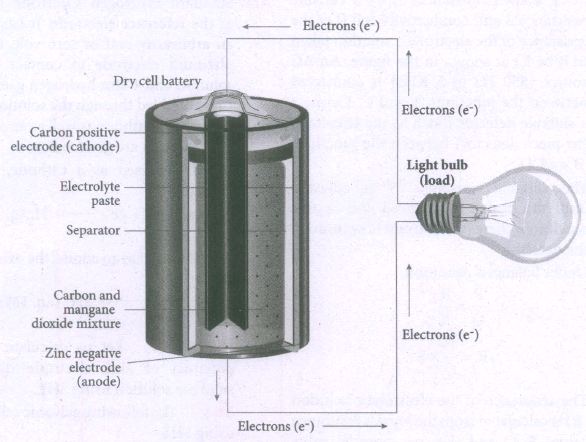
26.
(i) Faraday is defined as the quantity of electricity required to liberate one gram equivalent of a substance and it is equal to 96,495 coulombs.
(ii) It is denoted by the symbol F Faraday is the quantity of electricity that contains 1 mole of electrons.
(iii) 1 Faraday = 96,495 coulombs = 1 Mole electron.
27.
Oxidation occurs at the anode
\({ Pb }_{ (s) }\rightarrow { Pb }_{ (aq) }^{ 2+ }+{ 2e }^{ - }\)
The Pb2+ions combine with \({ SO }_{ 4(aq) }^{2-}\) to from PbSO4 precipitate.
\({ Pb }_{ (aq) }^{ 2+ }+{ SO }_{ 4(aq) }^{ 2- }\rightarrow { PbSO }_{ 4(s) }\)
Reduction occurs at the cathode
\({ PbO }_{ 2(s) }+{ 4H }_{ (aq) }^{ + }+{ 2e }^{ - }\rightarrow { Pb }_{ (aq) }^{ 2+ }+{ 2H }_{ 2 }O(l)\)
The Pb2+ ions also combine with \({ SO }_{ 4(aq) }^{2-}\) ions from sulphuric acid to form PbSO4 precipitate.
\({ Pb }_{ (aq) }^{ 2+ }+{ SO }_{ 4(aq) }^{ -2 }\rightarrow { PbSO }_{ 4 }\)
28.
Zinc is oxidised to Zn2+ ions and the Cu2+ ions are reduced to metallic copper. The half reactions are represented as below.
\( { Zn }_{ (s) }\rightarrow { Zn }_{ (aq) }^{ + }+2e^{ - }\) (oxiation)
Loss of election oxidation
\({ Cu }_{ (aq) }^{ 2+ }+{ 2e }^{ - }\rightarrow { Cu }_{ (s) }\) (reduction)
Gain of electron oxidation.
29.
Oxidation half cell : A metallic zinc strip that dips into an aqueous solution of zinc sulphate taken in a beaker.
Reduction half cell : A copper strip that dips into an aqueous solution of copper sulphate taken in a beaker.
30.
The conductivity cell in which the electrodes are separated by 1m and having V m3 of electrolytic solution which contains 1 mole of electrolyte. The conductance of such a system is called the molar conductance (\({ \Lambda }_{ m }\))
\({ \Lambda }_{ m }=\frac { k({ Sm }^{ -1 })\times { 10 }^{ -3 } }{ M } { mol }^{ -1 }{ m }^{ 3 }\)
31.
E = EO- 2.303 \(\frac { RT }{ 2F } \) log Zn2+
EZn2+/Zn = EZn2+/ Zn- 2.303 \(\frac { RT }{ 2F } \) log [Zn2+]
32.
(i) The half cell reactions are :
\(2Br^{-} \rightarrow Br_{2}+2e^{-}\) \(E^{0}_{ox}=-1.09V\) ...(1)
\(2Fe^{3+}+2e^{-}\rightarrow2Fe^{2+}\) \(E_{\mathrm{Fe}^{3+} / \mathrm{Fe}^{2+}}^{0}=+0.771V\) ..(2)
(ii) Adding (1) of (2) :
\(2Fe^{3+}+2Br^{-}\rightarrow 2Fe^{2+}+Br_{2}\) \(E^{0}_{cell}=?\) ...(3)
\(E^{0}_{cell}=E^{0}_{ox}+E_{\mathrm{Fe}^{3+} / \mathrm{Fe}^{2+}}^{0}\)
= (-1.09 + 0.771)V
= -0.319V
(iii) E0cell is – ve; \(\Delta G\) is +ve and the cell reaction is non spontaneous.
(iv) Hence Fe3+ cannot oxidises Br- to Br2.
33.
(a) If we apply DC current through the conductivity cell, it will lead to the electrolysis of the solution taken in the cell.
(b) So, AC current is used for this measurement to prevent electrolysis.
34.
Anodic oxidation:
The electrode at which the oxidation occurs is called the anode. In Daniel cell, the oxidation take place at zinc electrode, i.e., zinc is oxidised to Zn2+ ions and the electrons. The Zn2+ ions enters the solution and the electrons enter the zinc metal, then flow through the external wire and then enter the copper strip. Electrons are liberated at zinc electrode and hence it is negative (-ve).
\({ Zn }_{ (s) }\longrightarrow { Zn }^{ 2+ }{ _{ (aq) } }+ 2{ e }^{ - } \) (loss of electron-oxidation)
Cathodic reduction:
The electrons flow through the circuit from zinc to copper, where the Cu2+ ions in the solution accept the electrons, get reduced to copper and the same get deposited on the electrode. Here, the electrons are consumed and hence it is positive (+ve).
\({ Cu }^{ 2+ }_{ (aq) }+{ 2e }^{ - }\longrightarrow { Cu }_{ (s) } \)(gain of electron-reduction)
35.
(i) The electrolytic cell consists of two iron electrodes dipped in molten sodium chloride and they are connected to an external DC power supply via a key as shown in the figure. The electrode which is attached to the negative end of the power supply is called the cathode, and the one which attached to the positive end is called the anode. Once the key is closed, the external DC power supply drives the electrons to the cathode and at the same time pull the electrons from the anode.
Cell reactions:
Na+ ions are attracted towards cathode, where they combines with the electrons and reduced to liquid sodium.
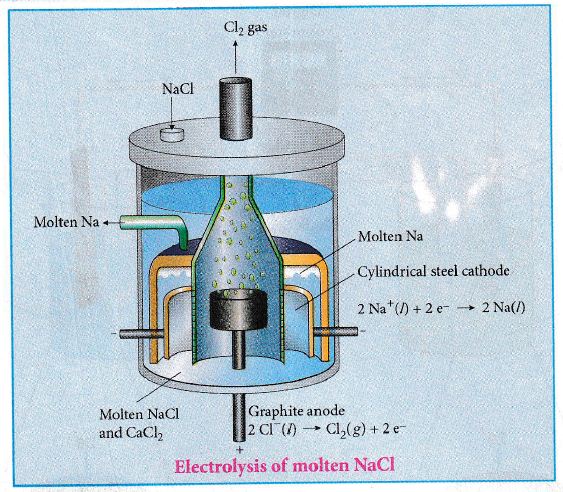
Cathode (reduction)
\(N a_{(l)}^{+}+e^{-} \rightarrow N a_{(l)} \quad ; \quad E^{0}=-2.71 V\)
Similarly, Cl- ions are attracted towards anode where they lose their electrons and oxidised to chlorine gas.
Anode (oxidation)
2CI-(l) ⟶ CI2(g) + 2e- E0 = -1.36V
The overall reaction is
2Na+(l) + 2Cl-(l)➝ 2Na(l) + Cl2(g) ; E° = - 4.07V
(ii) The negative E° value shows that the above reaction is a non-spontaneous one.
(iii) Hence, we have to supply a voltage greater than 4.07V to cause the electrolysis of molten NaCI.
(iv) In electrolytic cell, oxidation occurs at the anode and reduction occur at the cathode as in a galvanic cell.
(v) But the sign of the electrodes is the reverse i.e., in the electrolytic cell cathode is -ve and anode is +ve.
36.
(i) Current: The flow of electrons through a wire or any conductor.
(ii) Electrode: A metallic rod / barf strip which conducts electrons into and out of a solution.
(iii) Anode: The electrode at which oxidation occurs. It sends electrons into the outer circuit. It has negative charge and is shown as (-) in cell diagrams.
(iv) Cathode: The electrode at which lect ons are received from the outer circuit. It has a positive charge and is known as (+) in the cell diagrams.
(v) Electrolyte is the salt solunon in a cell
(vi) Anode compartment: The compartment of cell in which oxidation half-reaction occurs. It contains the anode.
(vii) Cathode compartment: The compartment of the cell in which reduction half-reaction occurs. It contains the cathode.
(vii) Half-cell: Each half of an electrochemical cell, where oxidaton occurs, is called the half cell.
37.
According to Ostwald dilution Law,
\({ K }_{ a }=\frac { { \alpha }^{ 2 }C }{ (1-\alpha ) } \) ...(1)
Substitute a value in the above expression (1)
\({ K }_{ a }=\frac { { \Lambda }_{ m }^{ 2 }C }{ { \Lambda }_{ m }^{ 2 }\left( 1-\frac { { \Lambda }_{ m } }{ { \Lambda }_{ m }^{ o } } \right) } \)
\({ K }_{ a }=\frac { { \Lambda }_{ m }^{ 2 }C }{ { \Lambda }_{ m }^{ 2 }\frac { { \Lambda }_{ m }^{ o }-{ \Lambda }_{ m } }{ { \Lambda }_{ m }^{ o } } } \)
⇒ \({ K }_{ a }=\frac { { \Lambda }_{ m }^{ 2 }C }{ { \Lambda }_{ m }^{ 2 }{ (\Lambda }_{ m }^{ o }-{ \Lambda }_{ m }) } \)
38.
Eocell = 1.56V [Zn2+]
= 0.1 M [Ag+] = 10 M
Formula:
\([{ E }_{ cell }={ E }_{ cell }^{ o }-\frac { RT }{ nF } In\frac { [{ Zn }^{ 2+ }] }{ [{ Ag] }^{ 2 } } ]\)
Solution:
= 1.56 - 0.02955 log 0.001;
= 1.56 - (- 0.08865)
= 1.56 + 0.08865 = 1.6486 V
Ecell = 1.6486 V.
39.
Given:
E1 = 0.5 V
Cr3++ 3e- ➝ Cr(s).......(1)
E2 = 0.41 V
Cr3++ e- ➝ Cr2+ .....(2)
The required reaction is,
Cr2++ 2 e- ➝ Cr(s)
Then,
Formula:
\({ E }_{ 3 }=\frac { 3{ E }_{ 1 }+{ E }_{ 2 } }{ 2 } \)
Solution:
= \(\frac { 3(0.5)+(0.41) }{ 2 } =\frac { 1.5+0.41 }{ 2 } \)
= 0.955 V
E3 = 0.955 V
40.
Quantity of electricity, Q = 0.5 F
Concentration of solution, C = 5 M
Solution:
(i) For AgNO3
1 mol of Ag+ = 1F
0.5F = 0.5 mol of AgNO3
Concentration of AgNO3 after electrolysis
= 5 - 0.5
= 4.5M
(ii) For CuSO4
1 mol of CuSO4 (or) Cu2+ = 2F
2F = 1M CuSO4
0.5F = \(\frac12\) x 0.5 = 0.25 M
Concentration of CuSO4 after electrolysis
= 5 - 0.25
= 4.75M
(iii) For AlCl3
1 mol of AlCl3 Br Al3+ = 3F
3F = 1M AlCl3
0.5F = \(\frac13\) x 0.5
= \(\frac{0.5}{3}\) = 0.167 M
Concentration of AlCl3 after electrolysis = 5 - 0.167
Concentration of AlCl3 after electrolysis = 4.833 M
41.
42.
i) Molar conductivity
Given : C = 0.01 M;
\(\kappa=1.5 \times 10^{-4} \mathrm{~S} \mathrm{~cm}^{-1} \)
\(=1.5 \times 10^{-2} \mathrm{~S} \mathrm{~m}^{-1} \)
\(\lambda_{\text {cation }}^{0}=248.2 \mathrm{~S} \mathrm{~cm}^{2} \mathrm{~mol}^{-1} \)
\(\lambda_{\text {anion }}^{0}=51.8 \mathrm{~S} \mathrm{~cm}^{2} \mathrm{~mol}^{-1} \)
\(\Lambda_{m}^{0}=\frac{\kappa \times 10^{-3}}{C} \mathrm{~S} \mathrm{~m}^{2} \mathrm{~mol}^{-1} \)
\(=\frac{1.5 \times 10^{-2} \times 10^{-3}}{0.01} \)
\(=1.5 \times 10^{-3} \mathrm{~S} \mathrm{~m}^{2} \mathrm{~mol}^{-1}\)
ii) \(\alpha=\frac{\Lambda_{m}}{\Lambda_{m}^{0}}\)
\(\Lambda_{\mathrm{m}}^{0}=\lambda_{\text {cation }}^{0}+\lambda_{\text {anion }}^{0} \)
\(=(248.2+51.8) \mathrm{S} \mathrm{cm}^{2} \mathrm{~mol}^{-1} \)
\(=300 \mathrm{~S} \mathrm{~cm}^{2} \mathrm{~mol}^{-1}\)
\(=300 \times 10^{-4} \mathrm{Sm}^{2} \mathrm{~mol}^{-1} \)
\(\alpha =\frac{1.5 \times 10^{-3}}{300 \times 10^{-4}}=0.05\)
iii) \(\mathrm{K}_{\mathrm{a}} =\frac{\alpha^{2} \mathrm{C}}{1-\alpha} \)
\(\mathrm{K}_{\mathrm{a}} =\frac{(0.05)^{2} \times(0.01)}{1-0.05}=2.6 \times 10^{-5} \)
(or)
\(\mathrm{K}_{\mathrm{a}} =\alpha^{2} \mathrm{C} \)
\(=(0.05)^{2} \times(0.01) \)
\(\mathrm{K}_{\mathrm{a}} =2.5 \times 10^{-5}\)

12th Standard Syllabus & Materials
12th Standard
TN 12th Computer Applications களப்பெயர் முறைமை (DNS) Sample Question Papers Study Material - QB365 Set A
NEW12th Standard
TN 12th Computer Applications வலையமைப்பு எடுத்துக்காட்டுகள் மற்றும் நெறிமுறைகள் Sample Question Papers Study Material - QB365 Set A
NEW12th Standard
TN 12th Computer Applications கணினி வலையமைப்பு ஓர் அறிமுகம் Sample Question Papers Study Material - QB365 Set A
NEW12th Standard
TN 12th Computer Applications PHP-உடன் MySQL-ஐ இணைத்தல் Sample Question Papers Study Material - QB365 Set A



Tamilnadu Stateboard 12th Standard Subjects

Maths
Chemistry

Physics

Biology

Computer Science

Business Maths and Statistics

Economics

Commerce

Accountancy

History

Computer Applications
Biology
Computer Technology
Computer Applications
Computer Science
Business Maths and Statistics
Commerce
Economics
Maths
Chemistry
Physics
Computer Technology
History
Accountancy

Tamil

English

French
Tamilnadu Stateboard Standards
