
 100% FREE ACCESS
12th Standard Syllabus & Materials
12th Standard
TN 12th Computer Applications மின்னணு தரவு பரிமாற்றம் Sample Question Papers Study Material - QB365 Set A
NEW12th Standard
TN 12th Computer Applications மின் - வணிக பாதுகாப்பு அமைப்புகள் Sample Question Papers Study Material - QB365 Set A
NEW12th Standard
TN 12th Computer Applications மின்னணு செலுத்தல் முறைகள் Sample Question Papers Study Material - QB365 Set A
NEW12th Standard
TN 12th Computer Applications மின் - வணிகம் Sample Question Papers Study Material - QB365 Set A
NEW12th Standard
TN 12th Computer Applications திறந்த மூல கருத்துருக்கள் Sample Question Papers Study Material - QB365 Set A
NEW12th Standard
TN 12th Computer Applications வலையமைப்பு வடமிடல் Sample Question Papers Study Material - QB365 Set A

Published on: 13/10/2020
12th Standard Chemistry English Medium Free Online Test One Mark Questions with Answer Key 2020
Download Tamil Nadu 12th Standard Chemistry question papers, model tests, one-mark questions, important questions, and public exam papers in PDF format. Free study materials and answer keys for TN State Board students.
Questions + Answers key
Take MCQ Chemistry Test
1.
The standard conditions for determination of standard emf of the cell are ______.
1M solution of the reactant
temperature of 25°C
both 1M solution of the reactant and temperature of 25°C
none of these
2.
Using the data given below find out the strongest reducing agent ______.
\({ E }_{ { Cr }_{ 2 }{ O }_{ 7 }^{ 2- } }^{ o }{ Cr }^{ 3+ }=1.33V{ ,E }_{ { Cl }_{ 2 }{ / }{ Cl }^{ - } }^{ o }=1.36V\)
\({ E }_{ { Mn }O_{ 4 }^{ - } }^{ 0 }/{ Mn }^{ 2+ }=1.51V,{ E }_{ { Cr }^{ 3+ }/Cr }^{ o }=-0.74V\)
Cr
Cr3+
Cl-
Mn2+
3.
Which among the following has the highest pH?
1M NH4 OH
1M HCI
1M NaOH
0.1 M NaOH
4.
Saccharin, an artificial sweetener is manufactured from ____________.
cellulose
toluene
cyclohexene
starch
5.
The correct corresponding order of names of four aldoses with configuration given below Respectively is ______.
L-Erythrose, L-Threose, L-Erythrose, D-Threose
D-Threose, D-Erythrose, L-Threose, L-Erythrose,
L-Erythrose, L-Threose, D-Erythrose, D-Threose
D-Erythrose, D-Threose, L-Erythrose, L-Threose
6.
CH3Br \(\overset { KCN }{ \longrightarrow } (A)\overset { { H }_{ 2 }{ O }^{ + } }{ \longrightarrow } (B)\overset { { PCl }_{ 5 } }{ \longrightarrow } \) (C) product (c) is ______.
acetylchloride
chloro acetic acid
\(\alpha\)- chlorocyano ethanoic acid
none of these
7.
In the reaction Ethanol \(\overset { { PCl }_{ 5 } }{ \longrightarrow } X\overset { alc.KOH }{ \longrightarrow } Y\overset { { H }_{ 2 }{ SO }_{ 4 }/{ H }_{ 2 }O }{ \underset { 298k }{ \longrightarrow } } Z.\) The ‘Z’ is ______.
ethane
ethoxyethane
ethylbisulphite
ethanol
8.
MY and NY3, are insoluble salts and have the same Ksp values of 6.2 × 10⁻¹³ at room temperature. Which statement would be true with regard to MY and NY3?
The salts MY and NY3 are more soluble in 0.5M KY than in pure water
The addition of the salt of KY to the suspension of MY and NY3 will have no effect on their solubility’s
The molar solubility of MY and NY3 in water are identical
The molar solubility of MY in water is less than that of NY3
9.
For a reaction: aA ⟶ bB, the rate of reaction is doubled when the concentration of A is increased by four times. The rate of reaction is equal to _____.
k[A]a
\(k{ \left[ A \right] }^{ \frac { 1 }{ 2 } }\)
\(k{ \left[ A \right] }^{ \frac { 1 }{ a } }\)
K[A]
10.
What would be the activation energy of a reaction when the temperature is increased from 27oC to 37oC?
534 kJ mol-1
53.4 kJ mol-1
5.34 kJ mol-1
None of these
11.
Strong reducing behaviour of H3PO2 is due to______.
High oxidation state of phosphorus
High electro gain enthalpy of phosphorus
Presence of two-OH groups and one P-H bond
Presence of one-OH groups and two P-H bonds
12.
Sometimes vessels made of copper or bronze show traces of green colour. This is due to the formation of _________.
Cu(OH)2
CuCO3
Cu(OH)2CuCO3
Cu(OH)2CuSO4
13.
Among the following, one does not belong to calcination, Pick the odd one out.
\({ PBCO }_{ 3 }\overset { \Delta }{ \longrightarrow } PBO+{ CO }_{ 2 }\uparrow \)
\({ CaCo }_{ 3 }\overset { \Delta }{ \longrightarrow } Cao+{ CO }_{ 2 }\uparrow \)
\(PbS{ O }_{ 3 }\overset { \Delta }{ \rightarrow } PbO+{ 2SO }_{ 2 }\uparrow \)
\({ ZnCO }_{ 3 }\overset { \Delta }{ \rightarrow } ZnO+{ CO }_{ 2 }\uparrow \)
14.
The chemical formula for diammine silver (I) chloride is _______.
[Ag(NH3)2] Cl
[Ag(NH3)]Cl
[Ag(NH2)2]Cl
[Ag(NH4)2]Cl
15.
The name of complex ion, [Fe(CN)6]3- is _______.
Trieyanoferrate (III) ion
Hexacyano iron (III) ion
Hexacyanitoferrate (III) ion
Hexacyanido ferrate (III) ion
16.
After 2 hours, a radioactive substance becomes \(\left( \frac { 1 }{ 16 } \right) ^{ th }\) of original amount Then the half life (in min) is _______.
60 minutes
120 minutes
30 minutes
15 minutes
17.
The fraction of total volume occupied by the atoms in a simple cubic is ________.
\(\left( \frac { \pi }{ 4\sqrt { 2 } } \right) \)
\(\left( \frac { \pi }{ 6 } \right) \)
\(\left( \frac { \pi }{ 4 } \right) \)
\(\left( \frac { \pi }{ 3\sqrt { 2 } } \right) \)
18.
19.
The alloy of copper that contain Zinc is________.
Monel metal
Bronze
bell metal
brass
20.
Which of the following d block element has half filled penultimate d sub shell as well as half filled valence sub shell?
Cr
Pd
Pt
none of these
21.
An element belongs to group 15 and 3rd period of the periodic table, its electronic configuration would be_______.
1s2 2s2 2p4
1s2 2s2 2p3
1s2 2s2 2p6 3s2 3p2
1s2 2s2 2p6 3s2 3p3
22.
Carbon atoms in fullerene with formula C60 have _______hybridisation.
sp3 hybridised
sp hybridised
sp2 hybridised
partially sp2 and partially sp3 hybridised
23.
Which one of the following ores is best concentrated by froth – floatation method?
Magnetite
Haematite
Galena
Cassiterite
24.
The metal oxide which cannot be reduced to metal by carbon is ________.
PbO
Al2O3
ZnO
FeO
1.
(c)
both 1M solution of the reactant and temperature of 25°C
2.
(a)
Cr
3.
(c)
1M NaOH
4.
(b)
toluene
5.
(d)
D-Erythrose, D-Threose, L-Erythrose, L-Threose
6.

7.

8.
Addition of salt KY (having a common ion Y-) decreases the solubility of MY and NY3 due to common ion effect.
Option (a) and (b) are wrong
For salt MY, MY ⇌ M+ + Y-
Ksp = (s) (s)
6.2 × 10-13 = s2
\(\therefore\) s = \(\sqrt{6.2 \times 10^{-13}} = 10^{-7}\)
For salt NY3,
NY3 ⇌ N3+ + 3Y-
Ksp = (s) (3s)3
Ksp = 27s4
\(s = (\frac{6.2 \times 10^{-13}}{27})^{1/4}\)
s = 10-4
The molar solubility of MY in water is less than of NY3
9.
(b)
\(k{ \left[ A \right] }^{ \frac { 1 }{ 2 } }\)
10.
(d)
None of these
11.
(d)
Presence of one-OH groups and two P-H bonds
12.
(c)
Cu(OH)2CuCO3
13.
(c)
\(PbS{ O }_{ 3 }\overset { \Delta }{ \rightarrow } PbO+{ 2SO }_{ 2 }\uparrow \)
14.
(a)
[Ag(NH3)2] Cl
15.
(d)
Hexacyanido ferrate (III) ion
16.
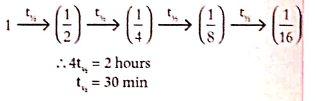
17.
(b)
\(\left( \frac { \pi }{ 6 } \right) \)
18.
(d)
19.
(d)
brass
20.
Cr ⇒ [Ar]3d54s1
21.
(d)
1s2 2s2 2p6 3s2 3p3
22.
(c)
sp2 hybridised
23.
(c)
Galena
24.
(b)
Al2O3

12th Standard Syllabus & Materials
12th Standard
TN 12th Computer Applications களப்பெயர் முறைமை (DNS) Sample Question Papers Study Material - QB365 Set A
NEW12th Standard
TN 12th Computer Applications வலையமைப்பு எடுத்துக்காட்டுகள் மற்றும் நெறிமுறைகள் Sample Question Papers Study Material - QB365 Set A
NEW12th Standard
TN 12th Computer Applications கணினி வலையமைப்பு ஓர் அறிமுகம் Sample Question Papers Study Material - QB365 Set A
NEW12th Standard
TN 12th Computer Applications PHP-உடன் MySQL-ஐ இணைத்தல் Sample Question Papers Study Material - QB365 Set A



Tamilnadu Stateboard 12th Standard Subjects

Maths
Chemistry

Physics

Biology

Computer Science

Business Maths and Statistics

Economics

Commerce

Accountancy

History

Computer Applications
Biology
Computer Technology
Computer Applications
Computer Science
Business Maths and Statistics
Commerce
Economics
Maths
Chemistry
Physics
Computer Technology
History
Accountancy

Tamil

English

French
Tamilnadu Stateboard Standards
