
 100% FREE ACCESS
12th Standard Syllabus & Materials
12th Standard
TN 12th Maths Applications of Matrices and Determinants Sample Question Papers Study Material - QB365 Set A
NEW12th Standard
TN 12th Computer Applications மின்னணு தரவு பரிமாற்றம் Sample Question Papers Study Material - QB365 Set A
NEW12th Standard
TN 12th Computer Applications மின் - வணிக பாதுகாப்பு அமைப்புகள் Sample Question Papers Study Material - QB365 Set A
NEW12th Standard
TN 12th Computer Applications மின்னணு செலுத்தல் முறைகள் Sample Question Papers Study Material - QB365 Set A
NEW12th Standard
TN 12th Computer Applications மின் - வணிகம் Sample Question Papers Study Material - QB365 Set A
NEW12th Standard
TN 12th Computer Applications திறந்த மூல கருத்துருக்கள் Sample Question Papers Study Material - QB365 Set A

Published on: 02/09/2022
QB365 provides a detailed and simple solution for every Possible Creative Questions in Class 12 Chemistry Subject - Hydroxy Compounds and Ethers, English Medium. It will help Students to get more practice questions, Students can Practice these question papers in addition to score best marks.
Download Tamil Nadu 12th Standard Chemistry question papers, model tests, one-mark questions, important questions, and public exam papers in PDF format. Free study materials and answer keys for TN State Board students.
Questions + Answers key
Take MCQ Chemistry Test
1.
Give the IUPAC names of each of the following and classify them as 1°, 2° and 3°
(a) CH3(CH2)3CHOHCH(CH3)2
(b) (CH3)3C-CH2OH
(c) \(({ CH }_{ 3 })_{ 2 }\underset { \overset { | }{ { C }_{ 6 }{ H }_{ 5 } } }{ C } -OH\)
(d) \(BrCH_{ 2 }-\underset { \overset { | }{ OH } }{ { CH }_{ 2 } } -CH-C({ CH }_{ 3 })_{ 3 }\)
(e) CH2=CH-CHOHCH
(f) PhCH2OH
(g) HOCH2CH2CH2CH2C6H5
(h) (C2H5)3COH
2.
Complete the following equations by writing the missing A, B, C, D etc.,
3.
Identify the isomerism in each of the following pairs.
CH3OCH2OCH3 and CH3OCH2CH2OH
CH3CH(OH)CH2OH and CH2OHCH2CH2OH
\({ CH }_{ 3 }-\underset { \overset { | }{ { CH }_{ 3 } } }{ CH } -{ CH }_{ 2 }-OH\) and CH3-CH2-CH2-CH2OH
4.
Account for the following:
(i) Phenol has a smaller dipole moment than methanol,
(ii) Phenols do not give protonation reaction readily.
5.
Give a brief account of the following reaction: Etherification.
6.
How does glycerol react with KHSO4?
7.
How is glycerol obtained commercially? State its uses.
8.
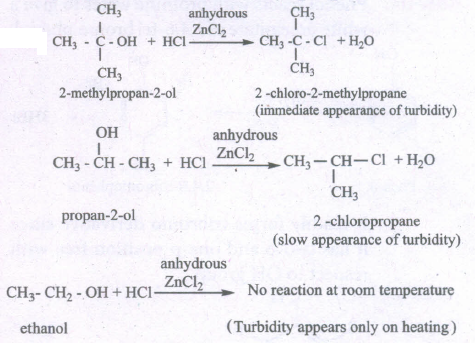
Give chemical tests to distinguish between propan-2-ol and 2-methyl-propan-2-ol.
9.
Why is that tertiary alcohols show greater reactivity towards hydrogen halides than secondary and primary alcohols?
10.
Account for the following:
(a) Lower members of alcohols are soluble in water but higher members are not.
(b) Alcohols cannot be used as solvent for Grignard reagent.
11.
Complete the following sequence of reaction and Identify A, B and C.
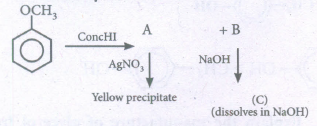
12.
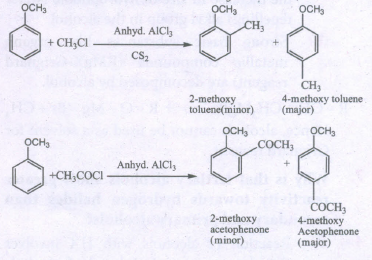
Write a note on Friedel Crafts reaction of anisole.
13.
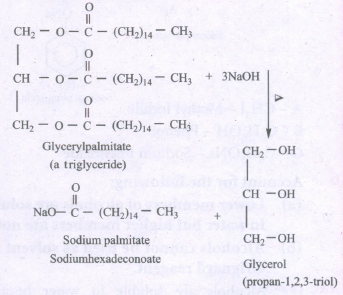
Explain the manufacture of glycerol from triglycerides,
14.
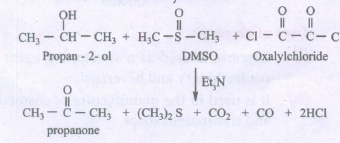
Explain Swern oxidation of propan-2-ol to propanane.
15.
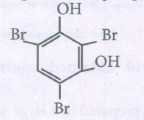
When phenol on treatement with Br2/H2O readily gives a precipitate of 2, 4, 6 - tribomo phenol.
1.
(a) 2-methyl-heptan-3-ol (2°)
(b) 2,2-dimethyl-propan-1-01-(1°)
(c) 2-phenyl-2-propanol (3°)
(d) 2,2-dimethyl-S-bromo-3-pentanol (2°)
(e) l-Butene-ol (2°)
(f) Phenyl methanol (1°)
(g) 4-phenyl-1-butanol (1°)
(h) 3-ethyl-3-pentanol (3°)
2.
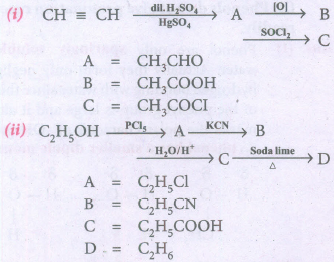
3.
Functional isomerism.
(a) dimethoxy methane
(b) 2-methoxy ethonal
Position isomerism - diol position is changed.
(a) propane - 1,2-diol
(b) propane - 1,3 - diol
Chain isomerism - carbon chain is changed
(a) isobutyl alcohol
(b) n-butyl alcohol
4.
(i) Phenol are only sparingly soluble in water. Actually they form only negligible hydrogen bonding with water since the size of the phenyl group is large and it almost masks the polar character of -OH group. So, phenol has a smaller dipole moment.
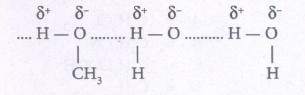
(ii) But methanol is soluble in soluble in water due to the formation of hydrogen bonding with water and it results in higher dipole moment. In henol, there is +ve charge on oxygen, therefore it does not undergo protonation easily.

5.
When an alkyl halide is heated with an alcoholic solution of sodium alkoxide, the corresponding ethers are obtained. The reaction involves SN2 mechanism.
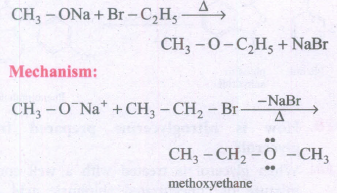
Primary alkyl halides are more susceptible for SN2 reaction. Hence for the preparation of mixed having primary and tertiary alkyl group, primary alkyl halide and tertiary alkoxide are used. On the other hand, if we use tertiary alkyl halide and primary alkoxide, elimination dominates and succedes over substitution to form an alkene.
6.
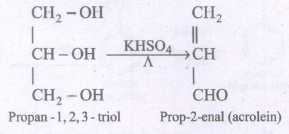
When glycerol is heated with dehydrating agents such as Con H2SO, KHSO4 etc .... , it undergoes dehydration to form acrolein.
7.
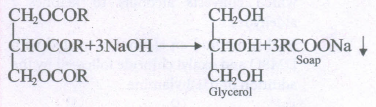
(i) Glycerol is prepared in a large scale by the hydrolysis of oils or fats either by using alkali or by super heated steam.
(ii) During this process, soap is formed along with the byproduct glycerol and this process is called saponification.
Uses of glycerol:
(i) Glycerol is used as a sweetening agent in confectionery and beverages.
(ii) It is used in the manufacture of cosmetics and transparent soaps.
(iii) It is used in making printing inks and stamp pad ink and lubricant for watches and clocks.
(iv) It is used in the manufacture of explosive like dynamite and cordite by mixing it with chaina clay.
8.
9.
(i) Reaction of alcohols with HX involves the cleavage of C-OH bond of alcohols (30>20>10).
This is due to the electron releasing inductive effect of alkyl groups and thus the electron density towards oxygen gets increased.
(ii) As a result the polarity of C-O bond increases making the cleavage between the C and O easier.
(iii) Hence, greater the number of alkyl groups on carbon, more easy would be the cleavage of C-O bond and thus greater would be the reactivity of alcohol.
10.
(a) Alcohols are soluble in water because they form intermolecular hydrogen bonding with water. Lower members are completely miscible with water and the higher members are not. This is because of the increase in size of hydrophobic (water repelling) alkyl group in the alcohol.
(b) Strong basic substances like organo metallic compounds (RMgX-Grignard reagent) are decomposed by alcohol.
R - OH + CH3MgBr ⟶ R - O - Mg - Br + CH4
Hence, alcohols cannot be used as a solvent for Grignard reagent.
11.
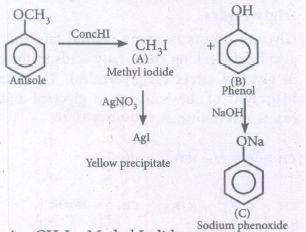
A - CH3I- Methyl Iodide
B - C6H5OH - Phenol
C - C6H5ONa - Sodium Phenoxide
12.
Anisole undergoes Friedel Craft's reaction in presence of anhydrous AlCl3 as a catalyst.
13.
Glycerol occurs in many natural fats and it is also found in long chain fatty acids in the form of glyceryl esters (Triglycerides). The alkaline hydrolysis of these fats gives glycerol and the reaction is known as saponification.
14.
(i) In this method, dimethyl sulfoxide (DMSO) is used as the oxidising agent, which converts alcohols to ketones aldehydes.
(ii) In this method an alcohol is treated with DMSO and oxalyl chloride followed by the addition of triethylamine.
15.
(i) Phenol reacts with bromine water to give a white precipitate of 2,4,6-tri bromo phenol.
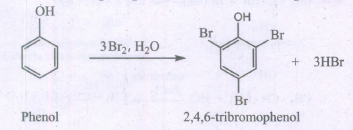
(ii) It readily forms tribromo derivative since it has two-o and one-p position free with respect to OH group.

12th Standard Syllabus & Materials
12th Standard
TN 12th Computer Applications வலையமைப்பு வடமிடல் Sample Question Papers Study Material - QB365 Set A
NEW12th Standard
TN 12th Computer Applications களப்பெயர் முறைமை (DNS) Sample Question Papers Study Material - QB365 Set A
NEW12th Standard
TN 12th Computer Applications வலையமைப்பு எடுத்துக்காட்டுகள் மற்றும் நெறிமுறைகள் Sample Question Papers Study Material - QB365 Set A
NEW12th Standard
TN 12th Computer Applications கணினி வலையமைப்பு ஓர் அறிமுகம் Sample Question Papers Study Material - QB365 Set A



Tamilnadu Stateboard 12th Standard Subjects

Maths
Chemistry

Physics

Biology

Computer Science

Business Maths and Statistics

Economics

Commerce

Accountancy

History

Computer Applications
Biology
Computer Technology
Computer Applications
Computer Science
Business Maths and Statistics
Commerce
Economics
Maths
Chemistry
Physics
Computer Technology
History
Accountancy

Tamil

English

French
Tamilnadu Stateboard Standards
