
 100% FREE ACCESS
12th Standard Syllabus & Materials
12th Standard
TN 12th Computer Applications மின்னணு தரவு பரிமாற்றம் Sample Question Papers Study Material - QB365 Set A
NEW12th Standard
TN 12th Computer Applications மின் - வணிக பாதுகாப்பு அமைப்புகள் Sample Question Papers Study Material - QB365 Set A
NEW12th Standard
TN 12th Computer Applications மின்னணு செலுத்தல் முறைகள் Sample Question Papers Study Material - QB365 Set A
NEW12th Standard
TN 12th Computer Applications மின் - வணிகம் Sample Question Papers Study Material - QB365 Set A
NEW12th Standard
TN 12th Computer Applications திறந்த மூல கருத்துருக்கள் Sample Question Papers Study Material - QB365 Set A
NEW12th Standard
TN 12th Computer Applications வலையமைப்பு வடமிடல் Sample Question Papers Study Material - QB365 Set A

Published on: 29/01/2021
12th Standard Chemistry English Medium Hydroxy compounds and ethers Reduced Syllabus Important Questions 2021
Download Tamil Nadu 12th Standard Chemistry question papers, model tests, one-mark questions, important questions, and public exam papers in PDF format. Free study materials and answer keys for TN State Board students.
Questions + Answers key
Take MCQ Chemistry Test
1.
The IUPAC name of phenetole is _______.
ethoxybenzene
methyl phenyl ether
diethyl ether
diphenyl ether
2.
Ethers are functional isomers of ________.
acids
alcohols
nitro compounds
aldehydes
3.
C6H5 - O - CH3 is an example of ________.
nitriles
mixed ether
symmetrical ether
anhydride
4.
Ether is formed when alkylhalide is treated with sodium alkoxide, this method is known as ________.
Hoffmann reaction
Williamson's synthesis
Wurtz synthesis
Kolbe's reaction
5.
Intermolecular hydrogen bonds are not _______ present in.
CH3COOH
C2H5OC2H5
CH3CH2OH
C2H5NH2
6.
When phenol reacts with CCl4 and NaOH, the product formed is ________ acid.
salicylic
cinnamic
benzoic
carboxylic
7.
Lucas reagent is _______.
ZnCl2
cone. H2SO4 and anhydrous ZnSO4
ZnSO4
cone. HCl and anhydrous ZnCl2
8.
The structure of cumene is ________.
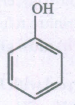
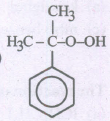
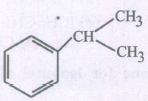
None
9.
The IUPAC name for isobutyl alcohol is _______.
2-methyl-l-propanol
2-methyl-l-butanol
2,2-dimethyl-2-propanol
1,1-dimethyl- 2-butanol
10.
When alcohols are converted to alkyl chlorides by thionyl chloride in presence of pyridine the intermediate formed is ______.
sulphonium ion
chlorosulphonic acid
alkyl chlorosulphite
chlorosulphite
11.
Ethers in the presence of atmospheric oxygen oxidises to give hydroperoxides and dialkyl peroxides Such a spontaneous reaction by atmospheric oxygen is called ______.
auto oxidation
acylation
alkylation
dehydration
12.
Compound of molecular formula C7H8O is a sweet smeeling liquid. A on reaction with acidified K2Cr2O7 gives compound B of molecular formula C7H8O. B reduces Tollen's reagent A and B are respectively.
benzaldelyde and benzoic acid
Methyl phenykarbinol and acetophenone
benzyl alcohol and benzaldehyde
diphenyl carbinol and benzophenone
13.
Higher alcohols are not soluble in water because of ______.
hydrophilic alkyl group
hydrophobic alkyl groups
hydrophilic aryl group
hydrophobic aryl groups
14.
Among the following ethers which one will produce methyl alcohol on treatment with hot HI?
(H3C)3C-O-CH3
(CH3-)2-CH-CH2-O-CH3
CH3-(CH2)3-O-CH3
CH3-CH2-\(\underset { \overset { | }{ { CH }_{ 3 } } }{ CH } \)-O-CH3
15.
The reaction

Can be classified as ______.
dehydration
Williams on alcoholsynthesis
Williamson ether synthesis
dehydrogenation of alcohol
16.
Halo alkane are easily prepared from alcohols while alkyl halides cannot be prepared from phenol. Justify.
17.
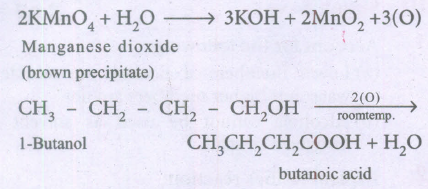
When tertiary butyl alcohol and 1-butanol are separately treated with a few drops of KMnO4, in one case only the purple colour disappears and a brown precipitate is formed. Which of the two alcohols gives the above reaction and what is that brown precipitate?
18.
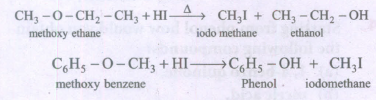
How do ethers react with HI? Give the significances of the reaction.
19.
Ethers should not be heated to dryness. Why?
20.
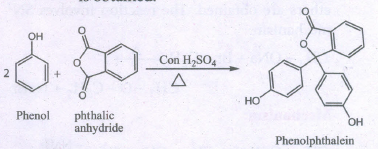
How can the following conversion be effected? (i) Phenol to phenolphthalein.
21.
Give the IUPAC names of each of the following and classify them as 1°, 2° and 3°
(a) CH3(CH2)3CHOHCH(CH3)2
(b) (CH3)3C-CH2OH
(c) \(({ CH }_{ 3 })_{ 2 }\underset { \overset { | }{ { C }_{ 6 }{ H }_{ 5 } } }{ C } -OH\)
(d) \(BrCH_{ 2 }-\underset { \overset { | }{ OH } }{ { CH }_{ 2 } } -CH-C({ CH }_{ 3 })_{ 3 }\)
(e) CH2=CH-CHOHCH
(f) PhCH2OH
(g) HOCH2CH2CH2CH2C6H5
(h) (C2H5)3COH
22.
Account for the following:
(a) Lower members of alcohols are soluble in water but higher members are not.
(b) Alcohols cannot be used as solvent for Grignard reagent.
23.
When phenol on treatement with Br2/H2O readily gives a precipitate of 2, 4, 6 - tribomo phenol.
24.
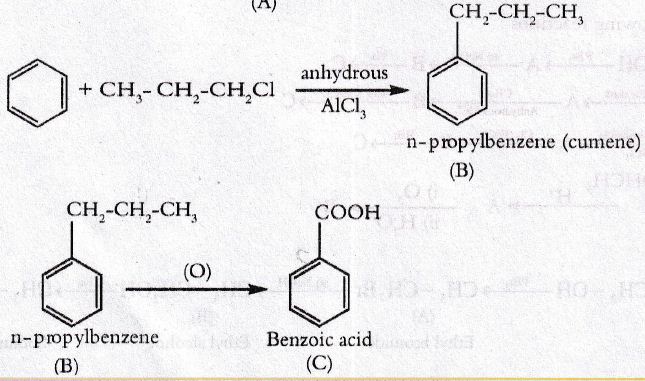
Phenol is distilled with Zn dust followed by friedel – crafts alkylation with prophyl chloride to give a compound B, B on oxidation gives (c) Indentify A,B and C.
25.
How is phenol prepared from
i) chloro benzene
ii) isopropyl benzene
26.
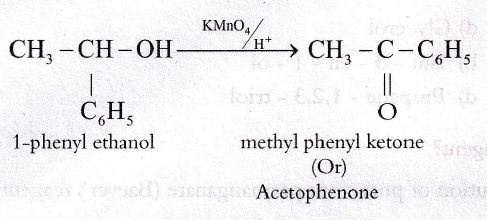
What happens when 1-phenyl ethanol is treated with acidified KMnO4.
27.
Is it possible to oxidise t – butyl alcohol using acidified dichromate to form a carbonyl compound.
28.
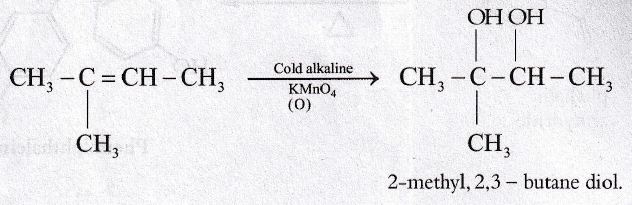
Predict the major product, when 2-methyl but -2-ene is converted into an alcohol in each of the following methods.
(i) Acid catalysed hydration
(ii) Hydroboration
(iii) Hydroxylation using Baeyer's reagent
29.
Draw the major product formed when 1-ethoxyprop-1-ene is heated with one equivalent of HI.
30.
How can isopropyl alcohols be converted to t-butyl alcohol?
31.
Preparation of ethers by intermolecular dehydration of alcohols in the presence of an add is not a suitable method for mixed ethers. Give reason.
32.
Give a test to identify whether a given -OH group is alcoholic or phenolic in nature.
33.
Write the IUPAC names of
(a) C2H5OCH3
(b) C6H5OC2H5
34.
Why sodium metal cannot be used to dry alcohols but it can be used to dry ethers?
35.
Give the IUPAC names of
(i) CH3CH(OH)CH2OH
(ii) HO-CH2-CH2-OH
(iii) \({ { CH } }_{ 3 }-\underset { \overset { | }{ OH } }{ CH } -COOH\)
36.
Explain why phenol does not undergo substitution of the -OH group like alcohol.
37.
An organic compound 'A' is a sodium salt of phenolic acid with molecular formula C7H5O3Na. 'A' on heating with soda lime gives compound 'B' of molecular formula C6H6O. 'B' gives violet colour with neutral ferric chloride. 'B' on treatment with C6H5COCI in the presence of NaOH gives an ester 'C'. Identify 'A', 'B' and 'C'. Explain the reactions.
38.
What are ethers? Write note on simple and mixed ethers with examples.
39.
How would you distinguish between (i) methyl alcohol and ethyl alcohol (ii) benzyl alcohol and phenol, (iii) ethyl alcohol and benzyl alcohol?
40.
How will you distinguish the primary, secondary and tertiary alcohols by Victor Meyer's method?
41.
Explain the mechanism involved in the intermolecular dehydration of alcohols to give ethers.
42.
An organic compound A of molecular f formula C6H6O gives violet colouration with neutral FeCl3. Compound A on treatment with metallic Na gives compound B. Compound B on treatment with CO2 at 400 K under pressure gives C. This product on acidification gives compound D (C7H6O3) which is used in medicine. Identify (A) (B) (C) and D and explain the reactions.
1.
(a)
ethoxybenzene
2.
(b)
alcohols
3.
(b)
mixed ether
4.
(b)
Williamson's synthesis
5.
(b)
C2H5OC2H5
6.
(a)
salicylic
7.
(d)
cone. HCl and anhydrous ZnCl2
8.
(c)
9.
(a)
2-methyl-l-propanol
10.
(c)
alkyl chlorosulphite
11.
(a)
auto oxidation
12.
(c)
benzyl alcohol and benzaldehyde
13.
(b)
hydrophobic alkyl groups
14.

15.
Cyclic alcolhol → sodium cyclic alkoxide- Williamson ether synthesis.
16.
(i) Alcohols are weakly basic in nature so easily in presence of strong acids.
(ii) Due to the presence of +ve charge on the oxygen atom, C-O in protonated alcohols became weak hence easily cleaved by halide ions to form alkyl halides.
(iii) Where as phenols are much weaker bases due to delocalisation of the lone pair of electrons on the oxygen atom due to resonance and so are not easily protonated.
(iv) The C-O bond in phenols has some double bond character; hence not easily cleaved by halide ions to form respective alkyl halides.
17.
1-Butanol, being primary alcohol gets oxidised by dilute KMnO4. The brown precipitate is due to the formation of manganese dioxide.
18.
Ethers can undergo nucleophilic substitution reactions with HBr or HI. HI is more reactive I than HBr.
19.
When ethers are heated to dryness,
(i) They form peroxide by the action of air or oxygen.
(ii) Ether oxygen is capable of forming a co-ordinate covalent bond with electron deficient species.

(ii) These peroxides are unstable and decomposes violently with explosion on heating. Hence, ether should not be heated to dryness.
20.
On heating phenol with phthalic anhydride in presence of con.H2SO4 phenolphthalein is obtained.
21.
(a) 2-methyl-heptan-3-ol (2°)
(b) 2,2-dimethyl-propan-1-01-(1°)
(c) 2-phenyl-2-propanol (3°)
(d) 2,2-dimethyl-S-bromo-3-pentanol (2°)
(e) l-Butene-ol (2°)
(f) Phenyl methanol (1°)
(g) 4-phenyl-1-butanol (1°)
(h) 3-ethyl-3-pentanol (3°)
22.
(a) Alcohols are soluble in water because they form intermolecular hydrogen bonding with water. Lower members are completely miscible with water and the higher members are not. This is because of the increase in size of hydrophobic (water repelling) alkyl group in the alcohol.
(b) Strong basic substances like organo metallic compounds (RMgX-Grignard reagent) are decomposed by alcohol.
R - OH + CH3MgBr ⟶ R - O - Mg - Br + CH4
Hence, alcohols cannot be used as a solvent for Grignard reagent.
23.
(i) Phenol reacts with bromine water to give a white precipitate of 2,4,6-tri bromo phenol.
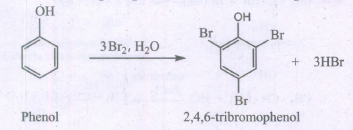
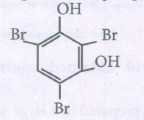
(ii) It readily forms tribromo derivative since it has two-o and one-p position free with respect to OH group.
24.
\(\underset {Phenol} {\mathrm{C}_{6} \mathrm{H}_{5} \mathrm{OH}}+\mathrm{Zn}(\text { dust }) \rightarrow \underset {benzene(A)} {\mathrm{C}_{6} \mathrm{H}_{6}}+\mathrm{ZnO}\)
25.
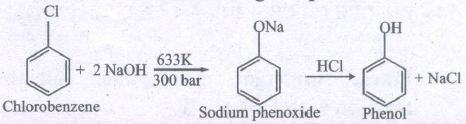
(i) Chloro benzene:
When Chlorobenzene is hydrolysed with 6-8% NaOH at 300 bar and 633K in a closed vessel, sodium phenoxide is formed which on treatment with dilute HCl gives phenol.
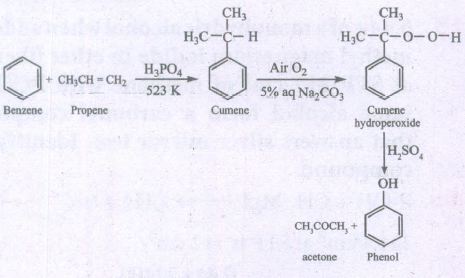
(ii) isopropyl benzene:
A mixture of benzene and propene is heated at 523K in a closed vessel in presence of H3PO4 catalyst gives cumene (isopropylbenzene). On passing air to a mixture of cumene and 5% aqueous sodium carbonate solution, cumene hydro peroxide is formed by oxidation. It is treated with dilute acid to get phenol and acetone. Acetone is also an important byproduct in this reaction.
26.
27.
Tertiary alcohols do not undergo oxidation reaction under normal conditions, but at elevated temperature under strong oxidizing, agent cleavage of C-C-bond takes place to give a mixture of carboxylic acid.
28.
(i) Acid catalysed hydration
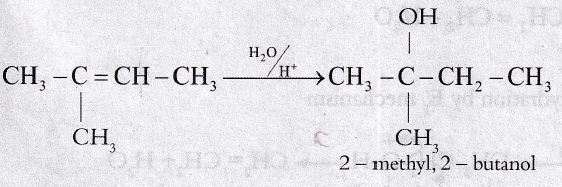
(ii) Hydroboration
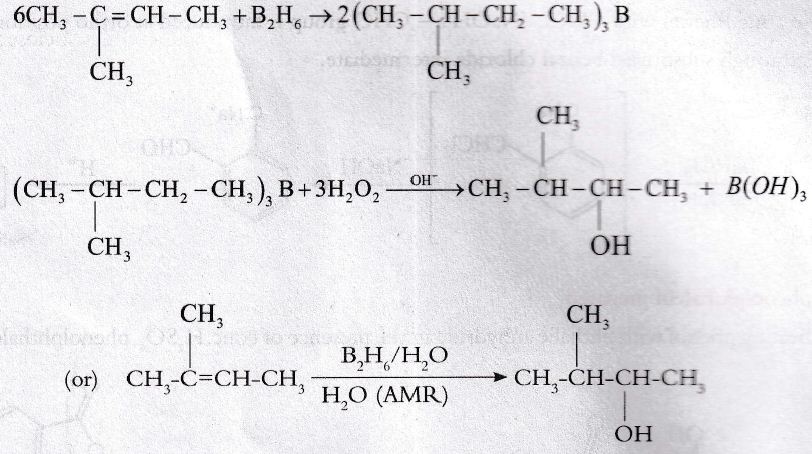
(iii) Hydroxylation using Baeyer's reagent
29.

30.

31.
This method is useful for the preparation of simple ethers and not suitable for preparing mixed ethers. If a mixture of two different alcohols is used, mixture of different ethers will be formed and they are difficult to separate.
32.
Phenolic OR group gives a violet colouration with neutral FeCl3 but alcoholic OR does not.
33.
| Formula | IUPAC Name |
| (a) C2H5OCH3 | Methoxy ethane |
| (b) C6H5OC2H5 | Ethoxy benzene |
34.
Alcohols are acidic enough to react with sodium but ethers are inert.
35.
(i) Propane-1, 2-diol
(ii) Ethane-1,2 - diol
(iii) 2-Hydroxy propanoic acid
36.
In phenol the electron density is increased in the benzene ring and hence the benzene ring is activated towards electrophilic substitution reaction and -OH group does not undergo substitution reaction like alcohol.
37.
(i) The organic compound (A) which is sodium salt of phenolic acid is sodium salicylate.
(ii) (A) on heating with soda lime gives Compound (B) phenol. Phenol gives violet colouration with neutral perchloride.
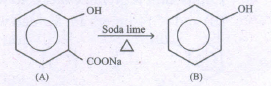
(iii) Phenol on treatment with C6H5COCl in the presence of NaOH gives on ester 'C':
C6H5OH + C6H5COCl \(\overset { NaOH }{ \longrightarrow } \underset { (C) }{ { C }_{ 6 }{ H }_{ 5 }OCO{ C }_{ 6 }{ H }_{ 5 }+HCl } \)
| Compound | Compound Name | Formula |
| A | Sodium benzoate' | 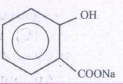 |
| B | Phenol | C6H5OH |
| C | Phenyl benzoate | C6H5OCO C6H5 |
38.
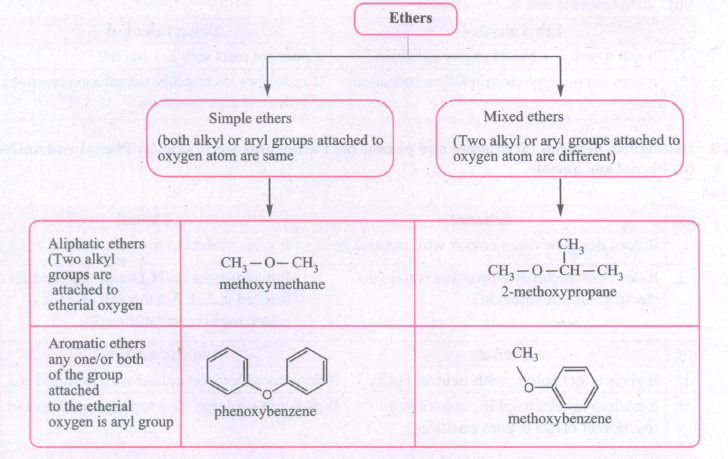
Ethers are a class of organic compound in which an oxygen atom is connected to two alkyl/aryl groups Ethers can be considered as the derivatives of hydrocarbon in which one hydrogen atom is replaced by an alkoxy (-OR) or an aryloxy (-OAr ) group. The general formula of aliphatic ether is CnH2n+2O.
Classification:
39.
(i) Methyl alcohol and Ethyl alcohol
| S.No | Methyl alcohol | Ethyl alcohol |
| 1. | It does not react with cone. H2SO4 at any temperature. | It reacts with cone. H2SO4 at 410K, to produces diethyl ether and at 440K it produces ethylene products. |
| 2. | It does not react with I2 + NaOH to form iodoform. | It reacts with I2 + NaOH to produce iodoform CHI3. |
(ii) Benzyl alcohol and phenol
| S.No | Benzyl alcohol | Phenol |
| 1. | It does not give violet colour with neutral ferric chloride. |
It gives-violet colour with neutral ferric chloride |
| 2. | It does not decolourise bromin water. | It decolourise bromine water and produce 2,4,6- tribromo phenol. |
(iii) Ethyl alcohol and benzyl alcohol
| S.No | Ethyl alcohol | Benzyl alcohol |
| 1. | It reacts with I2 + NaOH to give iodoform | It does not react with I2 + NaOH |
| 2. | It does not undergo electrophilic substitution | It undergoes electrophilic substitution reactions at ortho and para positions. |
40.
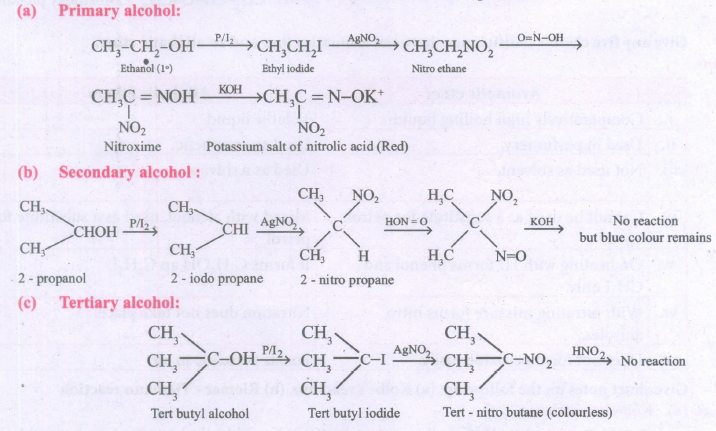
Victor Meyer's test:
This test is used to distinguish 1°, 2°, and 3° alcohols.
This test consists of the following steps:
(i) Alcohol is converted into alkyl iodide by treatment with P/I2.
(ii) The alkyl iodide is then converted into nitro alkane by silver nitrate (AgNO2).
(iii) The nitro alkane is treated with nitrous acid (HNO2) and then with aqueous KOH.
(iv) The 1°,2° and 3° alcohols are identified from the colour of the product.
41.
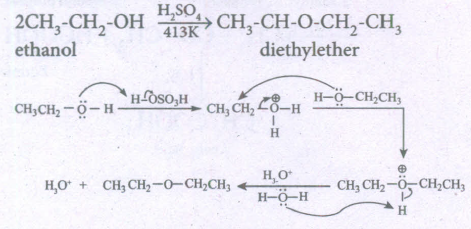
Inter molecular dehydration of alcohol: We have already learnt that when ethanol is treated with con.HSO2 4 at 443K, elimination takes place to form ethene. If the same reaction is carried out at 413K, substitution competes over elimination to form ethers.
42.
(i) Compound A is phenol. (C6H5OH)
Phenols on reaction with metallic Na compound (B) ie., Sodium Phenoxide
\(\underset { (A) }{ { 3C }_{ 6 }{ H }_{ 5 }OH+2Na } \longrightarrow \underset { (B) }{ { 2C }_{ 6 }{ H }_{ 5 }ONa+{ H }_{ 2 } } \)
(ii) (B) is heated with CO2 at 400K under pressure, to give (C). This is decomposed by dil.HCl, and (D) is formed
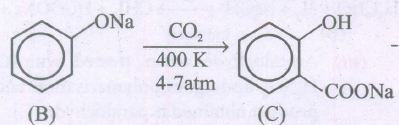
| Compound | Compound Name | Formula |
| A | Phenol | C6H5OH |
| B | Sodium Phenoxide | C6H5ONa |
| C | Sodium Salicylate | 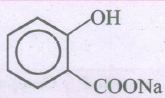 |
| D | Salicylicacid | 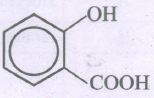 |

12th Standard Syllabus & Materials
12th Standard
TN 12th Computer Applications களப்பெயர் முறைமை (DNS) Sample Question Papers Study Material - QB365 Set A
NEW12th Standard
TN 12th Computer Applications வலையமைப்பு எடுத்துக்காட்டுகள் மற்றும் நெறிமுறைகள் Sample Question Papers Study Material - QB365 Set A
NEW12th Standard
TN 12th Computer Applications கணினி வலையமைப்பு ஓர் அறிமுகம் Sample Question Papers Study Material - QB365 Set A
NEW12th Standard
TN 12th Computer Applications PHP-உடன் MySQL-ஐ இணைத்தல் Sample Question Papers Study Material - QB365 Set A



Tamilnadu Stateboard 12th Standard Subjects

Maths
Chemistry

Physics

Biology

Computer Science

Business Maths and Statistics

Economics

Commerce

Accountancy

History

Computer Applications
Biology
Computer Technology
Computer Applications
Computer Science
Business Maths and Statistics
Commerce
Economics
Maths
Chemistry
Physics
Computer Technology
History
Accountancy

Tamil

English

French
Tamilnadu Stateboard Standards
