
 100% FREE ACCESS
12th Standard Syllabus & Materials
12th Standard
TN 12th Maths Applications of Matrices and Determinants Sample Question Papers Study Material - QB365 Set A
NEW12th Standard
TN 12th Computer Applications மின்னணு தரவு பரிமாற்றம் Sample Question Papers Study Material - QB365 Set A
NEW12th Standard
TN 12th Computer Applications மின் - வணிக பாதுகாப்பு அமைப்புகள் Sample Question Papers Study Material - QB365 Set A
NEW12th Standard
TN 12th Computer Applications மின்னணு செலுத்தல் முறைகள் Sample Question Papers Study Material - QB365 Set A
NEW12th Standard
TN 12th Computer Applications மின் - வணிகம் Sample Question Papers Study Material - QB365 Set A
NEW12th Standard
TN 12th Computer Applications திறந்த மூல கருத்துருக்கள் Sample Question Papers Study Material - QB365 Set A

Published on: 25/08/2020
12th Standard Chemistry English Medium Important 1 Mark Book Back Questions (New Syllabus) 2020
Download Tamil Nadu 12th Standard Chemistry question papers, model tests, one-mark questions, important questions, and public exam papers in PDF format. Free study materials and answer keys for TN State Board students.
Questions + Answers key
Take MCQ Chemistry Test
1.
Drugs that bind to the receptor site and inhibit its natural function are called _______.
antagonists
agonists
enzymes
molecular targets
2.
Antiseptics and disinfectants either kill or prevent growth of microorganisms. Identify which of the following statement is not true.
dilute solutions of boric acid and hydrogen peroxide are strong antiseptics.
Disinfectants harm the living tissues
A 0.2% solution of phenol is an antiseptic while 1% solution acts as a disinfectant
Chlorine and iodine are used as strong disinfectants
3.
The correct statement regarding RNA and DNA respectively is ______.
the sugar component in RNA is an arabinos and the sugar component in DNA is ribose
the sugar component in RNA is 2’-deoxyribose and the sugar component in DNA is arabinose
the sugar component in RNA is an arabinose and the sugar component in DNA is 2’-deoxyribose
the sugar component in RNA is ribose and the sugar component in DNA is 2’-deoxyribose
4.
The product formed by the reaction an aldehyde with a primary amine ________.
carboxylic acid
aromatic acid
schiff ’s base
ketone
5.
Aniline + benzoylchloride \(\overset { NaOH }{ \longrightarrow } \)C6H5 - NH - COC6 H5 this reaction is known as ______.
Friedel – crafts reaction
HVZ reaction
Schotten – Baumann reaction
none of these
6.
In which of the following reactions new carbon – carbon bond is not formed?
Aldol condensation
Friedel craft reaction
Kolbe’s reaction
Wolf kishner reduction
7.
The reagent used to distinguish between acetaldehyde and benzaldehyde is _______.
Tollens reagent
Fehling’s solution
2,4 – dinitrophenyl hydrazine
semicarbazide
8.
Predict the product Z in the following series of reactions Ethanoic acid \(\overset { { PCI }_{ 5 } }{ \longrightarrow } X\overset { { C }_{ 6 }{ H }_{ 6 } }{ \underset { Anhydrous \ AlCI }-_{3}{ \longrightarrow } } Y\overset { 1){ CH }_{ 3 }MgBr }{ \underset { II){ H }_{ 3 }{ O }^{ + } }{ \longrightarrow } } Z.\)
(CH3)2 C(OH)C6H5
CH3CH(OH)C6H5
CH3CH(OH)CH2- CH3

9.
Williamson synthesis of preparing dimethyl ether is a / an ______.
SN1 reactions
SN2 reaction
electrophilic addition
electrophilic substitution
10.
In the reaction Ethanol \(\overset { { PCl }_{ 5 } }{ \longrightarrow } X\overset { alc.KOH }{ \longrightarrow } Y\overset { { H }_{ 2 }{ SO }_{ 4 }/{ H }_{ 2 }O }{ \underset { 298k }{ \longrightarrow } } Z.\) The ‘Z’ is ______.
ethane
ethoxyethane
ethylbisulphite
ethanol
11.
Which of the following compounds on reaction with methyl magnesium bromide will give tertiary alcohol.
benzaldehyde
propanoic acid
methyl propanoate
acetaldehyde
12.
Match the following
| a | V2O5 | i | High density polyethylene |
| b | Ziegler – Natta | ii | PAN |
| c | Peroxide | iii | NH3 |
| d | Finely divided Fe | iv | H2SO4 |
| A | B | C | D |
| iv | i | ii | iii |
| A | B | C | D |
| i | ii | iv | iii |
| A | B | C | D |
| ii | iii | iv | i |
| A | B | C | D |
| iii | iv | ii | i |
13.
Statement : To stop bleeding from an injury, ferric chloride can be applied. Which comment about the statement is justified?
It is not true, ferric chloride is a poison.
It is true, Fe3+ ions coagulate blood which is a negatively charged sol
It is not true; ferric chloride is ionic and gets into the blood stream.
It is true, coagulation takes place because of formation of negatively charged sol with Cl-.
14.
Conductivity of a saturated solution of a sparingly soluble salt AB (1:1 electrolyte) at 298K is 1.85 ×10⁻⁵ S m−1. Solubility product of the salt AB at 298K (Λom)AB = 14 ×10−3 S m2 mol−1.
5.7 x 10⁻¹²
1.32 x 10⁻¹²
7.5 x 10⁻¹²
1.74 x 10⁻¹²
15.
The button cell used is watches function as follows
Zn (s) + Ag2O (s) + H2O (l) ⇌ 2Ag (s) + Zn2+ (aq) + 2OH-(aq) the half cell potentials are Ag2O (s) + H2O (l) + 2e- → 2Ag (s) + 2OH- (aq) Eo = 34V and Zn (s) → Zn2+ (aq) + 2e− E0 = 0.76V . The cell potential will be_______.
0.84V
1.34V
1.10V
0.42V
16.
The solubility of BaSO4 in water is 2.42 × 10⁻³gL-1 at 298K. The value of its solubility product(Ksp) will be (Given molar mass of BaSO4 =233g mol-1)
1.08 × 10⁻¹⁴mol2L-2
1.08 × 10⁻¹²mol2L-2
1.08 × 10⁻¹⁰mol2L-2
1.08 × 10⁻⁸mol2L-2
17.
If ‘a’ is the length of the side of the cube, the distance between the body centered atom and one corner atom in the cube will be_________.
\(\left( \cfrac { 2 }{ \sqrt { 3 } } \right) a\)
\(\left( \cfrac { 4 }{ \sqrt { 3 } } \right) a\)
\(\left( \cfrac { \sqrt { 3 } }{ 4 } \right) a\)
\(\left( \cfrac { \sqrt { 3 } }{ 2 } \right) a\)
18.
For a first order reaction A ⟶ product with initial concentration x mol L-1, has a half life period of 2.5 hours. For the same reaction with initial concentration \(\left( \frac { x }{ 2 } \right) \) mol L-1 the half life is
(2.5 x 2) hours
\(\left( \frac { 2.5 }{ 2 } \right) \) hours
2.5 hours
Without knowing the rate constant, t1/2 cannot be determined from the given data
19.
The number of unit cells in 8 gm of an element X (atomic mass 40) which crystallizes in bcc pattern is (NA is the Avogadro number)________.
6.023 x 10²³
6.023 x 10²²
60.23 x 10²³
\(\left( \frac { 6.023\times { 10 }^{ 23 } }{ 8\times 40 } \right) \)
20.
Solid CO2 is an example of ________.
Covalent solid
metallic solid
molecular solid
ionic solid
21.
Which kind of isomerism is possible for a complex [Co(NH3)4Br2]CI?
geometrical and ionization
geometrical and optical
optical and ionization
geometrical only
22.
Oxidation state of Iron and the charge on the ligand NO in [Fe(H2O)5NO]SO4 are_______.
+2 and 0 respectively
+3 and 0 respectively
+3 and -1 respectively
+1 and +1 respectively
23.
An excess of silver nitrate is added to 100ml of a 0.01M solution of Pentaaquachlorochromium (III)chloride. The number of moles of AgCl precipitated would be _______.
0.02
0.002
0.01
0.2
24.
Which one of the following statements related to lanthanons is incorrect?
Europium shows +2 oxidation state
The basicity decreases as the ionic radius decreases from Pr to Lu.
All the lanthanons are much more reactive than aluminium
Ce4+ solutions are widely used as oxidising agents in volumetric analysis.
25.
MnO4- react with Br- in alkaline PH to give ________.
BrO3- MnO2
Br2, MnO42-
Br2, MnO2
BrO-, MnO42-
26.
Which of the following compounds is colourless?
Fe3+
Ti4+
Co2+
Ni2+
27.
Which of the following d block element has half filled penultimate d sub shell as well as half filled valence sub shell?
Cr
Pd
Pt
none of these
28.
Duralumin is an alloy of ______.
Cu, Mn
Cu, Al, Mg
Al, Mn
Al, Cu, Mn, Mg
29.
On hydrolysis, PCl3 gives________.
H3PO3
PH3
H3PO4
POCl3
30.
The basic structural unit of silicates is _______.
\(\left( SiO_{ 3 } \right) ^{ 2- }\)
\(\left( SiO_{ 4 } \right) ^{ 2- }\)
\(\left( Sio \right) ^{ - }\)
\(\left( SiO_{ 4 } \right) ^{ 4- }\)
31.
Which of the following metals has the largest abundance in the earth’s crust?
Aluminium
Calcium
Magnesium
Sodium
32.
Which one of the following is not feasible
Zn(s) + Cu2+(aq) \(\rightarrow\) Cu(s) + Zn2+(aq)
Cu(s)+ Zn2+(aq)\(\rightarrow\) Zn(s) + Cu2+(aq)
Cu(s) + 2Ag+(ag)\(\rightarrow\) 2Ag(s) + Cu2+(aq)
Fe(s) + Cu2+(aq) \(\rightarrow\) Cu(s)+ Fe2+(aq)
33.
Which one of the following reaction represents calcinations?
\(2Zn+{ O }_{ 2 }\rightarrow 2ZnO\)
\(2ZnS+3O_{ 2 }\rightarrow 2ZnO+2SO_{ 2 }\)
\(MgCO_{ 3 }\rightarrow MgO+CO_{ 2 }\)
Both (a) and (c)
34.
Assertion: A solution of sucrose in water is dextrorotatory. But on hydrolysis in the presence of little hydrochloric acid, it becomes levorotatory.
Reason: Sucrose hydrolysis gives unequal amounts of glucose and fructose. As a result of this change in sign of rotation is observed.
Codes:
a) If both accretion and reason are true and reason is the correct explanation of assertion.
b) If both assertion and reason are true but reason is not the correct explanation of assertion.
c) If assertion is true but reason is false.
d) if both assertion and reason are false.
If both accretion and reason are true and reason is the correct explanation of assertion
If both assertion and reason are true but reason is not the correct explanation of assertion
If assertion is true but reason is false.
if both assertion and reason are false.
35.
Assertion: Rate of reaction doubles when the concentration of the reactant is doubles if it is a first order reaction.
Reason: Rate constant also doubles
Codes:
a) Both assertion and reason are true and reason is the correct explanation of assertion.
b) Both assertion and reason are true but reason is not the correct explanation of assertion.
c) Assertion is true but reason is false
d) Both assertion and reason are false.
Both assertion and reason are true and reason is the correct explanation of assertion.
Both assertion and reason are true but reason is not the correct explanation of assertion.
Assertion is true but reason is false
Both assertion and reason are false.
36.
1.
(a)
antagonists
2.
(a)
dilute solutions of boric acid and hydrogen peroxide are strong antiseptics.
3.
(d)
the sugar component in RNA is ribose and the sugar component in DNA is 2’-deoxyribose
4.
(c)
schiff ’s base
5.
(c)
Schotten – Baumann reaction
6.
(d)
Wolf kishner reduction
7.
(b)
Fehling’s solution
8.

9.
(b)
SN2 reaction
10.

11.
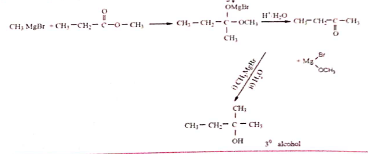
12.
(a)
| A | B | C | D |
| iv | i | ii | iii |
13.
(b)
It is true, Fe3+ ions coagulate blood which is a negatively charged sol
14.
For 1:1 electrolyte Ksp = S2
\(=[\frac{ K \times 10^{-3}}{Λ^o}]^2\)
\(=[\frac{1.85 \times 10^{-5} \times 10^{-3}}{14 \times 10^{-3}}]^2\)
= (0.1321 x 10⁻³)2
= 0.01745 x 10¹⁰-10
= 1.74 x 10⁻¹²
15.
Anodic Oxidation: (Reverse the given reaction)
(Eoox ) = 0.76 V Cathodic reduction
Eocell = (Eoox )+ (Eored)
= 0.76 + 0.34 = 1.1 V
16.
BaSO4 ⇌ Ba2+ + SO42-
Ksp = (s) (s)
Ksp = (s)2
= (2.42 × 10⁻³gL-1)2
\(=\frac{2.42 \times 10^{-3} gL^{-1}}{233 \text{ g mol}^{-1}}\)
= (0.01038 x 10⁻³)2
= (1.038 x x 10-5)2
= 1.077 x 10-10
= 1.08 × 10⁻¹⁰mol2L-2
17.
If a is the length of the side, then the length of the leading diagonal passing through the body centered atom is \(\sqrt{3a} \)
Required distance = \(\left( \cfrac { \sqrt { 3 } }{ 2 } \right) a\)
18.
For a first order reaction
t1/2 = \(\frac { 0.693 }{ { k }}\)
t1/2 does not depend on the initial concentration and it remains constant (whatever may be the initial concentration)
t1/2 = 2.5 hrs
19.
In bcc unit cell,
2 atoms = 1 unit cell
Number of atoms in 8 g of element is, Number of moles = 8g / 40 g mol-1 = 0.2 mol
1 mole contains 6.023 x10²³ atoms
0.2 mole contains 0.2 x 6.023 x 1023 atoms
[1 unit cell / 2 atoms] x 0.2 x 6.023 x 1023
= 6.023 x 10²² unit cells.
20.
Lattice points are occupied by CO2 molecules
21.
For [MA4B2]4+ complexes - geometrical isomerism is possible
{[Co(NH3)4Br2]CI,[Co(NH3)4Br CI]Br} - ionisation isomers
22.
[\( \overset{+}{Fe}\)(H2O)5\( \overset{+}{NO}\)]2+ SO2-4
+1 and +1 respectively
23.
The complex is [M(H2O)5Cl]Cl2
1000 ml of 1 M solution of the complex gives 2 moles of Cl- ions 1000 ml of 0.01 M solution of the complex will give
\(\frac{100 ml \times 0.01M \times 2Cl^-}{1000 ml \times 1M}\)
= 0.002 moles of Cl- ions
24.
As we move from La to Lu, their metallic behaviour because almost similar to that of aluminium.
25.
(a)
BrO3- MnO2
26.
(b)
Ti4+
27.
Cr ⇒ [Ar]3d54s1
28.
(d)
Al, Cu, Mn, Mg
29.
(a)
H3PO3
30.
(d)
\(\left( SiO_{ 4 } \right) ^{ 4- }\)
31.
(a)
Aluminium
32.
(b)
Cu(s)+ Zn2+(aq)\(\rightarrow\) Zn(s) + Cu2+(aq)
33.
(c)
\(MgCO_{ 3 }\rightarrow MgO+CO_{ 2 }\)
34.
a) If both accretion and reason are true and reason is the correct explanation of assertion.
35.
c) Assertion is true but reason is false
36.
(d)

12th Standard Syllabus & Materials
12th Standard
TN 12th Computer Applications வலையமைப்பு வடமிடல் Sample Question Papers Study Material - QB365 Set A
NEW12th Standard
TN 12th Computer Applications களப்பெயர் முறைமை (DNS) Sample Question Papers Study Material - QB365 Set A
NEW12th Standard
TN 12th Computer Applications வலையமைப்பு எடுத்துக்காட்டுகள் மற்றும் நெறிமுறைகள் Sample Question Papers Study Material - QB365 Set A
NEW12th Standard
TN 12th Computer Applications கணினி வலையமைப்பு ஓர் அறிமுகம் Sample Question Papers Study Material - QB365 Set A



Tamilnadu Stateboard 12th Standard Subjects

Maths
Chemistry

Physics

Biology

Computer Science

Business Maths and Statistics

Economics

Commerce

Accountancy

History

Computer Applications
Biology
Computer Technology
Computer Applications
Computer Science
Business Maths and Statistics
Commerce
Economics
Maths
Chemistry
Physics
Computer Technology
History
Accountancy

Tamil

English

French
Tamilnadu Stateboard Standards
