
 100% FREE ACCESS
12th Standard Syllabus & Materials
12th Standard
TN 12th Computer Applications மின்னணு தரவு பரிமாற்றம் Sample Question Papers Study Material - QB365 Set A
NEW12th Standard
TN 12th Computer Applications மின் - வணிக பாதுகாப்பு அமைப்புகள் Sample Question Papers Study Material - QB365 Set A
NEW12th Standard
TN 12th Computer Applications மின்னணு செலுத்தல் முறைகள் Sample Question Papers Study Material - QB365 Set A
NEW12th Standard
TN 12th Computer Applications மின் - வணிகம் Sample Question Papers Study Material - QB365 Set A
NEW12th Standard
TN 12th Computer Applications திறந்த மூல கருத்துருக்கள் Sample Question Papers Study Material - QB365 Set A
NEW12th Standard
TN 12th Computer Applications வலையமைப்பு வடமிடல் Sample Question Papers Study Material - QB365 Set A

Published on: 31/08/2020
12th Standard Chemistry English Medium Important 2 Mark Book Back Questions (New Syllabus) 2020
Download Tamil Nadu 12th Standard Chemistry question papers, model tests, one-mark questions, important questions, and public exam papers in PDF format. Free study materials and answer keys for TN State Board students.
Questions + Answers key
Take MCQ Chemistry Test
1.
State the laws of reflection.
2.
A conductivity cell has two platinum electrodes separated by a distance 1.5 cm and the cross sectional area of each electrode is 4.5 sq cm. Using this cell, the resistance of 0.5 N electrolytic solution was measured as 15 Ω. Find the specific conductance of the solution.
3.
Why does conductivity of a solution decrease on dilution of the solution.
4.
Name the Vitamins whose deficiency cause i) rickets ii) scurvy
5.
The concentration of hydroxide ion in a water sample is found to be 2.5 × 10⁻⁶M. Identify the nature of the solution.
6.
What is the order with respect to each of the reactant and overall order of the following reactions?
a) 5Br-(aq)+BrO3-(aq)+6H+(aq) ➝3Br2(l)+3H2O(l)
The experimental rate law is Rate = k [Br−][BrO3−][H+]2
b) CH3CHO(g)\(\overset { \Delta }{ \longrightarrow } \) CH4(g)+CO(g) the experimental rate law is
Rate =K[CH3CHO]\(\frac{3}{2}\)
7.
[CuCl4]2- exists while [Cul4]2- does not exist why?
8.
Explain why fluorine always exhibit an oxidation state of -1?
9.
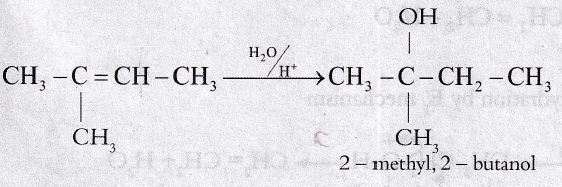
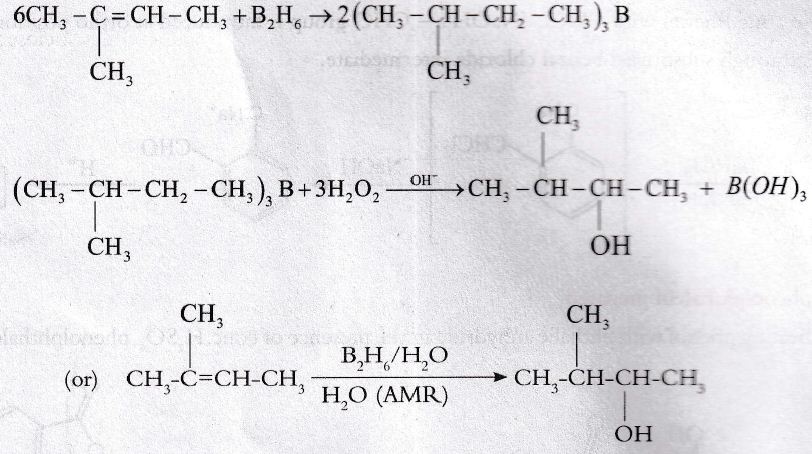
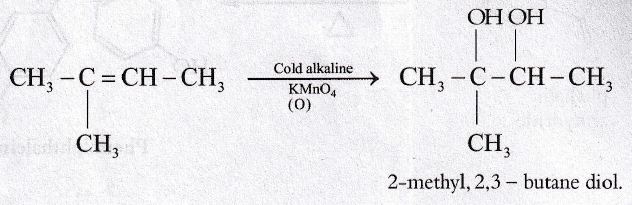
Predict the major product, when 2-methyl but -2-ene is converted into an alcohol in each of the following methods.
(i) Acid catalysed hydration
(ii) Hydroboration
(iii) Hydroxylation using Baeyer's reagent
10.
Write a note on synthetic detergents
11.
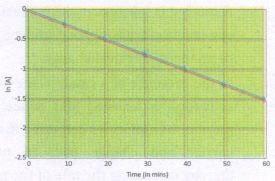
Describe the graphical representation of first order reaction.
12.
Justify the position of lanthanoids and actinoids in the periodic table.
13.
Explain briefly seven types of unit cell.
14.
Differentiate physisorption and chemisorption.
15.
Identify compounds A, B and C in the following sequence of reactions.
i) \({ C }_{ 6 }{ H }_{ 5 }NO_{ 2 }\overset { Fe/HCL }{ \longrightarrow } A\overset { HN{ O }_{ 2 } }{ \underset { 273K }{ \longrightarrow } } B\overset { { C }_{ 6 }{ H }_{ 5 }OH }{ \longrightarrow } C\)
ii) \({ C }_{ 6 }{ H }_{ 5 }N_{ 2 }cl\overset { CuCN }{ \longrightarrow } A\overset { H_{ 2 }O/H^{ + } }{ \longrightarrow } B\overset { NH_3 }{ \longrightarrow } C\)
iii) \({ C }{ H }_{ 3 }{ C }{ H }_{ 2 }I\overset { NaCN}{ \longrightarrow } A\overset {OH^-}{ \underset {Partial hydrolysis}{ \longrightarrow } } B\overset {NaOH+Br_2 }{ \longrightarrow } C\)
iv) \({ C }{ H }_{ 3 }NH_{ 2 }\overset { CH_3 Br }{ \longrightarrow } A\overset { CH_{ 3 }COCl}{ \longrightarrow } B\overset { B_2H_6 }{ \longrightarrow } C\)
v) \({ C }_{ 6 }{ H }_{ 5 }NH_{ 2 }\overset { (CH_{ 3 }CO)_{ 2 }O }{ \underset { Pyridine }{ \longrightarrow } } A\overset { HNO_{ 3 } }{ \underset { H_{ 2 }SO_{ 4 },288K }{ \longrightarrow } } B\overset { { H }_{ 2 }O/{ H }^{ + } }{ \longrightarrow C } \)
vi)
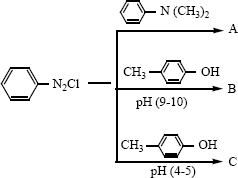
vii) \({ C }{ H }_{ 3 }CN_{ 2 }NC\overset { HgO }{ \longrightarrow } A\overset { H_{ 2 }O }{ \longrightarrow } B\overset { i) NaN{ O }_{ 2 }/HCL }{ \underset { ii){ H }_{ 2 }O }{ \longrightarrow } } \)
1.
According to law of reflection,
(i) The incident ray, reflected ray and normal to the reflecting surface all are coplanar (i.e: lie in the same plane).
(ii) The angle of incidence i is equal to the angle of reflection r.
i = r
2.
l = 1.5 cm = 1.5 × 10⁻²m
A = 4.5 cm2 = 4.5 × (10-4)m2
R = 15Ω
\(\kappa = \frac{1}{R}(\frac{l}{A})\)
\(\kappa = \frac{1}{15\Omega}\times\frac{1.5\times10^{-2}m}{4.5\times10^{-4}m^2}\)
= 2.22 ohm-1 m-1
= 2.22 Sm-1
3.
On dilution the concentration decreases. Conductivity decreases with decrease in concentration (or dilution) as the number of ions per unit volume that carry the current in a solution decrease on dilution.
4.
i) Rickets - Vitamin - D (Cholecalciferol - (D3) Ergocalciferol - (D2)
ii) Scurvy (bleeding gums) - vitamin - C (Ascorbic acid)
5.
1. If \(\left[\mathrm{OH}^{-}\right]>1 \times 10^{-7} \mathrm{M}\), the solution is basic. \(2.5 \times 10^{-6} \mathrm{M}>1 \times 10^{-7} \mathrm{M}\)
2. \(\therefore\) The solution is basic.
6.
a) First order with respect to Br−, first order with respect to BrO3− and second order with respect to H+. Hence the overall order of the reaction is equal to 1 + 1 + 2 = 4
b) Order of the reaction with respect to acetaldehyde is \(\frac{3}{2}\) and overall order is also \(\frac{3}{2}\)
7.
In [CuCI4]-2 Cu2+, is reduced to Cu+ by I-. Hence Cupric Iodide in converted to cuprous Iodide so [CuI4]-2 does not exist. In [CuCI4]-2 Cl- cannot effect this change and so exists.
8.
(i) Fluorine is most electronegative atom.
(ii) It has only one unpaired electron.
9.
(i) Acid catalysed hydration
(ii) Hydroboration
(iii) Hydroxylation using Baeyer's reagent
10.
Detergents:
a) Anionic detergents:
These are sodium salt of sulphonated long chain alcohols (or) hydrocarbons. The anionic part of the molecule is involved in the cleansing action.
Eg: sodium lawryl sulphate, sodium dodecyl benzene sulphonate.
Use: Household work & tooth paste.
b) Cationie detergents:
These are quarternary. ammonium salts of amines with acetates, chlorides (or) bromides as anions.
It is the cationic part of the molecule which is involved in cleansing action.
Eg: n-hexadecyl trimethyl ammonium chloride
c) Non-ionic detergents:
These donot contain any ion. These are esters of high molecular mass alcohols.
Eg: Pentaerythrityl stearate
Use dish washing detergents.
| Detergent Type | Example |
| Anionic detergent | Sodium Lauryl Sulphate (SLS).JPG) |
| Cationic detergent | N - hexadecyltrimethyl ammonium chloride.JPG) N,N,N - trimethylhexadecan - 1 - aminium chloride |
| Non - ionic detergent | Pentaerythrityl stearate.JPG) 3 - hydroxy -2,2 - bis (hydroxymethyl) propyl heptanoate |
11.
A Reaction whose rate depends on the reactant concentration raised to the first power is called a first order reaction. For a first order reaction,
A ⟶ product
Rate law can be expressed as
Rate = k[A]-1
\(\frac { -d\left[ A \right] }{ \left[ A \right] } =k dt\) ...(1)
Integrate the above equation between the limits of time t = 0 and time equal to t, while the concentration varies from the initial: concentration [Ao] to [A] at the later time.
\(\int _{ { [A }_{ 0 }] }^{ [A] }{ \frac { -d\left[ A \right] }{ \left[ A \right] } } =k\int _{ 0 }^{ t }{ dt } \)
\({ \left( -In\left[ A \right] \right) }_{ \left[ { A }_{ 0 } \right] }^{ \left[ A \right] }=k{ \left( t \right) }_{ 0 }^{ t }\)
\(-In\left[ A \right] -\left( In\left[ { A }_{ 0 } \right] \right) =k\left( t-0 \right) \)
\(-In\left[ A \right] -\left( In\left[ { A }_{ 0 } \right] \right) =kt\)
\(In\left( \frac { \left[ { A }_{ 0 } \right] }{ \left[ A \right] } \right) =kt\) ...(2)
This equation is in natural logarithm. To convert it into usual logarithm with base 10, we have to multiply the term by 2.303.
\(2.303\quad log\left( \frac { \left[ { A }_{ 0 } \right] }{ \left[ A \right] } \right) =kt\)
\(k=\frac { 2.303 }{ t } log\left( \frac { \left[ { A }_{ 0 } \right] }{ \left[ A \right] } \right) \) ...(3)
Equation (2) can be written in the form
y = mx+c as below
In [A0]-In[A] = kt
In[A] = In[A0]-kt
⇒ y = c + mx
If we follow the reaction by measuring the concentration of the reactants at regular time interval 't' a plot of In[A] against 't' yields a straight line with a negative slope. From this, the rate constant is calculated.
12.
(i) The actual position of Lanthanides in the periodic table is at group number 3 and period number 6. However, in the sixth period after lanthanum, the electrons are preferentially filled in inner 4f sub shell and these fourteen elements following lanthanum show similar chemical properties.
(ii) Similarly the fourteen elements following actinium resemble in their physical and chemical properties. Hence they are placed separately bottom of the modern periodic table.
13.
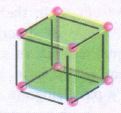
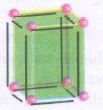
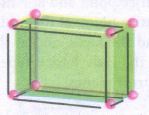
There are seven types of unit cell, Cubic, tetragonal, orthorhombic, hexagonal, monoclinic, triclinic and rhombohedral. They differ in the arrangement of their crystallographic axes and angles.
i) Cubic: a = b = c; α = β = ૪ = 90o.
ii) Tetragonal: a = b ≠ c; α = β = ૪ = 90°.
iii) Orthorhombic: a ≠ b ≠ c; α = β = ૪ = 90°.
iv) Hexagonal: a = b ≠ c; α = β = 90o, ૪ = 120o.
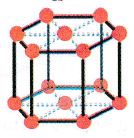
v) Monoclinic: a ≠ b ≠ c; α = ૪ = 90o, β ≠ 90o,
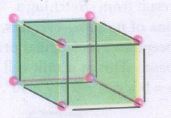
vi) Triclinic: a ≠ b ≠ c; α ≠ β ≠ ૪ ≠ 90o.
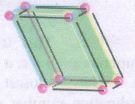
vii) Rhombohedral: a = b = c; α = β = ૪ ≠ 90o.
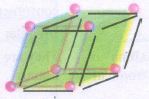
14.
| S.No | Physical adsorption or vander waals adsorption or Physisorption | Chemical adsorption or Chemisorption or Activated adsorption |
|---|---|---|
| 1. | It is instantaneous | It is very slow |
| 2. | It is non-specific | It is very specific depends on nature of adsorbent and adsorbate |
| 3. | In Physisorption, when pressure increases the amount of adsorption increases | Chemical adsorption is fast with increase pressure, it can not alter the amount. |
| 4. | Physisorption decreases with increase in temerature | When temperature is raised chemisorption first increases and then decreases |
| 5. | No transfer of electrons | Chemisorption involves transfer of electrons between the adsorbent and adsorbate |
| 6. | Heat of adsorption is low in the order of 40kJ/ mole. | Heat of adsorption is high i.e., from 40- 400kJ/mole. |
| 7. | Multilayer of the adsorbate is formed on the adsorbent. | Monolayer of the adsorbate is formed |
| 8. | It occurs on all sides | Adsorption occurs at fixed sites called active centres. It depends on surface area |
| 9 | Activation energy is insignificant. | Chemisorption involves the formation of activated complex with appreciable activation energy. |
15.
.JPG)
.JPG)
.JPG) +CO2
+CO2
.JPG)
.JPG)
.JPG)
.JPG)

12th Standard Syllabus & Materials
12th Standard
TN 12th Computer Applications களப்பெயர் முறைமை (DNS) Sample Question Papers Study Material - QB365 Set A
NEW12th Standard
TN 12th Computer Applications வலையமைப்பு எடுத்துக்காட்டுகள் மற்றும் நெறிமுறைகள் Sample Question Papers Study Material - QB365 Set A
NEW12th Standard
TN 12th Computer Applications கணினி வலையமைப்பு ஓர் அறிமுகம் Sample Question Papers Study Material - QB365 Set A
NEW12th Standard
TN 12th Computer Applications PHP-உடன் MySQL-ஐ இணைத்தல் Sample Question Papers Study Material - QB365 Set A



Tamilnadu Stateboard 12th Standard Subjects

Maths
Chemistry

Physics

Biology

Computer Science

Business Maths and Statistics

Economics

Commerce

Accountancy

History

Computer Applications
Biology
Computer Technology
Computer Applications
Computer Science
Business Maths and Statistics
Commerce
Economics
Maths
Chemistry
Physics
Computer Technology
History
Accountancy

Tamil

English

French
Tamilnadu Stateboard Standards
