
 100% FREE ACCESS
12th Standard Syllabus & Materials
12th Standard
TN 12th Computer Applications மின்னணு தரவு பரிமாற்றம் Sample Question Papers Study Material - QB365 Set A
NEW12th Standard
TN 12th Computer Applications மின் - வணிக பாதுகாப்பு அமைப்புகள் Sample Question Papers Study Material - QB365 Set A
NEW12th Standard
TN 12th Computer Applications மின்னணு செலுத்தல் முறைகள் Sample Question Papers Study Material - QB365 Set A
NEW12th Standard
TN 12th Computer Applications மின் - வணிகம் Sample Question Papers Study Material - QB365 Set A
NEW12th Standard
TN 12th Computer Applications திறந்த மூல கருத்துருக்கள் Sample Question Papers Study Material - QB365 Set A
NEW12th Standard
TN 12th Computer Applications வலையமைப்பு வடமிடல் Sample Question Papers Study Material - QB365 Set A

Published on: 31/08/2020
12th Standard Chemistry English Medium Important 2 Mark Creative Questions (New Syllabus) 2020
Download Tamil Nadu 12th Standard Chemistry question papers, model tests, one-mark questions, important questions, and public exam papers in PDF format. Free study materials and answer keys for TN State Board students.
Questions + Answers key
Take MCQ Chemistry Test
1.
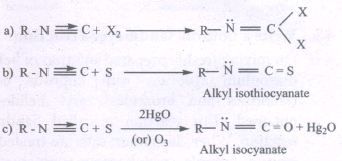
Write a note on addition reactions of alkyl isocyanides.
2.
How is anisole prepared from benzene diazonium chloride?
3.
Can aniline be prepared by Gabriel phthalimide reaction? Justify your answer.
4.
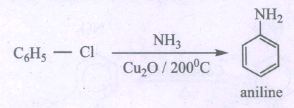
Bring about the conversion of Chlorobenzene to aniline
5.
Amides are amphoteric in nature. Justify.
6.
Lower aliphatic carboxylic acids are soluble in water where as higher ones are insoluble. Give reason
7.
Mention the inductive effect in monochloro acetic acid.
8.
Acetone is soluble in water but benzophenone is not. Give reason.
9.
Benzaldehyde reduces Tollen's reagent but not Fehling's solution explain.
10.
What is aldol condensation?
11.
Does formaldehyde undergo aldol condensation? Justify your answer.
12.
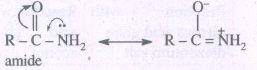
Explain why amines are more basic than amides.
13.
Write the name and structure of four isomeric amines having the molecular formula C3H9N
14.
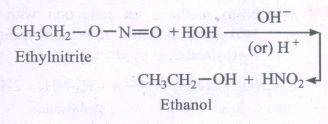
Two isomers having the molecular formula C2H5NO2 on hydrolysis in acidic medium gives (A) and (B). Identify (A) and (B) and explain the reactions involved.
15.
Explain why chloroform is not used as an anaesthetic.
16.
Give an example of bacteriocidal antobiotic.
17.
Common salt is added to the preparation of glycerol by saponification. Give reason.
18.
What are drug targets?
19.
ExpIain taro tatiIon m gIucose.
20.
Name the two types of nucleic acids.
21.
What is meant by blood sugar?
22.
Adsorption of a gas on the surface of solid is generally accompanied by decrease in entropy. Still it is a spontaneous process. Explain.
23.
Tanning makes leather get hardened-Explain why?
24.
What are the concepts of catalysis that intermediate compound formation theory throws light on?
25.
Give examples of primary cells.
26.
Define electrolysis.
27.
Define conductance. Give its unit
28.
Name the only primary alcohol which gives positive iodoform test.
29.
What is 'Glycerose'? How is it prepared from glycerol?
30.
How will you convert of ethylene glycol to 1,4 - dioxane.
31.
How is common ion effect related to the solubility of the electrolyte?
32.
Give a condition for a compound to be precipitated.
33.
What is hydroformylation of olefins?
34.
The decomposition reaction of ammonia gas on platinum surface has a rate constant R = 2.5 x 10⁻⁴mol L-1. What is the order of the reaction.
35.
A compound forms hexagonal dosed packed structure. What is the total number of voids in 0.5 mol of it? How many of these are tetrahedral voids?
36.
Explain Why in spite of nearly the same electronegativity, nitrogen forms hydrogen bonding while chlorine does not - Give reason.
37.
How is ammonia prepared in the lab?
38.
Ionic solids conduct electricity in molten state but not in solid state. Explain.
39.
What is inert pair effect?
40.
Explain the formation of boron trifluoride.
41.
Why lanthanoids are called f block elements?
42.
What are anionic & cationic complex? Give an example.
43.
Give the formula and IUPAC ligand name for Ethylenediamine.
44.
What is distillation?
45.
Name some reducing agents used to convert Metal oxides to metal
46.
Give reason for the following: Optical isomerism is not shown by square planar complexes.
47.
Give the names of two complexes which are used in medicines.
1.
Addition reaction: Alkyl isocyanides add on halogen, sulphur, and oxygen to form the corresponding addition compounds.
2.
The N2CI group can be replaced by alkoxy group by warming with alcohol or by acyloxy group by boiling with carboxylic acids.

3.
No, aniline cannot be prepared by Gabriel phthalimide reaction. This method involves the treatment of potassium phthalimide with aryl halides. But aryl halides does not undergo nucleophilic substitution under ordinary conditions.
4.
When chlorobenzene is heated with alcoholic ammonia, aniline is obtained
5.
Amides behave both as weak acid as well as weak base and thus show amphoteric character. This can be proved by the following reactions. Acetamide (as base) reacts with hydrochloric I acid to form salt.
\(\underset { Acetamide }{ { CH }_{ 3 }-\overset { \underset { || }{ O } }{ C } -{ NH }_{ 2 } } +HCl\longrightarrow \underset { acetamide\ hdrochloride }{ { CH }_{ 3 }-\overset { \underset { || }{ O } }{ C } -\overset { + }{ N } { CH }_{ 3 }{ Cl }^{ - } } \)
Acetamide (as acid) reacts with sodium to form sodium salt and hydrogen gas is liberated.
\(\underset { Acetamide }{ { 2CH }_{ 3 }-\overset { \underset { || }{ O } }{ C } -{ NH }_{ 2 } } +Na\longrightarrow \underset { sodium\ acetamide }{ { 2CH }_{ 3 }-\overset { \underset { || }{ O } }{ C } -\overset { + }{ N } HNa+{ H }_{ 2 } } \)
6.
(i) Lower aliphatic carboxylic acids (up to four carbon) are miscible with water due to the formation of hydrogen bonds with water.
(ii) Higher carboxylic acid are insoluble in water due to increased hydrophobic interaction of hydrocarbon part
7.
(i) In monochloro acetic acid, the -I effect of chlorine (electron withdrawing group) increases its strength.
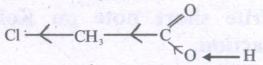
(ii) This effect weakens the -O-H bond. There by facilitating the removal of H from -OH group. This acid (ClCH2COOH) becomes stronger than formic acid.
8.
Acetone is soluble in water due to the intermolecular hydrogen bonding between polar carbonyl group and water molecules. In benzophenone, the phenyl groups are bulkier so C = 0 cannot form hydrogen bonds with water due to steric hindrance.
9.
Benzaldehyde reduces Tollen's reagent, but does not reduce Fehling's solution. Because Ag+ is more easily reduced to Ag than Cu2+ to Cu+
10.
Two molecules of acetaldehyde undergoes condensation reaction in the presence of NaOH to form aldol.
\({ CH }_{ 3 }-\underset { \overset { | }{ \underset { acetadelhyde }{ H } } }{ C } =O+{ CH }_{ 3 }-CHO\overset { NaOH }{ \longrightarrow } { CH }_{ 3 }-\underset { \overset { | }{ \underset { Aldol }{ OH } } }{ CH } -{ CH }_{ 2 }-CHO\)
11.
(i) Formaldehyde does not undergo aldol condensation.
(ii) Aldol condensation reaction is the characteristic of carbonyl compounds having a hydrogen atom. So this reaction does not take place in formaldehyde.
12.
In simple amines the lone pair of electrons is on nitrogen and hence available for protonation. In amides, on the other hand, the electron pair on nitrogen is delocalized to the carbonyl oxygen through resonance.
13.
(i) CH3 - CH2 - CH2NH2 1-amino propane
(ii) \({ CH }_{ 3 }-\underset { \overset { | }{ { NH }_{ 2 } } }{ CH } -{ CH }_{ 3 }\) 2-amino propane
(iii) \({ CH }_{ 3 }-{ CH }_{ 2 }-\underset { \overset { | }{ H } }{ N } -{ CH }_{ 3 }\) N - Methyl amino ethane
(iv) \(\quad { CH }_{ 3 }-\overset { \underset { | }{ { CH }_{ 2 } } }{ N } -{ CH }_{ 3 }\) N,N-Dimethyl methanamine
14.
(A) CH3COOH - Acetic acid
(B) CH3CH2OH - Ethanol
CH3CH2 - NO2
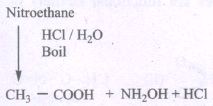
On the other hand, the acid or base hydrolysis of ethyl nitrite gives ethanol.
15.
With oxygen it forms a toxic carbonyl chloride Hence it is not used an an anaesthetic.
16.
Penicillin.
17.
Common salt is added to the reaction mixture to decrease the solubility of soap and it helps to precipitate out from the aqueous solution.
18.
The drug molecule interacts with biomolecules such as enzymes, receptors etc., which are referred as drug targets.
19.
The specific rotation of pure α and β(D) glucose are 112° & 18.7° respectively. However, when pure form of anyone of these sugars dissolved in water, slow interconversion of α-D glucose and β-D glucose via open chain form until equilibrium is established giving constant specific rotation + 53°. This phenomenon is called mutarotation.
20.
Two types of nucleic acids are deoxyribonucleic acid (DNA) and ribonucleic acid (RNA).
21.
Human blood contains about 100 mg/dL of glucose, hence it is also known as blood sugar.
22.
Adsorption is an exothermic process, i.e.,energy factor favours the process. As ΔG = ΔH - TΔS, in adsorption, though ΔS is -ve but ΔH is also -ve and ΔH > TΔS in magnitude so that ΔG is -ve.
Hence, the process is spontaneous.
23.
Skin and hides are protein containing positively charged particles which are coagulated by adding tannin which is negatively charged to give hardened leather for further application.
24.
Intermediate compound formation theory:
(i) the specificity of a catalyst and
(ii) the increase in the rate of the reaction with increase in the concentration of a catalyst
25.
(i) Leclanche cell
(ii) Mercury button cell
26.
Electrolysis is a process in which the electrical energy is used to cause a non-spontaneous chemical reaction to occur.
27.
The reciprocal of the resistance \((\frac{l}{R})\) gives the conductance of an electrolytic solution. The SI unit of conductance is Siemen (S).
28.
Ethanol
29.
Oxidation of glycerol with Br2/H2O (or) NaOBr (or) Fenton reagent (FeSO4 + H2O2) gives a mixture of glyceraldehyde and dihydroxy acetone (This mixture is named as glycerose).
30.
When ethylene glycol is treated with cone. H2SO4 two molecules of water are removed and the product formed is dioxane.
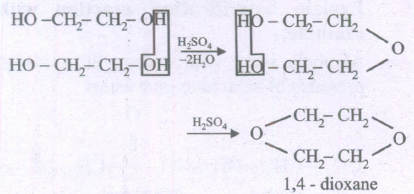
31.
Common ion effect decreases the solubility of the electrolyte.
32.
When the product of molar concentration of the constituent ions i.e., ionic product, exceeds the solubility product then the compound gets precipitated. Ionic product > Ksp, precipitation will occur and the solution is super saturated.
33.
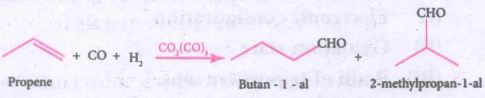
34.
The order of the reaction is zero.
35.
1 Mole of hexagonal packed structure contains 1 mole of octahedral voids and two moles of tetrahedral voids. Therefore, 0.5 moles of hexagonal packed structure contains 0.5 moles of octahedral voids and 1 mole of tetrahedral voids.
No. of tetrahedral voids = 6.022 x 10²³
No. of octahedral voids\(\frac{1}{2}\) x no. of tetrahedral voids
No. of octahedral voids = \(\frac{1}{2}\) x 6.022 x 1023
= 3.011 x 10²³
Total No. of voids = (6.022+3.011) x 1023
= 9.033 x 10²³.
36.
Nitrogen has smaller size and can polarise N-H bond d more efficiently than chlorine can do in a CI-H bond. Hence, nitrogen forms H- bond, while chlorine does not.
37.
Ammonia is prepared in the laboratory by heating an ammonium salt with a base.
\({ 2NH }_{ 4 }^{ + }+{ OH }^{ - }\longrightarrow { 2NH }_{ 3 }+{ H }_{ 2 }O\)
\({ 2NH }_{ 4 }Cl+CaO\longrightarrow { CaCl }_{ 2 }+{ 2NH }_{ 3 }+{ H }_{ 2 }O\)
38.
(i) In ionic compounds, electricity is conducted by ions.
(ii) In solid state, ions are held together by A strong electrostatic forces and are not free to move about within the solid.
(iii) Hence, ionic solids do not conduct electricity in solid state
(iv) However, in molten state or in solution form, the ions are free to move and can conduct electricity.
39.
(i) In the elements of 4th, 5th and 6th period of the p-block the electrons present in the intervening d and f - orbitals do not shield the s-electrons of the valence shell effectively.
(ii) As a result, ns2-electons remains more tightly held by the nucleus and hence do not participate in bonding. This is called inert pair effect.
40.
(i) Boric acid reacts with calcium fluoride in presence of conc. sulphuric acid and gives boron trifluoride.
3CaF2 + 3H2SO4 + 2B(OH)3 ⟶ 3CaSO4 + 2BF3 + 6H2O
(ii) Borax when heated with soda ash it gives borax
Na2CO3 + 4B(OH)3 ⟶ Na2B4O7 +.CO2 + 6H2O
41.
This is because the last electron enters into the (n-2) f-subshell.
42.
(i) An anionic complex compound contains a complex anion and simple cation.
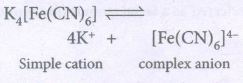
(ii) A cationic complex contains complex cation and simple anion
.JPG)
43.
Ethylenediamine (en)
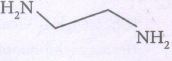
ethane - 1, 2 - diamine.
44.
(i) Distillation is employed for low boiling volatile metals like zinc (boiling point 1180 K) and mercury (630 K).
(ii) In this method, the impure metal is heated to evaporate and the vapours are condensed to get pure metal.
45.
Metal oxides to metal : Carbon, carbon monoxide, hydrogen, aluminum and metals like sodium.
46.
Square planar complexes do not show optical isomerism because they contain a plane of symmetry.
47.
(i) EDTA is used in the treatment of lead poisoning
(ii) Cis-platin[Pt(NH3)2Cl2] is used in the treatment of cancer.

12th Standard Syllabus & Materials
12th Standard
TN 12th Computer Applications களப்பெயர் முறைமை (DNS) Sample Question Papers Study Material - QB365 Set A
NEW12th Standard
TN 12th Computer Applications வலையமைப்பு எடுத்துக்காட்டுகள் மற்றும் நெறிமுறைகள் Sample Question Papers Study Material - QB365 Set A
NEW12th Standard
TN 12th Computer Applications கணினி வலையமைப்பு ஓர் அறிமுகம் Sample Question Papers Study Material - QB365 Set A
NEW12th Standard
TN 12th Computer Applications PHP-உடன் MySQL-ஐ இணைத்தல் Sample Question Papers Study Material - QB365 Set A



Tamilnadu Stateboard 12th Standard Subjects

Maths
Chemistry

Physics

Biology

Computer Science

Business Maths and Statistics

Economics

Commerce

Accountancy

History

Computer Applications
Biology
Computer Technology
Computer Applications
Computer Science
Business Maths and Statistics
Commerce
Economics
Maths
Chemistry
Physics
Computer Technology
History
Accountancy

Tamil

English

French
Tamilnadu Stateboard Standards
