
 100% FREE ACCESS
12th Standard Syllabus & Materials
12th Standard
TN 12th Maths Applications of Matrices and Determinants Sample Question Papers Study Material - QB365 Set A
NEW12th Standard
TN 12th Computer Applications மின்னணு தரவு பரிமாற்றம் Sample Question Papers Study Material - QB365 Set A
NEW12th Standard
TN 12th Computer Applications மின் - வணிக பாதுகாப்பு அமைப்புகள் Sample Question Papers Study Material - QB365 Set A
NEW12th Standard
TN 12th Computer Applications மின்னணு செலுத்தல் முறைகள் Sample Question Papers Study Material - QB365 Set A
NEW12th Standard
TN 12th Computer Applications மின் - வணிகம் Sample Question Papers Study Material - QB365 Set A
NEW12th Standard
TN 12th Computer Applications திறந்த மூல கருத்துருக்கள் Sample Question Papers Study Material - QB365 Set A

Published on: 03/09/2020
12th Standard Chemistry English Medium Important 3 Mark Book Back Questions (New Syllabus) 2020
Download Tamil Nadu 12th Standard Chemistry question papers, model tests, one-mark questions, important questions, and public exam papers in PDF format. Free study materials and answer keys for TN State Board students.
Questions + Answers key
Take MCQ Chemistry Test
1.
Arrange the following
i. In increasing order of solubility in water, C6H5 NH2, (C2H5)2NH, C2H5NH2
ii. In increasing order of basic strength
a) aniline, p- toludine and p – nitroaniline
b) C6H5 NH2, C6H5 NHCH3, C6H5NH2, p-Cl-C6- H4-NH2
iii. In decreasing order of basic strength in gas phase
(C2H5)NH2, (C2H5)NH, (C2H5)5N and NH3
iv. In increasing order of boiling point
C6H5OH, (CH3)2NH, C2H5NH2
v. In decreasing order of the pKb values
C2H5NH2, C6H5NHCH3.(C2H5)2 NH and CH3NH2
vi. Increasing order of basic strength
C2H5NH2,C6H5N(CH3)2, (C2H5)2 NH and CH3NH2
vii. In decreasing order of basic strength

2.
Explain the mechanism of cleansing action of soaps and detergents.
3.
Explain briefly the collision theory of bimolecular reactions.
4.
Give the difference between double salts and coordination compounds.
5.
Write short note on metal excess and metal deficiency defect with an example.
6.
Explain zone refining process with an example.
7.
How will you convert benzaldehyde into the following compounds?
(i) benzophenone
(ii) benzoic acid
(iii) α-hydroxyphenylaceticacid.
8.
Calculate the pH of 0.1M CH3COOH solution. Dissociation constant of acetic acid is \(1.8\times10^{-5}\).
9.
Reduction potential of two metals M1 and M2 are \(E^{0}_{M^{2+}_{1}|M_{1}} = -2.3V\) and \(E^{0}_{M^{2+}_{1}|M_{1}} = 0.2V\) Predict which one is better for coating the surface of iron. Given : \(\mathrm{E}_{\mathrm{Fe}^{2+} \mid \mathrm{Fe}}^{\circ}=-0.44 \mathrm{~V}\)
10.
Calculate the number of unpaired electrons in Ti3+ , Mn2+ and calculate the spin only magnetic moment.
11.
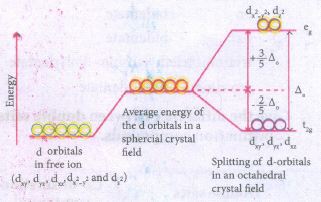
In an octahedral crystal field, draw the figure to show splitting of d orbitals
12.
Give the uses of argon.
13.
What is the two dimensional coordination number of a molecule in square close packed layer?
14.
How will you prepare chlorine in the laboratory?
15.
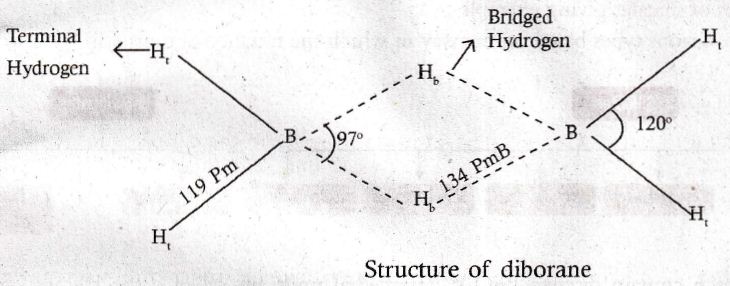
Describe the structure of diborane.
16.
Compound (A) C6H12O2 on reduction with LiAlH4 yields two compounds B and C. The compound (B) on oxidation gave (D) which on treatment with aqueous alkali and subsequent heating furnished E. The latter on catalytic hydrogenation gave (C). Compound (D) on oxidation gave monobasic acid (molecular formula weight = 60). Deduce the structure of (A), (B), (C), (D) and (E).
17.
Why are lyophillic colloidal sols are more stable than lyophobic colloidal sol.
18.
Write the mechanism of acid catalysed dehydration of ethanol to give ethene.
19.
Why is AC current used instead of DC in measuring the electrolytic conductance?
20.
What are reducing and non – reducing sugars?
21.
Calculate the pH of 1.5\(\times\)10-3 M solution of Ba(OH)2
22.
The half life of a first order reaction x →products is 6.932 x 10⁴ s at 500K. What percentage of x would be decomposed on heating at 500K for 100 min. (e0.06 = 1.06).
23.
24.
Explain why Cr2+ is strongly reducing while Mn3+ is strongly oxidizing.
1.
i) In increasing order of solubility in water:
\(\mathrm{C}_{6} \mathrm{H}_{5} \mathrm{NH}_{2},\left(\mathrm{C}_{2} \mathrm{H}_{5}\right)_{2} \mathrm{NH}, \mathrm{C}_{2} \mathrm{H}_{5} \mathrm{NH}_{2} \)
\(\mathrm{C}_{2} \mathrm{H}_{5} \mathrm{NH}_{2}>\mathrm{C}_{6} \mathrm{H}_{5} \mathrm{NH}_{2}>\left(\mathrm{C}_{2} \mathrm{H}_{5}\right)_{2} \mathrm{NH}\)
ii) In increasing order of basic strength:
a. Aniline, p - toluidine and p - nitro aniline
p - toluidine > aniline >p - nitro aniline
.JPG)
b. \(\mathrm{C}_{6} \mathrm{H}_{5} \mathrm{NH}_{2}, \mathrm{C}_{6} \mathrm{H}_{5} \mathrm{NHCH}_{3}, \mathrm{p}-\mathrm{Cl}-\mathrm{C}_{6} \mathrm{H}_{4}-\mathrm{NH}_{2} \)
\(\mathrm{C}_{6} \mathrm{H}_{5} \mathrm{NHCH}_{3}>\mathrm{C}_{6} \mathrm{H}_{5} \mathrm{NH}_{2}>\mathrm{p}-\mathrm{Cl}-\mathrm{C}_{6} \mathrm{H}_{4}-\mathrm{NH}_{2}\\ 2^{o} \text { amine } \quad \quad \quad \quad e^{\ominus} \text { with drawing (group) }\)
(iii) In decreasing order of basic strength in gas phase:
\(\mathrm{C}_{2} \mathrm{H}_{5} \mathrm{NH}_{2},\left(\mathrm{C}_{2} \mathrm{H}_{5}\right) \mathrm{NH},\left(\mathrm{C}_{2} \mathrm{H}_{5}\right)_{3} \mathrm{~N} \text { and } \mathrm{NH}_{3} \)
\(\mathrm{NH}_{3}<\mathrm{C}_{2} \mathrm{H}_{5} \mathrm{NH}_{2}<\left(\mathrm{C}_{2} \mathrm{H}_{5}\right)_{2} \mathrm{~N}<\left(\mathrm{C}_{2} \mathrm{H}_{5}\right)_{3} \mathrm{NH}\\ \quad \quad \quad 1^{0} \text { amine } \quad 2^{0} \text { amine } \quad \quad \quad 3^{0} \text { amine }\)
(iv) In increasing order of boiling point:
\(\mathrm{C}_{6} \mathrm{H}_{5} \mathrm{OH},\left(\mathrm{CH}_{3}\right)_{2} \mathrm{NH}, \mathrm{C}_{2} \mathrm{H}_{5} \mathrm{NH}_{2} \)
\(\left(\mathrm{CH}_{3}\right)_{2} \mathrm{NH}>\mathrm{C}_{2} \mathrm{H}_{5} \mathrm{NH}_{2}>\mathrm{C}_{6} \mathrm{H}_{5} \mathrm{OH} \\ 2^{0} \text { amine } \quad \quad1^{0} \text { amine }\)
Generally amines have lower boiling point than alcohol. Due to comparable molecular mass and weaker H-bonds in Amines.
(v) In decreasing order of the pKb values:
\( \mathrm{C}_{2} \mathrm{H}_{5} \mathrm{NH}_{2}, \mathrm{C}_{6} \mathrm{H}_{5} \mathrm{NHCH}_{3},\left(\mathrm{C}_{2} \mathrm{H}_{5}\right)_{2} \mathrm{NH} \text { and } \mathrm{CH}_{3} \mathrm{NH}_{2} \)
\(\left(\mathrm{C}_{2} \mathrm{H}_{5}\right)_{2} \mathrm{NH}<\mathrm{C}_{2} \mathrm{H}_{5} \mathrm{NH}_{2}<\mathrm{CH}_{3} \mathrm{NH}_{2}<\mathrm{C}_{6} \mathrm{H}_{5} \mathrm{NHCH}_{3} \)
\(\quad \quad \quad 2^{0} \text { amine } \quad 1^{0} \text { amine } 1^{0} \text { amine } \quad 2^{0} \text { amine } \)
\(\mathrm{PK}_{b}: \quad 3.00\quad < \quad 3.29 \quad < \quad 3.38 \quad<\quad 9.30\)
pKb ,Due to + 1 effect of C2H5 group. Higher the value of pKb lower is the basicity
(vi) Increasing Order of basic strength:
\(\mathrm{C}_{6} \mathrm{H}_{5} \mathrm{NH}_{2}, \mathrm{C}_{6} \mathrm{H}_{5} \mathrm{~N}\left(\mathrm{CH}_{3}\right)_{2},\left(\mathrm{C}_{2} \mathrm{H}_{5}\right)_{2} \mathrm{NH} \text { and } \mathrm{CH}_{3} \mathrm{NH}_{2} \)
\(\mathrm{C}_{6} \mathrm{H}_{5} \mathrm{NH}_{2}>\mathrm{C}_{6} \mathrm{H}_{5} \mathrm{~N}\left(\mathrm{CH}_{3}\right)_{2}>\mathrm{CH}_{3} \mathrm{NH}_{2}>\left(\mathrm{C}_{2} \mathrm{H}_{5}\right)_{2} \mathrm{NH} \\ \left(\mathrm{pK}_{6}: 9.38 \quad > \quad \quad 8.92 \quad \quad > \quad 3.38 \quad > \quad \quad 3.00\right)\)
Due to + 1 effect of C2H5 group.
In decreasing order of basic strength:
.JPG)
2.
(i) To understand how a soap works as a cleansing agent, let us consider sodium palmitate an example of a soap. The cleansing action of soap is directly related to the structure of carboxylate ions (palmitate ion) present in soap. The structure of palmitate exhibit dual polarity. The hydrocarbon portion is non polar and the carboxyl portion is polar.

(ii) The nonpolar portion is hydrophobic while the polar end is hydrophilic. The hydrophobic hydro carbon portion is soluble in oils and greases, but not in water. The hydrophilic carboxylate group is soluble in water.
(iii) The dirt in the cloth is due to the presence of dust particles intact or grease which stick. When the soap is added to an oily or greasy part of the cloth, the hydrocarbon part of the soap dissolve in the grease, leaving the negatively charged carboxylate end exposed on the grease surface.
(iv) At the same time the negatively charged carboxylate groups are strongly attracted by water, thus leading to the formation of small droplets called micelles and grease is floated away from the solid object. When the water is rinsed away, the grease goes with it. As a result, the cloth gets free from dirt and the droplets are washed away with water. The micelles do not combine into large drops because their surfaces are all negatively charged and repel each other. The cleansing ability of a soap depends upon its tendency to act as a emulsifying agent between water and water insoluble greases.
.JPG)
The cleansing action of detergents are similar to cleansing action of soap. Eg: the structure of a cationic detergents is:
.JPG)
3.
(i) Collision theory is based on the kinetic theory of gases. According to this theory, a chemical reaction occurs as a result of collisions between the reacting molecules.
(ii) Let us understand this theory by considering the following reaction.
A2(g) + B2(g) ⟶ 2AB(g)
(iii) If we consider that, the reaction between A2 and B2 molecules proceeds through collisions between them, then the rate would be proportional to the number of collisions per second.
(iv) Rate ∝ number of molecules colliding per litre per second (collision rate).
(v) The number of collisions is directly proportional to the concentration of both A2 and B2.
Collison rate ∝ [A2][B2]
Collision rate = Z [A2][B2]
(vi) Where, Z is a constant
(vii) A fraction of effective collisions (f) is given by the following expression
\(f={ e }^{ \frac { { -E }_{ a } }{ RT } }\)
(xiv) This fraction of collisions is further reduced due to orientation factor i.e., even if the reactant collides with sufficient energy, they will not react unless the orientation of the reactant molecules is suitable for the formation of the transition state.
(viii) The diagram illustrates the importance of proper alignment of molecules which leads to reaction.
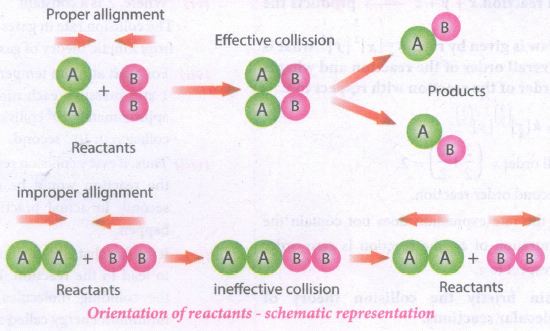
(ix) The fraction of effective collisions (f) having proper orientation is given by the steric factor p.
⇒ Rate = p x f x collision rate
\(\Rightarrow Rate=p\times { e }^{ \frac { -Ea }{ RT } }\times Z\left[ { A }_{ 2 } \right] \left[ { B }_{ 2 } \right] \quad ...(1)\)
As per the rate law,
Rate = \(k=\left[ { A }_{ 2 } \right] \left[ { B }_{ 2 } \right] \quad ...(2)\)
Where k is the rate constant
On comparing equation (1) and (2), the rate constant k is
\(k=pZ{ e }^{ \frac { -Ea }{ RT } }\)
4.
| S. No | Double salts | Co-ordination compound |
|---|---|---|
| 1. | They usually contain two simple salt in equimolar proportions | The simple salts from which they are formed may or may not be in equimolar proportion. |
| 2. | They exists only in the solid state. In aqueous solution they dissociate completely into ions. | They exist in the solid state as well as in aqueous solution. This is because even in solution, the complex ion does not dissociate into ions. |
| 3. | They are ionic compounds and do not contain any co-ordinate bond. | They may or may not be ion but the complex part always contain coordinate bonds |
| 4. | The properties of the double salts are same as those of its constituent compounds. | The properties of the coordination compounds are different for its constituent bonds. |
| 5. | In a double salt, the metal ion show their normal valency. | In a coordinate compound the metal ion satisfies its two types of valence called primary & secondary valenices. |
| 6. | A double salt loses its identity and dissociates into its constitute simple ions in solution. | The complex ion does not lose its identity and never dissociate to give simple ions. |
| Example: FeSO4 (NH4)2 SO4.6H2O | Example: K4[Fe(CN)6), K3[Fe(SCN)6) |
5.
Metal excess defect:
(i) It arises due to the presence of more number of metal ions as compared to anions.
(ii) Examples: NaCl, KCl
(iii) The electrical neutrality of the crystal can be maintained by the presence of anionic vacancies equal to the presence of extra cation.
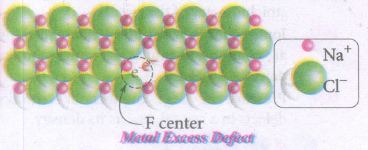
(iii) For example, when NaCI crystals are heated in the presence of sodium vapour, Na+ ions are formed and are deposited on the surface of the crystal.
(iv) Chloride ions (Cl-) diffuse to the surface from the lattice point and combines with Na+ ion.
(v) The electron lost by the sodium vapour diffuse into the vacancy created by the Cl- ions.
(vi) Such anionic vacancies which are occupied by unpaired electrons are called F centers. Hence, the formula of NaCl can be written as Na1+xCl.
Metal deficiency defect:
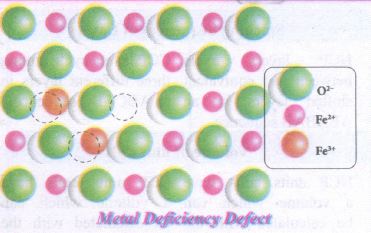
(i) Metal deficiency defect arises due to the presence of less number of cations than the anions. This defect is observed in a crystal in which, the cations have variable oxidation states.
(ii) For example, In FeO crystal, some of the Fe2+ ions are missing from the crystal lattice. To maintain the electrical neutrality, twice the number of other Fe2+ ions in the crystal is oxidized to Fe3+ ions. In such cases, overall number of Fe2+ and Fe3+ ions is less than the O2- ions.
6.
Zone refining :
1. Zone refining method is based on the principles of fractional crystallisation.
2. When an impure metal is melted and allowed to solidify, the impurities will prefer to be in the molten region. In this process the impure metal is taken in the form of a rod.
3. One end of the rod is heated using a mobile induction heater which results in melting of the metal on that portion of the rod.
4. When the heater is slowly moved to the other end the pure metal crystallises while the impurities will move on to the adjacent molten zone.
5. As the heater moves further away, the molten zone containing impurities also moves along with it.
6. The process is repeated several times by moving the heater in the same direction again and again to get pure metal.
7. This process is carried out in an inert gas atmosphere to prevent the oxidation of metals.
8. Elements such as germanium (Ge), silicon (Si) and galium (Ga) that are used as semiconductor are refined using this process.
7.
.JPG)
(ii) benzoic acid
.JPG)
(iii) α - hydroxyphenylaceticacid.
.JPG)
8.
pH=-log[H+]
For weak acids,
\(= \sqrt{k_a \times C}\)
=\(\sqrt{1.8\times10^{-5}\times0.1}\)
=\(1.34 \times10^{-3}\) M
\(pH=-\log(1.34\times10^{-3})\)
= 3-log1.34
= 3-0.1271
= 2.8729 \(\simeq\) 2.87
9.
The oxidation potential of M1 is more +ve than the oxidation potential of Fe which indicates that it will prevent iron from rusting.
10.
Electronic configuration of Ti = 3d24s2
Electronic configuration of Ti3+ =3d1
Hence number of unpaired electron = 1
Spin only magnetic moment \((\mu)=\sqrt{\mathrm{n}(\mathrm{n}+2)}\)
= \(\sqrt{1(1+2)} \)
= \(\sqrt{3}\)
=1.732 BM
Electronic configuration of \(\mathrm{Mn}=3 \mathrm{~d}^{5} 4 \mathrm{~s}^{2}\)
Electronic configuration of \(\mathrm{Mn}^{2+}=3 \mathrm{~d}^{5}\)
Hence number of unpaired electrons = 5
Spin only magnetic moment
\((\mu) =\sqrt{5(5+2)}\)
= 5.92 BM
11.
The energy of the two eg orbitals will increase by \(\frac{3}{5} \Delta_{O}\) and that of the three t2g will decrease by (2/5) \(\Delta_{O}\)
12.
Argon prevents the oxidation of hot filament and prolongs the life in filament bulbs.
13.
Linear arrangement of spheres in one direction is repeated in two dimension (i.e.) more number of rows can be generated identical to the one dimensional arrangement such that all spheres of different rows align vertically as well as horizontal.
If we denote the first row as A type arrangement, then the above mentioned packing is called AAA type, because all rows are identical as the first one. In this arrangement each sphere is in contact with four of its neighbours.
14.
Chlorine is prepared by the action of conc. sulphuric acid on chlorides in presence of manganese dioxide
4NaCl + MnO2 + 4H2SO4 \(\longrightarrow \)Cl2+ MnCl2 +4NaHSO4 + 2H2O
15.
(i) In diborane two BH2 units are linked by two bridged hydrogens.
(ii) It has eight B-H bonds.
(iii) Diborane has only 12 valance electrons.
(iv) The four terminal B-H- bonds is "2c - 2e" bond (two centre - two electron bond.)
(v) Two three centred B - H - B bonds two electrons each. "(3c - 2e)"
(vi) In diborane, the boron is "sp3" hybridised
(vii) Three of the four "sp3" hydridised orbitals contains single electron and the fourth orbital is empty.
16.
(i) E is monobasic acid (RCOOH) having molecular weight 60 and it is formed from D on oxidation. So E must be acetic acid and D must be acetaldehyde.
(ii) (B) on oxidation gives CH3CHO. So (B) must be alcohol (CH3CH2OH).
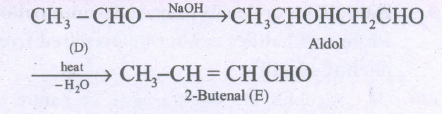
(iii) Acetaldehyde (D) on treating with aqueous alkali (NaOH) gives aldol which on heating gives 2- butenal (E).
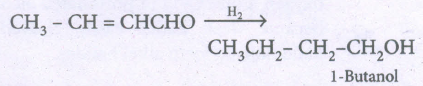
(iv) Compound E on catalytic hydrogenation gives butyl alcohol.
(v) Hence compound (A) must be an ester. Ester (A) on reduction with LiAIH4 yields two alcohols (B) and (C). (A) is ethyl butyrate.
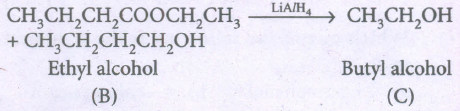
'A' can also be CH3COOCH2CH2CH2CH3. This structure will be answering all the above reactions.
17.
(i) In lyophillic colloids or sols definite attractive force or affinity exists between dispersion medium and dispersed phase. Examples: sols of protein and starch. They are more stable and will not get precipitated easily.
(ii) In a lyophobic colloids, no attractive force exists between the dispersed phase and dispersion medium. They are less stable and precipitated readily, but cannot be produced again by just adding the dispersion medium.
Examples: sols of gold, silver, platinum and copper.
18.
\({ CH }_{ 3 }-{ CH }_{ 2 }-OH\overset { { H }_{ 2 }{ SO }_{ 4 } }{ \underset { 443k }{ \longrightarrow } } { CH }_{ 2 }={ CH }_{ 2 }+{ H }_{ 2 }O\)
Mechanism
Primary alcohols undergo dehydration by E2 mechanism

19.
(a) If we apply DC current through the conductivity cell, it will lead to the electrolysis of the solution taken in the cell.
(b) So, AC current is used for this measurement to prevent electrolysis.
20.
i) Reducing sugars:
1. Sugars which reduce Tollen's reagent or Fehling's solution or Benedict's solution are called reducing sugars.
2. These contain either α - hydroxyl ketone or cyclical hemi acetal or hemi ketal or structures in equilibrium with open chain forms having a free- CHO or C=O group.
3. E.g. a) All monosaccharide's like D - glucose, D - fructose (aldoses and ketoses)
b) Sugars like Lactose and maltose except sucrose.
ii) Non - reducing sugars:
1. Sugars which do not reduce either Tollen's reagent, Fehling's solution or Benedict's solution are called non-reducing sugars.
2. They contain a stable acetal or ketal structures which cannot be opened into a free carbonyl group.
E.g. Sucrose, starch, cellulose, glycogen, dextrin etc.
21.
Considering Ba(OH)2 to be a strong base:
\(\text { Normality } =\text { Molarity } \times \text { Acidity } \)
\(=1.5 \times 10^{-3} \times 2\)
\({\left[\mathrm{OH}^{-}\right] } =3 \times 10^{-3} \)
\(\mathrm{pOH} =-\log _{10}[\mathrm{OH}^-] \)
\(=-\log _{10}\left(3 \times 10^{-3}\right) \)
\(=-\left[\log _{10} 3+3 \log 10\right] \)
= 3-log 3
= 3-0.4771
= 2.5229
\(\mathrm{pH} =14-\mathrm{pOH} \)
= 14-2.5229
pH = 11.4771 = 11.48
22.
Given t1/2= 0.6392 \(\times\)104 s
To solve: when t = 100 min,
\(\frac { [{ A }_{ 0 }]-[A] }{ [{ A }_{ 0 }] } \times 100=?\)
We know that
For a first order reaction, \({ t }_{ 1/2 }=\frac { 0.6932 }{ k } \)
\(k=\frac { 0.6932 }{ 6.932\times { 10 }^{ 4 } } \)
\(k={ 10 }^{ -5 }{ s }^{ -1 }\)
\(k=\left( \frac { 1 }{ t } \right) In\left( \frac { [{ A }_{ 0 }] }{ [{ A }] } \right) \)
\({ 10 }^{ -5 }{ s }^{ -1 }\times 100\times 60s=In\left( \frac { [{ A }_{ 0 }] }{ [{ A }] } \right) \)
\(0.06-In\ \left( \frac { [{ A }_{ 0 }] }{ [{ A }] } \right) \)
\(\frac { [{ A }_{ 0 }] }{ [{ A }] } ={ e }^{ 0.06 }\) ?(given : e0.06 = 1.06)
\(\frac { [{ A }_{ 0 }] }{ [{ A }] } =1.06\)
\(\therefore \frac { [{ A }_{ 0 }]-[{ A }] }{ [{ A }_{ 0 }] } \times 100\%\)
\(=\left( 1-\frac { [{ A }] }{ [{ A }_{ 0 }] } \right) \times 100\%\)
=\(\left( 1-\frac { 1 }{ 1.06 } \times 100\% \right) \)
= 5.66%
23.
24.
Mn3+ has large and negative standard electrode potential E0 (-1.18 V) than that of Cr2+ which has only -0.91 V. If the standard electrode potential of a metal is large and negative, the metal is a powerful reducing agent because it loses electrons easily. Hence Mn3+ is strongly oxidizing while Cr2+ is strongly reducing.

12th Standard Syllabus & Materials
12th Standard
TN 12th Computer Applications வலையமைப்பு வடமிடல் Sample Question Papers Study Material - QB365 Set A
NEW12th Standard
TN 12th Computer Applications களப்பெயர் முறைமை (DNS) Sample Question Papers Study Material - QB365 Set A
NEW12th Standard
TN 12th Computer Applications வலையமைப்பு எடுத்துக்காட்டுகள் மற்றும் நெறிமுறைகள் Sample Question Papers Study Material - QB365 Set A
NEW12th Standard
TN 12th Computer Applications கணினி வலையமைப்பு ஓர் அறிமுகம் Sample Question Papers Study Material - QB365 Set A



Tamilnadu Stateboard 12th Standard Subjects

Maths
Chemistry

Physics

Biology

Computer Science

Business Maths and Statistics

Economics

Commerce

Accountancy

History

Computer Applications
Biology
Computer Technology
Computer Applications
Computer Science
Business Maths and Statistics
Commerce
Economics
Maths
Chemistry
Physics
Computer Technology
History
Accountancy

Tamil

English

French
Tamilnadu Stateboard Standards
