
 100% FREE ACCESS
12th Standard Syllabus & Materials
12th Standard
TN 12th Computer Applications மின்னணு தரவு பரிமாற்றம் Sample Question Papers Study Material - QB365 Set A
NEW12th Standard
TN 12th Computer Applications மின் - வணிக பாதுகாப்பு அமைப்புகள் Sample Question Papers Study Material - QB365 Set A
NEW12th Standard
TN 12th Computer Applications மின்னணு செலுத்தல் முறைகள் Sample Question Papers Study Material - QB365 Set A
NEW12th Standard
TN 12th Computer Applications மின் - வணிகம் Sample Question Papers Study Material - QB365 Set A
NEW12th Standard
TN 12th Computer Applications திறந்த மூல கருத்துருக்கள் Sample Question Papers Study Material - QB365 Set A
NEW12th Standard
TN 12th Computer Applications வலையமைப்பு வடமிடல் Sample Question Papers Study Material - QB365 Set A

Published on: 03/09/2020
12th Standard Chemistry English Medium Important 3 Mark Creative Questions (New Syllabus) 2020
Download Tamil Nadu 12th Standard Chemistry question papers, model tests, one-mark questions, important questions, and public exam papers in PDF format. Free study materials and answer keys for TN State Board students.
Questions + Answers key
Take MCQ Chemistry Test
1.
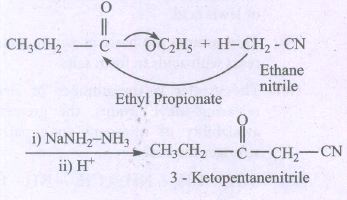
Explain Levine and hauser acetylation.
2.
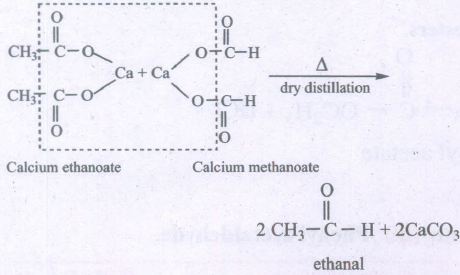
Predict the product when calcium ethanoate and calcium methanoate are dry distilled. Explain the reaction.
3.
Explain the isomerism exhibited by carboxylic acids.
4.
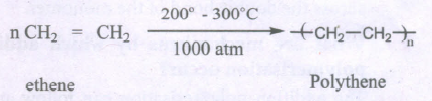
How is Low density polyethene prepared?
5.
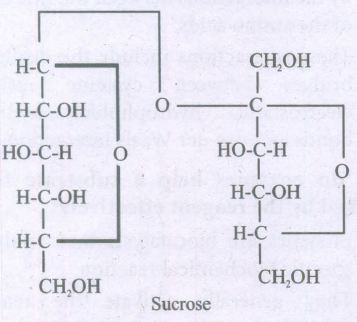
Give the structure of sucrose.
6.
What are amino add? Explain essential and non-essential amino acids.
7.
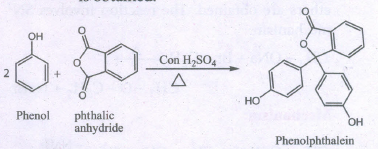
How can the following conversion be effected? (i) Phenol to phenolphthalein.
8.
Write a note on Ultrafilteration?
9.
Explain why Zn on reaction with dil. H2SO4 liberate hydrogen, whereas copper cannot?
10.
Corrosion of aluminum takes place at a much slower rate than iron. Give reason
11.
Give the oxidation and reduction half cell reaction taking place in the Daniel cell.
12.
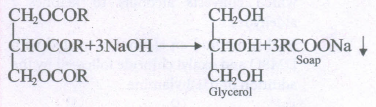
How is glycerol obtained commercially? State its uses.
13.
When phenol on treatement with Br2/H2O readily gives a precipitate of 2, 4, 6 - tribomo phenol.
14.
How will you calculate solubility product from molar solubility?
15.
Explain the oxidising property of KMnO4 in natural medium. Give the equations.
16.
The decomposition of NH3 on platinum surface is zero order reaction what are the rates of production of N2 and H2 if k = 2.5 x10⁻⁴ mol + L S-1.
17.
(i) Name the transition metal
(a) Which is used in the manufacture of sulphuric add.
(b) That is used in Haber's process.
(c) That have light sensitive properties and act as valuable source in photo graphic industry.
(ii) Write the equations which are involved in the oxidation of hydrogen sulphide to sulphur by KMnO4 solution.
18.
Write chemical equations for the reactions involved in the manufacture of potassium permanganate from pyrolusite ore.
19.
Prove that the time required for the completion \({ \frac { 3 }{ 4 } }^{ th }\) of the reaction of a first order is twice the time required for the completion of a half of the reaction.
20.
Predict the product
(i) PCI5+ C2H5OH \(\longrightarrow \)?
(ii) P4+ SO2Cl2 \(\longrightarrow \) ?
(iii) POCl3 + H2O \(\longrightarrow \) ?
(iv) HBr + PH3\(\longrightarrow \) ? :,
(v) PCl3+ H2O\(\longrightarrow \) ?
21.
Name a reaction for the estimation of Ozone.
22.
(i) What change occurs when AgCl is doped with CdCI2?
(ii) What type of semiconductor is produced when silicon is doped with boron?
23.
Classify the following solids in different categories based on the nature of intermolecular force operating in them: Potassium sulphate, tin, benzene, urea, ammonia, water, zinc sulphide, graphite, rubidium, argon, silicon carbide.
24.
Describe the structure of fullerenes.
25.
What are the applications of the Ellingham diagram?
26.
What is the role of depressants in froth flotation process?
27.
What is meant by ammonia leaching?
28.
Mohr's salt answers the presence of Fe2+, NH4+and SO42- ions, whereas the potassium ferrithiocyanate will not answer Fe3+ and SCN ions give reason.
29.
What are the limitations of VBT?
30.
What is meant by unidentate, didentate and ambidentate Iigands Give two examples for each.
1.
(i) The nitriles containing a-hydrogen also undergo condensation with esters in the presence of sodamide in ether to form ketonitriles.
(ii) This reaction is known as "Levine and hauser" acetylation.
(iii) This reaction involves replacement of ethoxy (OC2H5) group by methylnitrile (-CH2CN) group and is called as cyanomethylation reaction.
2.
The product obtained is ethanol
3.
(i) Chain isomerism: This arises due to the difference in the carbon chain of alkyl group attached to carboxyl group. C5H10O2.
\({ CH }_{ 3 }-\underset { Pentanoic\ acid }{ { CH }_{ 2 }-{ CH }_{ 2 }-{ CH }_{ 2 } } -COOH\quad \underset { 3-mrthyl\ butanoic\ acid }{ { CH }_{ 3 }-\overset { \underset { | }{ { CH }_{ 3 } } }{ CH } -{ CH }_{ 2 }-COOH } \)
(ii) Functional isomerism: Carboxylic acids are functional isomers of ester . C3H6O2
\(\underset { Propanic \ acid }{ { CH }_{ 3 }-{ CH }_{ 2 }-COOH } \) and \(\underset { Methyl\ acetate }{ { CH }_{ 3 }COO{ H }_{ 5 } } \) \(\underset { Ethyl\ formate }{ HCOO{ C }_{ 2 }{ H }_{ 5 } } \)
4.
LDPE is formed by heating ethene at 200° to 300°C under oxygen as a catalyst. The reaction follows free radical mechanism. The peroxides formed from oxygen acts as a free radical initiator.
5.
6.
(i) An amino acid is bifunctional organic molecule that contains both a carboxyl group, -COOH as well as an amine group, -NH2.
(ii) Those amino acids that cannot be synthesised by the body and must be supplied in the diet are called essential amino acids
(iii) The amino acids that can be synthesised from other compounds by the tissues of the body are called non-essential amino acids.
7.
On heating phenol with phthalic anhydride in presence of con.H2SO4 phenolphthalein is obtained.
8.
(i) The pores of ordinary filter papers permit the passage of colloidal solutions.
(ii) In ultra filtrations, the membranes are made by using collodion cellophane or visiking.
(iii) When a colloidal solution is filtered using such a filter, colloidal particles are separated on the filter and the impurities are removed as washings.
(iv) This process is quickened by application of pressure.
(v) The separation of sol particles from electrolyte by filteration through an ultrafilter is called ultrafiltration.
9.
(i) Any metal above hydrogen in the electrochemical series is a weaker reducing agent than hydrogen and will not convert H+ to H2.
(ii) This explains why Zn lying below hydrogen reacts with dil. H2SO4 to liberate H2, while Cu lying above hydrogen does not react.
Zn + 2H+ (dil.H2SO4) ➝ Zn2+ + H2 ↑
Cu + 2H+ (dil.H2SO4) Cu2+ + H2
10.
Other metals such as aluminium, copper and silver also undergo corrosion, but at a slower rate than iron. Let us consider the reduction of aluminium,
\({ Al }_{ (s) }\rightarrow { Al }_{ (aq) }^{ 3+ }+{ 3e }^{ - }\)
Al3+, which reacts with oxygen in air to form a protective coating of Al2O3. This coating act as a protective film for the inner surface. So, further corrosion is prevented.
11.
Zinc is oxidised to Zn2+ ions and the Cu2+ ions are reduced to metallic copper. The half reactions are represented as below.
\( { Zn }_{ (s) }\rightarrow { Zn }_{ (aq) }^{ + }+2e^{ - }\) (oxiation)
Loss of election oxidation
\({ Cu }_{ (aq) }^{ 2+ }+{ 2e }^{ - }\rightarrow { Cu }_{ (s) }\) (reduction)
Gain of electron oxidation.
12.
(i) Glycerol is prepared in a large scale by the hydrolysis of oils or fats either by using alkali or by super heated steam.
(ii) During this process, soap is formed along with the byproduct glycerol and this process is called saponification.
Uses of glycerol:
(i) Glycerol is used as a sweetening agent in confectionery and beverages.
(ii) It is used in the manufacture of cosmetics and transparent soaps.
(iii) It is used in making printing inks and stamp pad ink and lubricant for watches and clocks.
(iv) It is used in the manufacture of explosive like dynamite and cordite by mixing it with chaina clay.
13.
(i) Phenol reacts with bromine water to give a white precipitate of 2,4,6-tri bromo phenol.
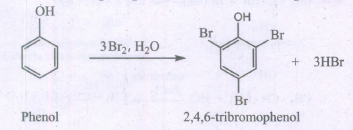
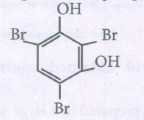
(ii) It readily forms tribromo derivative since it has two-o and one-p position free with respect to OH group.
14.
Solubility can be calculated from the molar solubility i.e., the maximum number of moles of solute that can be dissolved in one litre of the solution.
For a solute XmYn,
\({ X }_{ m }{ Y }_{ n(s) }\rightleftharpoons m{ X }_{ (aq) }^{ n+ }+{ nY }_{ (aq) }^{ m- }\)
From the above stoichiometrically balanced equation we have come to know that 1 mole of Xm Yn(s) dissociated to furnish 'm' moles of Xn+ and 'n' moles of Ym- if 's' is molar solubility of XmYn then
[Xn+] = ms and [Ym-] = ns
ஃKsp = [Xn+]m [Ym-]n
Ksp = (ms)m (ns)n
Ksp = (m)m (n)n (s)m+n
15.
Potassium permanganate is a strong oxidising agent, its oxidising action differs in different reaction medium.
In neutral medium:
In neutral medium, it is reduced to MnO2
MnO4- + 2H2O + 3e- ⟶ MnO2 + 4OH-
(i) It oxidises H2S to sulphur
2MnO4- + 3H2S ⟶ 2MnO2 + 3S + 2OH- + 2H2O
(ii) It oxidises thiosulphate into sulphate
8MnO4- + 3S2O3-2 + H2O ⟶ 6SO4-2 + 8MnO2 + 2OH-
16.
\(2{ NH }_{ { 3 }_{ (g) } }\overset { pt }{ \longrightarrow } { N }_{ { 2 }_{ (g) } }+3{ H }_{ { 2 }_{ (g) } }\)
Rate = \(-\frac { 1 }{ 2 } \frac { d\left[ { NH }_{ 3 } \right] }{ dt } =\frac { d\left[ { N }_{ 2 } \right] }{ dt } =\frac { 1 }{ 3 } \frac { d\left[ { N }_{ 2 } \right] }{ dt } \)
However, it is given that the reaction is of zero order. Therefore
\(-\frac { 1 }{ 2 } \frac { d\left[ { NH }_{ 3 } \right] }{ dt } =\frac { d\left[ { N }_{ 2 } \right] }{ dt } =\frac { 1 }{ 3 } \frac { d\left[ { N }_{ 2 } \right] }{ dt } k\)
= 2.5 x 10⁻⁴ mol L-1 S-1
The rate of production of N2 is
\(\frac { d\left[ { N }_{ 2 } \right] }{ dt } \)= 2.5 x 10⁻⁴ mol L-1 S-1
The rate of production of H2 is
\(\frac { d\left[ { N }_{ 2 } \right] }{ dt } \)= 3 x 2.5 x 10-4 mol L-1 s-1
= 7.5 x 10⁻⁴ mol L-1 s-1.
17.
(i) (a) Vanadium
(b) Iron
(c) Silver
(ii) H2S ⟶ 2H++ S2-
[MnO4- + 8H+ + 5e- ⟶ Mn2+ + 4H2O] x 2
[S2- ⟶ S + 2e-] x 5
______________________________________
2MnO4- + 5S2- + 16H+⟶ 2Mn2+ + 5S + 8H2O
_______________________________________
18.
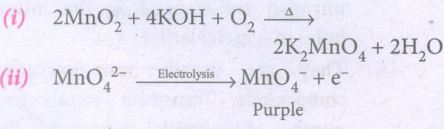
19.
\({ t }_{ \frac { 3 }{ 4 } }=\frac { 2.303 }{ K } \log { \frac { { \left[ R \right] }_{ 0 } }{ \frac { 1 }{ 4 } { \left[ R \right] }_{ 6 } } } \)
\({ t }_{ \frac { 3 }{ 4 } }=\frac { 2.303 }{ K } \log 4\)
\(=\frac { 2.303\times 0.6021 }{ K } =\frac { 1.386 }{ K } \)
\(=2\times \frac { 0.693 }{ K } \)
\(=2{ t }_{ \frac { 1 }{ 2 } }\)
20.
(i) PCI5+ C2H5OH \(\longrightarrow \) C2H5CI + POCl3 + HCI
(ii) P4+ 10SO2Cl2 \(\longrightarrow \) 4PCI5 + 10SO2
(iii) POCl3 + 3H2O \(\longrightarrow \) H3PO4 + 3HCI
(iv) PH3 + HBr\(\longrightarrow \) PH4Br
(v) PCl3+ 3H2O\(\longrightarrow \) H3PO3 + 3 HCI
21.
O3 oxidises potassium iodide to iodine. This reaction is quantitative and can be used for estimation of ozone
\({ O }_{ 3 }+2KI+{ H }_{ 2 }O\longrightarrow 2KOH+{ O }_{ 2 }+{ I }_{ 2 }\)
22.
(i) (a) When AgCl is doped with CdCI2, two Ag+ ions will be replaced by one Cd2+ ion to maintain electrical neutrality.
(b) Thus, a hole is created at the lattice site for every Cd2+ ion introduced. Hence the crystal becomes conductor.
(ii) p-type semiconductor is obtained, when Si is doped with boron.
23.
(i) Covalent Solids: Silicon carbide, graphite.
(ii) Molecular Solids: Urea, benzene, ammonia, water and argon.
(iii) Ionic Solids: Zinc sulphide, potassium sulphate.
(iv) Metallic solids: Rubidium and tin.
24.
(i) Fullerenes are newly synthesised allotropes of carbon.
(ii) Unlike graphite and diamond, these allotropes are discrete molecules such as C32' C50' C60' C70' C76 etc.
(iii) These molecules have cage like structures.
(iv) The C60 molecules have a soccer ball like structure and is called buckminster fullerene or buckyballs.
(v) It has a fused ring structure consists of 20 six membered rings and 12 five membered rings.
(vi) Each carbon atom is sp2 hybridised and forms three σ bonds & a delocalised π bond giving aromatic character to these molecules.
(vii) The C-C bond distance is 1.44 Å and C=C distance 1.38 Å.
25.
(i) Ellingham diagram helps us to select a suitable reducing agent and appropriate temperature range for reduction.
(ii) From the Ellingham diagram, we can infer the relative stability of different metal oxides at a given temperature.
(iii) Ellingham diagram is used to predict thermodynamic feasibility of reduction of oxides of one metal by another metal.
26.
(i) Depressant are used to prevent one type of sulphide ore particles from forming the froth with air bubbles.
(ii) Eg: In the process of separation of lead sulphide (Pbs) ore from zinc sulphide (ZnS) ore, sodium cyanide is used as depressant.
27.
When a crushed ore containing nickel, copper and cobalt is treated with aqueous ammonia under suitable pressure, ammonia selectively leaches these metals by forming their soluble complexes viz. [Ni(NH3)6]2+, [Cu(NH3)4]2+, and [Co(NH3)5H2O]3+ respectively from the ore leaving behind the gangue, iron(III) oxides/ hydroxides and aluminosilicate.
28.
If we perform a qualitative analysis to identify the constituent ions present in both the compounds, Mohr's salt answers the presence of Fe2+, NH4+, and SO42- ions, whereas the potassium ferrithiocyanate will not answer Fe3+ and SCN ions. We can infer that the double salts loose their identity and dissociate into their constituent simple ions in solutions, whereas the complex ion in coordination compound, does not loose its identity and never dissociate to give simple ions.
29.
Even though VBT explains many of the observed properties of complexes, it still has following limitations.
(i) It does not explain the colour of the complex.
(ii) It considers only the spin only magnetic moments and does not consider the other components of magnetic moments.
(iii) It does not provide a quantitative explanation as to why certain complexes are inner orbital complexes and the: others are outer orbital complexes for the same metal. For example, [Fe(CN)6]4- is diamagnetic (low spin) whereas [FeF6]4-is paramagnetic (high spin).
30.
(i) UNIDENTATE LIGAND: (or) Monodentate
When a ligand is bonded through one donor site to central metal atom/ion it is said to be unidentate ligand.
Eg: Cl-, CO, NH3, H2O, etc.
(ii) DIDENTATE LIGAND: (or) Bidentate
When a ligand is bonded through two donor sites to central metal atom/ion, it is said to be didentate ligand.
Eg: Oxalate, 1,2 - ethanediamine.
(iii) AMBIDENTATE LIGAND:
When a ligand i.s bonded through two different atoms, it is said to be ambidentate ligand.
Eg: NO2-, SCN-, CN-

12th Standard Syllabus & Materials
12th Standard
TN 12th Computer Applications களப்பெயர் முறைமை (DNS) Sample Question Papers Study Material - QB365 Set A
NEW12th Standard
TN 12th Computer Applications வலையமைப்பு எடுத்துக்காட்டுகள் மற்றும் நெறிமுறைகள் Sample Question Papers Study Material - QB365 Set A
NEW12th Standard
TN 12th Computer Applications கணினி வலையமைப்பு ஓர் அறிமுகம் Sample Question Papers Study Material - QB365 Set A
NEW12th Standard
TN 12th Computer Applications PHP-உடன் MySQL-ஐ இணைத்தல் Sample Question Papers Study Material - QB365 Set A



Tamilnadu Stateboard 12th Standard Subjects

Maths
Chemistry

Physics

Biology

Computer Science

Business Maths and Statistics

Economics

Commerce

Accountancy

History

Computer Applications
Biology
Computer Technology
Computer Applications
Computer Science
Business Maths and Statistics
Commerce
Economics
Maths
Chemistry
Physics
Computer Technology
History
Accountancy

Tamil

English

French
Tamilnadu Stateboard Standards
