
 100% FREE ACCESS
12th Standard Syllabus & Materials
12th Standard
TN 12th Maths Applications of Matrices and Determinants Sample Question Papers Study Material - QB365 Set A
NEW12th Standard
TN 12th Computer Applications மின்னணு தரவு பரிமாற்றம் Sample Question Papers Study Material - QB365 Set A
NEW12th Standard
TN 12th Computer Applications மின் - வணிக பாதுகாப்பு அமைப்புகள் Sample Question Papers Study Material - QB365 Set A
NEW12th Standard
TN 12th Computer Applications மின்னணு செலுத்தல் முறைகள் Sample Question Papers Study Material - QB365 Set A
NEW12th Standard
TN 12th Computer Applications மின் - வணிகம் Sample Question Papers Study Material - QB365 Set A
NEW12th Standard
TN 12th Computer Applications திறந்த மூல கருத்துருக்கள் Sample Question Papers Study Material - QB365 Set A

Published on: 31/12/2022
QB365 provides a detailed and simple solution for every Possible Questions in Class 12 Chemistry Subject - Important 3 Mark English Medium. It will help Students to get more practice questions, Students can Practice these question papers in addition to score best marks.
Download Tamil Nadu 12th Standard Chemistry question papers, model tests, one-mark questions, important questions, and public exam papers in PDF format. Free study materials and answer keys for TN State Board students.
Questions + Answers key
Take MCQ Chemistry Test
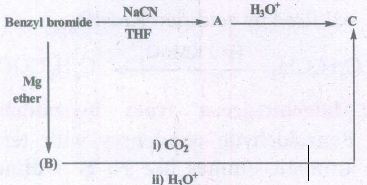
1.
Identify A, B and C
2.
What is the pH of an aqueous solution obtained by mixing 6 gram of acetic acid and 8.2 gram of sodium acetate and making the volume equal to 500 ml. (Given: Ka for acetic acid is \(1.8\times10^{-5}\))
3.
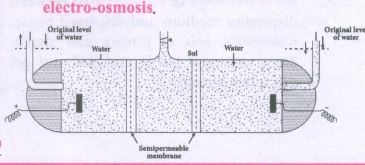
Write a note on electro osmosis.
4.
How is phenol prepared from
i) chloro benzene
ii) isopropyl benzene
5.
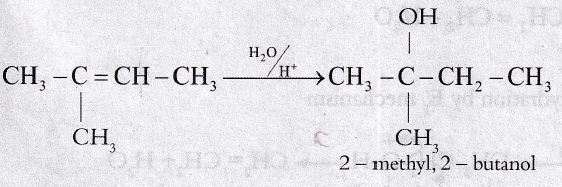
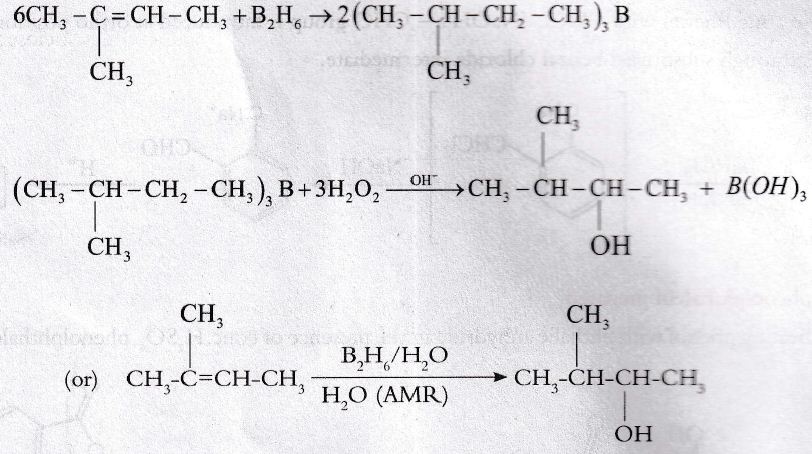
Predict the major product, when 2-methyl but -2-ene is converted into an alcohol in each of the following methods.
(i) Acid catalysed hydration
(ii) Hydroboration
(iii) Hydroxylation using Baeyer's reagent
6.
How will you prepare propan – 1- amine from
i) butane nitrile
ii) propanamide
ii) 1- nitropropane
7.
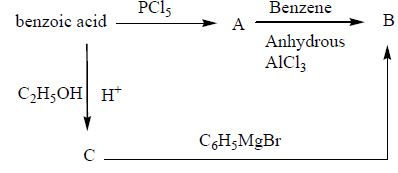
Identify A, B and C
8.
Derive an expression for the hydrolysis constant and degree of hydrolysis of salt of strong acid and weak base.
9.
Complete the following reactions?
i) Cr2 + 2e- ⟶
ii) Mn2+ + 2e- ⟶
iii) Fe2+ + 2e- ⟶
iv) CO2+ + 2e- ⟶
10.
The rate constant, the activation energy and frequency factor of a chemical reaction at 25oC are 3.0 x 10⁻⁴ S-1; 104.4 kJ mol-1 and 6.0 x 10¹⁴ S-1 respectively. What is the value of the rate constant when T ⟶ ∞?
11.
Discuss the anomalous nature of fluorine.
12.
Find out the oxidation state of carbon in each of the following:
(i) CaC2
(ii) H2CO3
(iii) HCN
(iv) CO
13.
Write the complete set of reactions occurring in the zone of reduction in the blast furnace in the metallurgy of iron.
14.
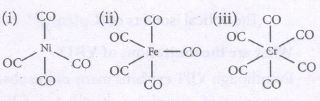
Draw the structure of the following homoleptic metal carbonyl.
(i) [Ni(CO)4]
(ii) [Fe(CO)5]
(iii) [Cr(CO)6]
15.
Benzene diazonium chloride in aqueous solution decomposes according to the equation \({ C }_{ 6 }{ H }_{ 5 }{ N }_{ 2 }Cl\longrightarrow { C }_{ 6 }{ H }_{ 5 }Cl+{ N }_{ 2 }\)Starting with an initial concentration of 10g L-1, the volume of N2 gas obtained at 50 °C at different intervals of time was found to be as under:
| t(min) | 6 | 12 | 18 | 24 | 30 | \(\infty \) |
| Vol of N2 (ml) | 19.3 | 32.6 | 41.3 | 46.5 | 50.4 | 58.3 |
Show that the above reaction follows the first order kinetics. What is the value of the rate constant?
16.
The rate law for a reaction of A, B and C has been found to be rate = k[A]2[B][L]3/2 How would the rate of reaction change when
(i) Concentration of [L] is quadrupled
(ii) Concentration of both [A] and [B] are doubled
(iii) Concentration of [A] is halved
(iv) Concentration of [A] is reduced to \(\left(\frac{1}{3}\right)\) and concentration of [L] is quadrupled.
17.
The E0M2+/M value for copper is positive. Suggest a possible reason for this.
18.
19.
Explain why Cr2+ is strongly reducing while Mn3+ is strongly oxidizing.
20.
Give one test to differentiate [Co(NH3)5Cl]SO4 and [Co(NH3)5SO4]Cl.
21.
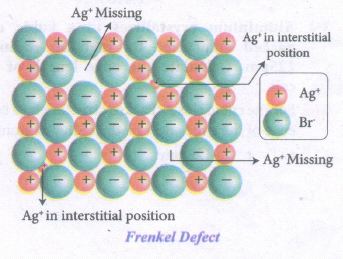
Write a note on Frenkel defect.
22.
What is meant by the term “coordination number”? What is the coordination number of atoms in a bcc structure?
23.
Write the reason for the anomalous behaviour of Nitrogen.
24.
A hydride of 2nd period alkali metal (A) on reaction with compound of Boron (B) to give a reducing agent (C). Identify A, B and C.
25.
Explain the following terms with suitable examples.
(i) Gangue
(ii) slag
26.
What is the difference between a sol and a gel?
27.
Is it possible to store copper sulphate in an iron vessel for a long time?
Given : \(E^{0}_{Cu^{2+}|Cu} = 0.34\) V and \(E^{0}_{Fe^{2+}|Fe} = -0.44\)V.
28.
What is the coordination entity formed when excess of liquid ammonia is added to an aqueous solution of copper sulphate?
29.
The conductivity of a 0.01M solution of a 1 :1 weak electrolyte at 298K is 1.5\(\times\)10-4 S cm−1.
i) molar conductivity of the solution
ii) degree of dissociation and the dissociation constant of the weak electrolyte
Given that
\(\lambda^{0}_{cation}=248.2 \ S\) cm2 mol-1
\(\lambda^{0}_{anlon}=51.8 \ S\) cm2 mol-1
30.
Write a short note on peptide bond.
1.
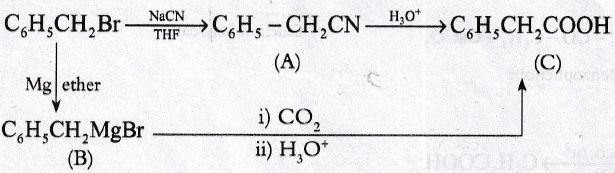 Phenyl Acetic acid
Benzyl Magnesium bromide
2.
According to Henderson – Hasselbalch equation,
\(pH=pK_{a}+\log\frac{[salt]}{[acid]}\)
\(p{K_{a}}=-\log K_{a}=-\log(1.8\times10^{-5})=4.74\)
[Salt]=\(\frac{\text {Number of moles of sodium acetate}}{\text {Volume of the solution (litre)}}\)
Number of moles of sodium acetate =\(\frac{\text {mass of sodium acetate}}{\text {molar mass of sodium acetate}}\)
\(=\frac{8.2}{82}=0.1\)
\(\therefore [Salt]=\frac{0.1\ mole}{1/2 \ Litre}=0.2M\)
\([acid]=\frac{(\frac{mass \ of \ CH_{3}COOH}{molar \ mass \ of \ CH_{3}COOH})}{\text{Volume of solution in litre}}\)
=\(\frac{(\frac{6}{60})}{\frac{1}{2}}\)=0.2 M
\(\therefore pH=4.74+log\frac{(0.2)}{(0.2)}\)
pH = 4.74 + log1
pH = 4.74 + 0 = 4.74
3.
A sol is electrically neutral. Hence the medium carries an equal but opposite charge to that of dispersed particles. When sol particles are prevented from moving, under the influence of electric field the medium moves in a direction opposite to that of the sol particles. This movement of dispersion medium under the influence of electric potential is called electro osmosis.
4.
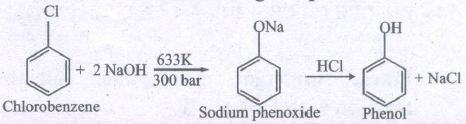
(i) Chloro benzene:
When Chlorobenzene is hydrolysed with 6-8% NaOH at 300 bar and 633K in a closed vessel, sodium phenoxide is formed which on treatment with dilute HCl gives phenol.
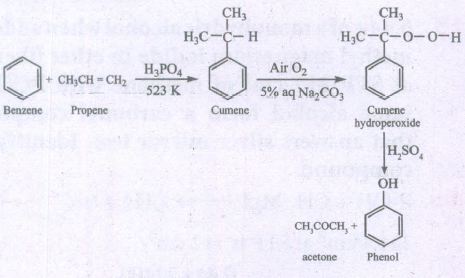
(ii) isopropyl benzene:
A mixture of benzene and propene is heated at 523K in a closed vessel in presence of H3PO4 catalyst gives cumene (isopropylbenzene). On passing air to a mixture of cumene and 5% aqueous sodium carbonate solution, cumene hydro peroxide is formed by oxidation. It is treated with dilute acid to get phenol and acetone. Acetone is also an important byproduct in this reaction.
5.
(i) Acid catalysed hydration
(ii) Hydroboration
(iii) Hydroxylation using Baeyer's reagent
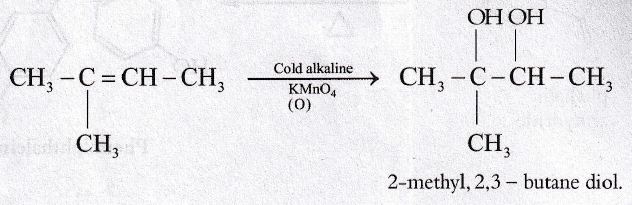
6.
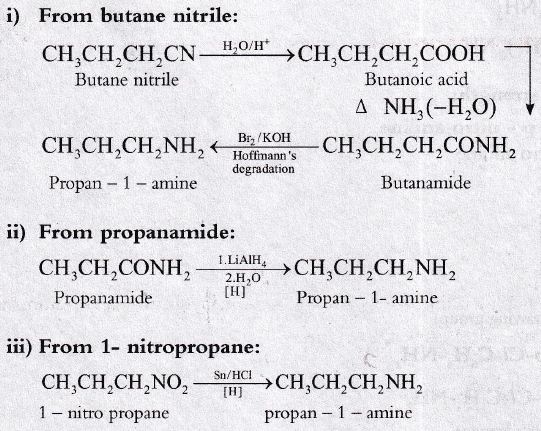 + 2H2O
7.
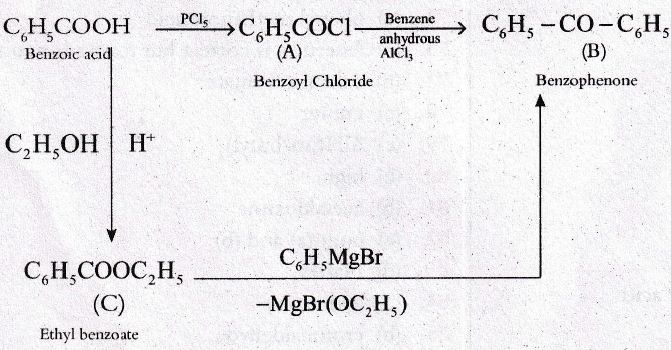
| Compound | Name |
| A | Benzoyl Chloride |
| B | Benzophenone |
| C | Ethylbenzoate |
8.
(i) Let us consider the reactions between a strong acid, HCI, and a weak base, NH4OH, to produce a salt, NH4CI, and water.
HCI(aq) + NH4OH(aq) ⇌ NH4CI(aq) + H2O (I)
NH4CI(aq) ⟶ NH4+ +CI-(aq)
(ii) NH4+ is a strong conjugate acid of the weak base NH4OH and it has a tendency to react with OH- from water to produce unionised NH4OH
NH4+ (aq) + H2O(I) ⇌ NH4OH(aq) + H+(aq)
(iii) There is no such tendency shown by Cl- and therefore [H+] > [OH-]; the solution is acidic and the pH is less than 7.
(iv) The Kh and Kb are related by
\(\mathrm{K}_{\mathrm{h}} \cdot \mathrm{K}_{\mathrm{b}}=\mathrm{K}_{\mathrm{w}}\)
(Or)
\(\mathrm{K}_{\mathrm{h}}=\frac{\mathrm{K}_{\mathrm{w}}}{\mathrm{K}_{\mathrm{b}}}\)
Degree of hydrolysis (h)
\(\underset{(1-h)}{\mathrm{NH}_{4}^{+}(\mathrm{aq})}+\mathrm{H}_{2} \mathrm{O}_{(j)} \rightleftharpoons \underset{h} {\mathrm{NH}_{4} \mathrm{OH}_{(\mathrm{aq})}} +\mathrm{H}^{+} \underset{h}{(\mathrm{aq})}\\ \)
\(\mathrm{K}_{\mathrm{h}} =\frac{\left[\mathrm{NH}_{4} \mathrm{OH}\right]\left[\mathrm{H}^{+}\right]}{\left[\mathrm{NH}_{4}^{+}\right]} \\ \)
\(=\frac{\mathrm{hc} \times \mathrm{h}}{(1-\mathrm{h}) \mathrm{c}} \)
\(K_{h}=\frac{h^{2} c}{(1-h)} \)
\(\text{If } \mathrm{h}<<1 ; \mathrm{K}_{\mathrm{h}} \simeq \mathrm{h}^{2} \mathrm{c} \)
\(h^{2}=\frac{K_{h}}{c}\)
\(h=\sqrt{\frac{K_{h}}{c}} \ (or) \ h=\sqrt{\frac{K_{w}}{K_{b} \cdot C}} \quad\left(\because K_{h}=\frac{K_{w}}{K_{b}}\right)\)
Also; \(\left[\mathrm{H}^{+}\right]=\sqrt{\mathrm{K}_{\mathrm{h}} \cdot \mathrm{C}} \) (or) \(\left[\mathrm{H}^{+}\right]=\sqrt{\frac{\mathrm{K}_{\mathrm{w}} \cdot \mathrm{C}}{\mathrm{K}_{\mathrm{b}}}}\)
pH = -log [H+]
9.
i) Cr2 + 2e- ⟶ Cr
ii) Mn2+ + 2e- ⟶ Mn
iii) Fe2+ + 2e- ⟶ Fe
iv) CO2+ + 2e- ⟶ Co
10.
Formula:
k1 = A.e-Ea/RT
Given:
Rate constant, k1 - 3.0 x 10⁻⁴ s-1
Frequency factor, A = 6.0 x 10¹⁴ s-1
Activation energy, Ea = 104.4 kJ
= 104400 J
Temperatures, T1 = 25o C; T2 =∞
Solution:
\({ k }_{ 2 }=A.{ e }^{ -\frac { { E }_{ a } }{ RT } }\)
k2 = 6.0 x 10¹⁴ x \(\frac { 104400 }{ { e }^{ 8.314\times \infty } } \)
k2 = 6.0 x 1014 x 1 \(\left( \therefore e\frac { -{ { E }_{ a } } }{ R\infty } =1 \right) \)
∴ The rate constant at T ⟶ ∞ is 6.0 x 10¹⁴ s-1
11.
(i) Fluorine is the most reactive element among halogens due to minimum value of F- F bond dissociation energy.
(ii) It can form two types of salts with metals NaF and NaHF2
(iii) AgF is soluble in water but other AgX are insoluble.
(iv) HF attacks glass while others do not.
(v) Fluorine, does not form any polyhalides (absence of d - orbitals)
(vi) Fluorine exhibit only negative oxidation state (highly electronegative) while other halogens have both +ve and -ve oxidation state.
12.
(i) CaC2
2 + 2x = 0
2x = -2
x = -1
(ii) H2CO3
2 + x + (-6) = 0
x = +4
(iii) HCN
1 + x + (-3) = 0
x = +3 - 1 = +2
(iv) CO
x + (-2) = 0
x= +2
13.
In Ellingham diagram, the graph of \(CO\rightarrow { CO }_{ 2 }\) conversion remains below \(Fe\rightarrow { Fe }_{ 2 }{ O }_{ 3 }\) upto 1073 K
(for Fe\(\longrightarrow \) FeO). SO, CO (g) act as reducing agent upto this temperature.
\(3{ Fe }_{ 2 }{ O }_{ 3 }+CO\longrightarrow 2{ Fe }_{ 3 }{ O }_{ 4 }\) (i.e. FeO.Fe2O3) + CO2
\({ Fe }_{ 3 }{ O }_{ 4 }+CO\longrightarrow 3Feo+{ CO }_{ 2 }\)
FeO + CO \(\longrightarrow \) Fe + CO2
Also, graph of C\(\longrightarrow \) CO is below the graph of
Fe \(\longrightarrow \)Fe2O3 after 1123 K. So, carbon acts as reducing agent above this temperature.
Fe2O3 + C\(\longrightarrow \) 3 CO + 2 Fe.
14.
15.
For a first order reaction
\(k=\frac { 2.303 }{ t } \log\frac { \left[ { A }_{ 0 } \right] }{ \left[ A \right] } \)
\(k=\frac { 2.303 }{ t } \log\frac { { V }_{ \infty } }{ { V }_{ \infty }-{ V }_{ 1 } } \)
V∞= 58.3 ml.
| t(min) | Vt | V∞=Vt | \(k=\frac { 2.303 }{ t } \log\frac { { V }_{ \infty } }{ { V }_{ \infty }-{ V }_{ t } } \) |
| 6 | 19.3 | 58.3-19.3=39.0 | \(k=\frac { 2.303 }{ 6 } \log\left( \frac { 58.3 }{ 39 } \right) =0.0670\) min-1 |
| 12 | 32.6 | 58.3-32.6=25.7 | \(k=\frac { 2.303 }{ 12 } \log\left( \frac { 58.3 }{ 25.7 } \right) =0.06838\) min-1 |
| 18 | 41.3 | 58.3-41.3=17.0 | \(k=\frac { 2.303 }{ 18 } \log\left( \frac { 58.3 }{ 17 } \right) =0.06838\) min-1 |
| 24 | 46.5 | 58.3-46.5=11.8 | \(k=\frac { 2.303 }{ 24 } \log\left( \frac { 58.3 }{ 11.8 } \right) =0.0666\) min-1 |
| 30 | 50.4 | 58.3 - 50.4 = 7.9 | \(k=\frac{2.303}{30} \log \left(\frac{58.3}{7.9}\right)=0.067\) min-1 |
| Mean value of k = 0.0674 min-1 |
As the rate constants are constant through out it is a first order reaction.
16.
(i) Reaction Rate = \(k{ \left[ A \right] }^{ 2 }{ \left[ B \right] }{ \left[ L \right] }^{ 3/2 }\) ...(1)
When [L] = [4L]
Rate = \(k{ \left[ A \right] }^{ 2 }{ \left[ B \right] }{ \left[ 4L \right] }^{ 3/2 }\)
The Reaction Rate = \(8(k{ \left[ A \right] }^{ 2 }{ \left[ B \right] }{ \left[ L \right] }^{ 3/2 })\) ...(2)
Comparing (1) and (2) rate is increased by 8 times
(ii) [A] = [2A] and [B] = [2B]
Reaction Rate = \(k{ \left[ 2A \right] }^{ 2 }\left[ 2B \right] { \left[ L \right] }^{ 3/2 }\)
Reaction Rate = \(\\ 8(k{ \left[ A \right] }^{ 2 }{ \left[ B \right] }{ \left[ L \right] }^{ 3/2 })\) ...(3)
Comparing (1) and (3) rate is increased by 8 times
(iii) \(\left[ A \right] =\left[ \frac { A }{ 2 } \right] \)
Reaction Rate = \(k{ \left[ \frac { A }{ 2 } \right] }^{ 2 }{ \left[ B \right] }{ \left[ L \right] }^{ 3/2 }\)
Reaction Rate = \(\frac { 1 }{ 4 } \left( k\left[ { A }^{ 2 } \right] { \left[ B \right] }{ \left[ L \right] }^{ 3/2 } \right) \) ...(4)
Comparing (1) and (4); rate is reduced to (1/4) times.
(iv) \(\left[ A \right] =\left[ \frac { 1 }{ 3 }A \right] and\left[ L \right] =\left[ 4L \right] \)
Rate = \(k{ \left[ \frac { 1 }{ 3 }A \right] }^{ 2 }{ \left[ B \right] }{ \left[ 4L \right] }^{ 3/2 }\)
Rate = \(\left( \frac { 8 }{ 9 } \right) \left( k{ \left[ A \right] }^{ 2 }{ \left[ B \right] }{ \left[ L \right] }^{ 3/2 } \right)\) ...(5)
Comparing (1) and (5); rate is reduced to \(\frac { 8 }{ 9 } \) times.
17.
Elemental copper is more stable than Cu2+. The electronic configuration of copper is 3d10 4s1 completely filled 3d orbital with stable configuration.
But Cu2+ has configuration as 3d9. Hence \(\mathrm{E}_{\mathrm{M}^{2+} / \mathrm{M}}^{0}\) value is positive for Cu2+.
18.
19.
Mn3+ has large and negative standard electrode potential E0 (-1.18 V) than that of Cr2+ which has only -0.91 V. If the standard electrode potential of a metal is large and negative, the metal is a powerful reducing agent because it loses electrons easily. Hence Mn3+ is strongly oxidizing while Cr2+ is strongly reducing.
20.
These two are ionisation isomers. [Co(NH3)5Cl]SO4 gives white precipitate with BaCl2 solution, but not with AgNO3 solution. [Co(NH3)5SO4]Cl gives curdy white precipitate with AgNO3 solution but not with BaCl2 solution.
21.
(i) Frenkel defect arises due to the dislocation of ions from its crystal lattice.
(ii) The ion which is missing from the lattice point occupies an interstitial position.
(iii) This defect is shown by ionic solids in which cation and anion differ in size.
(iv) Unlike Schottky defect, this defect does not affect the density of the crystal.
For example AgBr, in this case, small Ag+ ion leaves its normal site and occupies an interstitial position.
22.
1. The number of nearest neighbours that surrounding a particle in a crystal is called the coordination number of that particle.
2. The coordination number of atoms in a bcc structure is '8'.
23.
(i) Its small size
(ii) Its high electronegativity
(iii) Its high ionisation energy
(iv) Non-availability of d-orbital in the valence shell.
(v) Rather inert
(vi) High bond energy
24.
A hydride of 2nd period alkali metal (A) is lithium hydride (LiH).
Lithium hydride (A) reacts with diborane (B) to give lithium borohydride (C) which is acts as a reducing agent.
B2H6 + 2 LiH \(\xrightarrow[]{ether}\) 2 LiBH4
[Diborane (B)] [Lithium hydride (A)] [Lithium borohydride (C)]
Result:
| Compound | Formula | Name |
| A | LiH | Lithium hydride |
| B | B2H6 | Diborane |
| C | LiBH4 | Lithium borohydride |
25.
(i) Gangue: The ores are associated with nonmetallic impurities, rocky materials and siliceous matter which are collectively known as gangue.
Eg: SiO2 is the gangue present in the iron ore (Fe2O3)
(ii) Slag: In the smelting process, a flux combines with Silica gangue forming slag.
CaO(s) + SiO2(s) → CaSiO3(s)
Flux + gangue → Slag
26.
| S.no | Sol | Gel |
| (a) | The liquid state of collidal solution | The solid (or) semi solid stage of a colloidal solution. |
| (b) | Very low viscosity | Very high viscosity |
| (c) | It does not have definite structure. | It possesses definite structure. |
27.
\((E^{0}_{ox})_{Fe^{2+}|Fe} = -0.44\) and
\((E^{0}_{red})_{Cu^{2+}|Cu} = 0.34\)
These +ve emf values shows that iron will oxidise and copper will get reduced i.e., the vessel will dissolve. Hence it is not possible to store copper sulphate in an iron vessel.
28.
(i) When excess of liquid ammonia is added to an aqueous solution of copper sulphate gives tetra ammine copper (II) sulphate is formed.
CUso4 + 4NH3 \(\rightarrow\) [Cu(NH3)4]SO4
(ii) The co-ordination entity is [Cu(NH3)4]2+
29.
i) Molar conductivity
Given : C = 0.01 M;
\(\kappa=1.5 \times 10^{-4} \mathrm{~S} \mathrm{~cm}^{-1} \)
\(=1.5 \times 10^{-2} \mathrm{~S} \mathrm{~m}^{-1} \)
\(\lambda_{\text {cation }}^{0}=248.2 \mathrm{~S} \mathrm{~cm}^{2} \mathrm{~mol}^{-1} \)
\(\lambda_{\text {anion }}^{0}=51.8 \mathrm{~S} \mathrm{~cm}^{2} \mathrm{~mol}^{-1} \)
\(\Lambda_{m}^{0}=\frac{\kappa \times 10^{-3}}{C} \mathrm{~S} \mathrm{~m}^{2} \mathrm{~mol}^{-1} \)
\(=\frac{1.5 \times 10^{-2} \times 10^{-3}}{0.01} \)
\(=1.5 \times 10^{-3} \mathrm{~S} \mathrm{~m}^{2} \mathrm{~mol}^{-1}\)
ii) \(\alpha=\frac{\Lambda_{m}}{\Lambda_{m}^{0}}\)
\(\Lambda_{\mathrm{m}}^{0}=\lambda_{\text {cation }}^{0}+\lambda_{\text {anion }}^{0} \)
\(=(248.2+51.8) \mathrm{S} \mathrm{cm}^{2} \mathrm{~mol}^{-1} \)
\(=300 \mathrm{~S} \mathrm{~cm}^{2} \mathrm{~mol}^{-1}\)
\(=300 \times 10^{-4} \mathrm{Sm}^{2} \mathrm{~mol}^{-1} \)
\(\alpha =\frac{1.5 \times 10^{-3}}{300 \times 10^{-4}}=0.05\)
iii) \(\mathrm{K}_{\mathrm{a}} =\frac{\alpha^{2} \mathrm{C}}{1-\alpha} \)
\(\mathrm{K}_{\mathrm{a}} =\frac{(0.05)^{2} \times(0.01)}{1-0.05}=2.6 \times 10^{-5} \)
(or)
\(\mathrm{K}_{\mathrm{a}} =\alpha^{2} \mathrm{C} \)
\(=(0.05)^{2} \times(0.01) \)
\(\mathrm{K}_{\mathrm{a}} =2.5 \times 10^{-5}\)
30.
(i) The amino acids are linked covalently by peptide bonds. The carboxyl group of the first amino acid react with the amino group of the second amino acid to give an amide linkage between these amino acids. This amide linkage is called peptide bond. The resulting compound is called a dipeptide. Addition an another amino acid to this dipeptide a second peptide bond results in tripeptide.
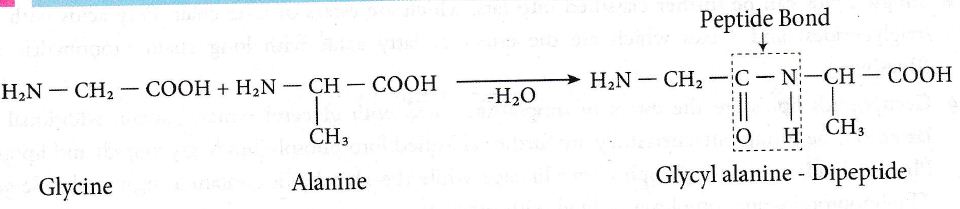
(ii) Thus we can generate tetra peptide, penta peptide etc... When you have more number of amino acids linked this way you get a polypeptide. If the number of amino acids are less it is called as a polypeptide, if it has large number of amino acids (and preferably has a function) then it is called a protein.
(iii) The amino end of the peptide is known as N - terminal or amino terminal while the carboxy end is called C-terminal or carboxy terminal. In general protein sequences are written from N-Terminal to C-Terminal.The atoms other than the side chains (R-groups) are called main chain or the back bone of the polypeptide.

12th Standard Syllabus & Materials
12th Standard
TN 12th Computer Applications வலையமைப்பு வடமிடல் Sample Question Papers Study Material - QB365 Set A
NEW12th Standard
TN 12th Computer Applications களப்பெயர் முறைமை (DNS) Sample Question Papers Study Material - QB365 Set A
NEW12th Standard
TN 12th Computer Applications வலையமைப்பு எடுத்துக்காட்டுகள் மற்றும் நெறிமுறைகள் Sample Question Papers Study Material - QB365 Set A
NEW12th Standard
TN 12th Computer Applications கணினி வலையமைப்பு ஓர் அறிமுகம் Sample Question Papers Study Material - QB365 Set A



Tamilnadu Stateboard 12th Standard Subjects

Maths
Chemistry

Physics

Biology

Computer Science

Business Maths and Statistics

Economics

Commerce

Accountancy

History

Computer Applications
Biology
Computer Technology
Computer Applications
Computer Science
Business Maths and Statistics
Commerce
Economics
Maths
Chemistry
Physics
Computer Technology
History
Accountancy

Tamil

English

French
Tamilnadu Stateboard Standards
