
 100% FREE ACCESS
12th Standard Syllabus & Materials
12th Standard
TN 12th Computer Applications மின்னணு தரவு பரிமாற்றம் Sample Question Papers Study Material - QB365 Set A
NEW12th Standard
TN 12th Computer Applications மின் - வணிக பாதுகாப்பு அமைப்புகள் Sample Question Papers Study Material - QB365 Set A
NEW12th Standard
TN 12th Computer Applications மின்னணு செலுத்தல் முறைகள் Sample Question Papers Study Material - QB365 Set A
NEW12th Standard
TN 12th Computer Applications மின் - வணிகம் Sample Question Papers Study Material - QB365 Set A
NEW12th Standard
TN 12th Computer Applications திறந்த மூல கருத்துருக்கள் Sample Question Papers Study Material - QB365 Set A
NEW12th Standard
TN 12th Computer Applications வலையமைப்பு வடமிடல் Sample Question Papers Study Material - QB365 Set A

Published on: 03/09/2020
12th Standard Chemistry English Medium Important 5 Mark Book Back Questions (New Syllabus) 2020
Download Tamil Nadu 12th Standard Chemistry question papers, model tests, one-mark questions, important questions, and public exam papers in PDF format. Free study materials and answer keys for TN State Board students.
Questions + Answers key
Take MCQ Chemistry Test
1.
Rate constant k of a reaction varies with temperature T according to the following Arrhenius equation \(\log K=\log A-\frac { { E }_{ a } }{ 2.303R } \left( \frac { 1 }{ T } \right) \)Where Ea is the activation energy. When a graph is plotted for log k Vs \(\frac{1}{T}\) a straight line with a slope of -4000K is obtained. Calculate the activation energy.
2.
What is crystal field stabilization energy (CFSE)?
3.
Deduce the oxidation number of oxygen in hypofluorous acid – HOF.
4.
Sodium metal crystallizes in bcc structure with the edge length of the unit cell 4.3 x 10⁻⁸ cm. Calculate the radius of sodium atom.
5.
The selection of reducing agent depends on the thermodynamic factor: Explain with an example.
6.
Write the structure of the major product of the aldol condensation of benzaldehyde with acetone.
7.
What is the pH of an aqueous solution obtained by mixing 6 gram of acetic acid and 8.2 gram of sodium acetate and making the volume equal to 500 ml. (Given: Ka for acetic acid is \(1.8\times10^{-5}\))
8.
For the cell Mg (s) Mg2+(aq)||Ag+(aq)|Ag(s), calculate the equilibrium constant at 250C and maximum work that can be obtained during operation of cell. Given: \(E^{0}_{Mg^{2+}|Mg}\)=-237V and \(E^{0}_{Ag^{2+}|Ag}\) = 0.80V.
9.
How will you convert acetylene into n-butyl alcohol.
10.
Identify A,B and C
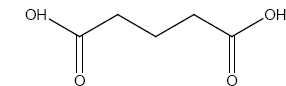 \(\overset{SOCl_2}\longrightarrow A \overset{NH_3}\longrightarrow B\overset{LiAlH_4}\longrightarrow (C)\)
11.
Write the expression for the solubility product of Ca3(PO4)2
12.
Write a note on co –polymer
13.
14.
Describe the variable oxidation state of 3d series elements.
15.
Why europium (II) is more stable than Cerium (II)?
16.
Aluminium crystallizes in a cubic close packed structure. Its metallic radius is 125pm. calculate the edge length of unit cell.
17.
A hydride of 2nd period alkali metal (A) on reaction with compound of Boron (B) to give a reducing agent (C). Identify A, B and C.
18.
Explain intermediate compound formation theory of catalysis with an example.
19.
Give three uses of emulsions.
20.
The time for half change in a first order decomposition of a substance A is 60 seconds. Calculate the rate constant. How much of A will be left after 180 seconds?
1.
\(\log K=\log A-\frac { { E }_{ a } }{ 2.303R } \left( \frac { 1 }{ T } \right) \)
y = c + mx
\(m=-\frac { { E }_{ a } }{ 2.303R } \)
Ea = -2.303 Rm
Ea = -2.303 x 8.314 x (-4000)
Ea = 76,589J mol-1
Ea = 76.589 KJ mol-1
2.
The CFSE is defined as the energy of the electronic configuration in the ligand field minus the energy of the electronic configuration in the isotropic field.
CFSE (\(\Delta\)Eo) = {ELf}-{Eiso}
={[nt2g(-0.4) + neg(0.6)]\(\Delta\)o + npP} - {n'pP}
Here, nt2g is the number of electrons in t2g orbitals;
neg is number of electrons in eg orbitals;
np is number of electron pairs in the ligand field; &
n'p is the number of electron pairs in the isotropic field (barycenter).
P - pairing energy
3.
Oxidation number of F = -1
Oxidation number of H = +1
Oxidation number of O in HOF =x
(+1) + x + (-1) = 0
x = 0
Oxidation number of O in HOF = 0
4.
For bcc structure \((r)=\frac{\sqrt{3}}{4} a\)
a = 4.3 \(\times\) 10-8 cm, r = ?
\(=\frac{1.732 \times 4.3 \times 10^{-8}}{4}\)
\(r=1.86 \times 10^{-8} \mathrm{~cm}\)
5.
(i) The extraction of metals from their oxides can be carried out by using different reducing agents.
(ii) Consider the following reaction
\(\frac{2}{\mathrm{y}} \mathrm{M}_{\mathrm{x}} \mathrm{O}_{\mathrm{y}(\mathrm{s})} \rightarrow \frac{2 \mathrm{x}}{\mathrm{y}} \mathrm{M}_{(s)}+\mathrm{O}_{ 2(\mathrm{~g})}\) (1)
(iii) The above reduction may be carried out with carbon. In this case the reducing agent carbon may be oxidized to either CO or CO2
\(\mathrm{C}+\mathrm{O}_{2} \rightarrow \mathrm{CO}_{2(\mathrm{~g})} \) (2)
\(2 \mathrm{C}+\mathrm{O}_{2} \rightarrow 2 \mathrm{CO}_{(\mathrm{g})} \) (3)
(iv) If CO is used as a reducing agent
\(2 \mathrm{CO}+\mathrm{O}_{2} \rightarrow 2 \mathrm{CO}_{2(\mathrm{~g})}\) (4)
(v) A suitable reducing agent is selected based on the thermodynamics considerations.
(vi) We know that for a spontaneous reaction, the change in free energy (\(\triangle\)G) should be negative.
(vii) Therefore, thermodynamically, the reduction of metal oxide with a given reducing agent can occur if the free energy change for the coupled reaction is negative.
(viii) Hence, the reducing agent is selected in such a way that it provides a large negative \(\triangle\)G value for the coupled reaction.
6.
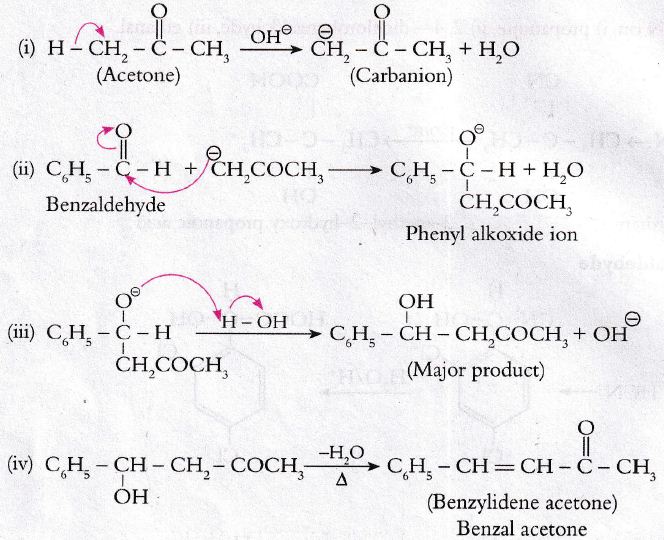
7.
According to Henderson – Hasselbalch equation,
\(pH=pK_{a}+\log\frac{[salt]}{[acid]}\)
\(p{K_{a}}=-\log K_{a}=-\log(1.8\times10^{-5})=4.74\)
[Salt]=\(\frac{\text {Number of moles of sodium acetate}}{\text {Volume of the solution (litre)}}\)
Number of moles of sodium acetate =\(\frac{\text {mass of sodium acetate}}{\text {molar mass of sodium acetate}}\)
\(=\frac{8.2}{82}=0.1\)
\(\therefore [Salt]=\frac{0.1\ mole}{1/2 \ Litre}=0.2M\)
\([acid]=\frac{(\frac{mass \ of \ CH_{3}COOH}{molar \ mass \ of \ CH_{3}COOH})}{\text{Volume of solution in litre}}\)
=\(\frac{(\frac{6}{60})}{\frac{1}{2}}\)=0.2 M
\(\therefore pH=4.74+log\frac{(0.2)}{(0.2)}\)
pH = 4.74 + log1
pH = 4.74 + 0 = 4.74
8.
a) Oxidation at anode :
\(\mathrm{Mg} \rightarrow \mathrm{Mg}^{2+}+2 \mathrm{e}^{-} ; \mathrm{E}_{\mathrm{Ox}}^{0}=2.37 \mathrm{~V}\) ...(1)
Reduction at cathode:
\(A \mathrm{~g}^{+} +\mathrm{e}^{-} \rightarrow \mathrm{Ag} ; \mathrm{E}_{\text {red }}^{0}=+0.80 \mathrm{~V} \) ...(2)
\(E_{\text {Cell }}^{0} =\left(\mathrm{E}_{\text {ox }}^{0}\right)_{\text {anode }}+\left(\mathrm{E}_{\text {red }}^{0}\right)_{\text {cathode }} \)
= 2.37 + 0.80 = 3.17V
Overall reaction : (1) + 2 x (2)
\(\mathrm{Mg} \rightarrow M g^{2+}+2 e^{-} \)
\(2 \mathrm{Ag}^{+}+2 \mathrm{e}^{-} \rightarrow 2 A g \)
__________________
\(M g+2 A g^{+} \rightarrow M g^{2+}+2 A g\)
b) \( \therefore \Delta G^{0}=-n F E^{0} \)
\(=-2 \times 96500 \times 3.17 \)
\(=-611810=-6.12 \times 10^{5} \mathrm{~J} \)
\(W=6.12 \times 10^{5} \mathrm{~J}\)
c) \(\Delta \mathrm{G}^{0}=-2.303 \mathrm{RT} \log \mathrm{K}_{c} \)
\(\log \mathrm{K}_{\mathrm{c}}=-\frac{\Delta G^{0}}{2.303 R T} \)
\(\log \mathrm{K}_{c}=-\frac{\left(-6.12 \times 10^{5}\right)}{2.303 \times 8.314 \times 298}=107.2 \)
\(K_{c}=A . \log 107.2 \)
\(\mathrm{K}_{c}=\text { Antilog of (107.2) }\)
= 1.58 x 10107
9.
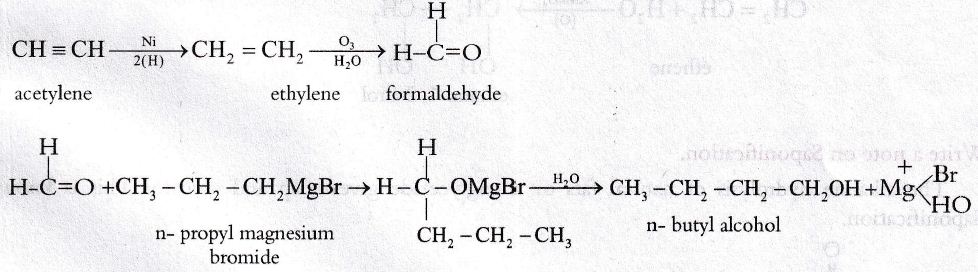
10.

11.
\(\mathrm{Ca}_{3}\left(\mathrm{PO}_{4}\right)_{2} \rightleftharpoons 3 \mathrm{Ca}^{2+}_{(aq)}+2 \mathrm{PO}_{4_{(aq)}}^{3-}\\\)
(s) (3s) (2s)
\(K_{sp}=[Ca^{2+}]^{3}[PO_{4}^{3-}]^{2}\)
\(K_{sp}=(3s)^{3}(2s)^{2}\)
\(K_{sp}=27s^{3}.4s^{2}\)
\(K_{sp}=108s^{5}\)
(or)
\(K_{s p} =m^{m} \cdot n^{n} \cdot(s)^{m+n} \)
\(K_{\text {sp }} =3^{3} \cdot 2^{2} \cdot(s)^{3+2} \)
\(K_{s p} =27 \times 4 \times(s)^{5} \)
\(=108(s)^{5}=108 s^{5}\)
12.
(i) A polymer containing two or more different kinds of monomer units is called a copolymer.
(ii) For example, SBR rubber(Buna-S) contains styrene and butadiene monomer units.
(iii) Copolymers have properties quite different from the homopolymers.
(iv) Mixture of styrene and 1,3 butadiene to form a copolymer (Buna -S)
Preparation of Buna-S:
It is a co-polymer. It is obtained by the polymerisation of buta -1,3 - diene and styrene in the ratio 3: 1 in the presence of sodium.
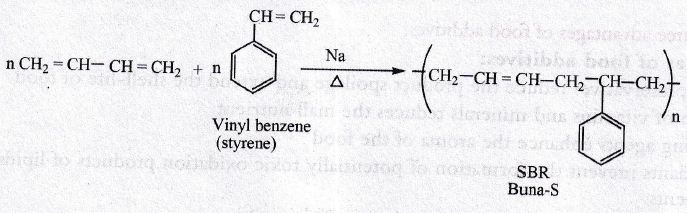
13.
14.
(i) The first transition metal Scandium exhibits only +3 oxidation state, but all other transition elements exhibit variable oxidation states by loosing electrons from (n-1)d orbital and ns orbital as the energy difference between them is very small. At the beginning of the series, +3 oxidation state is stable but towards the end +2 oxidation state becomes stable. The first and last elements show less number of oxidation states and the middle elements with more number of oxidation states
(ii) For example, the first element Sc has only one oxidation state +3; the middle element Mn has six different oxidation states from +2 to +7. The last element Cu shows +1 and +2 oxidation states only.
15.
\(Eu (63)-[\mathrm{Xe}] 4 \mathrm{f}^{7} 5 \mathrm{~d}^{0} 6 \mathrm{~s}^{2}, \mathrm{Eu}^{2+}-[\mathrm{Xe}] 4 \mathrm{f}^{7} \)
\(\mathrm{Ce}(58)-[\mathrm{Xe}] 4 \mathrm{f}^{1} 5 \mathrm{~d}^{1} 6 \mathrm{~s}^{2}, \mathrm{Ce}^{2+}-[\mathrm{Xe}] 4 \mathrm{f}^{1} 5 \mathrm{~d}^{1} \)
Eu2+ has exactly half filled stable electronic configuration. Hence Europium (II) is more stable than Cerium (II).
16.
For cubic closed packed structure
\(r =\frac{a \sqrt{2}}{4} \)
\(\therefore a =\frac{4 r}{\sqrt{2}} \)
\(=\frac{4 \times 1.25 \times 10^{-8}}{1.414}=3.53 \times 10^{-8} \mathrm{~cm} \)
= 353 pm
17.
A hydride of 2nd period alkali metal (A) is lithium hydride (LiH).
Lithium hydride (A) reacts with diborane (B) to give lithium borohydride (C) which is acts as a reducing agent.
B2H6 + 2 LiH \(\xrightarrow[]{ether}\) 2 LiBH4
[Diborane (B)] [Lithium hydride (A)] [Lithium borohydride (C)]
Result:
| Compound | Formula | Name |
| A | LiH | Lithium hydride |
| B | B2H6 | Diborane |
| C | LiBH4 | Lithium borohydride |
18.
The intermediate compound formation theory :
A catalyst acts by providing a new path with low energy of activation. In homogeneous catalysed reactions a catalyst may combine with one or more reactant to form an intermediate which reacts with other reactant or decompose to give products and the catalyst is regenerated.
Consider the reactions :
A+B➝AB; C is the catalyst .............(1)
A + C ➝ AC (intermediate) ..........(2)
AC + B ⟶ AB + C ...............(3)
Example 1:
The mechanism of Fridel crafts reaction is given below
\({ C }_{ 6 }{ H }_{ 6 }+{ { CH }_{ 3 }Cl\overset { anhydrous\\ { AlCl }_{ 3 } }{ \longrightarrow } }{ C }_{ 6 }{ H }_{ 5 }{ CH }_{ 3 }+HCl\)
The action of catalyst is explained as follows
CH3Cl + AlCl3 ⟶ [CH3]+ [AlCl4]-
It is an intermediate.
\({ C }_{ 6 }{ H }_{ 6 }+\left[ { CH }_{ 3 }^{ + } \right] \left[ { AlCl }_{ 4 } \right] ^{ - }\longrightarrow { C }_{ 6 }{ H }_{ 5 }{ CH }_{ 3 }+{ AlCl }_{ 3 }+Hcl\)
Example 2:
\({ { 2KClO }_{ 3 }\overset {\\ { MnO }_{ 3 } }{ \longrightarrow } }{ 2KCl }+{ 3O }_{ 2 }\)
Thermal decomposition of KCIO3 in the presence of MnO2 proceeds as follows. Steps in the reaction
2KCIO3 ⟶ 2KCI + 3O2 Can be given as
2KClO3 + 6MnO2 → 6MnO3 + 2KCl
It is an intermediate
6MnO3 → 6MnO2 + 3O2
Example 3:
Formation of water due to the reaction of H2 and O2 in the presence of Cu can be given as
H2 + 1/2O2 → H2O
2Cu + \(\frac{1}{2}\)O2 → Cu2O
It is an intermediate.
Cu2O + H2 → H2O + 2Cu
Advantages:
This theory describes
(a) The specificity of a catalyst and
(b) The increase in the rate of the reaction with increasc inthe concentration of a catalyst
Limitations:
(a) The intermediate compound theory fails to explain the action of catalytic poison and activators (promoters).
(b) This theory is unable to explain the mechanism of heterogeneous catalysed reactions.
19.
(i) Emulsions are used in food industries. Food stuff like milk, cream, butter, etc., are emulsions.
(ii) Emulsions are very common in pharmaceutical industries. Many medicines are produced in the form of emulsions. Ex: Milk of magnesia is used for stomach troubles. Many lotions and ointments are emulsions.
(iii) Non ionic emulsions are most popular due to their low toxicity.
(iv) Cationic emulsions have anti microbial properties.
(v) In agriculture industry emulsions are used as delivery vehicles for insecticides, fungicides and pesticides.
(vi) In cosmetics, emulsions are the delivery vehicles for many hair and skin conditioning agents.
(v) The blood, protoplasm in plant and animal cells and fats in intestines are emulsions.
20.
(i) Order of the reaction =1; \(\mathrm{t}_{1 / 2}=60 \mathrm{~s} ; \mathrm{k}=?\)
\(\mathrm{k}=\frac{0.6932}{\mathrm{t}_{\frac{1}{2}}} \)
\(=\frac{0.6932}{60} \)
\(k =1.155 \times 10^{-2} \mathrm{~s}^{-1}\)
(ii) \(\left[\mathrm{A}_{0}\right]=100 \% ; \mathrm{t}=180 \mathrm{~s} ;[\mathrm{A}]=? ; \mathrm{k}=1.155 \times 10^{-2} \mathrm{~s}^{-1}\)
For first order reaction
\(\mathrm{k}=\frac{2.303}{\mathrm{t}} \log \frac{\left[\mathrm{A}_{0}\right]}{[\mathrm{A}]} \)
\(1.155 \times 10^{-2} =\frac{2.303}{180} \log \left(\frac{100}{[A]}\right) \)
\(\frac{0.01155 \times 180}{2.303} =\log \left(\frac{100}{[A]}\right) \)
\(0.9027 =\log 100-\log [\mathrm{A}] \)
\(\log [\mathrm{A}] =\log 100-0.9027 \)
\(\log [A]=2-0.9027 \)
\(\log [A]=1.0972 \)
[A] = antilog of (1.0972)
[A] =12.51 %

12th Standard Syllabus & Materials
12th Standard
TN 12th Computer Applications களப்பெயர் முறைமை (DNS) Sample Question Papers Study Material - QB365 Set A
NEW12th Standard
TN 12th Computer Applications வலையமைப்பு எடுத்துக்காட்டுகள் மற்றும் நெறிமுறைகள் Sample Question Papers Study Material - QB365 Set A
NEW12th Standard
TN 12th Computer Applications கணினி வலையமைப்பு ஓர் அறிமுகம் Sample Question Papers Study Material - QB365 Set A
NEW12th Standard
TN 12th Computer Applications PHP-உடன் MySQL-ஐ இணைத்தல் Sample Question Papers Study Material - QB365 Set A



Tamilnadu Stateboard 12th Standard Subjects

Maths
Chemistry

Physics

Biology

Computer Science

Business Maths and Statistics

Economics

Commerce

Accountancy

History

Computer Applications
Biology
Computer Technology
Computer Applications
Computer Science
Business Maths and Statistics
Commerce
Economics
Maths
Chemistry
Physics
Computer Technology
History
Accountancy

Tamil

English

French
Tamilnadu Stateboard Standards
