
 100% FREE ACCESS
12th Standard Syllabus & Materials
12th Standard
TN 12th Computer Applications மின்னணு தரவு பரிமாற்றம் Sample Question Papers Study Material - QB365 Set A
NEW12th Standard
TN 12th Computer Applications மின் - வணிக பாதுகாப்பு அமைப்புகள் Sample Question Papers Study Material - QB365 Set A
NEW12th Standard
TN 12th Computer Applications மின்னணு செலுத்தல் முறைகள் Sample Question Papers Study Material - QB365 Set A
NEW12th Standard
TN 12th Computer Applications மின் - வணிகம் Sample Question Papers Study Material - QB365 Set A
NEW12th Standard
TN 12th Computer Applications திறந்த மூல கருத்துருக்கள் Sample Question Papers Study Material - QB365 Set A
NEW12th Standard
TN 12th Computer Applications வலையமைப்பு வடமிடல் Sample Question Papers Study Material - QB365 Set A

Published on: 03/09/2020
12th Standard Chemistry English Medium Important 5 Mark Creative Questions (New Syllabus) 2020
Download Tamil Nadu 12th Standard Chemistry question papers, model tests, one-mark questions, important questions, and public exam papers in PDF format. Free study materials and answer keys for TN State Board students.
Questions + Answers key
Take MCQ Chemistry Test
1.
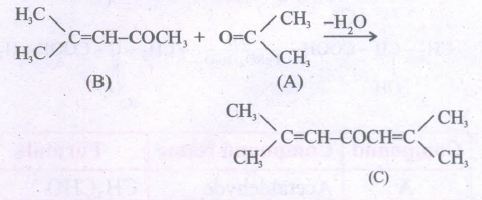
An organic compound (A) with molecular formula C3H6O undergoes iodoform reaction. Two molecules of compound (A) react with dry HCI to give compound (B) (C6H10O). Compound (B) reacts with one more molecule of compound (A) to give compound (C) (C9H14O). Identify (A), (B) and (C). Explain the reactions.
2.
Give two tests for aldehydes.
3.
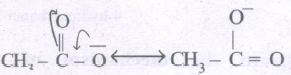
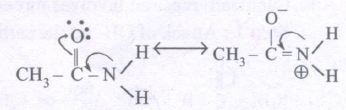
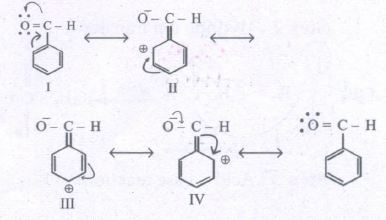
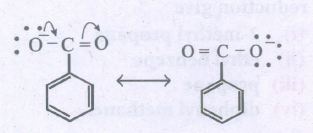
Draw resonance structures for the following
(i) CH3COO-
(ii)CH3CONH2
(iii) C6HsCHO
(iv) C6H5COO-
4.
Explain the classification of hormones.
5.
Explain the classification of polymers based on their structure and mode of synthesis.
6.
An organic compound (A) of molecular formula C3H8O2 is obtained as by-product in the manufacture of soap. Compound (A) on heating with P2O5 gives an unsaturated compound (B) of molecular formula C3H4O. Compound (A) with well cooled mixture of Conc.H2SO4 and fuming HNO3 form compound (C) which is an explosive. Identify A, B and C and explain the rection.
7.
How do primary, secondary and tertiary amines react with nitrous acid?
8.
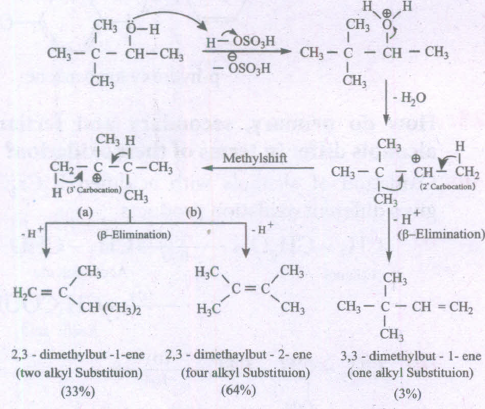
What is major product formed when 3,3-dimethyl-2-butanol is heated in the presence of H2SO4.
9.
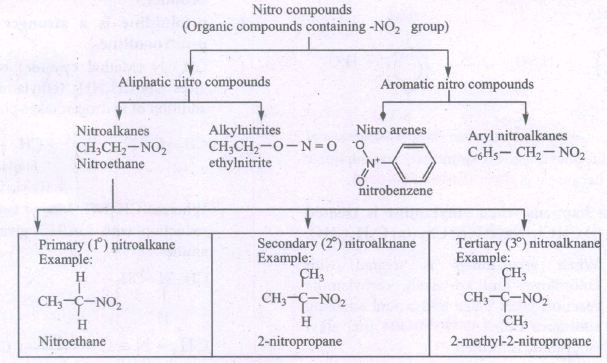
Draw a flow chart to show classification of nitro compound giving examples for each type.
10.
Ail organic compound (A) C3H8O answers Lucas test within 5-10 minutes and on oxidation forms B (C3H6O). This on further oxidation forms C(C2H4O2) which gives effervescence with Na2 CO3 Balso undergoes iodoform reaction. Identify A, B and C. Explain the conversion of A to B and C.
11.
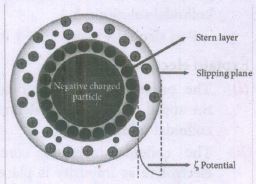
Explain the electrical property of colloids with a neat diagram. (or) Write a note on Helmholta electrical double layer.
12.
Write the characteristics of catalysts.
13.
Derive a relationship between dissociation constant Ka and molar conductivity \({ \Lambda }_{ m }\)
14.
Derive Henderson - Hasselbalch equation
15.
Calculate the pH of a buffer mixture which contains 7.5 gms if acetic acid and 10.25 gms of sodium acetate in 1 litre of the solution. Ka for acetic acid is 1.8 x 10⁻⁵.
16.
The conversion of molecules x to y follows second order kinetics. Its concentration of x is increased to three times how will it affect the rate of formation of y?
For the reaction x ➝ y as it follows second order kinetics wherefore the rate of formation of y?
17.
Write a short note on the oxidation states of 3d series elements.
18.
An element 'A' occupies group number 15 and period number 3. It reacts with chlorine to give B which further reacts with chlorine to give C at 273K. Both B and C are chlorinating agents for organic compounds. C is a better chlorinating agent because it chlorinates metals also. Breasts with SO3 and reduces it to SO2 B has a pyramidal shape. C has trigonal bipyramidal shape by sp3d hybridisation. Identify the element A and the compounds B and C. Write the reactions.
19.
How does sulphuric acid react with metals at various conditions.
20.
Why is dioxygen a gas but sulphur a solid?
21.
How can you determine the atomic mass of an unknown metal if you know its density and the dimension of its unit cell? Explain.
22.
How are silicates classified? Give an example for each type of silicate.
23.
What is zone refining? Describe the principle involved in the purification of the metal by this method.
24.
How are metal carbonyls classified depending on the number of metal atoms?
25.
Give the postulates and limitation of Werner's theory of co-ordination compounds.
26.
Write the Nernst equation for the half cell Zn2+(aq)/ Zn(s)
1.
(i) Compound (A) with molecular formula C3H6O that undergoes iodoform reaction is CH3COCH3 (A) (acetone).
(ii) Two molecules of (A) react with dry HCl to give compound (B).

(iii) Compound (B) reacts with (A) to give compound (C).
| Compound | Compound Name | Formula |
| A | Acetone | 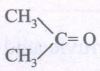 |
| B | Mesityl oxide | 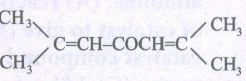 |
| C | Phorone | 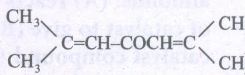 |
2.
(i) Tollens Reagent Test: Tollens reagent is an ammoniacal silver nitrate solution. When an aldehyde is warmed with Tollens reagent a bright silver mirror is produced due to the formation of silver metal. This reaction is also called silver mirror test for aldehydes.
\({ CH }_{ 3 }CHO+2\left[ Ag\left( { NH }_{ 3 } \right) _{ 2 } \right] ^{ + }+3{ OH }^{ - }\longrightarrow { CH }_{ 3 }CO{ O }^{ - }+\underset { Silver\ mirror }{ 4{ NH }_{ 3 }+2Ag+2{ H }_{ 2 }O } \)
(ii) Fehlings solution Test:
(a) Fehling's solution is prepared by mixing equal volumes of Fehlings solution A containing aqueous copper sulphate and Fehlings solution 'B' containing alkaline solution of sodium potassium tartarate (Rochelle salt).
(b) When aldehyde is warmed with Fehlings solution deep blue colour solution is changed to red precipitate of cuprous oxide.
\(\\ \\ { CH }_{ 3 }CHO+\underset { blue }{ 2{ Cu }^{ 2 } } +5{ OH }^{ - }\longrightarrow { CH }_{ 3 }{ COO }^{ - }+\underset { red }{ { Cu }_{ 2 }O\downarrow } +3{ H }_{ 2 }O\)
(iii) Schiffs' reagent Test: Dilute solution of aldehydes when added to Schiff's reagent (Rosaniline hydrochloride dissolved in water and its red colour decolourised by passing SO2) yields its red colour. This is known as Schiff's test for aldehydes. Ketones do not give this test. Acetone however gives a positive test but slowly.
3.
(i) CH3COO-
(ii) CH3CONH2
(iii) C6HsCHO
(iv) C6H5COO-
4.
(i) Hormones are classified according to the distance over which they act as, endocrine, paracrine and autocrine hormones.
(ii) Endocrine hormones act on cells distant from the site of their release. Example: insulin and epinephrine are synthesized and released in the bloodstream by specialized ductless endocrine glands.
(iii) Paracrine hormones (alternatively, local mediators) act only on cells close to the cell that released them. For example, interleukin -1 (IL-1) Autocrine hormones act on the same cell that released them. For example, protein growth factor interleukin-2 (IL-2).
5.
(i) Structure:
(a) Linear polymers (long continuous chain) E.g. HDPE, PVC
(b) Branched polymers (one main chain with small chains as branches) E.g. polypropylene, LDPE.
(c) Cross linked polymers (linking of chain polymers) E.g. bakelite, melamine, formaldehyde
(ii) Mode of synthesis:
(a) Addition polymers. Formed by polymerisation of monomers without the elimination of byproduct. E.g. polyethylene, PVC, teflon.
(b) Condensation Polymer formed by the condensation of two or more monomers with the elimination of simple molecules like H2O, NH3, etc., E.g. Nylon:6-6, polyester.
6.
(i) Compound (A) with molecular formula C3H8O3 is glycerol.
(ii) Glycerol on heating with P2O5 gives an unsaturated compound (B).
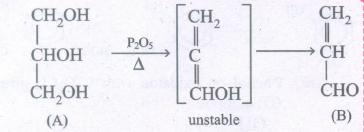
(iii) Glycerol with cooled mixture of cone. H2SO4 and fuming HNO3 form compound (C).
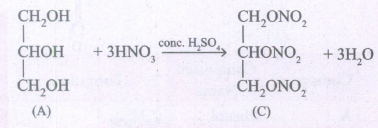
| Compound | Compound Name | Formula |
| A | Glycerol | \(\overset { CH_{ 2 }OH }{ \underset { \overset { CHOH }{ \underset { { CH }_{ 2 }OH }{ | } } }{ | } } \) |
| B | Acrolein | \(\overset { CH_{ 2 } }{ \underset { \overset { CH }{ \underset { { CH }O }{ | } } }{ || } } \) |
| C | Nitroglycerine | \(\overset { CH_{ 2 }O{ NO }_{ 2 }\quad }{ \underset { \overset { CHO{ NO }_{ 2 } }{ \underset { { CH }_{ 2 }O{ NO }_{ 2 } }{ | } } }{ | } } \) |
7.
(i) Primary amine react with nitrous acid to form alcohols and nitrogen gas
\(\underset { primary \ amine }{ { CH }_{ 3 }NH_{ 2 } } \rightarrow \underset { unstable }{ { [{ CH } }_{ 3 }-N=N-OH] } \rightarrow { CH }_{ 3 }OH+{ N }_{ 2 }\)
Aliphatic diazonium compound is unstable because of absence of resonance stabilisation.
(ii) Secondary amines react with nitrous acid to form N-nitroso amines which are water insoluble yellow oils.
\(\underset { Secondary \ amine }{ { { (CH }_{ 3 } })_{ 2 }NH } +HO-N=O\rightarrow \underset { N-nitroso \ dimethy \ amine-yellow \ oil\\ (insolube \ in \ water) }{ { (CH }_{ 3 })_{ 2 }N-N=O } \)
(iii) Tertiary amine react with nitrous acid to form trialkyl ammonium nitrite salts which are soluble in water
\(\underset { Tertiary \ amine }{ { (CH }_{ 3 })_{ 2 }N } +HONO\rightarrow \underset { trimethyl \ ammonium \ nitrite\\ (salt \ soluble \ in \ water) }{ { { (CH }_{ 3 }) }_{ 3 }{ NH }^{ + }{ NO }_{ 2 }^{ - } } \)
8.
Saytzeff's rule: During intramolecular dehydration, if there is a possibility to form a carbon-carbon double bond at different locations, the preferred location is the one that gives the more (highly) substituted alkene l.e., the stable alkene.
For example, the dehydration of 3,3 - dimethyl - 2- butanol gives a mixture of alkenes. The secondary carbocation formed in this reaction undergoes rearrangement to form a more stable tertiary carbocation.
9.
Classification of nitro compounds
10.
(i) Isopropyl alcohol (A).
(ii) (B) on oxidation gives (B)
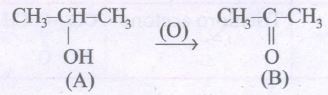
(B) On further oxidation gives (C) which gives brisk efferescencewith Na2CO3.
\({ CH }_{ 3 }-\underset { \overset { || }{ \underset { (B) }{ O } } }{ C } -{ CH }_{ 3 }+{ I }_{ 2 }+KOH\longrightarrow \underset { (C) }{ { CH }I_{ 3 }+{ CH }_{ 3 }COOH } \)
| Compuund | Compound Name | Formula |
| A | Isopropyl alcohol | \({ CH }_{ 3 }-\underset { \overset { | }{ OH } }{ CH } -{ CH }_{ 3 }\) |
| B | Acetone | \({ CH }_{ 3 }-\underset { \overset { || }{ O } }{ C } -{ CH }_{ 3 }\) |
| C | Acetic acid | CH3COOH |
11.
Helmholtz double layer:
(i) The surface of colloidal particle adsorbs one type of ion due to preferential adsorption.
(ii) This layer attracts the oppositely charged < ions in the medium and hence at the boundary separating the two electrical double layers are setup.
(iii) This is called as Helmholtz electrical double layer.
(iv) As the particies nearby are having similar: charges, they cannot come close and condense.
12.
(i) For a chemical reaction, catalyst is needed in very small quantity.
(ii) There may be some physical changes, but the catalyst remains unchanged in mass and chemical composition in a chemical reaction.
(iii) A catalyst itself cannot initiate a reaction.
(iv) A solid catalyst will be more effective if it is taken in a finely divided form.
(v) A catalyst are specific in nature.
(vi) In an equilibrium reaction, presence of catalyst reduces the time for attainment of equilibrium and hence it does not affect the position of equilibrium and the value of equilibrium constant.
(vii) A catalyst is highly effective at a particular temperature called as optimum temperature.
(viii) Presence of a catalyst generally does not change the nature of products
13.
According to Ostwald dilution Law,
\({ K }_{ a }=\frac { { \alpha }^{ 2 }C }{ (1-\alpha ) } \) ...(1)
Substitute a value in the above expression (1)
\({ K }_{ a }=\frac { { \Lambda }_{ m }^{ 2 }C }{ { \Lambda }_{ m }^{ 2 }\left( 1-\frac { { \Lambda }_{ m } }{ { \Lambda }_{ m }^{ o } } \right) } \)
\({ K }_{ a }=\frac { { \Lambda }_{ m }^{ 2 }C }{ { \Lambda }_{ m }^{ 2 }\frac { { \Lambda }_{ m }^{ o }-{ \Lambda }_{ m } }{ { \Lambda }_{ m }^{ o } } } \)
⇒ \({ K }_{ a }=\frac { { \Lambda }_{ m }^{ 2 }C }{ { \Lambda }_{ m }^{ 2 }{ (\Lambda }_{ m }^{ o }-{ \Lambda }_{ m }) } \)
14.
(i) The concentration of hydronium ion in an acidic buffer solution depends on the ratio of the concentration of the weak acid to the concentration of its conjugate base present in the solution i.e.,
\(\left[ { H }_{ 3 }{ O }^{ + } \right] ={ K }_{ a }\frac { [{ acid] }_{ aq } }{ [{ base] }_{ aq } } \)
(ii) The weak acid is dissociated only to a small extent. Moreover, due to common ion effect, the dissociation is further suppressed and hence the equilibrium concentration of the acid is nearly equal to the initial concentration of the unionised acid. Similarly, the concentration of the conjugate base is nearly equal to the initial concentration of the added salt.
\(\left[ { H }_{ 3 }{ O }^{ + } \right] ={ K }_{ a }\frac { [{ acid] } }{ [{ salt] } } \)
(iii) Here [acid] and [salt] represent the initial concentration of the acid and salt, respectively used to prepare the buffer solution
Taking logarithm on both sides of the equation
\(\log\left[ { H }_{ 3 }{ O }^{ + } \right] ={ \log K }_{ a }+\log\frac { [{ acid] } }{ [{ salt] } } \)
reverse the sign on both sides
- \(\log\left[ { H }_{ 3 }{ O }^{ + } \right] ={- \log K }_{ a }-\log\frac { [{ acid] } }{ [{ salt] } } \)
We know that
pH = -log [H3O+] and pKa = -log Ka
\(\Rightarrow pH={ pK }_{ a }-\log\frac { [{ acid] } }{ [{ salt] } } \)
\(\Rightarrow pH={ pK }_{ a }+\log\frac { [{ acid] } }{ [{ salt] } } \)
Similarly for a basic buffer,
pOH = \({ pK }_{ a }+\log\frac { [{ acid] } }{ [{ salt] } } \)
15.
\(pH={ pK }_{ a }+{ \log }\frac { [salt] }{ [acid] } \)
The concentration of the salt and the acid should be in moles/lit.
Number of moles of acetic acid
= \(\frac{weight \ of \ acetic \ acid}{molecular \ weight \ of \ acetic \ acid}=\frac{7.5}{60}\)
Number of moles of sodium acetate
= \(\frac{weight \ of \ sodium \ acetate}{molecular \ weight \ of \ sodium acetate}=\frac{10.25}{82}\)
pKa = -log Ka
= -Iog 1.8 x 10⁻⁵
\(=log\frac { 1 }{ 1.8\times { 10 }^{ -5 } } \)
= log 1 - log 1.8 - log 10-5
= 5 - 0.2553 = 4.7447
\(\therefore pH=4.7447+\log\frac { 0.12 }{ 0.08 } \)
pH = 4.7447.
16.
Rate = k [x]2 = ka2
[x] = a mol-1
If the concentration of x is in cross three time, then
(x) = 3a mol L-1
Rate = R(3a)2 = 9 ka2
Hence, the rate of formation will increase by 9 times.
17.
(i) The first transition metal Scandium exhibits only +3 oxidation state, but all other transition elements exhibit variable oxidation states by loosing electrons from (n-1)d orbital and ns orbital as the energy difference between them is very small.
(ii) At the beginning of the series, +3 oxidation state is stable but towards the end +2 oxidation state becomes stable.
(iii) The number of oxidation states increases with the number of electrons available, and it decreases as the number of paired electrons increases.
(iv) Hence, the first and last elements show less number of oxidation states and the middle elements with more number of oxidation states.
(v) For example, the first element Sc has only one oxidation state +3; the middle element Mn has six different oxidation states from +2 to +7. The last element Cu shows +1 and +2 oxidation states only.
(vi) The relative stability of different oxidation - states of 3d metals is correlated with the extra stability of half filled and fully filled electronic configurations. Example: Mn2+(3d5) is more stable than Mn4+(3d3).
18.
(i) The element which occupies group number 15 and period number 3 is phosphorus. Therefore A is phosphorus. Phosphorus reacts with chlorine to give PCI3There fore compound B is phosphorus trichloride and it has a pyramidal shape.
P4 + 6Cl2 \(\longrightarrow \) 4PCl3
PCl3 further reacts with Cl2 to give PCl5
Therefore, the compound C is phosphorus pentachloride and it has a trigonal bipyramidal shape.
PCI + CI\(\longrightarrow \) PCI
Thus, A= Phosphorus
B = Phosphorus trichloride (PCI3)
C = Phosphorous pentachloride (PCI5)
19.
Reaction with metals:
(i) Sulphuric acid reacts with metals and gives different product depending on the reactants and reacting condition
(ii) Dilute sulphuric acid reacts with metals like: tin, aluminium, zinc to give corresponding: sulphates.
Zn + H2SO4\(\longrightarrow \) ZnSO4 + H2 \(\uparrow \)
2AI + 3H2SO4 \(\longrightarrow \) Al2(SO4)3+ 3H2 \(\uparrow \)
(iii) Hot concentrated sulphuric acid reacts with copper and lead to give the respective sulphates as shown below
Cu + 2H2SO4 \(\longrightarrow \) CuSO4 + 2H2O + SO2\(\uparrow \)
Pb + 2H2SO4 \(\longrightarrow \) PbSO4 + 2H2O + SO2\(\uparrow \)
(iv) Sulphuric acid doesn't react with noble metals like gold, silver and platinum.
20.
(i) O2 molecules are held together by weak Vander Waal's force because of small size and high electronegativity of oxygen.
(ii) In contrast, sulphur shows catenation and forms stronger S-S bonds.
(iii) Due to catenation, sulphur forms octa-atomic S8 molecules having eight membered puckered ring structure.
(iv) Because of its bigger size the force of attraction holding S8 molecules are much stronger.
(v) Hence sulphur is a solid at room temperature or in other words, that is why there is a large difference between the boiling point (also melting points) of the two elements.
21.
(i) By knowing the density of an unknown metal and the dimension of its unit cell, the atomic mass of the metal can be: determined.
(ii) Let 'a' be the edge length of a unit cell of a crystal, 'd' be the density of the metal, 'm' be the atomic mass of the metal and 'z' be the number of atoms in the unit cell.
(iii) Now,
Density of the unit cell
\(=\frac{Mass\ of\ the\ unit\ cell}{Volume\ of\ the\ unit\ cell}\)
\(d=\frac{Z\times m}{a^3}\) ...(1)
[Since, mass of the unit cell = Number of atoms in the unit cell x Atomic mass]
[Volume of the unit cell = (edge length of the cubic unit cell)3]
(iv) From equation (1), We have
\(m=\frac{d\times a^3}{Z}\) ....(2)
(v) Now,
Mass of the metal (M) \(=\frac{Atomic\ mass(M)}{Avogadro's\ number(N_A)}\)
M=\(\frac{d\times a^3 \times N_A}{Z}\)
(vi) From equation (3), we can determine the atomic mass of the unknown metal.
22.
Silicates are classified into various types based on the way in which the tetrahedral units, [SiO4]4- are linked together.
(i) Ortho silicates (Neso silicates):
The simplest silicates which contain discrete [SiO4]4- tetrahedral units are called ortho silicates or nesosilicates.
Examples: Phenacite - Be2SiO4 (Be2+ ions are tetrahedrally surrounded by O2- ions)
(ii) pyro silicate (or) Soro silicates: Silicates:
Which contain [Si2O7]6- ions are called pyro silicates (or) Soro silicates.
Example: Thortveitite - Sc2Si2O7
(iii) Cyclic silicates (or Ring silicates):
Silicates which contain (SiO3)32n- ions which are formed by linking three or more tetrahedral SiO44- units cyclically are called cyclic silicates.
Example: Beryl [Be3Al2 (SiO3)6] (an aluminosilicate with each aluminium is surrounded by 6 oxygen atoms octahedrally)
(iv) Inosilicates: Silicates which contain 'n':
number of silicate units liked by sharing two or more oxygen atoms are called inosilicates.
Example: They are further classified as chain silicates and double chain silicates.
(v) Chain silicates (or pyroxenes):
These silicates contain [(SiO3)n]2n- ions formed: by linking 'n' number of tetrahedral [SiO4]4- units linearly. Each silicate unit shares two of its oxygen atoms with other units.
Example: Spodumene - LiAl(SiO3)2·
(vi) Double chain silicates (or amphiboles):
These silicates contains \(\left[ { Si }_{ 4 }{ O }_{ 11 } \right] _{ n }^{ 6n- }\) ions. In these silicates there are two different types of tetrahedra:
(a) Those sharing 3 vertices
(b) those sharing only 2 vertices.
Example:
Asbestos: These are fibrous and non-combustible silicates.
(vii) Sheet or phyllo silicates:
Silicates which contain \(({ Si }_{ 2 }{ O }_{ 5 })_{ n }^{ 2n- }\) are called sheet or phyllo silicates. In these, Each [SiO4]4- tetrahedron unit shares three oxygen atoms with others and thus by forming two dimensional sheets.
Example: Talc, Mica etc.
(viii) Three dimensional silicates (or tectosilicates):
Silicates in which all the oxygen atoms of [SiO4]4- tetrahedra are shared with other tetrahedra to form three dimensional network are called three dimensional or tectosilicates.
Example: Quartz.
23.
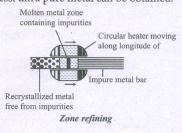
Zone refining:
This method is employed for preparing highly pure metal (such as silicon, tellurium, germanium), which are used as semiconductors. It is based on the principle that melting point of a substance is lowered by the presence of impurities. Consequently, when an impure molten metal is cooled, crystals of the pure metal are solidified, and the impurities remain behind the remaining metal.
The process consists In casting the impure metal in the form of a bar. A circular heater fitted around this bar is slowly moved longitudinally from one end to the other. At the heated zone, the bar melts, and as the heater moves on, pure metal crystallizes, while the impurities pass into the adjacent molten part In this way, the impurities are swept from one end of the bar to the other. By repeating the process, ultra pure metal can be obtained.
24.
Metal carbonyls are classified in two different ways as described below Classification based on the number of metal atoms present.
a. Mononuclear carbonyls
These compounds contain only one metal atom. For example, [Ni(CO)4] - nickel tetracarbonyl is tetrahedral, [Fe(CO)5] - Iron pentacarbonyl is trigonal bipyramidal, and [Cr(CO)6] - Chromium hexacarbonyl is octahedral.
b. Polynuclear carbonyls
Metallic carbonyls containing two or more metal atoms are called polynuclear carbonyls. Polynuclear metal carbonyls may be Homonuclear [Co2(CO)8], [Mn2(CO)10], [Fe3 (CO)12] or heteronuclear [MnCo(CO)9], [MnRe(CO)10] etc.
25.
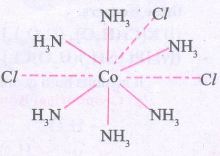
(i) Every metal atom has two types of valencies Primary valency or ionisable valency Secondary valency or non ionisable valency
(ii) The primary valency corresponds to the oxidation state of the metal ion. It is always satisfied by negative ions.
(iii) Secondary valency corresponds to the coordination number of the metal ion or atom. It is satisfied by either negative ions or neutral molecules.
(iv) The molecules or ions that satisfy secondary valencies are called ligands.
(v) The ligands which satisfy secondary valencies must project in definite directions in space. So the secondary valencies are directional in nature whereas the primary valencies are non - directional in nature.
(vi) The ligands have unshared pair of electrons. These unshared pair of electrons are donated to central metal ion or atom in a compound. Such compounds are called coordination compounds.
Werner's representation
Eg: [Co(NH)6]Cl3
Cl: primary valency (dotted lines)
NH3: secondary valency (solid lines).
Defects of Werner's theory
Werner's theory describes the structures of many co-ordination compounds successfully. However, it does not explain the magnetic and spectral properties.
26.
E = EO- 2.303 \(\frac { RT }{ 2F } \) log Zn2+
EZn2+/Zn = EZn2+/ Zn- 2.303 \(\frac { RT }{ 2F } \) log [Zn2+]

12th Standard Syllabus & Materials
12th Standard
TN 12th Computer Applications களப்பெயர் முறைமை (DNS) Sample Question Papers Study Material - QB365 Set A
NEW12th Standard
TN 12th Computer Applications வலையமைப்பு எடுத்துக்காட்டுகள் மற்றும் நெறிமுறைகள் Sample Question Papers Study Material - QB365 Set A
NEW12th Standard
TN 12th Computer Applications கணினி வலையமைப்பு ஓர் அறிமுகம் Sample Question Papers Study Material - QB365 Set A
NEW12th Standard
TN 12th Computer Applications PHP-உடன் MySQL-ஐ இணைத்தல் Sample Question Papers Study Material - QB365 Set A



Tamilnadu Stateboard 12th Standard Subjects

Maths
Chemistry

Physics

Biology

Computer Science

Business Maths and Statistics

Economics

Commerce

Accountancy

History

Computer Applications
Biology
Computer Technology
Computer Applications
Computer Science
Business Maths and Statistics
Commerce
Economics
Maths
Chemistry
Physics
Computer Technology
History
Accountancy

Tamil

English

French
Tamilnadu Stateboard Standards
