
 100% FREE ACCESS
12th Standard Syllabus & Materials
12th Standard
TN 12th Maths Applications of Matrices and Determinants Sample Question Papers Study Material - QB365 Set A
NEW12th Standard
TN 12th Computer Applications மின்னணு தரவு பரிமாற்றம் Sample Question Papers Study Material - QB365 Set A
NEW12th Standard
TN 12th Computer Applications மின் - வணிக பாதுகாப்பு அமைப்புகள் Sample Question Papers Study Material - QB365 Set A
NEW12th Standard
TN 12th Computer Applications மின்னணு செலுத்தல் முறைகள் Sample Question Papers Study Material - QB365 Set A
NEW12th Standard
TN 12th Computer Applications மின் - வணிகம் Sample Question Papers Study Material - QB365 Set A
NEW12th Standard
TN 12th Computer Applications திறந்த மூல கருத்துருக்கள் Sample Question Papers Study Material - QB365 Set A

Published on: 02/09/2022
QB365 provides a detailed and simple solution for every Possible Creative Questions in Class 12 Chemistry Subject - Ionic Equilibrium, English Medium. It will help Students to get more practice questions, Students can Practice these question papers in addition to score best marks.
Download Tamil Nadu 12th Standard Chemistry question papers, model tests, one-mark questions, important questions, and public exam papers in PDF format. Free study materials and answer keys for TN State Board students.
Questions + Answers key
Take MCQ Chemistry Test
1.
Derive the expression for pH of the hydrolysis of the salt of
a) A strong base and a weak acid
b) A strong acid and a weak base
c) A weak acid and a weak base
a) A strong base and a weak acid
2.
Write note on Lewis concepts of acids and bases.
3.
Explain Lewis theory of acids and bases.
4.
Prove that: pH + pOH =14 at 25oC.
5.
Derive the relation between pH and pOH.
6.
What are the two types of buffer solution? Give example for each type.
7.
Write the pH value of the following substances:
A) Vinegar
B) Black coffee
C) Baking soda
D) Soapy water
8.
What do you mean by buffer action?
9.
What is Henderson equation?
10.
For an aqueous solution of NH4CI, prove that [H+] = \(\sqrt { { K }_{ n }.C } \)
11.
How will you calculate solubility product from molar solubility?
12.
Define buffer Index
13.
What do you mean by auto ionisation of water?
14.
Based on Arrhenius concept, defame acid and bases and give an example for each.
15.
A buffer solution containing 0.1 mole of ammonium hydroxide and 0.15 mole of ammonium chloride per litre of the solution. Calculate the pH of the buffer solution. Kb for ammonium hydroxide is 1.8 x 10⁻⁵.
1.
\(\mathrm{pH} +\mathrm{pOH}=14 \)
\(\mathrm{pH} =14-\mathrm{pOH} \)
\(=14-\left(-\log _{10}\left[\mathrm{OH}^{-}\right]\right) \)
\(=14+\log _{10}\left[\mathrm{OH}^{-}\right] \)
\(\mathrm{pH}=14+\log \left(\mathrm{K}_{\mathrm{h}} \cdot \mathrm{C}\right)^{1 / 2}\left[\because\left(\mathrm{OH}^{-}\right)=\sqrt{\mathrm{K}_{\mathrm{h}} \cdot \mathrm{C}}\right] \)
\(\mathrm{pH}=14+\log \left(\frac{\mathrm{K}_{w}}{\mathrm{~K}_{\mathrm{a}}} \cdot \mathrm{C}\right)^{1 / 2}\left[\because \mathrm{K}_{\mathrm{h}}=\frac{\mathrm{K}_{\mathrm{w}}}{\mathrm{K}_{\mathrm{a}}}\right] \)
\(\mathrm{pH}=14+1 / 2 \log \mathrm{K}_{\mathrm{w}}+1 / 2 \log \mathrm{C}-1 / 2 \log \mathrm{K}_{\mathrm{a}}\)
As \(1 / 2 \log \mathrm{K}_{\mathrm{w}}=1 / 2 \log 10^{-14}=-14 / 2 \log 10=-7 \quad\left[\because \mathrm{K}_{\mathrm{w}}=10^{-14}\right]\)
So eqn (4) becomes
\(\mathrm{pH}=14-7+1 / 2 \log \mathrm{C}-1 / 2 \log \mathrm{K}_{\mathrm{a}} \)
\(\text { As }-\log \mathrm{K}_{\mathrm{a}}=\mathrm{pK}_{\mathrm{a}} \)
\(\mathrm{pH}=7+1 / 2 \log \mathrm{C}+1 / 2 \mathrm{pK}_{\mathrm{a}} \)
\(\mathrm{pH}=7+1 / 2 \mathrm{pK}_{\mathrm{a}}+1 / 2 \log \mathrm{C}\)
b) A strong acid and a weak base
\(\mathrm{pH}=-\log \left[\mathrm{H}^{+}\right] \)
\({\left[\mathrm{H}^{+}\right]=\sqrt{\mathrm{K}_{\mathrm{h}} \cdot \mathrm{C}}=\sqrt{\frac{\mathrm{K}_{\mathrm{w}}}{\mathrm{K}_{\mathrm{b}}} \cdot \mathrm{C}}=\left(\frac{\mathrm{K}_{w} \cdot \mathrm{C}}{\mathrm{K}_{\mathrm{b}}}\right)^{1 / 2}}\)
So. Eqn (1) becomes
\(\mathrm{pH}=-\log \left(\frac{\mathrm{K}_{\mathrm{w}} \cdot \mathrm{C}}{\mathrm{K}_{\mathrm{b}}}\right)^{1 / 2} \)
\(\mathrm{pH}=-1 / 2 \log \mathrm{K}_{\mathrm{w}}-1 / 2 \log \mathrm{C}+1 / 2 \log \mathrm{K}_{\mathrm{b}} \)
\(\text { As }-1 / 2 \log \mathrm{K}_{\mathrm{w}}=-1 / 2 \log 10^{-14}=14 / 2 \log 10=7 \)
\(1 / 2 \log \mathrm{K}_{\mathrm{b}}=-1 / 2 \mathrm{pK} \quad\left(\because-\log \mathrm{K}_{\mathrm{b}}=\mathrm{pK}_{\mathrm{b}}\right)\)
So. Eqn (3) becomes
\(\mathrm{pH}=7-1 / 2 \log \mathrm{C}-1 / 2 \mathrm{pK}_{\mathrm{b}} \)
\(\mathrm{pH}=7-1 / 2 \mathrm{pK}_{\mathrm{b}}-1 / 2 \log \mathrm{C}\)
c) A weak acid and a weak base
\(\mathrm{pH}=-\log _{10}^{\cdot}\left[\mathrm{H}^{+}\right] \)
\(As \left[\mathrm{H}^{+}\right]=\mathrm{K}_{\mathrm{a}} \cdot \mathrm{h} \)
\(\left[\mathrm{H}^{+}\right]=\mathrm{K}_{\mathrm{a}} \cdot \sqrt{\mathrm{K}_{\mathrm{h}}} \)
\(\left(\because h=\sqrt{\mathrm{K}_{\mathrm{h}}}\right) \)
\(\left[\mathrm{H}^{+}\right]=\mathrm{K}_{\mathrm{a}} \cdot \sqrt{\frac{\mathrm{K}_{\mathrm{w}}}{\mathrm{K}_{\mathrm{a}} \cdot \mathrm{K}_{\mathrm{b}}}} \)
\((2) \left(\because \mathrm{K}_{\mathrm{h}}=\frac{\mathrm{K}_{\mathrm{w}}}{\mathrm{K}_{\mathrm{a}} \cdot \mathrm{K}_{\mathrm{b}}}\right) \)
\(\left[\mathrm{H}^{+}\right]=\sqrt{\frac{\mathrm{K}_{\mathrm{a}} \cdot \mathrm{K}_{\mathrm{w}}}{\mathrm{K}_{\mathrm{b}}}}=\left(\frac{\mathrm{K}_{\mathrm{a}} \cdot \mathrm{K}_{\mathrm{w}}}{\mathrm{K}_{\mathrm{b}}}\right)^{1 / 2}\)
Sub. (3) in (1)
\(\mathrm{pH}=-\log \left(\frac{\mathrm{K}_{\mathrm{a}} \cdot \mathrm{K}_{\mathrm{w}}}{\mathrm{K}_{\mathrm{b}}}\right)^{1 / 2} \)
\(\mathrm{pH}=-1 / 2 \log \mathrm{K}_{\mathrm{a}}-1 / 2 \log \mathrm{K}_{\mathrm{w}}+1 / 2 \log \mathrm{K}_{\mathrm{b}}\)
As \(a) 1 / 2 \log \mathrm{K}_{\mathrm{w}}=1 / 2 \log 10^{-14}=-14 / 2 \log 10=-7\)
\(b) -1 / 2 \log \mathrm{K}_{\mathrm{a}}=1 / 2 \mathrm{pK} \)
\(c) -1 / 2 \log \mathrm{K}_{\mathrm{b}}=1 / 2 \mathrm{pK}_{\mathrm{b}} \Rightarrow 1 / 2 \log \mathrm{K}_{\mathrm{b}}=-1 / 2 \mathrm{pK}_{\mathrm{b}}\)
Eqn. (4) becomes
\(\mathrm{pH}=1 / 2 \mathrm{pK}_{\mathrm{a}}-(-7)-1 / 2 \mathrm{pK}_{\mathrm{b}}\)
(Or)
\(\mathrm{pH}=7+1 / 2 \mathrm{pK}_{\mathrm{a}}-1 / 2 \mathrm{pK}_{\mathrm{b}}\)
2.
(i) According to Lewis (1923), an acid is a species that accepts an electron pair while base is a species that donates an electron pair. We call such species as Lewis acids and bases.
(ii) A Lewis acid is a positive ion (or) an electron deficient molecule and a Lewis base is a anion (or) neutral molecule with at least one lone pair of electrons.
(iii) Let us consider the reaction between Boron tri fluoride and ammonia
.JPG)
(iv) Here, boron has a vacant 2p orbital to accept the lone pair of electrons donated by ammonia to form a new coordinate covalent bond.
(v) In coordination compounds, the Ligands act as a lewis base and the central metal atom or ion that accepts a pair of electrons from the ligand behaves as a Lewis acid.
3.
(i) According to Lewis (1923), an acid is a species that accepts an electron pair while base is a species that donates an electron pair. We call such species as Lewis acids and bases.
(ii) A Lewis acid is a positive ion (or) an electron deficient molecule and a Lewis base is a anion (or) neutral molecule with at least one lone pair of electrons.
(iii) Let us consider the reaction between Boron tri fluoride and ammonia
(iv) Here, boron has a vacant 2p orbital to accept the lone pair of electrons donated by ammonia to form a new coordinate covalent bond.
(v) In coordination compounds, the Ligands act as a lewis base and the central metal atom or ion that accepts a pair of electrons from the ligand behaves as a Lewis acid.
4.
A relation between pH and pOH can be established using their following definitions
\(\mathrm{pH} =-\log _{10}\left[\mathrm{H}_{3} \mathrm{O}^{+}\right] \) ..........(1)
\(\mathrm{pOH} =-\log _{10}\left[\mathrm{OH}^{-}\right]\) ..........(2)
Adding equation (1) and (2)
\(\mathrm{pH}+\mathrm{pOH} =-\log _{10}\left[\mathrm{H}_{3} \mathrm{O}^{+}\right]-\log _{10}\left[\mathrm{OH}^{-}\right] \)
\(=-\left(\log _{10}\left[\mathrm{H}_{3} \mathrm{O}^{+}\right]+\log _{10}\left[\mathrm{OH}^{-}\right]\right)\)
\(\mathrm{pH}+\mathrm{pOH}=-\log _{10}\left[\mathrm{H}_{3} \mathrm{O}^{+}\right]\left[\mathrm{OH}^{-}\right]\)
\([\because \log a+\log b=\log a b]\)
We know that \(\left[\mathrm{H}_{3} \mathrm{O}^{+}\right]\left[\mathrm{OH}^{-}\right]=\mathrm{K}_{\mathrm{w}}\)
\(\Rightarrow \mathrm{pH}+\mathrm{pOH}=-\log _{10} \mathrm{~K}_{\mathrm{w}}\)
\(\Rightarrow \mathrm{pH}+\mathrm{pOH}=\mathrm{pK}_{\mathrm{w}}\)
(3) \(\left[\because \mathrm{pK}_{\mathrm{w}}=-\operatorname{Iog}_{10} \mathrm{~K}_{\mathrm{w}}\right]\)
At 25oC, the ionic product of water, \(\mathrm{K}_{\mathrm{w}}=1 \times 10^{-14}\)
\(\mathrm{pK}_{\mathrm{w}}=-\log _{10} 10^{-14}=14 \log _{10} 10=14 \)
\(\therefore(3) \Rightarrow \mathrm{At} 25^{\circ} \mathrm{C}, \mathrm{pH}+\mathrm{pOH}=14\)
5.
A relation between pH and pOH can be established using their following definitions
\(\mathrm{pH} =-\log _{10}\left[\mathrm{H}_{3} \mathrm{O}^{+}\right] \) .............(1)
\(\mathrm{pOH} =-\log _{10}\left[\mathrm{OH}^{-}\right]\) ............(2)
Adding equation (1) and (2)
\(\mathrm{pH}+\mathrm{pOH} =-\log _{10}\left[\mathrm{H}_{3} \mathrm{O}^{+}\right]-\log _{10}\left[\mathrm{OH}^{-}\right] \)
\(=-\left(\log _{10}\left[\mathrm{H}_{3} \mathrm{O}^{+}\right]+\log _{10}\left[\mathrm{OH}^{-}\right]\right)\)
\(\mathrm{pH}+\mathrm{pOH}=-\log _{10}\left[\mathrm{H}_{3} \mathrm{O}^{+}\right]\left[\mathrm{OH}^{-}\right]\)
\([\because \log a+\log b=\log a b]\)
We know that \(\left[\mathrm{H}_{3} \mathrm{O}^{+}\right]\left[\mathrm{OH}^{-}\right]=\mathrm{K}_{\mathrm{w}}\)
\(\Rightarrow \mathrm{pH}+\mathrm{pOH}=-\log _{10} \mathrm{~K}_{\mathrm{w}}\)
\(\Rightarrow \mathrm{pH}+\mathrm{pOH}=\mathrm{pK}_{\mathrm{w}}\)
(3) \(\left[\because \mathrm{pK}_{\mathrm{w}}=-\operatorname{Iog}_{10} \mathrm{~K}_{\mathrm{w}}\right]\)
At 25oC, the ionic product of water, \(\mathrm{K}_{\mathrm{w}}=1 \times 10^{-14}\)
\(\mathrm{pK}_{\mathrm{w}}=-\log _{10} 10^{-14}=14 \log _{10} 10=14 \)
\(\therefore(3) \Rightarrow \mathrm{At} 25^{\circ} \mathrm{C}, \mathrm{pH}+\mathrm{pOH}=14\)
6.
There are two types of buffer solutions
1) Acidic buffer solution
(i) A solution containing a weak acid and its salt.
(ii) Example: Solution containing acetic acid and sodium acetate.
2) Basic buffer solution
(i) A solution containing a weak base and its salt.
(ii) Example: Solution containing NH4OH and NH4Cl
7.
| Substance | pH value | ||
| A | Vinegar | < 7 | 2 |
| B | Black coffee | < 7 | 5 |
| C | Baking soda | > 7 | 9 |
| D | Soapy water | > 7 | 12 |
8.
(i) To resist changes in its pH on the addition of an acid (or) a base, the buffer solution should contain both acidic as well as basic components so as to neutralize the effect of added acid (or) base and at the same time, these components should not consume each other.
(ii) Let us explain the buffer action in a solution containing CH3COOH and CH3COONa.
(iii) The dissociation of the buffer components occurs as below.
\(\mathrm{CH}_{3} \mathrm{COOH}_{(\mathrm{aq})} \rightleftharpoons \mathrm{CH}_{3}-\mathrm{COO}_{(\mathrm{aq})}^{-}+\mathrm{H}_{3} \mathrm{O}_{(\mathrm{aq})}^{+} \)
\(\mathrm{CH}_{3} \mathrm{COONa}_{(\mathrm{s})} \stackrel{\mathrm{H}_{2} \mathrm{O}_{(\mathrm{l})}}{\longrightarrow} \mathrm{CH}_{3}-\mathrm{COO}_{(\mathrm{aq})}^{-}+\mathrm{Ha}_{(\mathrm{aq})}^{+}\)
9.
Henderson equation is an equation which is used to determine the pH of an acid buffer with the help of the dissociation constant Ka of the weak acid and concentration of the acid and the salt used.
\(\boxed { pH={ pK }_{ a }+\log\frac { [salt] }{ [acid] } }\)
For a basic buffer \(pH={ pK }_{ b }+\log\frac { [salt] }{ [base] } \)
10.
NH4CI is a salt of a strong acid HCI and weak base NH4OH.
\({ HCl }_{ (aq) }+{ NH }_{ 4 }OH_{(aq)}\rightleftharpoons { { NH }_{ 4 }Cl }_{ (aq) }+{ H }_{ 2 }O(I)\)
\({ NH }_{ 4 }^{ + }\) is a strong conjugate acid of the weak base NH4OH and it has a tendency to react with OH- from water to produce unionised NH4OH shown below.
\({ NH }_{ 4 }^{ + }+{ H }_{ 2 }O(1)\rightleftharpoons { NH }_{ 4 }{ { { OH }_{ (aq) }+ }H }_{ (aq) }^{ + }\)
There is no such tendency shown by Cl- and therefore [H+] > [OH-]; the solution is acidic and the pH is less than 7.
As discussed in the salt hydrolysis of strong base and weak acid. In this case also, we can establish a relationship between the Kh and Kb as
Kh·Kb = Kw
Let us calculate the Kh value in terms of degree of hydrolysis (h) and the concentration of salt
Kb = h2C and \([{ H }^{ + }]=\sqrt { { K }_{ h }.C } \)
= \({ [H }^{ + }]=\sqrt { \frac { { K }_{ w } }{ { K }_{ b } } .C } \)
pH = - log [H+]
\(={ \left( \frac { { K }_{ w }.C }{ { K }_{ b } } \right) }^{ \frac { 1 }{ 2 } }\)
= \(-\frac { 1 }{ 2 } \log { K }_{ w }-\frac { 1 }{ 2 } \log C+\frac { 1 }{ 2 } \log{ K }_{ b }\)
\(pH=7-\frac { 1 }{ 2 } p{ K }_{ b }-\frac { 1 }{ 2 } \log C\)
11.
Solubility can be calculated from the molar solubility i.e., the maximum number of moles of solute that can be dissolved in one litre of the solution.
For a solute XmYn,
\({ X }_{ m }{ Y }_{ n(s) }\rightleftharpoons m{ X }_{ (aq) }^{ n+ }+{ nY }_{ (aq) }^{ m- }\)
From the above stoichiometrically balanced equation we have come to know that 1 mole of Xm Yn(s) dissociated to furnish 'm' moles of Xn+ and 'n' moles of Ym- if 's' is molar solubility of XmYn then
[Xn+] = ms and [Ym-] = ns
ஃKsp = [Xn+]m [Ym-]n
Ksp = (ms)m (ns)n
Ksp = (m)m (n)n (s)m+n
12.
Buffer index β, as a quantitative measure of the buffer capacity. It is defined as the number of gram equivalents of acid or base added to 1litre of the buffer solution to change its pH by unity.
\(\beta =\frac { dB }{ d(pH) } \)
Here,
dB = number of gram equivalents of acid / base added to one litre of buffer solution
d(pH) = The change in the pH after the addition of acid / base.
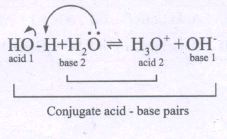
13.
Pure water itself has a little tendency to dissociate. i.e, one water molecule donates a proton to an another water molecule. This is known as auto ionisation of water and it is represented as below.
14.
According to Arrhenius, an acid is a substance that dissociates to give hydrogen ions in water. For example, HCl, H2SO4 etc., are acids. Their dissociation in aqueous solution is expressed as
\({ HCl }_{ (g) }\overset { { H }_{ 2 }O }{ \rightleftharpoons } { H }_{ (aq) }^{ + }+{ Cl }_{ (aq) }^{ - }\)
Similarly a base is a substance that dissociates to give hydroxyl ions in water. For example, substances like NaOH, Ca(OH)2 etc., are bases.
\({ Ca(OH) }_{ 2 }\overset { { H }_{ 2 }O }{ \rightleftharpoons } { Ca }_{ (aq) }^{ 2+ }+{ 2OH^- }_{ (aq) }\)
15.
This is a buffer mixture containing a weak base and its salt. Hence the equation to be used is
\(pH={ pK }_{ a }+{ \log }\frac { [salt] }{ [acid] } \)
pKb = logKb
= -log 1.8 - log 10-5 = 4.7447
∴ \(pOH=4.7447+\log\frac { 0.15 }{ 0.10 } \)
pOH = 4.7447 + log 1.5
= 4.7447 + 0.1761 = 4.9208
pH + POH = 14
pH + 4.9208 = 14
pH = 9.08

12th Standard Syllabus & Materials
12th Standard
TN 12th Computer Applications வலையமைப்பு வடமிடல் Sample Question Papers Study Material - QB365 Set A
NEW12th Standard
TN 12th Computer Applications களப்பெயர் முறைமை (DNS) Sample Question Papers Study Material - QB365 Set A
NEW12th Standard
TN 12th Computer Applications வலையமைப்பு எடுத்துக்காட்டுகள் மற்றும் நெறிமுறைகள் Sample Question Papers Study Material - QB365 Set A
NEW12th Standard
TN 12th Computer Applications கணினி வலையமைப்பு ஓர் அறிமுகம் Sample Question Papers Study Material - QB365 Set A



Tamilnadu Stateboard 12th Standard Subjects

Maths
Chemistry

Physics

Biology

Computer Science

Business Maths and Statistics

Economics

Commerce

Accountancy

History

Computer Applications
Biology
Computer Technology
Computer Applications
Computer Science
Business Maths and Statistics
Commerce
Economics
Maths
Chemistry
Physics
Computer Technology
History
Accountancy

Tamil

English

French
Tamilnadu Stateboard Standards
