
 100% FREE ACCESS
12th Standard Syllabus & Materials
12th Standard
TN 12th Computer Applications மின்னணு தரவு பரிமாற்றம் Sample Question Papers Study Material - QB365 Set A
NEW12th Standard
TN 12th Computer Applications மின் - வணிக பாதுகாப்பு அமைப்புகள் Sample Question Papers Study Material - QB365 Set A
NEW12th Standard
TN 12th Computer Applications மின்னணு செலுத்தல் முறைகள் Sample Question Papers Study Material - QB365 Set A
NEW12th Standard
TN 12th Computer Applications மின் - வணிகம் Sample Question Papers Study Material - QB365 Set A
NEW12th Standard
TN 12th Computer Applications திறந்த மூல கருத்துருக்கள் Sample Question Papers Study Material - QB365 Set A
NEW12th Standard
TN 12th Computer Applications வலையமைப்பு வடமிடல் Sample Question Papers Study Material - QB365 Set A

Published on: 28/01/2021
12th Standard Chemistry English Medium Ionic Equillibrium Reduced Syllabus Important Questions With Answer Key 2021
Download Tamil Nadu 12th Standard Chemistry question papers, model tests, one-mark questions, important questions, and public exam papers in PDF format. Free study materials and answer keys for TN State Board students.
Questions + Answers key
Take MCQ Chemistry Test
1.
The solution whose pH is maintained constant even upon the addition of small amounts of acid or base is called ________.
acidic solution
basic solution
buffer solution
true solution
2.
The Lewis base among the following is ______.
BF3
NH3
AICl3
NH+4
3.
When pH of a solution is 2, the hydrogen ion concentration in moles litre-1 is _______.
1 x 10-12
1 x 10⁻²
1 x 10⁻⁷
1 x 10⁻⁴
4.
NH4OH is a weak base because _______.
it has low vapour pressure
it is only partially ionised
it is completely ionised
it has low density
5.
The buffer present in human blood is _______.
CH3COOH + CH3COONa
NH4OH + NH4CI
H2CO3 + H\({ CO }_{ 3 }^{ - }\)
CH3COOH + CH3COONa and NH4OH + NH4CI
6.
The pH of pure water at 25°C is _______.
0
1
7
14
7.
The conjugate base of NH-2 is _______.
NH-
NH3
NH+3
NH2-
8.
Pick out the incorrect statement regarding Lewis acids and bases
A Lewis acid is a electron deficient molecule
Lewis bases is one which donates an electron pair
Lewis base is a cation
Lewis acid is a electron deficient molecule and Lewis base is a cation
9.
Dissociation constant of NH4OH is 1.8 x 10⁻⁵ the hydrolysis constant of NH4Cl would be _______.
1.8 × 10⁻¹⁹
5.55 × 10⁻¹⁰
5.55 × 10⁻⁵
1.80 × 10⁻⁵
10.
The pH of 10-5M KOH solution will be _______.
9
5
19
none of these
11.
If the solubility product of lead iodide is 3.2 × 10⁻⁸, its solubility will be _______.
2 × 10⁻³M
4 × 10⁻⁴M
1.6 × 10⁻⁵M
1.8 × 10⁻⁵M
12.
What is the decreasing order of strength of bases
OH, NH2- H - C ≡ C and CH3 - CH2-
OH->NH2- >H-C≡C >CH3-CH2-
NH2->OH->CH3-CH2- >H-C≡C
CH3-CH2->NH2->H-C≡C->OH-
OH->H-C ≡ C->CH3-CH2- >NH2-
13.
Which will make basic buffer?
50 mL of 0.1M NaOH+25mL of 0.1M CH3COOH
100 mL of 0.1M CH3COOH+100 mL of 0.1M NH4OH
100 mL of 0.1M HCl+200 mL of 0.1M NH4OH
100 mL of 0.1M HCl+100 mL of 0.1M NaOH
14.
pH of a saturated solution of Ca(OH)2 is 9. The Solubility product (Ksp) of Ca(OH)2 _______.
0.5 × 10⁻¹⁵
0.25 × 10⁻¹⁰
0.125 × 10⁻¹⁵
0.5 × 10⁻¹⁰
15.
Concentration of the Ag+ ions in a saturated solution of Ag2C2O4 is 2.24 ×10⁻⁴mol L-1 solubility product of Ag2C2O4 is_______.
2.42 × 10⁻⁸mol3L-3
2.66 × 10⁻¹²mol3L-3
4.5 × 10⁻¹¹mol3L-3
5.619 × 10⁻¹²mol3L-3
16.
Why is aqueous solution of FeCl3 acidic?
17.
BF3 is termed as an acid though it does not contain H+ ions. Explain.
18.
Magnesium is not precipitated from a solution of its salt by a mixture of NH4OH and NH4Cl. Explain
19.
Define neutralisation reaction.
20.
Define Buffer solution.
21.
A solution of 0.10M of a weak electrolyte is found to be dissociated to the extent of 1.20% at 25oC. Find the dissociation constant of the acid.
22.
Calculate the concentration of OH- in a fruit juice which contains \(2\times10^{-3}\) M, H3O+ ion. Identify the nature of the solution.
23.
A lab assistant prepared a solution by adding a calculated quantity of HCl gas 250C to get a solution with [H3O+] = 4\(\times\)10-5M. Is the solution neutral (or) acidic (or) basic.
24.
When aqueous ammonia is added to CuSO4 solution, the solution turns deep blue due to the formation of tetra ammine copper (II) complex,\({ [Cu({ H }_{ 2 }O)_4] }_{ (aq) }^{ 2+ }+ 4{ NH }_{ 3 }(aq)\rightleftharpoons { [Cu{ ({ NH }_{ 3 }) }_{ 4 }] }_{ (aq) }^{ 2+ }\) among H2O and NH3 Which is stronger Lewis base.
25.
What are Lewis acids and bases? Give two example for each.
26.
Derive the hydrolysis constant for the hydrolysis of salt of strong base and weak acid. Deduce its pH.
27.
Calculate the pH of 0.01 MNaOH.
28.
Calculate the Kb for ammonium hydroxide given its degree of dissociation to be 0.042 in 0.01 N solution.
29.
Calculate the pH of solution with HO+ concentrations in mol dm-3.
(i) 10-4
(ii) 10-7
(iii) 6.8 x 10⁻³
(iv) 3.2 x 10⁻⁵
(v) 0.035
(vi) 0.25
(vii) 5.4 x 10⁻⁹
(viii) 7.1 x 10⁻⁷
30.
Explain common ion effect with an example.
31.
What do you mean by buffer action?
32.
What is Henderson equation?
33.
For an aqueous solution of NH4CI, prove that [H+] = \(\sqrt { { K }_{ n }.C } \)
34.
What do you mean by auto ionisation of water?
35.
Based on Arrhenius concept, defame acid and bases and give an example for each.
36.
Establish a relationship between the solubility product and molar solubility for the following
a) BaSO4
b) Ag2(CrO4)
37.
Find the pH of a buffer solution containing 0.20 mole per litre sodium acetate and 0.18 mole per litre acetic acid. Ka for acetic acid is \(1.8\times10^{-5}\).
38.
Calculate pH of 10-7 M HCl
39.
A particular saturated solution of silver chromate Ag2CrO4 has \([Ag^{+}]=5\times10^{-5}\) and \([CrO_{4}]^{2-}=4.4\times10^{-4}M\). What is the value of Ksp for Ag2 CrO4?
40.
Solubility product of Ag2CrO4 is \(1\times10^{-12}\). What is the solubility of Ag2CrO4 in 0.01M AgNO3 solution?
41.
Derive an expression for the hydrolysis constant and degree of hydrolysis of salt of strong acid and weak base.
42.
50ml of 0.05M HNO3 is added to 50ml of 0.025M KOH. Calculate the pH of the resultant solution.
1.
(c)
buffer solution
2.
(b)
NH3
3.
(b)
1 x 10⁻²
4.
(b)
it is only partially ionised
5.
(c)
H2CO3 + H\({ CO }_{ 3 }^{ - }\)
6.
(c)
7
7.
(d)
NH2-
8.
(c)
Lewis base is a cation
9.
\(K_h= { \frac { { K }_{ w } }{ K_b } } = \frac{1 \times 10^{-14}}{1.8 \times 10^{-5}}\)
= 0.55 x 10-9 = 5.5 x 10⁻¹⁰
10.
KOH → K+ + OH-
10-5M 10-5M 10-5M
[OH-] = 10-5M
pH = 14 - pOH
pH= 14-(-log [OH-])
= 14 + log [OH-]
= 14 + log 10-5
= 14 - 5 = 9
11.
PbI2(s) ⇌ Pb2+(aq) + 2I-(aq)
Ksp = (s) (2s)2
3.2 × 10-8 = 4s3
s = (3.2 × 10⁻⁸/4)1/3
= ( 8 x 10⁻⁹)1/3
= 2 x 10⁻³ M
12.
(c)
CH3-CH2->NH2->H-C≡C->OH-
13.
Basic buffer is the solution which has weak base and its salt.
NH4OH + HCI → NH4CI +H2O + NH4OH
200 ml 100 ml salt 100 ml weak base
14.
Ca(OH)2 ⇌ Ca2+ + 2OH-
Given that pH = 9
pOH = 14 - 9 = 5
[pOH = - log10 [OH]]
[OH-] = 10 [pOH]
[OH] = 10-5 M
Ksp = [Ca2+] [OH-]
= 10-5/2 x (10-5)2 = 0.5 x 10⁻¹⁵
15.
\(\mathrm{Ag}_{2} \mathrm{C_2O_4} \rightleftharpoons 2 \mathrm{Ag}_{}^{+}+\mathrm{C_2O}_{4{}}^{2-}\)
\(\left[\mathrm{Ag}^{+}\right]=2 .24 \) ×10-4mol L-1
\(\mathrm{C_2O}_{4{}}^{2-} = \frac {2.24 \times 10 ^{-4}}{2}\) mol L-1
= 1.12 ×10⁻⁴mol L-1
Ksp = [Ag]2 [C2O42-]
= (2.24 ×10⁻⁴mol L-1) (1.12 ×10⁻⁴mol L-1)
= 5.619 × 10⁻¹²mol3L-3
16.
FeCl3 when dissolved in water gives strong acid HCl and a weak base Fe(OH)3 A strong acid ionises completely so concentration of H+ ion becomes much greater than OH- ion. So, aqueous solution of FeCl3 is acidic.
17.
According to Lewis concept of Acid and bases, any species capable of accepting an electron pair is an acid. BF3 is electron deficient so accepts a pair of electron, Hence termed as acid
18.
Magnesium has to precipitate as Mg(OH)2 when treated with NH4OH, but addition of NH4CI will suppress the ionisation of NH4OH due to common ion effect. So ionic product of Mg2+ and OH- ions will be less than the solubility product (Ksp) of Mg(OH)2. Hence will not precipitate.
19.
When an acid reacts with a base, a salt and water are formed and the reaction is called neutralization.
20.
Buffer is a solution which consists of a mixture of a weak acid and its conjugate base (or) a weak base and its conjugate acid.
21.
Given that \(\alpha=1.20\)%=\(\frac{1.20}{100}\times1.2\times10^{-2}\)
\(K_{a}=\alpha^{2}c\)
\(=(1.2\times10^{-2})^{2}(0.1)=1.44\times10^{-4}\times10^{-1}\)
=\(1.44\times10^{-5}\)
22.
Given that H3O+ = \(2\times10^{-3}M\)
\(K_{w}=[H_{3}O^{+}][OH^{-}]\)
\(\therefore [OH^{-}]=\frac{K_{w}}{[H_{3}O^{+}]}=\frac{1\times10^{-14}}{2\times10^{-3}}=0.5\times10^{-11}M\)
\(2\times10^{-3} >>0.5\times10^{-11}\)
i.e., [H3O+]>>[OH-], hence the juice is acidic in nature
23.
[H3O+] = 4 \(\times\) 10-5M
pH = - log10[H3O+]
pH=-log10[4 \(\times\) 10-5]
pH = -log10[4] - log10[10-5] log10 10 = 1
pH = -log 4 + 5log1010
= 5 - log 4
= 5 - 0.6021
=4.3979
Since pH is less than 7, the solution is acidic.
24.
(i) According to Lewis theory a species that donates a pair of electron is called Lewis base.
(ii) Nitrogen more in NH3 is less electro negative than oxygen in water. So the non - bonded electron pair on nitrogen is more available for sharing than a non - bonded electron pair on oxygen atom. So NH3 is a stronger lewis base than H2O.
25.
(i) Lewis acid: It is a species that accepts an electron pair. Eg: \(\mathrm{Ag}^{+} ; \mathrm{BF}_{3} ; \mathrm{A} / \mathrm{Cl}_{3}\)
(ii) Lewis base: It is a species that donates an electron pair. Eg: \( \mathrm{Cl}^{-} ; \mathrm{NH}_{3} ; \mathrm{H}_{2} \mathrm{O}\)
26.
Let us find a relation between the equilibrium constant for the hydrolysis reaction (hydrolysis constant) and the dissociation constant of the acid.
\({ K }_{ h }=\frac { [{ CH }_{ 3 }COOH][{ OH }^{ - }] }{ [{ CH }_{ 3 }{ COO }^{ - }][{ H }_{ 2 }O] } \)
\({ K }_{ h }=\frac { [{ CH }_{ 3 }COOH][{ OH }^{ - }] }{ [{ CH }_{ 3 }{ COO }^{ - }] } \) ...(1)
\({ CH }_{ 3 }{ COONH }_{ (aq) }\rightleftharpoons { C }{ H }_{ 3 }COO_{ (aq) }^{ - }+{ H }_{ (aq) }^{ + }\)
\({ K }_{ h }=\frac { [{ CH }_{ 3 }CO{ O }^{ - }][{ H }^{ + }] }{ [{ CH }_{ 3 }{ COO }H] } \) ...(2)
(1) x (2)
⇒ Kb . Ka = [H+][OH-]
we know that [H+] [OH-] = Kw
Kh· Ka = Kw
Kh value in terms of degree of hydrolysis (h) and the concentration of salt (C) for the equilibrium can be obtained as in the case of Ostwald's dilution law. Kh = h2C. and i.e [OH-] = \(\sqrt { { K }_{ h }.C } \)
pH of salt solution in terms of Ka and the concentration of the electrolyte
pH + pOH = 14
pH = 14 - pOH = 14 - {-log [OH-]}
= 14 + log [OH-]
∴ pH = 14 + log (KhC)\(\frac12\)
pH =14 + log \({ \left( \frac { { K }_{ w }C }{ { K }_{ a } } \right) }^{ \frac { 1 }{ 2 } }\)
pH = 14 + (\(\frac12\) log Kw + \(\frac12\) log C - \(\frac12\) log Ka)
[∴ Kw = 10-14]
\(pH=14-7+\frac { 1 }{ 2 } \log \ C+\frac { 1 }{ 2 } p{ K }_{ a }\frac { 1 }{ 2 } \log{ K }_{ w }=\frac { 1 }{ 2 } \times { \log10 }^{ -14 }=\frac { -14 }{ 2 } (1)=-7\)
\(pH=7+\frac { 1 }{ 2 } { pK }_{ a }+\frac { 1 }{ 2 } \log \ C\) [-log Ka = pKa]
27.
(NaOH strong base fully ionised)
\(pOH=\log\frac { 1 }{ { OH }^{ - } } =\log\frac { 1 }{ .01 } \)
\(=\log\frac { 100 }{ 1 } =2.0\)
pOH = 14 - pOH = 14 - 2 = 12.
28.
\(N{ H }_{ 4 }\rightleftharpoons { N{ H }_{ 4 } }^{ + }+{ OH }^{ - }\)
If α is the degree of dissociation, and C is the concentration in moles/lit. then
\({ K }_{ b }=\frac { { \alpha }^{ 2 }{ C } }{ 1-\alpha } =\frac { 0.04\times 0.042\times 0.01 }{ -0.042 } \)
Kb = 1.84 x 10⁻⁵.
29.
pH = - log [H3O+]
(i) pH - log [104]
pH = log 1 - log 104
pH = - 4
(ii) pH = - log [10-7]
pH = log 1 - log 10-7.
pH = 7
(iii) pH = - log [H3O+]
pH = - log [6.8 x 10⁻³]
pH = log 1 - log 6.8 - log 10-3
= 3 - 0.8325
pH = 2.17 (or) 2.2
(iv) pH = - log [3.2 x 10⁻⁵]
pH = log 1 - log 3.2 - log 10-5
= 5 - 0.5051
pH = 4.49 (or) 4.5
(v) pH = - log [0.035]
pH = log 1 - log 0.035
= 2 - 0.5441
pH = 1.46 (or) 1.5
(vi) pH = - log [0.25]
pH = log 1 - log 0.25
= 1 - 0.3979
pH = 0.602 (or) 0.60
(vii) pH = -log [H3O+]
pH = log 1 - log 5.4 - log 10-9
= 7 - 0.7324
pH = 8.267 (or) 8.3
(viii) pH = - log [7.1 x 10⁻⁷]
pH = log 1 - log 7.1 - log 10-7
= 7 - 0.8513
pH = 6.2.
30.
(i) The dissociation of a weak acid (CH3COOH) is suppressed in the presence of a salt (CH3COONa) containing an ion common to the weak electrolyte. It is called the common ion effect.
(ii) Consider the dissociation of a weak acid, acetic acid whose ionisation is incomplete.
CH3COOH(aq) ⇌ H+(aq) + CH3COO-(aq)
(iii) If the salt sodium acetate with common ion CH3COO- is added to the above equilibrium, it dissociates completely increasing.
CH3COONa(aq)⟶Na+(aq) + CH3COO-(aq)
(iv) Hence, the overall concentration of CH3COO- is increased, and the acid dissociation equilibrium is disturbed.
(v) So, in order to maintain the equilibrium, the excess CH3COO- ions combines with H+ ions to produce much more unionized CH3COOH i.e, the equilibrium will shift towards the left. In other words, the dissociation of CH3COOH is suppressed.
31.
(i) To resist changes in its pH on the addition of an acid (or) a base, the buffer solution should contain both acidic as well as basic components so as to neutralize the effect of added acid (or) base and at the same time, these components should not consume each other.
(ii) Let us explain the buffer action in a solution containing CH3COOH and CH3COONa.
(iii) The dissociation of the buffer components occurs as below.
\(\mathrm{CH}_{3} \mathrm{COOH}_{(\mathrm{aq})} \rightleftharpoons \mathrm{CH}_{3}-\mathrm{COO}_{(\mathrm{aq})}^{-}+\mathrm{H}_{3} \mathrm{O}_{(\mathrm{aq})}^{+} \)
\(\mathrm{CH}_{3} \mathrm{COONa}_{(\mathrm{s})} \stackrel{\mathrm{H}_{2} \mathrm{O}_{(\mathrm{l})}}{\longrightarrow} \mathrm{CH}_{3}-\mathrm{COO}_{(\mathrm{aq})}^{-}+\mathrm{Ha}_{(\mathrm{aq})}^{+}\)
32.
Henderson equation is an equation which is used to determine the pH of an acid buffer with the help of the dissociation constant Ka of the weak acid and concentration of the acid and the salt used.
\(\boxed { pH={ pK }_{ a }+\log\frac { [salt] }{ [acid] } }\)
For a basic buffer \(pH={ pK }_{ b }+\log\frac { [salt] }{ [base] } \)
33.
NH4CI is a salt of a strong acid HCI and weak base NH4OH.
\({ HCl }_{ (aq) }+{ NH }_{ 4 }OH_{(aq)}\rightleftharpoons { { NH }_{ 4 }Cl }_{ (aq) }+{ H }_{ 2 }O(I)\)
\({ NH }_{ 4 }^{ + }\) is a strong conjugate acid of the weak base NH4OH and it has a tendency to react with OH- from water to produce unionised NH4OH shown below.
\({ NH }_{ 4 }^{ + }+{ H }_{ 2 }O(1)\rightleftharpoons { NH }_{ 4 }{ { { OH }_{ (aq) }+ }H }_{ (aq) }^{ + }\)
There is no such tendency shown by Cl- and therefore [H+] > [OH-]; the solution is acidic and the pH is less than 7.
As discussed in the salt hydrolysis of strong base and weak acid. In this case also, we can establish a relationship between the Kh and Kb as
Kh·Kb = Kw
Let us calculate the Kh value in terms of degree of hydrolysis (h) and the concentration of salt
Kb = h2C and \([{ H }^{ + }]=\sqrt { { K }_{ h }.C } \)
= \({ [H }^{ + }]=\sqrt { \frac { { K }_{ w } }{ { K }_{ b } } .C } \)
pH = - log [H+]
\(={ \left( \frac { { K }_{ w }.C }{ { K }_{ b } } \right) }^{ \frac { 1 }{ 2 } }\)
= \(-\frac { 1 }{ 2 } \log { K }_{ w }-\frac { 1 }{ 2 } \log C+\frac { 1 }{ 2 } \log{ K }_{ b }\)
\(pH=7-\frac { 1 }{ 2 } p{ K }_{ b }-\frac { 1 }{ 2 } \log C\)
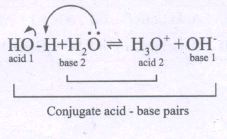
34.
Pure water itself has a little tendency to dissociate. i.e, one water molecule donates a proton to an another water molecule. This is known as auto ionisation of water and it is represented as below.
35.
According to Arrhenius, an acid is a substance that dissociates to give hydrogen ions in water. For example, HCl, H2SO4 etc., are acids. Their dissociation in aqueous solution is expressed as
\({ HCl }_{ (g) }\overset { { H }_{ 2 }O }{ \rightleftharpoons } { H }_{ (aq) }^{ + }+{ Cl }_{ (aq) }^{ - }\)
Similarly a base is a substance that dissociates to give hydroxyl ions in water. For example, substances like NaOH, Ca(OH)2 etc., are bases.
\({ Ca(OH) }_{ 2 }\overset { { H }_{ 2 }O }{ \rightleftharpoons } { Ca }_{ (aq) }^{ 2+ }+{ 2OH^- }_{ (aq) }\)
36.
a) \(BaSO_{4}(s)\overset{H_{2}O}{\rightleftharpoons }Ba^{2+}(aq)+SO^{2+}_{4}(aq)\)
\(K_{sp}=[Ba^{2+}][SO^{2-}_{4}]\) = (s) (s)
Ksp = s2
b) \(Ag_{2}CrO_{4}(s)\overset{H_{2}O}{\rightleftarrows }2Ag^{+}(aq)+CrO_{4}^{2-}(aq)\)
\(K_{sp}=[Ag^{+}]^{2}[CrO)^{2-}_{4}]\)
= (2s)2 (s)
Ksp = 4S3
37.
\(pH=pK_{a}+\log[\frac{salt}{acid}]\)
Given that Ka = \(1.8\times10^{-5}\)
\(\therefore pK_{a}=-\log(1.8\times10^{-5})\)
= 5 - log 1.8
= 5 - 0.26
= 4.74
\(\therefore pH=4.74+\log\frac{0.20}{0.18}\)
= 4.74 + log(10/9)
= 4.74 + log10 - log9
= 4.74 + 1 - 0.95
= 5.74 - 0.95
= 4.79
38.
If we do not consider [H3O]+ from the ionisation of H2O,
then [H3O+] = [HCl] = 10-7M
i.e., pH = 7, which is a pH of a neutral solution. We know that HCl solution is acidic whatever may be the concentration of HCl i.e, the pH value should be less than 7. In this case the concentration of the acid is very low (10-7M) Hence, the H3O+ (10-7M) formed due to the auto ionisation of water cannot be neglected.
so, in this case we should consider [H3O+] from ionisation of H2O
[H3O+] = 10-7 (from HCl) + 10-7 (from water)
= 10-7 (1+1)
= \(2\times10^{-7}\)
pH = -log10[H3O+]
=\(-\log_{10}(2\times10^{-7})=-[\log2+\log_{10}10^{-7}]\)
=\(-\log2-(-7)\log_{10}^{10}\)
= 7-log2
= 7-0.3010 = 0.6990 = 6.70
= 6.70
39.
\(Ag_{2}CrO_{4}(s)\rightleftharpoons 2Ag^{+}_{aq}+CrO^{2-}_{4}(aq)\)
\(K_{sp}=[Ag^{+}]^{2}[CrO_{4}^{2-}]\)
\(=(5\times10^{-5})^2(4.4\times10^{-4})\)
=\((1.1\times10^{-12})\)
40.
\(\mathrm{Ag}_{2} \mathrm{CrO}_{4(\mathrm{~s})} \rightleftharpoons 2 \mathrm{Ag}_{(\mathrm{aq})}^{+}+\mathrm{CrO}_{4{(\mathrm{aq})}}^{2-}\\ \quad s \quad \quad \quad \quad \quad 2s \quad \quad \quad \quad s\)
\(\left[\mathrm{Ag}^{+}\right]=2 \mathrm{~s}+0.01 \)
\(\simeq 0.01 \)
\((\because 2 s<<0.01) \)
\(\left[\mathrm{CrO}_{4}^{2-}\right]=\mathrm{S} \)
\(\mathrm{AgNO}_{3(\mathrm{~s})} \rightleftharpoons \mathrm{Ag}_{(\mathrm{aq})}^{+}+\mathrm{NO}_{3_{(\mathrm{aq})}}^{-}\\ 0.01M \quad \quad 0.01M \quad \quad 0.01M \quad\)
\(\mathrm{K}_{\mathrm{sp}}=\left[\mathrm{Ag}^{+}\right]^{2}\left[\mathrm{CrO}_{4}^{2-}\right] \)
\(1 \times 10^{-12}=(0.01)^{2}(\mathrm{~s}) \)
\(\mathrm{S}=\frac{1 \times 10^{-12}}{10^{-4}}=1 \times 10^{-8} \mathrm{M}\)
41.
(i) Let us consider the reactions between a strong acid, HCI, and a weak base, NH4OH, to produce a salt, NH4CI, and water.
HCI(aq) + NH4OH(aq) ⇌ NH4CI(aq) + H2O (I)
NH4CI(aq) ⟶ NH4+ +CI-(aq)
(ii) NH4+ is a strong conjugate acid of the weak base NH4OH and it has a tendency to react with OH- from water to produce unionised NH4OH
NH4+ (aq) + H2O(I) ⇌ NH4OH(aq) + H+(aq)
(iii) There is no such tendency shown by Cl- and therefore [H+] > [OH-]; the solution is acidic and the pH is less than 7.
(iv) The Kh and Kb are related by
\(\mathrm{K}_{\mathrm{h}} \cdot \mathrm{K}_{\mathrm{b}}=\mathrm{K}_{\mathrm{w}}\)
(Or)
\(\mathrm{K}_{\mathrm{h}}=\frac{\mathrm{K}_{\mathrm{w}}}{\mathrm{K}_{\mathrm{b}}}\)
Degree of hydrolysis (h)
\(\underset{(1-h)}{\mathrm{NH}_{4}^{+}(\mathrm{aq})}+\mathrm{H}_{2} \mathrm{O}_{(j)} \rightleftharpoons \underset{h} {\mathrm{NH}_{4} \mathrm{OH}_{(\mathrm{aq})}} +\mathrm{H}^{+} \underset{h}{(\mathrm{aq})}\\ \)
\(\mathrm{K}_{\mathrm{h}} =\frac{\left[\mathrm{NH}_{4} \mathrm{OH}\right]\left[\mathrm{H}^{+}\right]}{\left[\mathrm{NH}_{4}^{+}\right]} \\ \)
\(=\frac{\mathrm{hc} \times \mathrm{h}}{(1-\mathrm{h}) \mathrm{c}} \)
\(K_{h}=\frac{h^{2} c}{(1-h)} \)
\(\text{If } \mathrm{h}<<1 ; \mathrm{K}_{\mathrm{h}} \simeq \mathrm{h}^{2} \mathrm{c} \)
\(h^{2}=\frac{K_{h}}{c}\)
\(h=\sqrt{\frac{K_{h}}{c}} \ (or) \ h=\sqrt{\frac{K_{w}}{K_{b} \cdot C}} \quad\left(\because K_{h}=\frac{K_{w}}{K_{b}}\right)\)
Also; \(\left[\mathrm{H}^{+}\right]=\sqrt{\mathrm{K}_{\mathrm{h}} \cdot \mathrm{C}} \) (or) \(\left[\mathrm{H}^{+}\right]=\sqrt{\frac{\mathrm{K}_{\mathrm{w}} \cdot \mathrm{C}}{\mathrm{K}_{\mathrm{b}}}}\)
pH = -log [H+]
42.
\(\mathrm{M} =\frac{\mathrm{V}_{1} \mathrm{M}_{1}-\mathrm{V}_{2} \mathrm{M}_{2}}{\mathrm{~V}_{1}+\mathrm{V}_{2}} \)
\(=\frac{(50 \times 0.05)-(50 \times 0.025)}{50+50} \)
\(\text { Molarity }=\frac{\text { Number of millimoles }}{\mathrm{V}_{\mathrm{m} l}}\)
\(=\frac{2.5-1.25}{100}=\frac{1.25}{100}=0.0125 \mathrm{M} \)
\(\mathrm{pH} =-\log _{10}\left[\mathrm{H}^{+}\right] \)
\(=-\log _{10} 0.0125 \)
Normality = Molarity \(\times\) basicity
\(=-\log _{10}\left(1.25 \times 10^{-2}\right) \)
\(=-\left[\log _{10} 1.25-2 \log _{10} 10\right] \)
\(=2-\log _{10} 1.25=2-0.0969 \)
pH = 1.9031

12th Standard Syllabus & Materials
12th Standard
TN 12th Computer Applications களப்பெயர் முறைமை (DNS) Sample Question Papers Study Material - QB365 Set A
NEW12th Standard
TN 12th Computer Applications வலையமைப்பு எடுத்துக்காட்டுகள் மற்றும் நெறிமுறைகள் Sample Question Papers Study Material - QB365 Set A
NEW12th Standard
TN 12th Computer Applications கணினி வலையமைப்பு ஓர் அறிமுகம் Sample Question Papers Study Material - QB365 Set A
NEW12th Standard
TN 12th Computer Applications PHP-உடன் MySQL-ஐ இணைத்தல் Sample Question Papers Study Material - QB365 Set A



Tamilnadu Stateboard 12th Standard Subjects

Maths
Chemistry

Physics

Biology

Computer Science

Business Maths and Statistics

Economics

Commerce

Accountancy

History

Computer Applications
Biology
Computer Technology
Computer Applications
Computer Science
Business Maths and Statistics
Commerce
Economics
Maths
Chemistry
Physics
Computer Technology
History
Accountancy

Tamil

English

French
Tamilnadu Stateboard Standards
