
 100% FREE ACCESS
12th Standard Syllabus & Materials
12th Standard
TN 12th Computer Applications மின்னணு தரவு பரிமாற்றம் Sample Question Papers Study Material - QB365 Set A
NEW12th Standard
TN 12th Computer Applications மின் - வணிக பாதுகாப்பு அமைப்புகள் Sample Question Papers Study Material - QB365 Set A
NEW12th Standard
TN 12th Computer Applications மின்னணு செலுத்தல் முறைகள் Sample Question Papers Study Material - QB365 Set A
NEW12th Standard
TN 12th Computer Applications மின் - வணிகம் Sample Question Papers Study Material - QB365 Set A
NEW12th Standard
TN 12th Computer Applications திறந்த மூல கருத்துருக்கள் Sample Question Papers Study Material - QB365 Set A
NEW12th Standard
TN 12th Computer Applications வலையமைப்பு வடமிடல் Sample Question Papers Study Material - QB365 Set A

Published on: 01/09/2022
QB365 provides a detailed and simple solution for every Possible Creative Questions in Class 12 Chemistry Subject - Metallurgy, English Medium. It will help Students to get more practice questions, Students can Practice these question papers in addition to score best marks.
Download Tamil Nadu 12th Standard Chemistry question papers, model tests, one-mark questions, important questions, and public exam papers in PDF format. Free study materials and answer keys for TN State Board students.
Questions + Answers key
Take MCQ Chemistry Test
1.
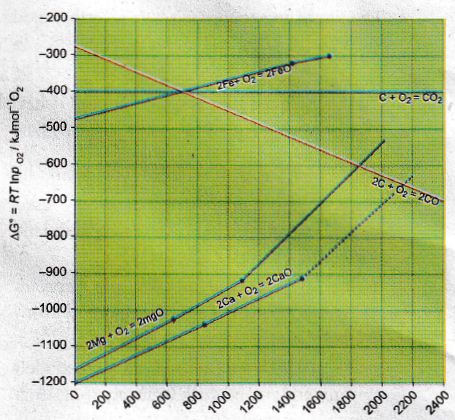
Using standard free energy change, Prove that at 1500 K coke can be used as a reducing agent for FeO.
2.
Write a note on Ellingham diagram.
3.
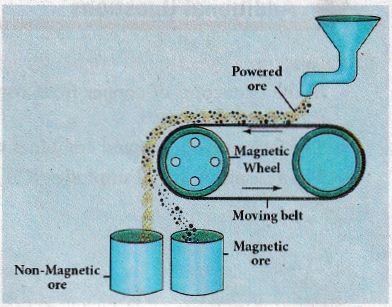
Explain magnetic separation with examples.
4.
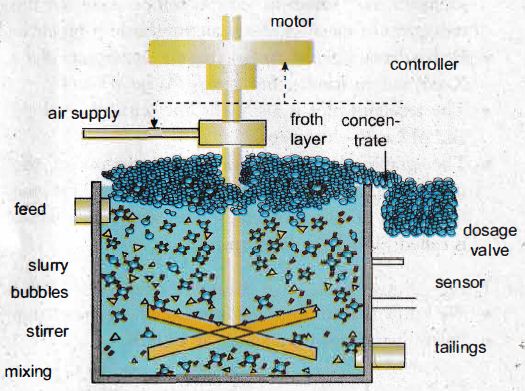
Explain froth flotation method with examples.
5.
Explain the extraction of copper by 'smelting' process.
6.
Write short note on the following:
(i) The process in which no external reducing agent is used.
(ii) The process which is used for highly electro positive metal.
(iii) Write the equation involved in the thermite process.
7.
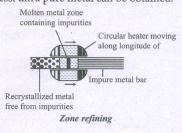
What is zone refining? Describe the principle involved in the purification of the metal by this method.
8.
How can you separate alumina from silica in a bauxite ore.
9.
List the applications of iron.
10.
List out the application of aluminum.
11.
Explain refining of titanium by Van-Arkel method.
12.
Explain refining of nickel by mond's process
13.
Explain concentration by magnetic separation with diagram.
14.
Explain froth flotation, with diagram.
1.
(i) We know that for a spontaneous reaction, the change in free energy should be negative.
(ii) From the Ellingham diagram at 1500 K,
\(2 \mathrm{Fe} +\mathrm{O}_{2(\mathrm{~g})} \rightarrow 2 \mathrm{Fe} \mathrm{O}_{(\mathrm{g})} \quad \Delta \mathrm{G}_{1}=-350 \mathrm{~kJ} \mathrm{~mol}^{-1}\) .....(1)
\(2 \mathrm{C}_{(s)}+\mathrm{O}_{2(\mathrm{~g})} \rightarrow 2 \mathrm{CO}_{(\mathrm{g})} \quad \Delta \mathrm{G}_{2}=-480 \mathrm{~kJ} \mathrm{~mol}^{-1}\) ....(2)
(iii) Reverse the reaction (1)
\(2 \mathrm{FeO}_{(\mathrm{g})} \rightarrow 2 \mathrm{Fe}_{(s)}+\mathrm{O}_{2(g)} -\Delta \mathrm{G}_{1}=+350 \mathrm{~kJ} \mathrm{~mol}^{-1}\) .... (3)
(iv) Now couple the reactions (2) and (3)
\(2 \mathrm{FeO}_{(s)}+2 \mathrm{C} \rightarrow 2 \mathrm{Fe}_{(0, s)}+2 \mathrm{CO}_{(g)} \quad \Delta \mathrm{G}_{3}=-130 \mathrm{~kJ} \mathrm{~mol}^{-1}\) ....(4)
(v) The standard free energy change for the reduction of one mole of \(\mathrm{FeO}\ is \ \frac{\Delta \mathrm{G}_{3}}{2}=-65 \mathrm{~kJ} \mathrm{~mol}^{-1}\)
(vi) Hence standard free energy is negative, coke can be used as the reducing agent for FeO at 1500 K.
2.
(i) The change in Gibb's free energy (ΔG) for a reaction is given by ΔG = ΔH - TΔS
(ii) Where ΔH - enthalpy change, T - temperature in kelvin. ΔS - entropy change.
(iii) For an equilibrium process ΔG0 can be calculated using the equilibrium constant as ΔG0 = -RT ln Kp
(iv) Harold Ellingham used the above relationship to calculate ΔG0 values at various temperature for the reduction of metal oxides as an equilibrium process.
(v) He has drawn a plot by considering the temperature in the X-axis and the standard free energy change in Y-axis.
(vi) The resultant plot is a straight line with ΔS as slope and ΔH as Y - intercept.
(vii) The graphical representation of variation of the standard Gibb's free energy of reaction for the formation of various metal oxides with temperature is called Ellingham diagram.
3.
Magnetic separation method is applicable to ferromagnetic ores and it is based on the difference in the magnetic properties of the ore and the impurities.
Example:
(i) Tin stone can be separated from the wolframite impurities (Electromagnetic separator).
(ii) Ores such as chromite, pyrolusite having magnetic property can be removed from the nonmagnetic siliceous impurities.
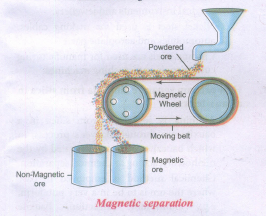
(a) The crushed ore is poured on to an electromagnet separator consisting of a belt moving over two rollers of which one is magnetic.
(b) The magnetic part of the ore is attracted towards the magnet and falls as a heap near the magnet.
(c) The non magnetic part falls away from it.
4.
1. Froth flotation method is commonly used to concentrate sulphide ores such as galena (PbS), zinc blende (ZnS) etc.
2. In this method, the metallic ore particles are wetted by oil can be separated from gangue.
3. In this method, the crushed ore is suspended in water and mixed with frothing agent such as pine oil, eucalyptus oil etc.
4. A small quantity of sodium ethyl xanthate acts as a collector is added.
5. A froth is generated by blowing air through this mixture.
6. The collector molecules attach to the ore particle and make them water repellent.
7. As a result, ore particles, wetted by the oil, rise to the surface along with the froth.
8. The froth is skimmed off and dried to recover the concentrated ore.
9. The gangue particles wetted by water settle at the bottom.
10. When a sulphide ore contains other metal sulphide as impurities, depressing agents such as sodium cyanide, sodium carbonate etc., are used to prevent other metal sulphides from coming to the froth.
11. Example: ZnS is present in galena (Pbs), sodium cyanide (NaCN) is added to depresses the flotation property of ZnS by forming a complex \(\mathrm{Na}_{2}\left[\mathrm{Zn}(\mathrm{CN})_{4}\right]\).
5.
(i) In the extraction of copper from copper pyrites, the concentrated ore is heated with silica (flux) in the reverberatory furnace.
(ii) The ferrous oxide formed combines with silica forming ferrous silicate (slag).
(iii) The remaining metal sulphides (Cu2S and FeS) form a copper matte.
\(2 \mathrm{CuFeS}_{2(\mathrm{~s})}+\mathrm{O}_{2(\mathrm{~g})} \rightarrow 2 \mathrm{FeS}_{(1)}+\mathrm{Cu}_{2} \mathrm{~S}_{(1)}+\mathrm{SO}_{2} \)
\(2 \mathrm{FeS}_{(s)}+3 \mathrm{O}_{2(\mathrm{~g})} \rightarrow 2 \mathrm{FeO}_{(s)}+2 \mathrm{SO}_{2(\mathrm{~g})} \)
\(\mathrm{FeO}_{(s)}+\mathrm{SiO}_{2(\mathrm{~s})} \rightarrow \mathrm{FeSiO}_{3(\mathrm{~s})} \\ \text { gangue} \quad \text { flux }\quad \quad \text { slag }\)
(iv) The matte is separated from the slag and fed to the converting furnace.
(v) During conversion FeS of matte oxidized to FeO.
(vi) It reacts with silica and removed as slag.
(vii) The remaining copper sulphide is further oxidised to its oxide, which is converted into metallic copper.
\(2 \mathrm{Cu}_{2} \mathrm{~S}_{(\mathrm{l} . \mathrm{s})}+3 \mathrm{O}_{2(\mathrm{~g})} \rightarrow 2 \mathrm{Cu}_{2} \mathrm{O}_{(\mathrm{a}, \mathrm{s})}+2 \mathrm{SO}_{2(\mathrm{~g})} \)
\(2 \mathrm{Cu}_{2} \mathrm{O}_{(i)}+\mathrm{Cu}_{2} \mathrm{~S}_{(0)} \rightarrow 6 \mathrm{Cu}_{(i)}+\mathrm{SO}_{2(\mathrm{~g})}\)
(viii) The metallic copper is solidified and it has blistered appearance due to the evolution of SO2.
(ix) This copper is called blistered copper (98 % pure).
6.
(i) The process in which no external reducing. When ore is heated in air, a part of the ore gets oxidised which combines with remaining sulphide to give metal.
Eg: Reduction copper glance (Cu2S)
\({ 2Cu }_{ 2 }S+{ 3O }_{ 2 }\longrightarrow { 2Cu }_{ 2 }O+2{ SO }_{ 2 }\uparrow \)
\({ 2Cu }_{ 2 }O+{ Cu }_{ 2 }S\longrightarrow 6Cu+{ SO }_{ 2 }\uparrow \)
(ii) Electrolytic reduction is used for highly electro positive metals. In this method, fused metal ore is electrolysed and pure metal is deposited at cathode.
Eg: Al is obtained by electrolysis of Al2O3
\({ 2Al }_{ 2 }{ O }_{ 3 }+3C\longrightarrow \underset { Cathode\quad Anode }{ 4Al+{ 3CO }_{ 2 } } \)
(iii) \({ Cr }_{ 2 }{ O }_{ 3 }+2Al\longrightarrow {Al }_{ 2 }{ O }_{ 3 }+2Cr\)
\(3 \mathrm{Mn} _3 O_{4}+8 \mathrm{Al} \longrightarrow 4 \mathrm{Al}_{2} \mathrm{O}_{3}+9 \mathrm{Mn}\)
7.
Zone refining:
This method is employed for preparing highly pure metal (such as silicon, tellurium, germanium), which are used as semiconductors. It is based on the principle that melting point of a substance is lowered by the presence of impurities. Consequently, when an impure molten metal is cooled, crystals of the pure metal are solidified, and the impurities remain behind the remaining metal.
The process consists In casting the impure metal in the form of a bar. A circular heater fitted around this bar is slowly moved longitudinally from one end to the other. At the heated zone, the bar melts, and as the heater moves on, pure metal crystallizes, while the impurities pass into the adjacent molten part In this way, the impurities are swept from one end of the bar to the other. By repeating the process, ultra pure metal can be obtained.
8.
(i) Alumina is separated from silica in a bauxite ore through Baeyer's process, in which bauxite ore is concentrated by the method of leaching or chemical separation.
(ii) Chemical method is employed in case where the ore is to be in a very pure form, e.g., aluminium extraction. Bauxite (Al2O3), an ore of aluminium, contains SiO2 and Fe2O3 as impurities. When bauxite ore is treated with NaOH, the Al2O3 goes into solution as sodium meta aluminate leaving behind the undissolved impurities [Fe2O3, SiO2, Fe(OH)3' etc.], which are then filtered off.
\({ Al }_{ 2 }{ O }_{ 3 }+{ 2NaOH }\longrightarrow \underset { Sod.meta.aliminate\\ (In \ solution \ form) }{ { 2NaAlO }_{ 2 }+{ H }_{ 2 }O } \)
(iii) The filtrate (containing sodium meta aluminate) on dilution, and stirring gives a precipitate of aluminium hydroxide, which is filtered, and ignited to get pure alumina.
\({ NaAlO }_{ 2 }+2{ H }_{ 2 }O\longrightarrow \underset { Ppt }{ { Al(OH) }_{ 3 } } +NaOH\)
\(2Al\left( OH \right) _{ 3 }\overset { \Delta }{ \longrightarrow } \underset { Pure }{ { Al }_{ 2 }{ O }_{ 3 } } +3{ H }_{ 2 }O\)
9.
(i) Iron is one of the most useful metals and its alloys are used everywhere including bridges, electricity pylons, bicycle chains, cutting tools and rifle barrels.
(ii) Cast iron is used to make pipes, valves and pumps stoves etc.
(iii) Magnets can be made from iron and its alloys and compounds.
(iv) An important alloy of iron is stainless steel, and it is very resistant to corrosion. It is used in architecture, bearings, cutlery, surgical instruments and jewellery.
(v) Nickel steel is used for making cables, automobiles and aeroplane parts.
(vi) Chrome steels are used for manufacturing cutting tools and crushing machines.
10.
(i) Many heat exchangers/sinks and our day to day cooking vessels are made of aluminum.
(ii) It is used as wraps (aluminum foils) and is used in packing materials for food items.
(iii) Aluminum alloys with copper, manganese, magnesium and silicon are light weight and strong and they are used in design of aeroplanes and other forms of transport.
(iv) Aluminum shows high resistance, to corrosion, so it is used in the design of chemical reactors, medical equipments, refrigeration units and gas pipelines.
(v) Aluminium is a good electrical conductor and cheap, hence used in electrical overhead electric cables with steel core for strength.
11.
(i) Van-Arkel method is based on the thermal decomposition of metal compounds which lead to the formation of pure metals.
(ii) Titanium and zirconium can be purified, using this method.
(iii) For example, the impure titanium metal is heated in an evacuated vessel with iodine at a temperature of 550 K to form the volatile titanium tetra-iodide(Til4)
(iv) The impurities are left behind, as they do not react with iodine
\({ Ti }_{ (s) }+{ 2I }_{ 2(s) }\longrightarrow { Til }_{ 4 }(vapour)\)
(v) The volatile titanium tetraiodide vapour is passed over a tungsten filament at a temperature around 1800 K.
(vi) The titanium tetraiodide is decomposed and pure titanium is deposited on the filament
(vii) The iodine is reused.
\({ Til }_{ 4 }(vapour)\longrightarrow { { Ti }_{ (s) } }+{ 2I }_{ 2(s) }\)
12.
(i) The impure nickel is heated in a stream of carbon monoxide at around 350 K.
(ii) The nickel reacts with the CO to form a highly volatile nickel tetracarbonyl.
(iii) The solid impurities are left behind
\({ Ni }_{ (s) }+4{ CO }_{ (g) }\longrightarrow { Ni(CO) }_{ 4(g) }\)
(iv) On heating the nickel tetracarbonyl around 460 K, the complex decomposes to give pure metal.
\({ Ni(CO) }_{ 4(g) }\longrightarrow { Ni }_{ (s) }+{ 4CO }_{ (g) }\)
13.
(i) Magnetic separation is applicable to ferromagnetic ores and it is based on the difference in the magnetic properties of the ore and the impurities.
(ii) For example tin stone can be separated from the wolframite impurities which is magnetic.
(iii) Similarly, ores such as chromite, pyrolusite having magnetic property can be removed from the non magnetic siliceous impurities.
(iv) The crushed ore is poured on to an electromagnetic separator consisting of a belt moving over two rollers of which one is magnetic.
(v) The magnetic part of the ore is attracted towards the magnet and falls as a heap close to the magnetic region while the nonmagnetic part falls away from it as shown in the figure.
14.
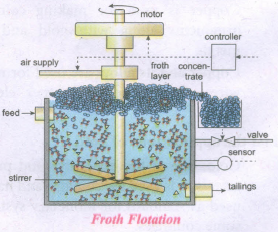
(i) Froth flotation method is commonly used to concentrate sulphide ores such as galena (PbS), zinc blende (ZnS) etc.
(ii) In this method, the metallic ore particles which are preferentially wetted by oil can be separated from gangue.
(iii) In this method, the crushed ore is suspended in water and mixed with frothing agent such as pine oil, eucalyptus oil etc.
(iv) A small quantity of sodium ethyl xanthate which acts as a collector is also added.
(v) A froth is generated by blowing air through this mixture.
(vi) The collector molecules attach to the ore particle and make them water repellent.
(vii) As a result, ore particles, wetted by the oil, rise to the surface along with the froth.
(viii) The froth is skimmed off and dried to recover the concentrated ore.
(ix) The gangue particles that are preferentially wetted by water settle at the bottom.

12th Standard Syllabus & Materials
12th Standard
TN 12th Computer Applications களப்பெயர் முறைமை (DNS) Sample Question Papers Study Material - QB365 Set A
NEW12th Standard
TN 12th Computer Applications வலையமைப்பு எடுத்துக்காட்டுகள் மற்றும் நெறிமுறைகள் Sample Question Papers Study Material - QB365 Set A
NEW12th Standard
TN 12th Computer Applications கணினி வலையமைப்பு ஓர் அறிமுகம் Sample Question Papers Study Material - QB365 Set A
NEW12th Standard
TN 12th Computer Applications PHP-உடன் MySQL-ஐ இணைத்தல் Sample Question Papers Study Material - QB365 Set A



Tamilnadu Stateboard 12th Standard Subjects

Maths
Chemistry

Physics

Biology

Computer Science

Business Maths and Statistics

Economics

Commerce

Accountancy

History

Computer Applications
Biology
Computer Technology
Computer Applications
Computer Science
Business Maths and Statistics
Commerce
Economics
Maths
Chemistry
Physics
Computer Technology
History
Accountancy

Tamil

English

French
Tamilnadu Stateboard Standards
