
 100% FREE ACCESS
12th Standard Syllabus & Materials
12th Standard
TN 12th Computer Applications மின்னணு தரவு பரிமாற்றம் Sample Question Papers Study Material - QB365 Set A
NEW12th Standard
TN 12th Computer Applications மின் - வணிக பாதுகாப்பு அமைப்புகள் Sample Question Papers Study Material - QB365 Set A
NEW12th Standard
TN 12th Computer Applications மின்னணு செலுத்தல் முறைகள் Sample Question Papers Study Material - QB365 Set A
NEW12th Standard
TN 12th Computer Applications மின் - வணிகம் Sample Question Papers Study Material - QB365 Set A
NEW12th Standard
TN 12th Computer Applications திறந்த மூல கருத்துருக்கள் Sample Question Papers Study Material - QB365 Set A
NEW12th Standard
TN 12th Computer Applications வலையமைப்பு வடமிடல் Sample Question Papers Study Material - QB365 Set A

Published on: 28/01/2021
12th Standard Chemistry English Medium Metallurgy Reduced Syllabus Important Questions 2021
Download Tamil Nadu 12th Standard Chemistry question papers, model tests, one-mark questions, important questions, and public exam papers in PDF format. Free study materials and answer keys for TN State Board students.
Questions + Answers key
Take MCQ Chemistry Test
1.
Galena is_______.
PbS
ZnS
Ag2S
FeS2
2.
Metal oxide is converted into metal by the _______ process.
Calcination
roasting
smelting
bessemerisation
3.
Froth flotation process is suitable for concentrating ______ores.
oxide
carbonate
sulphide
halide
4.
Semiconductors are purified by_______ method.
Zone refining
Electrolytic refining
Mond's process
Bessemerisation
5.
Na[Ag(CN)2] is _________.
Sodium aurocyanide
Sodium meta aluminate
Aluminosilicate
Sodium dicyanoargentate
6.
Magnetic separation it is based on the difference in the_________ of the ore and the impurities.
magnetic properties
chemical properties
physical properties
melting point
7.
Zinc blende is_______.
ZnS
PbS
Ag2S
Cu2S
8.
Identify the halide ore among the following
Epsom Salt
Pyrolusite
Anglesite
Rock Salt
9.
Which of the following mineral contains calcium as well as magnesium?
Zinc blende
Aragonite
Dolomite
Carnallite
10.
Name the process by which elements such as germanium, silicon and gallium are refined.
Vapour phase method
Electrolytic refining
Zone refining
Van-Arkel method
11.
Which of the following is incorrect with respect to metallurgy of iron in the blast furnace?
Zone of combustion : \(C+{ O }_{ 2 }\rightarrow { CO }_{ 2 }\)
Zone of heat absorption : \({ CO }_{ 2 }\rightarrow C+{ O }_{ 2 }\)
Zone of slag formation : \(CaO+{ SiO }_{ 2 }\rightarrow CaSiO_{ 3 }\)
Zone of reduction : \({ Fe }_{ 2 }{ O }_{ 3 }3C\rightarrow 3CO+2Fe\)
12.
The following set of reactions are used in refining Zirconium
\(Zr \text{(impure)}+2I_{ 2 }\overset { 523k }{ \longrightarrow } ZrI_{ 4 }\)
\({ ZrI }_{ 4 }\overset { 1800K }{ \longrightarrow } Zr \text{(pure)}+{ 2I }_{ 2 }\)This method is known as ______.
Liquation
Van Arkel process
Zone refining
Mond’s process
13.
Considering Ellingham diagram, which of the following metals can be used to reduce alumina?
Fe
Cu
Mg
Zn
14.
Which one of the following ores is best concentrated by froth – floatation method?
Magnetite
Haematite
Galena
Cassiterite
15.
Match items in column - I with the items of column – II and assign the correct code.
| Column-I | Column-II | ||
| A. | Cyanide process | (i) | Ultrapure Ge |
| B | Froth floatation process | (ii) | Dressing of ZnS |
| C | Electrolytic reduction | (iii) | Extraction of Al |
| D | Zone refining | (iv) | Extraction of Au |
| (v) | Purification of Ni | ||
| A | B | C | D |
| (i) | (ii) | (iii) | (iv) |
| A | B | C | D |
| (iii) | (iv) | (v) | (i) |
| A | B | C | D |
| (iv) | (ii) | (iii) | (i) |
| A | B | C | D |
| (ii) | (iii) | (i) | (v) |
16.
Write short note on the following:
(i) The process in which no external reducing agent is used.
(ii) The process which is used for highly electro positive metal.
(iii) Write the equation involved in the thermite process.
17.
How can you separate alumina from silica in a bauxite ore.
18.
Explain refining of titanium by Van-Arkel method.
19.
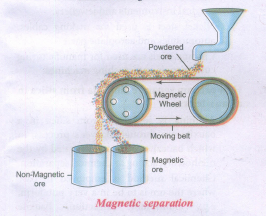
Explain concentration by magnetic separation with diagram.
20.
Explain the principle of electrolytic refining with an example.
21.
Using the Ellingham diagram,
(A) Predict the conditions under which
(i) Aluminium might be expected to reduce magnesia.
(ii) Magnesium could reduce alumina.
(B) it is possible to reduce Fe2O3 by coke at a temperature around 1200K
22.
Define roasting.
23.
What are the different methods of concentration of ores?
24.
What is the role of graphite rods in the electro metallurgy of aluminium?
25.
What is distillation?
26.
Why is the froth flotation method selected for the concentration of sulphide ores?
27.
Name the ore that can be concentrated by magnetic separation method.
28.
Name the metals that are obtained from their oxides using hydrogen as reducing agent.
29.
Name the two steps involved in the extraction of crude metal
30.
31.
Copper and silver lie low in the electrochemical series and yet they are found in the combined state as sulphides in nature. Comment.
32.
What is auto-reduction?
33.
(i) Which of the following metals cannot: be extracted by the smelting process: 1 AI, Zn, Fe and Pb. Give reasons.
(ii) Which one is a good reducing agent (C or CO) for Fe2O3, below 1073 k?
34.
Write the molecular composition of the following ores and mentions it metal: magnetite calamine and bauxite.
35.
Distinguish Roasting and Calcination.
36.
How is acid leaching done for the sulphide ores?
37.
Explain alkali leaching in the extraction of aluminum.
38.
What is meant by ammonia leaching?
1.
(a)
PbS
2.
(c)
smelting
3.
(c)
sulphide
4.
(a)
Zone refining
5.
(d)
Sodium dicyanoargentate
6.
(a)
magnetic properties
7.
(a)
ZnS
8.
(d)
Rock Salt
9.
(c)
Dolomite
10.
(c)
Zone refining
11.
(b)
Zone of heat absorption : \({ CO }_{ 2 }\rightarrow C+{ O }_{ 2 }\)
12.
(b)
Van Arkel process
13.
(c)
Mg
14.
(c)
Galena
15.
(c)
| A | B | C | D |
| (iv) | (ii) | (iii) | (i) |
16.
(i) The process in which no external reducing. When ore is heated in air, a part of the ore gets oxidised which combines with remaining sulphide to give metal.
Eg: Reduction copper glance (Cu2S)
\({ 2Cu }_{ 2 }S+{ 3O }_{ 2 }\longrightarrow { 2Cu }_{ 2 }O+2{ SO }_{ 2 }\uparrow \)
\({ 2Cu }_{ 2 }O+{ Cu }_{ 2 }S\longrightarrow 6Cu+{ SO }_{ 2 }\uparrow \)
(ii) Electrolytic reduction is used for highly electro positive metals. In this method, fused metal ore is electrolysed and pure metal is deposited at cathode.
Eg: Al is obtained by electrolysis of Al2O3
\({ 2Al }_{ 2 }{ O }_{ 3 }+3C\longrightarrow \underset { Cathode\quad Anode }{ 4Al+{ 3CO }_{ 2 } } \)
(iii) \({ Cr }_{ 2 }{ O }_{ 3 }+2Al\longrightarrow {Al }_{ 2 }{ O }_{ 3 }+2Cr\)
\(3 \mathrm{Mn} _3 O_{4}+8 \mathrm{Al} \longrightarrow 4 \mathrm{Al}_{2} \mathrm{O}_{3}+9 \mathrm{Mn}\)
17.
(i) Alumina is separated from silica in a bauxite ore through Baeyer's process, in which bauxite ore is concentrated by the method of leaching or chemical separation.
(ii) Chemical method is employed in case where the ore is to be in a very pure form, e.g., aluminium extraction. Bauxite (Al2O3), an ore of aluminium, contains SiO2 and Fe2O3 as impurities. When bauxite ore is treated with NaOH, the Al2O3 goes into solution as sodium meta aluminate leaving behind the undissolved impurities [Fe2O3, SiO2, Fe(OH)3' etc.], which are then filtered off.
\({ Al }_{ 2 }{ O }_{ 3 }+{ 2NaOH }\longrightarrow \underset { Sod.meta.aliminate\\ (In \ solution \ form) }{ { 2NaAlO }_{ 2 }+{ H }_{ 2 }O } \)
(iii) The filtrate (containing sodium meta aluminate) on dilution, and stirring gives a precipitate of aluminium hydroxide, which is filtered, and ignited to get pure alumina.
\({ NaAlO }_{ 2 }+2{ H }_{ 2 }O\longrightarrow \underset { Ppt }{ { Al(OH) }_{ 3 } } +NaOH\)
\(2Al\left( OH \right) _{ 3 }\overset { \Delta }{ \longrightarrow } \underset { Pure }{ { Al }_{ 2 }{ O }_{ 3 } } +3{ H }_{ 2 }O\)
18.
(i) Van-Arkel method is based on the thermal decomposition of metal compounds which lead to the formation of pure metals.
(ii) Titanium and zirconium can be purified, using this method.
(iii) For example, the impure titanium metal is heated in an evacuated vessel with iodine at a temperature of 550 K to form the volatile titanium tetra-iodide(Til4)
(iv) The impurities are left behind, as they do not react with iodine
\({ Ti }_{ (s) }+{ 2I }_{ 2(s) }\longrightarrow { Til }_{ 4 }(vapour)\)
(v) The volatile titanium tetraiodide vapour is passed over a tungsten filament at a temperature around 1800 K.
(vi) The titanium tetraiodide is decomposed and pure titanium is deposited on the filament
(vii) The iodine is reused.
\({ Til }_{ 4 }(vapour)\longrightarrow { { Ti }_{ (s) } }+{ 2I }_{ 2(s) }\)
19.
(i) Magnetic separation is applicable to ferromagnetic ores and it is based on the difference in the magnetic properties of the ore and the impurities.
(ii) For example tin stone can be separated from the wolframite impurities which is magnetic.
(iii) Similarly, ores such as chromite, pyrolusite having magnetic property can be removed from the non magnetic siliceous impurities.
(iv) The crushed ore is poured on to an electromagnetic separator consisting of a belt moving over two rollers of which one is magnetic.
(v) The magnetic part of the ore is attracted towards the magnet and falls as a heap close to the magnetic region while the nonmagnetic part falls away from it as shown in the figure.
20.
1. The crude metal is refined by electrolysis. It is carried out in an electrolytic cell
Anode : Impure metal to be refined with dilute acid.
Cathode : Thin strips of pure metal
Electrolyte : Aqueous solution of the salts of the metal with dilute acid.
2. The metal dissolves from the anode, pass into the solution.
3. At the same amount of metal ions from the solution will be deposited at the cathode.
4. During electrolysis, the less electropositive impurities in the anode, settle down at the bottom and are removed as anode mud.
Example: Electrolytic refining of silver.
Cathode: Pure silver
Anode: lmpure silver rods
Electrolyte: Acidified aqueous solution of silver nitrate
5. When a current is passed through the electrodes the following reactions will take place
(a) Reaction at anode: \({ Ag }_{ (s) }\longrightarrow { Ag }^{ + }_{ (aq) }+{ 1e }^{ - }\)
(b) Reaction at cathode: \({ Ag }^{ + }_{ (aq) }+{ 1e }^{ - }\longrightarrow { Ag }_{ (s) }\)
6. During electrolysis, at anode silver loses electrons and form silver ions and the silver ions migrate towards the cathode and get discharged and deposited on the cathode.
7. Copper, Zinc etc can also be refined by this process.
21.
a) i) Ellingham diagram for the formation of Al2O3 and MgO intersects around 1500oC. Above this temp Mg lies above the Aluminium line. Hence only above 1500oC Aluminium might be excepted to reduce magnesia.
ii) Ellingham diagram for the formation of MgO lies below the formation of Al2O3. Hence MgO is more stable than Al2O3. Hence Magnesium could reduce Alumina.
1. Below 983K, formation of CO line lies below many of the metal oxide formation in Ellingham diagram, hence CO is more effective reducing agent than Carbon.
2. But above this temperature Carbon lies below other metal oxides.
b) Around 1200K Carbon lies below the formation of Fe2O3. Hence it is possible to reduce Fe2O3 by coke at 1200K.
22.
In this method, the concentrated ore is oxidised by heating it with excess of oxygen in a suitable furnace below the melting point of the metal.
23.
(i) Hydraulic washing or gravity separation
(ii) Froth flotation
(iii) Electromagnetic separation
(iv ) Chemical method.
24.
(i) Graphite rods act a anode during electrolytic reduction of alumina.
(ii) At anode, O2 gas is produced which react with the carbon of anode (rods) to produce CO2 gas.
(iii) So these graphite rods are consumed slowly and need to be replaced from time to time.
25.
(i) Distillation is employed for low boiling volatile metals like zinc (boiling point 1180 K) and mercury (630 K).
(ii) In this method, the impure metal is heated to evaporate and the vapours are condensed to get pure metal.
26.
(i) Lighter sulphide ore particles are wetted by pine oil and rise to the surface with the from while gangue particles are wetted by water.
(ii) Therefore, the froth flotation method is selected for the concentration of sulphide ores.
27.
Magnetite (Fe3O4), haematite (Fe2O3) are the ores which can be separated by the magnetic separation method. In these ores, one component is magnetic in nature.
28.
Iron, Lead and Copper
29.
(i) Conversion of ores into oxides.
(ii) Reduction of metal oxides.
30.
31.
(i) At higher temperature, the reaction between copper and sulphur becomes feasible.
(ii) So they combine together and copper exists as copper sulphides in nature.
(iii) Besides this due to high polarising power of copper and silver ions, their sulphides are more stable.
32.
(i) Simple roasting of some of the ores give the crude metal. In such cases, the use of and hydrogen which does not rust and gives reducing agents is not necessary.
(ii) For example, mercury is obtained by Write the chemical composition of the roasting of its ore cinnabar (HgS)
\(Hg{ S }_{ (s) }+{ O }_{ 2(g) }\longrightarrow { Hg }_{ (I) }+{ SO }_{ 2 }\uparrow \)
33.
(i) Aluminium cannot be extracted by melting process due to the following reasons.
(a) Aluminium (AI) being highly electropositive element has very: strong affinity for oxygen. So, Al2O3 is very stable compound and cannot be reduced by C.
(b) On heating Al2O3 with C, aluminium carbide is formed
\({ 2Al }_{ 2 }{ O }_{ 3 }+9C\longrightarrow { Al }_{ 4 }{ C }_{ 3 }+6CO\)
(ii) Below 1073 k, CO is more effective, because the \(\Delta { G }^{ 0 }\) value for the conversion of CO into CO2 is more negative.
34.
| Ore | Molecular composition | Metal |
|---|---|---|
| Magnetite | Fe3O4 | Iron |
| Calamine | ZnCO3 | Zinc |
| Bauxite | Al2O3.nH2O | Aluminium |
35.
| Roasting | Calcination |
|---|---|
| Roasting is a process which ore is heated in the presence of excess of air. | Calcination is a process in which ore is heated in the absence of air. |
| As a result of roasting the sulphide ores are converted into their oxides. | As a result of calcination, the carbonal ore is converted into its oxide. |
| \(2PbS+3O2\overset { \Delta }{ \longrightarrow } PbO+{ 2SO }_{ 2 }\uparrow \) | \(PbCO\overset { \Delta }{ \longrightarrow } PbO+{ CO }_{ 2 }\uparrow \) |
| Roasting removes impurities such as arsenic, sulphur phosphorous by converting them into their volatile oxides \(4As+{ 3O }_{ 2 }\longrightarrow { 2As }_{ 2 }{ O }_{ 3 }\) |
During calcination of hydrated ore, the water of hydration is expelled as vapour. |
36.
(i) Leaching of sulphide ores such as ZnS, PbS etc., can be done by treating them with hot aqueous sulphuric acid
\(2Zn{ S }_{ (s) }+{ 2H }_{ 2 }{ SO }_{ 4(aq) }+{ O }_{ 2(g) }\longrightarrow { 2ZnSO }_{ 4(aq) }+2{ S }_{ (s) }+{ H }_{ 2 }O\)
(ii) In this process the insoluble sulphide is converted into soluble sulphate and elemental sulphur
37.
(i) In this method, the ore is treated with aqueous alkali to form a soluble complex.
(ii) Bauxite, an important ore of aluminum is heated with a solution of sodium hydroxide or sodium carbonate in the temperature range 470 - 520 K at 35 atm to form soluble sodium meta-aluminate leaving behind the impurities, iron oxide and titanium oxide.
\({ Al }_{ 2 }{ O }_{ 3(s) }+2NaO{ H }_{ (aq) }+3{ H }_{ 2 }{ O }_{ (l) }\longrightarrow 2Na[Al({ OH })_{ 4 }]_{ (aq) }\)
(iii) The hot solution is decanted, cooled, and diluted. This solution is neutralised by passing CO2 gas, to the form hydrated Al2O3 precipitate
\(2Na\left[ Al\left( OH \right) _{ 4 } \right] _{ (aq) }+{ CO }_{ 2(g) }\longrightarrow { Al }_{ 2 }{ { O }_{ 3 }.x{ H }_{ 2 }O_{ (s) }+2NaHCO_{ 3(aq) } }\)
(iii) The precipitate is filtered off and heated around 1670 K to get pure alumina Al2O3
38.
When a crushed ore containing nickel, copper and cobalt is treated with aqueous ammonia under suitable pressure, ammonia selectively leaches these metals by forming their soluble complexes viz. [Ni(NH3)6]2+, [Cu(NH3)4]2+, and [Co(NH3)5H2O]3+ respectively from the ore leaving behind the gangue, iron(III) oxides/ hydroxides and aluminosilicate.

12th Standard Syllabus & Materials
12th Standard
TN 12th Computer Applications களப்பெயர் முறைமை (DNS) Sample Question Papers Study Material - QB365 Set A
NEW12th Standard
TN 12th Computer Applications வலையமைப்பு எடுத்துக்காட்டுகள் மற்றும் நெறிமுறைகள் Sample Question Papers Study Material - QB365 Set A
NEW12th Standard
TN 12th Computer Applications கணினி வலையமைப்பு ஓர் அறிமுகம் Sample Question Papers Study Material - QB365 Set A
NEW12th Standard
TN 12th Computer Applications PHP-உடன் MySQL-ஐ இணைத்தல் Sample Question Papers Study Material - QB365 Set A



Tamilnadu Stateboard 12th Standard Subjects

Maths
Chemistry

Physics

Biology

Computer Science

Business Maths and Statistics

Economics

Commerce

Accountancy

History

Computer Applications
Biology
Computer Technology
Computer Applications
Computer Science
Business Maths and Statistics
Commerce
Economics
Maths
Chemistry
Physics
Computer Technology
History
Accountancy

Tamil

English

French
Tamilnadu Stateboard Standards
