
 100% FREE ACCESS
12th Standard Syllabus & Materials
12th Standard
TN 12th Computer Applications மின்னணு தரவு பரிமாற்றம் Sample Question Papers Study Material - QB365 Set A
NEW12th Standard
TN 12th Computer Applications மின் - வணிக பாதுகாப்பு அமைப்புகள் Sample Question Papers Study Material - QB365 Set A
NEW12th Standard
TN 12th Computer Applications மின்னணு செலுத்தல் முறைகள் Sample Question Papers Study Material - QB365 Set A
NEW12th Standard
TN 12th Computer Applications மின் - வணிகம் Sample Question Papers Study Material - QB365 Set A
NEW12th Standard
TN 12th Computer Applications திறந்த மூல கருத்துருக்கள் Sample Question Papers Study Material - QB365 Set A
NEW12th Standard
TN 12th Computer Applications வலையமைப்பு வடமிடல் Sample Question Papers Study Material - QB365 Set A

Published on: 28/01/2021
12th Standard Chemistry English Medium Metallurgy Reduced Syllabus Important Questions With Answer Key 2021
Download Tamil Nadu 12th Standard Chemistry question papers, model tests, one-mark questions, important questions, and public exam papers in PDF format. Free study materials and answer keys for TN State Board students.
Questions + Answers key
Take MCQ Chemistry Test
1.
In the thermite process __________is used as a reducing agent
AI
CO
C
CO2
2.
Steel is an alloy of___________
iron and carbon
iron and calcium
copper and carbon
copper and iron
3.
The percentage of carbon in high carbon steel is_________.
0.5 - 1%
0.15 - 1.5%
0.15 - 1.5%
0.15 - 0.3%
4.
A mixture containing sulphides of copper and iron is called______
mineral
ore
matte
matrix
5.
The following set of reaction is used for refining titanium. This method is known as___________
\({ Ti }_{ (g) }+{ 2I }_{ 2(s) }\longrightarrow { TiI }_{ 4 }\left( vapour \right) \)
\({ Til }_{ 4 }(vapour)\longrightarrow Ti_{ (g) }+{ 2I }_{ 2(s) }\)
Hall Heroult process
Mond process
Van-Arkel process
Alumino thermic process
6.
Magnesite is_______.
Magnesium oxide
Magnesium carbonate
Magnesium sulphate
Magnesium chloride
7.
Gibb's free energy is given by_______
\(\Delta { G }^{ 0 }=-nF{ E }^{ 0 }\)
\(\Delta { G }^{ o }=nF\)
\(\Delta { G }^{ o }=nF{ E }^{ o }\)
\(\Delta { E }^{ o }=-nF{ G }^{ 0 }\)
8.
Zinc is extracted from Zinc blende by________.
Carbon reduction process
Nitrogen reduction process
Oxygen reduction process
All of these
9.
Ignition mixture used in aluminothermic process is ________.
Cr + AI2O3
Mg + BaO2
AI + Cr2O3
Ba + MgO
10.
Identify the decreasing order of carbon content in different forms of iron________.
Wrought iron > Pig iron > cast iron
Cast iron > Pig iron > Wrought iron
Pig iron > Cast iron > Wrought iron
Cast iron > Wrought iron > Pig iron
11.
Which of the following is commonly used to produce foam in froth floatation process?
Pine oil
Cresol
NaCN
Xanthate
12.
Cupellation is a process used for the refining of________.
Silver
Lead
Copper
iron
13.
Which one of the following is not feasible
Zn(s) + Cu2+(aq) \(\rightarrow\) Cu(s) + Zn2+(aq)
Cu(s)+ Zn2+(aq)\(\rightarrow\) Zn(s) + Cu2+(aq)
Cu(s) + 2Ag+(ag)\(\rightarrow\) 2Ag(s) + Cu2+(aq)
Fe(s) + Cu2+(aq) \(\rightarrow\) Cu(s)+ Fe2+(aq)
14.
Match items in column - I with the items of column – II and assign the correct code.
| Column-I | Column-II | ||
| A. | Cyanide process | (i) | Ultrapure Ge |
| B | Froth floatation process | (ii) | Dressing of ZnS |
| C | Electrolytic reduction | (iii) | Extraction of Al |
| D | Zone refining | (iv) | Extraction of Au |
| (v) | Purification of Ni | ||
| A | B | C | D |
| (i) | (ii) | (iii) | (iv) |
| A | B | C | D |
| (iii) | (iv) | (v) | (i) |
| A | B | C | D |
| (iv) | (ii) | (iii) | (i) |
| A | B | C | D |
| (ii) | (iii) | (i) | (v) |
15.
Name and discuss the principle involved in obtaining silicon of high purity.
16.
The reaction \({ Cr }_{ 2 }{ O }_{ 3 }+2{ Al }_{ (s) }\longrightarrow { Al }_{ 2 }O_{ 3 }+2Cr\) \(\Delta { G }^{ 0 }=-421KJ\) is thermodynamically feasible why does it not take place at room temperature?
17.
Name the ore that can be concentrated by magnetic separation method.
18.
Discuss the process of roasting with suitable example.
19.
Name the various refining process.
20.
Name the two steps involved in the extraction of crude metal
21.
Can the same method of extraction be used for all metals.
22.
23.
Give the basic requirement for vapour phase refining.
24.
25.
What is the role of quick lime in the extraction of Iron from its oxide Fe2O3?
26.
Write the chemical composition of the following alloys and give anyone of its application.
(i) Bronze
(ii) Brass
(iii) Stainless steel
27.
What is auto-reduction?
28.
Define the term slag.
29.
What is the role of depressants in froth flotation process?
30.
Distinguish Roasting and Calcination.
31.
What is vapour phase method?
32.
What is cyanide leaching? Give an example
33.
34.
What is zone refining? Describe the principle involved in the purification of the metal by this method.
35.
List the applications of iron.
36.
List out the application of aluminum.
37.
Explain froth flotation, with diagram.
38.
Explain the principle of electrolytic refining with an example.
39.
Explain zone refining process with an example.
1.
(a)
AI
2.
(a)
iron and carbon
3.
(b)
0.15 - 1.5%
4.
(c)
matte
5.
(c)
Van-Arkel process
6.
(b)
Magnesium carbonate
7.
(a)
\(\Delta { G }^{ 0 }=-nF{ E }^{ 0 }\)
8.
(a)
Carbon reduction process
9.
(b)
Mg + BaO2
10.
(c)
Pig iron > Cast iron > Wrought iron
11.
(a)
Pine oil
12.
(a)
Silver
13.
(b)
Cu(s)+ Zn2+(aq)\(\rightarrow\) Zn(s) + Cu2+(aq)
14.
(c)
| A | B | C | D |
| (iv) | (ii) | (iii) | (i) |
15.
(i) Silicon of is refined by Zone refining method.
(ii) It is based on the principle that melting point of a substance is lowered by the presence of impurities
(iii) Consequently when an impure molten metal is cooled, crystals of the pure metal are solidified and the impurities remain behind the remaining metal.
16.
The change in Gibbs energy is related to the equilibrium constant K as \(\Delta \)G = - RT Ink. A room temperature all reactants and product of the given reaction are in solid state. As a result, equilibrium does not take place at room exist between the reactants and the products. Hence the reaction does not take place at room temperature. Certain amount of activation energy is essential even for reactions which are thermodynamically feasible
17.
Magnetite (Fe3O4), haematite (Fe2O3) are the ores which can be separated by the magnetic separation method. In these ores, one component is magnetic in nature.
18.
Sulphide ores are generally roasted in reverberatory furnace in free supply of air below its melting point. Ore changes to oxide with larger surface area and volatile impurities are removed.
\(2ZnS+{ 3O }_{ 2 }\overset { \Delta }{ \longrightarrow } 2ZnO+{ 2SO }_{ 2 }\)
\(2PbS+{ 3O }_{ 2 }\overset { \Delta }{ \longrightarrow } pbO+{ 2SO }_{ 2 }\)
19.
Distillation, liquation, electrolytic refining, zone refining, vapour phase method, van -Arkel method
20.
(i) Conversion of ores into oxides.
(ii) Reduction of metal oxides.
21.
The choice of method will depend on the nature of the ore, type of impurity and environmental factors
22.
23.
In this method, the metal is treated with a suitable reagent which can form a volatile compound with the metal.
Then the volatile compound is decomposed to give the pure metal.
24.
25.
In this extraction, a basic flux, quick lime (CaO) is used, since the silica gangue present in the ore is acidic in nature. The quick lime combines with it to form calcium silicate (slag).
CaO(s) + Sio2(s) ⟶ CaSio3(s)
Flux Gangue Slag
26.
| Alloy | Composition | Application |
|---|---|---|
| Bronze | Cu- 80%, Zn-10%, Sn-10% |
Making utensils, statutes, coins, etc. |
| Brass | Cu-60%, Zn-40% |
Making utensils, wires, pairs of machine etc |
| Stainless steel | Fe-73%, Cr-18%, Ni- 8% and CF -1% |
Making utensils, cutlery, cycles, etc. |
27.
(i) Simple roasting of some of the ores give the crude metal. In such cases, the use of and hydrogen which does not rust and gives reducing agents is not necessary.
(ii) For example, mercury is obtained by Write the chemical composition of the roasting of its ore cinnabar (HgS)
\(Hg{ S }_{ (s) }+{ O }_{ 2(g) }\longrightarrow { Hg }_{ (I) }+{ SO }_{ 2 }\uparrow \)
28.
The fusible compound formed by the combination of flux and gangue is called
Flux + Gangue \(\longrightarrow \) Slag
Eg: In the extraction of copper from copper pyrites, the ore is mixed with coke and heated in blast furnace.
Infusible FeO is converted to FeSiO3 (slag) and is removed.
\(\underset { Gangue }{ FeO } +\underset { Flux }{ { SiO }_{ 2 } } \longrightarrow \underset { slag }{ { FeSiO }_{ 3 } } \)
29.
(i) Depressant are used to prevent one type of sulphide ore particles from forming the froth with air bubbles.
(ii) Eg: In the process of separation of lead sulphide (Pbs) ore from zinc sulphide (ZnS) ore, sodium cyanide is used as depressant.
30.
| Roasting | Calcination |
|---|---|
| Roasting is a process which ore is heated in the presence of excess of air. | Calcination is a process in which ore is heated in the absence of air. |
| As a result of roasting the sulphide ores are converted into their oxides. | As a result of calcination, the carbonal ore is converted into its oxide. |
| \(2PbS+3O2\overset { \Delta }{ \longrightarrow } PbO+{ 2SO }_{ 2 }\uparrow \) | \(PbCO\overset { \Delta }{ \longrightarrow } PbO+{ CO }_{ 2 }\uparrow \) |
| Roasting removes impurities such as arsenic, sulphur phosphorous by converting them into their volatile oxides \(4As+{ 3O }_{ 2 }\longrightarrow { 2As }_{ 2 }{ O }_{ 3 }\) |
During calcination of hydrated ore, the water of hydration is expelled as vapour. |
31.
(i) Vapour phase method, the metal is treated with a suitable reagent which can form a volatile compound with the metal.
(ii) Then the volatile compound is decomposed to give the pure metal.
(iii) Vapour phase method is used for refining nickel.
32.
(i) The crushed ore of gold is leached with aerated dilute solution of sodium cyanide.
(ii) Gold is converted into a soluble cyanide complex.
(iii) The gangue, aluminosilicate remains insoluble
\({ 4Au }_{ (s) }+{ 8CN }_{ (aq) }^{ - }+{ O }_{ 2(g) }+2{ H }_{ 2 }{ O }_{ (l) }\longrightarrow 4\left[ Au(CN)_{ 2 } \right] +_{ (aq) }^{ - }+{ 4OH }_{ (aq) }^{ - }\)
33.
34.
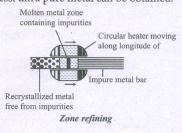
Zone refining:
This method is employed for preparing highly pure metal (such as silicon, tellurium, germanium), which are used as semiconductors. It is based on the principle that melting point of a substance is lowered by the presence of impurities. Consequently, when an impure molten metal is cooled, crystals of the pure metal are solidified, and the impurities remain behind the remaining metal.
The process consists In casting the impure metal in the form of a bar. A circular heater fitted around this bar is slowly moved longitudinally from one end to the other. At the heated zone, the bar melts, and as the heater moves on, pure metal crystallizes, while the impurities pass into the adjacent molten part In this way, the impurities are swept from one end of the bar to the other. By repeating the process, ultra pure metal can be obtained.
35.
(i) Iron is one of the most useful metals and its alloys are used everywhere including bridges, electricity pylons, bicycle chains, cutting tools and rifle barrels.
(ii) Cast iron is used to make pipes, valves and pumps stoves etc.
(iii) Magnets can be made from iron and its alloys and compounds.
(iv) An important alloy of iron is stainless steel, and it is very resistant to corrosion. It is used in architecture, bearings, cutlery, surgical instruments and jewellery.
(v) Nickel steel is used for making cables, automobiles and aeroplane parts.
(vi) Chrome steels are used for manufacturing cutting tools and crushing machines.
36.
(i) Many heat exchangers/sinks and our day to day cooking vessels are made of aluminum.
(ii) It is used as wraps (aluminum foils) and is used in packing materials for food items.
(iii) Aluminum alloys with copper, manganese, magnesium and silicon are light weight and strong and they are used in design of aeroplanes and other forms of transport.
(iv) Aluminum shows high resistance, to corrosion, so it is used in the design of chemical reactors, medical equipments, refrigeration units and gas pipelines.
(v) Aluminium is a good electrical conductor and cheap, hence used in electrical overhead electric cables with steel core for strength.
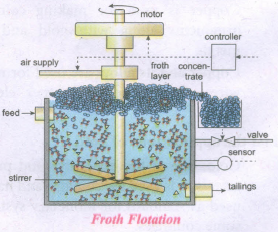
37.
(i) Froth flotation method is commonly used to concentrate sulphide ores such as galena (PbS), zinc blende (ZnS) etc.
(ii) In this method, the metallic ore particles which are preferentially wetted by oil can be separated from gangue.
(iii) In this method, the crushed ore is suspended in water and mixed with frothing agent such as pine oil, eucalyptus oil etc.
(iv) A small quantity of sodium ethyl xanthate which acts as a collector is also added.
(v) A froth is generated by blowing air through this mixture.
(vi) The collector molecules attach to the ore particle and make them water repellent.
(vii) As a result, ore particles, wetted by the oil, rise to the surface along with the froth.
(viii) The froth is skimmed off and dried to recover the concentrated ore.
(ix) The gangue particles that are preferentially wetted by water settle at the bottom.
38.
1. The crude metal is refined by electrolysis. It is carried out in an electrolytic cell
Anode : Impure metal to be refined with dilute acid.
Cathode : Thin strips of pure metal
Electrolyte : Aqueous solution of the salts of the metal with dilute acid.
2. The metal dissolves from the anode, pass into the solution.
3. At the same amount of metal ions from the solution will be deposited at the cathode.
4. During electrolysis, the less electropositive impurities in the anode, settle down at the bottom and are removed as anode mud.
Example: Electrolytic refining of silver.
Cathode: Pure silver
Anode: lmpure silver rods
Electrolyte: Acidified aqueous solution of silver nitrate
5. When a current is passed through the electrodes the following reactions will take place
(a) Reaction at anode: \({ Ag }_{ (s) }\longrightarrow { Ag }^{ + }_{ (aq) }+{ 1e }^{ - }\)
(b) Reaction at cathode: \({ Ag }^{ + }_{ (aq) }+{ 1e }^{ - }\longrightarrow { Ag }_{ (s) }\)
6. During electrolysis, at anode silver loses electrons and form silver ions and the silver ions migrate towards the cathode and get discharged and deposited on the cathode.
7. Copper, Zinc etc can also be refined by this process.
39.
Zone refining :
1. Zone refining method is based on the principles of fractional crystallisation.
2. When an impure metal is melted and allowed to solidify, the impurities will prefer to be in the molten region. In this process the impure metal is taken in the form of a rod.
3. One end of the rod is heated using a mobile induction heater which results in melting of the metal on that portion of the rod.
4. When the heater is slowly moved to the other end the pure metal crystallises while the impurities will move on to the adjacent molten zone.
5. As the heater moves further away, the molten zone containing impurities also moves along with it.
6. The process is repeated several times by moving the heater in the same direction again and again to get pure metal.
7. This process is carried out in an inert gas atmosphere to prevent the oxidation of metals.
8. Elements such as germanium (Ge), silicon (Si) and galium (Ga) that are used as semiconductor are refined using this process.

12th Standard Syllabus & Materials
12th Standard
TN 12th Computer Applications களப்பெயர் முறைமை (DNS) Sample Question Papers Study Material - QB365 Set A
NEW12th Standard
TN 12th Computer Applications வலையமைப்பு எடுத்துக்காட்டுகள் மற்றும் நெறிமுறைகள் Sample Question Papers Study Material - QB365 Set A
NEW12th Standard
TN 12th Computer Applications கணினி வலையமைப்பு ஓர் அறிமுகம் Sample Question Papers Study Material - QB365 Set A
NEW12th Standard
TN 12th Computer Applications PHP-உடன் MySQL-ஐ இணைத்தல் Sample Question Papers Study Material - QB365 Set A



Tamilnadu Stateboard 12th Standard Subjects

Maths
Chemistry

Physics

Biology

Computer Science

Business Maths and Statistics

Economics

Commerce

Accountancy

History

Computer Applications
Biology
Computer Technology
Computer Applications
Computer Science
Business Maths and Statistics
Commerce
Economics
Maths
Chemistry
Physics
Computer Technology
History
Accountancy

Tamil

English

French
Tamilnadu Stateboard Standards
