
 100% FREE ACCESS
12th Standard Syllabus & Materials
12th Standard
TN 12th Computer Applications மின்னணு தரவு பரிமாற்றம் Sample Question Papers Study Material - QB365 Set A
NEW12th Standard
TN 12th Computer Applications மின் - வணிக பாதுகாப்பு அமைப்புகள் Sample Question Papers Study Material - QB365 Set A
NEW12th Standard
TN 12th Computer Applications மின்னணு செலுத்தல் முறைகள் Sample Question Papers Study Material - QB365 Set A
NEW12th Standard
TN 12th Computer Applications மின் - வணிகம் Sample Question Papers Study Material - QB365 Set A
NEW12th Standard
TN 12th Computer Applications திறந்த மூல கருத்துருக்கள் Sample Question Papers Study Material - QB365 Set A
NEW12th Standard
TN 12th Computer Applications வலையமைப்பு வடமிடல் Sample Question Papers Study Material - QB365 Set A

Published on: 31/08/2020
12th Standard Chemistry English Medium Model 2 Mark Creative Questions (New Syllabus) 2020
Download Tamil Nadu 12th Standard Chemistry question papers, model tests, one-mark questions, important questions, and public exam papers in PDF format. Free study materials and answer keys for TN State Board students.
Questions + Answers key
Take MCQ Chemistry Test
1.
What is 'spirit of nitre'? Give its use.
2.
How is anisole prepared from benzene diazonium chloride?
3.
\({ C }_{ 2 }{ H }_{ 3 }N\xrightarrow [ Ether ]{ LiAl/{ H }_{ 4 } } B\underrightarrow { HN{ O }_{ 2 } } \) Identify A, B and C.
4.
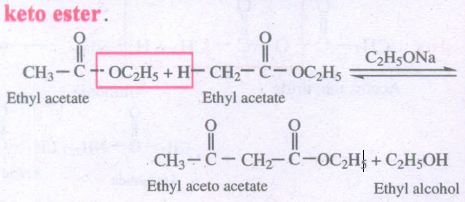
Write a note on Claisen Condensation.
5.
Write any three uses of formic acid.
6.
Write a note on esterification reaction with an example.
7.
What are carboxylic acids?
8.
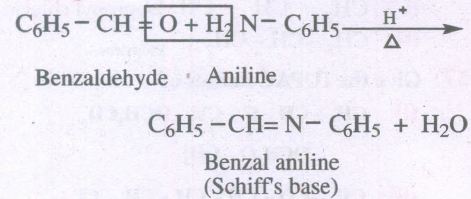
How is Schiff's base prepared?
9.
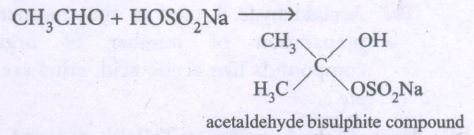
Give nucleophilic addition reaction of acetaldehyde with NaHSO3.
10.
Give four examples of carbonyl compounds?
11.
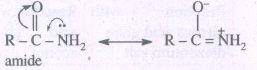
Explain why amines are more basic than amides.
12.
How will you distinguish between ethylamine and diethylamine?
13.
What is chloropicrin?
14.
Name a drug used in mental depression.
15.
Write a short note on Antimicrobials.
16.
What are Antacids? Give three examples of antacid.
17.
What do you mean by transcription?
18.
Give an example of a macromolecule chosen as drug targets.
19.
Write the main structural difference between RNA and DNA of the four bases, name those which are common to both RNA and DNA.
20.
Why cellulose is not used as food by humans?
21.
What are anomers? Give example.
22.
Explain the formation of delta.
23.
Define Deemulsification.
24.
What do you mean by positive and negative adsorption?
25.
Define electrochemical equivalent.
26.
Give examples of primary cells.
27.
What type of cell is a Daniel cell?
28.
Give the empirical relationship between molar conductance and concentration of the electrolyte.
29.
Define resistance. Give its mathematical expression
30.
What happens when crotonaldehyde is reduced in the presence of LiAlH4?
31.
Write the tests to differentrate phenol and alcohol.
32.
How is the following conversion effected? Ethyl alcohol ⟶ Ethylene glycol
33.
How will you convert C2H5OH to C2H5OC2H5?
34.
Define neutralisation reaction.
35.
Write the equation for the action of heat on KMnO4
36.
A first order reaction has a specific reaction rate of 10-3 S-1. How much time will it take for 10gm of the reactant to reduce to 2.5 gm?
37.
Rate of chemical reaction is not uniform throughout. Justify you answer:
38.
There is a huge difference between the melting and boiling points of oxygen and sulphur. Why?
39.
How is ammonia prepared in the lab?
40.
Why is FeS not formed in stoichiometric composition?
41.
Aluminium crystallises in a fee structure. Atomic radius of the metal is 125 pm. What is the length of the side of the unit cell of the metal?
42.
Ionic solids conduct electricity in molten state but not in solid state. Explain.
43.
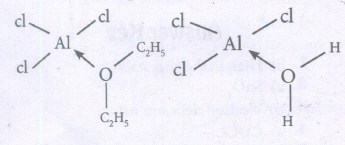
Which one is more soluble in diethyl ether, anhydrous Alcl3 or hydrated Alcl3? Explain in terms of bonding.
44.
Give the formula of chlorosilazanes. Explain its preparation from SiCI4.
45.
Write the reaction of diboranes with water and alkali.
46.
Why transition elements form complexes?
47.
Write ionic equation for the reaction between Cr2O7-2 ions and Fe2+ ions in acidic medium.
48.
List out the commercial uses of iron.
49.
What is hydrate isomerism? Give an example.
50.
What are Co-ordination isomers? Give examples
51.
What is Co-ordination sphere?
52.
Name the two steps involved in the extraction of crude metal
53.
Give the chemical formula of potassium trioxalato ferrate(III}
1.
4% solution of ethylnitrite in alcohol is known as sweet spirit of nitre and in used as diuretic.
2.
The N2CI group can be replaced by alkoxy group by warming with alcohol or by acyloxy group by boiling with carboxylic acids.

3.

4.
Esters containing at least one ∝- hydrogen atom undergo self condensation in the presence of a strong base such as sodium ethoxide to form β-keto ester.
5.
(i) for the dehydration of hides.
(ii) as a coagulating agent for rubber latex
(iii) in medicine for treatment of gout
(iv) as an antiseptic in the preservation of fruit juice.
6.
Carboxylic acid reacts with alcohols in the presence of mineral acid as catalyst and forms esters. This reaction is called esterlfleatlon.
\(\underset { Acetic\ acid }{ { CH }_{ 3 }COOH } +\underset { Ethyl\ alcohol }{ { C }_{ 2 }{ H }_{ 5 }OH } \overset { Conc.{ H }_{ 2 }{ SO }_{ 4 } }{ \longrightarrow } \underset { Ethyl\ acetate }{ { CH }_{ 3 }{ COOC }_{ 2 }{ H }_{ 5 } } +{ H }_{ 2 }O\)
7.
(i) Organic compounds containing the carboxyl group -COOH are called carboxylic acids.
(ii) The acid may be monocarboxylic acid if it contains one -COO H group; a dicarboxylic acid if it contains two - COOH groups; a tricarboxylic acid if it contains three - COOH groups.
Eg: CH3COOH - Acetic acid; (COOH)2- Oxalic acid
8.
Aromatic aldehydes react with primary amines (aliphatic or aromatic) in the presence of an acid to form Schiff's base.
Example:
9.
Addition reaction with NaHSO3.
In the addition of sodium bisulphite to give bisulphite compound - OSO2Na anion is the nucleophile.
10.
(i) \(H-\underset { \overset { || }{ O } }{ C } -H\) - Formaldehyde
(ii) \({ CH }_{ 3 }-\underset { \overset { || }{ O } }{ C } -H\) - Acetaldehyde
(iii) \({ CH }_{ 3 }-\underset { \overset { || }{ O } }{ C } -{ { CH }_{ 3 } }\) - Acetone
(iv) \(\\ { C }_{ 6 }{ H }_{ 5 }-\underset { \overset { || }{ O } }{ C } -{ CH }_{ 5 }\) - Aceopenone
11.
In simple amines the lone pair of electrons is on nitrogen and hence available for protonation. In amides, on the other hand, the electron pair on nitrogen is delocalized to the carbonyl oxygen through resonance.
12.
| S. NO. |
Ethylamine | Diethylamine |
| i. | It reacts with CHCl3 and KOH forms carbylamine. | It does not react with CHCl3 and KOH. |
| ii. | It reacts with HNO2 and forms ethyl alcohol. | It reacts with HNO2 and form N-nitroso amine (Yellowish oil). |
13.
CCl3 - NO2 (trichloronitro. methane) is Chloropicrin.
14.
Equanil.
15.
Antimicrobials inhibits bacterial cell wall biosynthesis
Uses: To treat skin infections, dental infections, ear infections, respiratory tract infections, pneumonia, urinary tract infections, and gonorrhoea.
E.g: Penicillin
16.
Neutralize the acid in the stomach that causes acidity.
Uses: To relieve symptoms such as burning sensation in the chest/ throat area (heart burns) caused by acid reflux.
Eg : Milk of Magnesia, Sodium bicarbonate, calcium bicarbonate, aluminium hydroxide.
17.
The synthesis of mRNA from DNA strand is called transcription.
18.
Proteins.
19.
DNA has double helix whereas RNA has single helix.
The common bases are Adenine, Guanine and Cytosine.
20.
Humans cannot use cellulose as food because our digestive systems do not contain the necessary enzymes (glycosidases or cellulases) that can hydrolyse the cellulose.
21.
Anomers are cyclic monosaccharide differing from each other in the configuration of C1 if they are aldoses or in the configuration of C2 if they are ketoses.
E.g. α and βD - glucose.
22.
(i) River water is colloidal solution of clay. Sea water contains a number of electrolytes.
(ii) When river water meets the sea water, the electrolytes present in sea water coagulate the colloidal solution of clay which get deposited with the formation of delta.
23.
Emulsion can be separated into two separate layers. The process is called Deemulsification.
24.
(i) In adsorption, if the concentration of a substance in the interface is high, then it is called positive adsorption.
(ii) In adsorption, if the concentration of a substance in the interface is less, then it is called negative adsorption.
25.
The electrochemical equivalent is defined as the amount of substance deposited or liberated at the electrode by a charge of 1 coulomb.
m = z (If I = 1 ampere and t = second).
26.
(i) Leclanche cell
(ii) Mercury button cell
27.
It is an Galvanic cell.
28.
Kohlrausch deduced the following empirical relationship between the molar conductance (\({ \Lambda }_{ m }\)) and the concentration of the electrolyte (C).
\({ \Lambda }_{ m }={ \Lambda }_{ m }^{ o }-k\sqrt { C } \)
29.
The resistance of such an electrolytic solution is also directly proportional to the length (l) and inversely proportional to the cross sectional area (A)
R α \(\frac{l}{A}\)
R = ρ \(\frac{l}{A}\)
30.

31.
Test to differentiate alcohol and phenols:
(i) Phenol react with benzene diazonium chloride to form a red orange dye, but ethanol has no reaction with it.
(ii) Phenol gives purple colouration with neutral ferric chloride solution, alcohols do not give such coloration with FeCI3.
(iii) Phenol reacts with NaOH to give sodium phenoxide. Ethyl alcohol does not react with NaOH.
32.
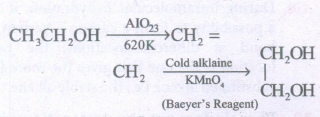
33.
When C2H5OH (Ethanol) is treated with cone H2SO4 at 410 K, intermolecular dehydration take place and the product formed will be diethyl ether C2H5-O-C2H5.

34.
When an acid reacts with a base, a salt and water are formed and the reaction is called neutralization.
35.
Action of heat : When heated, potassium permanganate decomposes to form potassium manganate and manganese dioxide.

36.
\({ k }=2.303\log { \frac { \left[ { A }_{ 0 } \right] }{ \left[ A \right] } } \)
\(t=\frac { 2.303 }{ { 10 }^{ -3 } } \log { \frac { 10 }{ 2.5 } } \)
t = 2303 x 0.301 x 2 = 1386 s.
37.
Rate of a reaction at any time depends on the concentration of the reactants which keeps on decreasing with time.
38.
(i) Sulphur has great catenation property and forms large molecule having high weight, which results higher melting point.
(ii) While oxygen exists as diatomic molecule of less molecular weight, hence has very low melting point.
39.
Ammonia is prepared in the laboratory by heating an ammonium salt with a base.
\({ 2NH }_{ 4 }^{ + }+{ OH }^{ - }\longrightarrow { 2NH }_{ 3 }+{ H }_{ 2 }O\)
\({ 2NH }_{ 4 }Cl+CaO\longrightarrow { CaCl }_{ 2 }+{ 2NH }_{ 3 }+{ H }_{ 2 }O\)
40.
In FeS, Fe2+ ions are replaced by Fe3+ ions. To maintain electrical neutrality, 3 Fe2+ ions are replaced by 2Fe3+ ions
41.
The length of the side of the unit cell of the metal is 353.55 pm.
For fee unit cell, a =(2√2) x r
= 2 x 1.414 x 125
= 353.55pm.
42.
(i) In ionic compounds, electricity is conducted by ions.
(ii) In solid state, ions are held together by A strong electrostatic forces and are not free to move about within the solid.
(iii) Hence, ionic solids do not conduct electricity in solid state
(iv) However, in molten state or in solution form, the ions are free to move and can conduct electricity.
43.
(i) Anhydrous AlCl3 is an electro-deficient compound while hydrated AICl3 is not.
(ii) Therefore, anhydrous AICl3 is more soluble in diethyl either because the oxygen atom of ether donates a pair of electrons to the vacant p-orbital on the Al atom in AlCl3 forming a co-ordinate bond.
(iii) In case of hydrated AlCl3, Al is not electron deficient, since, H2O has already donated a pair of e- to it.
44.
Chlorosilazanes is Cl3Si - NH - SiCl3.Silicon tetrachloride undergoes ammonolysis to form chlorosilazanes.
\(2Si{ Cl }_{ 4 }+{ NH }_{ 3 }\overset { 330K }{ \underset { Ether }{ \longrightarrow } } { Cl }_{ 3 }Si-NH-Si{ Cl }_{ 3 }\).
45.
Diboranes reacts with water and alkali to give boric acid and metaborates respectively.
B2H6+ 6H2O ⟶ 2H3BO3 + 6H2
B2H6+ 2NaOH + H2O ⟶ 2NaBO2 + 6H2
46.
Transition elements have strong tendency to form:
complexes because of two reasons. They are
(i) Small size and high positive charge density.
(ii) Presence of cant (n-1) d orbitals which are of appropriate energy to accept lone pair and unshared pair of electrons from the ligands for bonding with them.
47.
Cr2O72- + 14H+ + 6Fe2+ ⟶ 2Cr3+ + 6Fe3+ + 7H2O
48.
(i) Iron is used in the manufacture of wrought iron and steel.
(ii) Cast iron is used for casting stoves, railway sleepers, toys, etc.
(iii) Stainless steel is used for cycles, automobiles, utensils, pens, etc.
(iv) Chrome steel is used for cutting tools and crushing machines
49.
The best known examples of this type of isomerism occur for chromium chloride CrCI3.6H2O which may contain 4, 5, (or) 6 coordinated water molecules.
[Cr(H2O)4CI2]Cl.2H2O -Bright green
Tetraaquadichlorochromium(III)chloride dihydrate
[Cr(H2O)5CI]Cl2.H2O - grey-green
Pentaaquachlorochromium(III) chloride monohydrate
[Cr(H2O)6]CI3 Violet
Hexaaquachromium (III) chloride
50.
Isomers that arises in the coordination compounds having both the cation and anion as complex ions. The interchange of one or more ligands between the cationic and the anionic coordination entities result in different isomers.
(i) [Cr(NH3)5CN] [Co(NH3) (CN)5] and [Co(NH3)5CN] [Cr(NH3)( CN)5]
(ii) [Pt(NH3)4] [Pd(CI)4] and [Pd(NH3)4] [Pt(Cl)4]
51.
(i) The complex ion of the coordination compound containing the central metal atom/ion and the ligands attached to it is collectively called coordination sphere and are usually enclosed in square brackets with the net charge.
(ii) The other ionisable ions, are written outside the bracket are called counter ions. For example, the coordination compound K4[Fe(CN)6] contains the complex ion [Fe(CN)6]4- and is referred as the coordination sphere.
(iii) The other associated ion K+ is called the counter ion.
52.
(i) Conversion of ores into oxides.
(ii) Reduction of metal oxides.
53.
K3[Fe(C2O4)3]

12th Standard Syllabus & Materials
12th Standard
TN 12th Computer Applications களப்பெயர் முறைமை (DNS) Sample Question Papers Study Material - QB365 Set A
NEW12th Standard
TN 12th Computer Applications வலையமைப்பு எடுத்துக்காட்டுகள் மற்றும் நெறிமுறைகள் Sample Question Papers Study Material - QB365 Set A
NEW12th Standard
TN 12th Computer Applications கணினி வலையமைப்பு ஓர் அறிமுகம் Sample Question Papers Study Material - QB365 Set A
NEW12th Standard
TN 12th Computer Applications PHP-உடன் MySQL-ஐ இணைத்தல் Sample Question Papers Study Material - QB365 Set A



Tamilnadu Stateboard 12th Standard Subjects

Maths
Chemistry

Physics

Biology

Computer Science

Business Maths and Statistics

Economics

Commerce

Accountancy

History

Computer Applications
Biology
Computer Technology
Computer Applications
Computer Science
Business Maths and Statistics
Commerce
Economics
Maths
Chemistry
Physics
Computer Technology
History
Accountancy

Tamil

English

French
Tamilnadu Stateboard Standards
