
 100% FREE ACCESS
12th Standard Syllabus & Materials
12th Standard
TN 12th Computer Applications மின்னணு தரவு பரிமாற்றம் Sample Question Papers Study Material - QB365 Set A
NEW12th Standard
TN 12th Computer Applications மின் - வணிக பாதுகாப்பு அமைப்புகள் Sample Question Papers Study Material - QB365 Set A
NEW12th Standard
TN 12th Computer Applications மின்னணு செலுத்தல் முறைகள் Sample Question Papers Study Material - QB365 Set A
NEW12th Standard
TN 12th Computer Applications மின் - வணிகம் Sample Question Papers Study Material - QB365 Set A
NEW12th Standard
TN 12th Computer Applications திறந்த மூல கருத்துருக்கள் Sample Question Papers Study Material - QB365 Set A
NEW12th Standard
TN 12th Computer Applications வலையமைப்பு வடமிடல் Sample Question Papers Study Material - QB365 Set A

Published on: 03/09/2020
12th Standard Chemistry English Medium Model 3 Mark Book Back Questions (New Syllabus) 2020
Download Tamil Nadu 12th Standard Chemistry question papers, model tests, one-mark questions, important questions, and public exam papers in PDF format. Free study materials and answer keys for TN State Board students.
Questions + Answers key
Take MCQ Chemistry Test
1.
How will you convert benzaldehyde into the following compounds?
(i) benzophenone
(ii) benzoic acid
(iii) α-hydroxyphenylaceticacid.
2.
What happens when a colloidal sol of Fe(OH)3 and As2S3 are mixed?
3.
Why carbohydrates are generally optically active.
4.
A gas phase reaction has energy of activation 200 kJ mol-1. If the frequency factor of the reaction is 1.6 x 10¹³s-1. Calculate the rate constant at 600 K.(e-40.09 = 3.8 x 10-48)
5.
6.
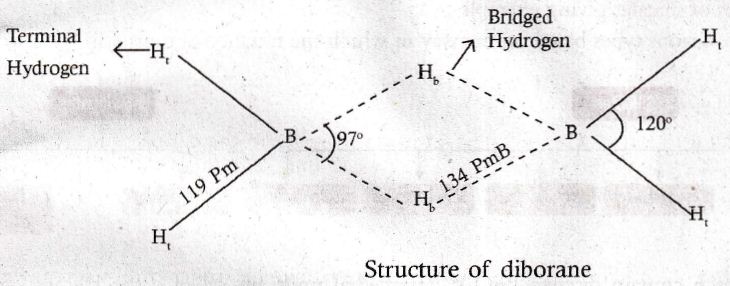
Describe the structure of diborane.
7.
Explain the electrometallurgy of aluminium.
8.
Compound (A) C6H12O2 on reduction with LiAlH4 yields two compounds B and C. The compound (B) on oxidation gave (D) which on treatment with aqueous alkali and subsequent heating furnished E. The latter on catalytic hydrogenation gave (C). Compound (D) on oxidation gave monobasic acid (molecular formula weight = 60). Deduce the structure of (A), (B), (C), (D) and (E).
9.
Write the mechanism of acid catalysed dehydration of ethanol to give ethene.
10.
How will you prepare propan – 1- amine from
i) butane nitrile
ii) propanamide
ii) 1- nitropropane
11.
0.1M NaCl solution is placed in two different cells having cell constant 0.5 and 0.25 cm-1 respectively. Which of the two will have greater value of specific conductance.
12.
Derive an expression for the hydrolysis constant and degree of hydrolysis of salt of strong acid and weak base.
13.
The rate of formation of a dimer in a second order reaction is 7.5 x 10⁻³ mol L-1 s-1 at 0.05 mol L-1 monomer concentration. Calculate the rate constant.
14.
Which is more stable? Fe3+ or Fe2+? Why ?
15.
Give one test to differentiate [Co(NH3)5Cl]SO4 and [Co(NH3)5SO4]Cl.
16.
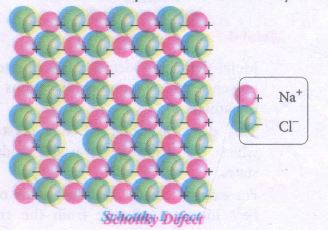
Explain Schottky defect.
17.
Account for the following
i. Aniline does not undergo Friedel – Crafts reaction
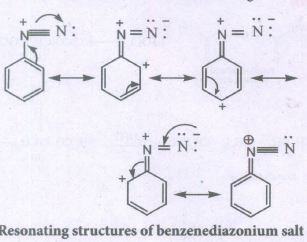
ii. Diazonium salts of aromatic amines are more stable than those of aliphatic amines
iii. pKb of aniline is more than that of methylamine
iv. Gabriel phthalimide synthesis is preferred for synthesising primary amines.
v. Ethylamine is soluble in water whereas aniline is not
vi. Amines are more basic than amides
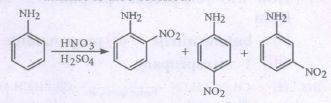
vii.Although amino group is o – and p – directing in aromatic electrophilic substitution reactions, aniline on nitration gives a substantial amount of m – nitroaniline.
18.
Explain the mechanism of cleansing action of soaps and detergents.
19.
Explain common ion effect with an example.
1.
.JPG)
(ii) benzoic acid
.JPG)
(iii) α - hydroxyphenylaceticacid.
.JPG)
2.
(i) Neutralisation of chargers of ion will taken place and hence precipitation will take place (ie) Fe3+ and S2- ion changes are neutralized. No new compounds are formed.
(ii) Fe(OH)3 is a positive Sol
(iii) As2S3 is a negative Sol
3.
(i) Almost all carbohydrates are optically active as they contain one or more chiral carbons.
(ii) The number of optical isomers depends upon the number of chiral carbons (ie) 2n isomers, where n = total number of chiral carbons.
(iii) Glucose has \(4{ }^{\star} \)C; ∴ It has 24 =16 isomers.
4.
Ea = 200 kJ mol-1=200 \(\times\) 103J mol-1
A = 1.6 \(\times\) 1013s-1; T = 600 K; R = 8.314 JK mol-1
\(k=A{ e }^{ -\left( \frac { Ea }{ RT } \right) }\)
\(k=1.6\times { 10 }^{ 13 }{ s }^{ -1 }{ e }^{ -\left( \frac { 200\times 10^3}{ 8.314 \times 600 } \right) }\)
\(k=1.6\times { 10 }^{ 13 }{ s }^{ -1 }{ e }^{ -\left( 40.09 \right) }\)
\(k=1.6\times { 10 }^{ 13 }\times 3.8\times { 10 }^{ -18 }{ s }^{ -1 }\)
\(k=6.08\times { 10 }^{ -5 }{ s }^{ -1 }\)
5.
6.
(i) In diborane two BH2 units are linked by two bridged hydrogens.
(ii) It has eight B-H bonds.
(iii) Diborane has only 12 valance electrons.
(iv) The four terminal B-H- bonds is "2c - 2e" bond (two centre - two electron bond.)
(v) Two three centred B - H - B bonds two electrons each. "(3c - 2e)"
(vi) In diborane, the boron is "sp3" hybridised
(vii) Three of the four "sp3" hydridised orbitals contains single electron and the fourth orbital is empty.
7.
1. This process is called as Hall-Heroult process.
Cathode: In this method, electrolysis is carried out in an iron tank lined with carbon which acts as the cathode.
Anode: The carbon blocks immersed in the electrolyte acts as a anode.
Eletrolyte: A 20% solution of alumina, obtained from the bauxite ore is mixed with molten Cryolite and is taken in the electrolysis chamber.
2. About 10% calcium chloride is also added to the solution.
3. Here Calcium chloride helps to lower the melting point of the mixture.
Temperature: The fused mixture is maintained at a temperature of above 1270 K.
4. The chemical reactions involved in this process as follows
(a) Ionisaiton of alumina: \({ A }l_{ 2 }{ O }_{ 3 }\longrightarrow { 2Al }^{ 3+ }+{ 3O }^{ 2- }\)
(b) Reaction at cathode: \(2{ Al }^{ 3+ }_{(melt)}+{ 6e }^{ - }\longrightarrow { Al }_{ (l) }\)
(c) Reaction at anode: \(6{ O }^{2-}_{(melt)}\longrightarrow { 3O }_{ 2 }+{ 12e }^{ - }\)
5. Since carbon acts as anode the following reaction also takes place
(a) \({ C }_{ (s) }+{ O }^{ 2- }_{(melt)}\longrightarrow CO+{ 2e }^{ - }\)
(b) \({ C }_{ (s) }+{ 2O }^{ 2- }_{(melt)}\longrightarrow { CO }_{ 2 }+{ 4e }^{ - }\)
6. Due to the above two reactions, anodes are slowly consumed during the electrolysis.
7. The pure aluminium is formed at the cathode. The net electrolysis reaction can be written as
\({ 4Al }^{ 3+ }_{(melt)}+{ 6O }^{ 2- }_{(melt)}+{ 3C }_{ (s) }\longrightarrow { 4Al }_{ (l) }+{ 3CO }_{ 2(g) }\)
8.
(i) E is monobasic acid (RCOOH) having molecular weight 60 and it is formed from D on oxidation. So E must be acetic acid and D must be acetaldehyde.
(ii) (B) on oxidation gives CH3CHO. So (B) must be alcohol (CH3CH2OH).
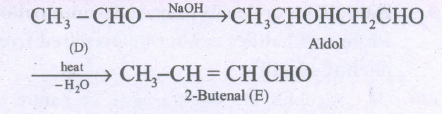
(iii) Acetaldehyde (D) on treating with aqueous alkali (NaOH) gives aldol which on heating gives 2- butenal (E).
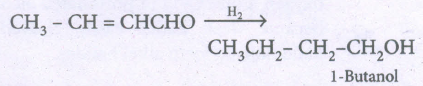
(iv) Compound E on catalytic hydrogenation gives butyl alcohol.
(v) Hence compound (A) must be an ester. Ester (A) on reduction with LiAIH4 yields two alcohols (B) and (C). (A) is ethyl butyrate.
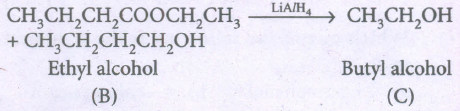
'A' can also be CH3COOCH2CH2CH2CH3. This structure will be answering all the above reactions.
9.
\({ CH }_{ 3 }-{ CH }_{ 2 }-OH\overset { { H }_{ 2 }{ SO }_{ 4 } }{ \underset { 443k }{ \longrightarrow } } { CH }_{ 2 }={ CH }_{ 2 }+{ H }_{ 2 }O\)
Mechanism
Primary alcohols undergo dehydration by E2 mechanism

10.
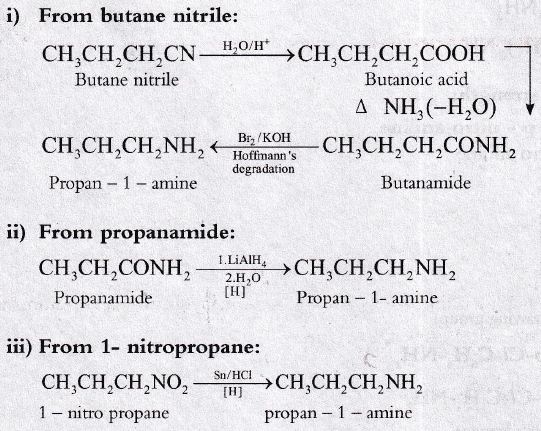 + 2H2O
11.
\(\kappa=\mathrm{C}\left(\frac{l}{\mathrm{~A}}\right)\) (or) k = 1/R.l/A
Where, C - Conductance
\(\frac{l}{A} \Rightarrow\) Cell constant (or)
Sp. Conductance \(\propto\) Cell constant
Sp. Conductance \(\propto\) Concentration
1. Sp. Conductance = concentration x cell constant
i) \(\kappa=0.1 \times 0.5=0.05=5 \times 10^{-2} \mathrm{Scm}^{-1}\)
ii) \(\kappa=0.1 \times 0.25=0.025=2.5 \times 10^{-2} \mathrm{Scm}^{-1}\)
2. So the first case will have greater specific conductance with cell constant 0.05.
12.
(i) Let us consider the reactions between a strong acid, HCI, and a weak base, NH4OH, to produce a salt, NH4CI, and water.
HCI(aq) + NH4OH(aq) ⇌ NH4CI(aq) + H2O (I)
NH4CI(aq) ⟶ NH4+ +CI-(aq)
(ii) NH4+ is a strong conjugate acid of the weak base NH4OH and it has a tendency to react with OH- from water to produce unionised NH4OH
NH4+ (aq) + H2O(I) ⇌ NH4OH(aq) + H+(aq)
(iii) There is no such tendency shown by Cl- and therefore [H+] > [OH-]; the solution is acidic and the pH is less than 7.
(iv) The Kh and Kb are related by
\(\mathrm{K}_{\mathrm{h}} \cdot \mathrm{K}_{\mathrm{b}}=\mathrm{K}_{\mathrm{w}}\)
(Or)
\(\mathrm{K}_{\mathrm{h}}=\frac{\mathrm{K}_{\mathrm{w}}}{\mathrm{K}_{\mathrm{b}}}\)
Degree of hydrolysis (h)
\(\underset{(1-h)}{\mathrm{NH}_{4}^{+}(\mathrm{aq})}+\mathrm{H}_{2} \mathrm{O}_{(j)} \rightleftharpoons \underset{h} {\mathrm{NH}_{4} \mathrm{OH}_{(\mathrm{aq})}} +\mathrm{H}^{+} \underset{h}{(\mathrm{aq})}\\ \)
\(\mathrm{K}_{\mathrm{h}} =\frac{\left[\mathrm{NH}_{4} \mathrm{OH}\right]\left[\mathrm{H}^{+}\right]}{\left[\mathrm{NH}_{4}^{+}\right]} \\ \)
\(=\frac{\mathrm{hc} \times \mathrm{h}}{(1-\mathrm{h}) \mathrm{c}} \)
\(K_{h}=\frac{h^{2} c}{(1-h)} \)
\(\text{If } \mathrm{h}<<1 ; \mathrm{K}_{\mathrm{h}} \simeq \mathrm{h}^{2} \mathrm{c} \)
\(h^{2}=\frac{K_{h}}{c}\)
\(h=\sqrt{\frac{K_{h}}{c}} \ (or) \ h=\sqrt{\frac{K_{w}}{K_{b} \cdot C}} \quad\left(\because K_{h}=\frac{K_{w}}{K_{b}}\right)\)
Also; \(\left[\mathrm{H}^{+}\right]=\sqrt{\mathrm{K}_{\mathrm{h}} \cdot \mathrm{C}} \) (or) \(\left[\mathrm{H}^{+}\right]=\sqrt{\frac{\mathrm{K}_{\mathrm{w}} \cdot \mathrm{C}}{\mathrm{K}_{\mathrm{b}}}}\)
pH = -log [H+]
13.
If the monomer is represented by X. Then
\(2 \mathrm{M} \rightarrow(\mathrm{M})_{2}\)
Since the reaction is of second order, the rate of reaction will be given by,
\(\text { Rate }=\mathrm{k}[\mathrm{M}]^{n} \)
\(7.5 \times 10^{-3} \mathrm{~mol} \mathrm{~L}^{-1} \mathrm{~s}^{-1}=\mathrm{k}\left(0.05 \mathrm{~mol} \mathrm{} \mathrm{~L}^{-1}\right)^{2} \)
\(\mathrm{k} =\frac{Rate}{[M]^{n}} \)
\(\mathrm{k} =\frac{7.5 \times 10^{-3}}{(0.05)^{2}} \)
\(=3 \mathrm{~mol}^{-1} \mathrm{~L} \mathrm{~s}^{-1}\)
14.
(i) Fe3+ - electronic configuration - [Ar] 3d5
(ii) It has exactly half-filled stable electronic configuration.
(iii) Fe2+ - electronic configuration -[Ar]3d6
(iv) It has only partially filled d-orbitals.
Hence Fe3+ is more stable than Fe2+.
15.
These two are ionisation isomers. [Co(NH3)5Cl]SO4 gives white precipitate with BaCl2 solution, but not with AgNO3 solution. [Co(NH3)5SO4]Cl gives curdy white precipitate with AgNO3 solution but not with BaCl2 solution.
16.
(i) Schottky defect arises due to the missing of equal number of cations and anions from the crystal lattice. This effect does not change the stoichiometry of the crystal.
(ii) Ionic solids in which the cation and anion are of almost of similar size show schottky defect.
Example: NaCl.
(iii) Presence of large number of schottky defects in a crystal, lowers its density.
(iv) Presence of Schottky defect in the crystal provides a simple way by which atoms or ions can move within the crystal lattice.
17.
Aniline does not undergo Friedel - Craft's reaction:
Aniline does not undergo Friedel - Craft's reaction (alkylation and acetylation). Aniline is basic in nature and it donates its lone pair of electrons to the lewis acid AlCl3 to form an adduct which inhibits further electrophilic substitution reaction.
Diazonium salts of aromatic amines are more stable than those of aliphatic amines:
This is due to resonance
Resonance Structure:
The stability of arene diazonium salt is due to the dispersal of the positive charge over the benzene ring.
pKb of aniline is more than that of methylamine:
pKb - methylamine -3.35
pKb - aniline -9.376
In aniline the lone pair of electrons on N - atom is delocalized over the benzene ring. So, the electron density on the N - atom decreases. In methylamine + 1 effect to CH3 group increases the electron density on the nitrogen atom Hence aniline is a weaker base than methylamine. Due to this, the pKb value for aniline is more than that of methylamine.
(iv) Gabriel phthalimide synthesis is preferred for synthesising primary amines:
In this method alkyl halides react with pottassium phthalimide to give pure primary amine by nucleophilic substitution. In contrast, Aniline (Aromatic primary amine) can not be prepared by this method because Aryl halides do not undergo nucleophilic substitution with the anion formed by phthalimide. Therefore, this method used for the Aliphatic primary. amines only. Aryl halides do not undergo SN2 mechanism with the ion formed by the phthalimide.
(v) Ethylamine is soluble in water whereas aniline is not:
(a) Ethylamine is soluble in water, as it can form intermolecular H - bonds with water molecules. In aqueous solution, the substituted ammonium cation get stabilized not only by electron releasing (+I) effect of the alkyl group but also by solvation with water molecules. The greater the size of the ion, the lower will be the solvation.
(b) Amiline doesn't form H - bond with water to a very large extent due to the presence of a large hydrophobic -C6H5 group.
(vi) Amines are more basic than amides:
This is because, in amides, the carbonyl group is highly electro negative It has a greater power to attract the electrons towards it. It makes the lone pair of electrons on amide nitrogen (-CONH2) less available to accept a proton.
(vii) Although amino group is o - and p - directing in aromatic electrophilic substitution reactions, aniline on nitration gives a substantial amount of m - nitro aniline:
In strong acid medium, aniline is protonated to form anilinium ion which is m - directing and hence m - nitro aniline is formed.
18.
(i) To understand how a soap works as a cleansing agent, let us consider sodium palmitate an example of a soap. The cleansing action of soap is directly related to the structure of carboxylate ions (palmitate ion) present in soap. The structure of palmitate exhibit dual polarity. The hydrocarbon portion is non polar and the carboxyl portion is polar.

(ii) The nonpolar portion is hydrophobic while the polar end is hydrophilic. The hydrophobic hydro carbon portion is soluble in oils and greases, but not in water. The hydrophilic carboxylate group is soluble in water.
(iii) The dirt in the cloth is due to the presence of dust particles intact or grease which stick. When the soap is added to an oily or greasy part of the cloth, the hydrocarbon part of the soap dissolve in the grease, leaving the negatively charged carboxylate end exposed on the grease surface.
(iv) At the same time the negatively charged carboxylate groups are strongly attracted by water, thus leading to the formation of small droplets called micelles and grease is floated away from the solid object. When the water is rinsed away, the grease goes with it. As a result, the cloth gets free from dirt and the droplets are washed away with water. The micelles do not combine into large drops because their surfaces are all negatively charged and repel each other. The cleansing ability of a soap depends upon its tendency to act as a emulsifying agent between water and water insoluble greases.
.JPG)
The cleansing action of detergents are similar to cleansing action of soap. Eg: the structure of a cationic detergents is:
.JPG)
19.
(i) The dissociation of a weak acid (CH3COOH) is suppressed in the presence of a salt (CH3COONa) containing an ion common to the weak electrolyte. It is called the common ion effect.
(ii) Consider the dissociation of a weak acid, acetic acid whose ionisation is incomplete.
CH3COOH(aq) ⇌ H+(aq) + CH3COO-(aq)
(iii) If the salt sodium acetate with common ion CH3COO- is added to the above equilibrium, it dissociates completely increasing.
CH3COONa(aq)⟶Na+(aq) + CH3COO-(aq)
(iv) Hence, the overall concentration of CH3COO- is increased, and the acid dissociation equilibrium is disturbed.
(v) So, in order to maintain the equilibrium, the excess CH3COO- ions combines with H+ ions to produce much more unionized CH3COOH i.e, the equilibrium will shift towards the left. In other words, the dissociation of CH3COOH is suppressed.

12th Standard Syllabus & Materials
12th Standard
TN 12th Computer Applications களப்பெயர் முறைமை (DNS) Sample Question Papers Study Material - QB365 Set A
NEW12th Standard
TN 12th Computer Applications வலையமைப்பு எடுத்துக்காட்டுகள் மற்றும் நெறிமுறைகள் Sample Question Papers Study Material - QB365 Set A
NEW12th Standard
TN 12th Computer Applications கணினி வலையமைப்பு ஓர் அறிமுகம் Sample Question Papers Study Material - QB365 Set A
NEW12th Standard
TN 12th Computer Applications PHP-உடன் MySQL-ஐ இணைத்தல் Sample Question Papers Study Material - QB365 Set A



Tamilnadu Stateboard 12th Standard Subjects

Maths
Chemistry

Physics

Biology

Computer Science

Business Maths and Statistics

Economics

Commerce

Accountancy

History

Computer Applications
Biology
Computer Technology
Computer Applications
Computer Science
Business Maths and Statistics
Commerce
Economics
Maths
Chemistry
Physics
Computer Technology
History
Accountancy

Tamil

English

French
Tamilnadu Stateboard Standards
