
 100% FREE ACCESS
12th Standard Syllabus & Materials
12th Standard
TN 12th Computer Applications மின்னணு தரவு பரிமாற்றம் Sample Question Papers Study Material - QB365 Set A
NEW12th Standard
TN 12th Computer Applications மின் - வணிக பாதுகாப்பு அமைப்புகள் Sample Question Papers Study Material - QB365 Set A
NEW12th Standard
TN 12th Computer Applications மின்னணு செலுத்தல் முறைகள் Sample Question Papers Study Material - QB365 Set A
NEW12th Standard
TN 12th Computer Applications மின் - வணிகம் Sample Question Papers Study Material - QB365 Set A
NEW12th Standard
TN 12th Computer Applications திறந்த மூல கருத்துருக்கள் Sample Question Papers Study Material - QB365 Set A
NEW12th Standard
TN 12th Computer Applications வலையமைப்பு வடமிடல் Sample Question Papers Study Material - QB365 Set A

Published on: 03/09/2020
12th Standard Chemistry English Medium Model 3 Mark Creative Questions (New Syllabus) 2020
Download Tamil Nadu 12th Standard Chemistry question papers, model tests, one-mark questions, important questions, and public exam papers in PDF format. Free study materials and answer keys for TN State Board students.
Questions + Answers key
Take MCQ Chemistry Test
1.
Write a note on structure of amine.
2.
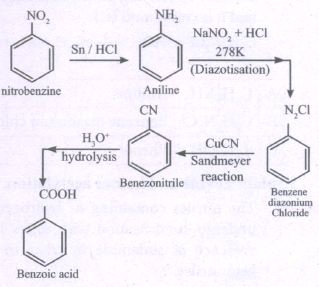
How will convert nitrobenzene to benzoic acid?
3.
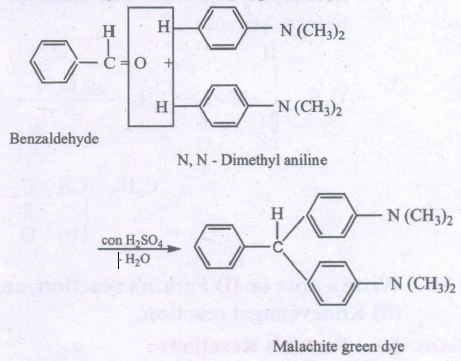
What is Malachite green dye? Explain its preparation?
4.
What is Rosenmund's reduction? What is the purpose of adding BaSO4 in it?
5.
6.
Give some of the advantages of using food additives.
7.
Amino acids are amphoteric in nature. Explain.
8.
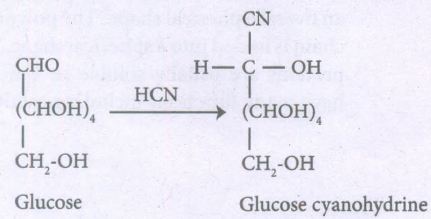
Write the product formed when HCN reacts with glucose.
9.
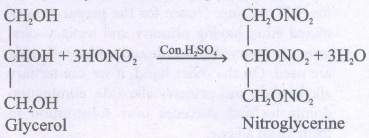
How is nitroglycerine prepared from glycerol?
10.
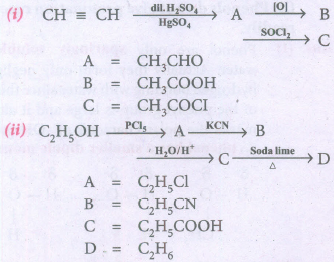
Complete the following equations by writing the missing A, B, C, D etc.,
11.
Explain the meaning of the statement. 'Adsorption is a surface phenomenon'.
12.
Explain the advantages of using nano catalyst.
13.
Show that SHE can act both as a anode as well as cathode.
14.
Explain the process of recharging of lead storage battery.
15.
Explain the relationship between free energy of the cell and its emf.
16.
17.
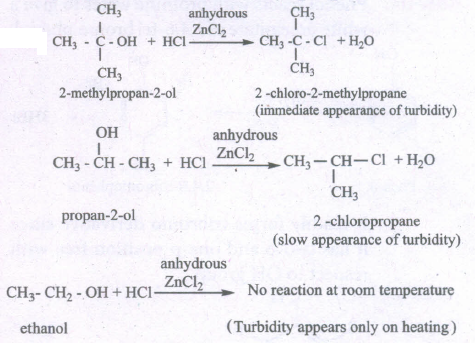
Give chemical tests to distinguish between propan-2-ol and 2-methyl-propan-2-ol.
18.
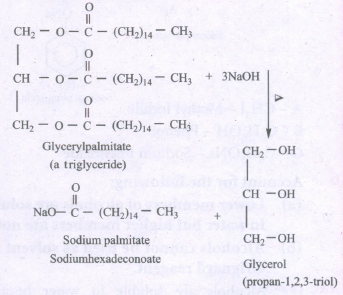
Explain the manufacture of glycerol from triglycerides,
19.
Define buffer Index
20.
Give three uses of KMnO4
21.
What is chromyl chloride test? Give equations.
22.
A reaction is second order with respect to a reactant. How is the rate of reaction affected if the concentration of the reactant is
(i) doubled (ii) reduced to half
23.
Give reason for the following:
(i) A transition metal exhibits highest oxidation state in oxides and fluorides.
(ii) Cu2+ is unstable in an aqueous solution.
24.
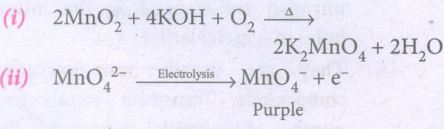
Write chemical equations for the reactions involved in the manufacture of potassium permanganate from pyrolusite ore.
25.
(i) Molecularity of any reaction is not equal to zero. Why?
(ii) For which type of reactions, order, and molecularity have the same value?
26.
Write the order of thermal stability of the hydrides of group 16 elements.
27.
Explain the structure of ammonia.
28.
How do the spacings of the three planes (100), (101) and (111) of simple cubic lattice vary?
29.
Silver crystallizes in fcc lattice. If edge length of the cell is 4.07 x 10⁻⁸ em and density is 10.5 g cm-3. Calculate the atomic mass of silver
30.
Describe the structure of fullerenes.
31.
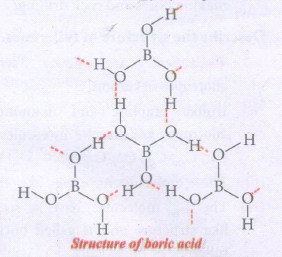
Draw the structure of boric acid.
32.
What is meant by aluminothermic process?
33.
Explain roasting with an example.
34.
What are the limitations of VBT?
1.
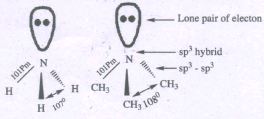
Structure of amines:
(i) Like, ammonia, nitrogen atom of amines is trivalent and carries a lone pair of electron and sp3 hybridised, out of the four sp3 hybridised orbitals of nitrogen, three sp3 orbitals overlap with orbitals of hydrogen (or) alkyl groups of carbon, the fourth sp3 orbital contains a lone pair of electron.
(ii) Hence, amines possess pyramidal geometry. Due to presence of lone pair of electron C-N-H (or) C-N-C bond angle is less than the normal tetrahedral bond angle 109.5°.
For example, the C-N-C bond angle of trimethylamine is 108° which is lower than tetrahedral angle and higher than the H-N-H bond angle of 107°.
(iii) This increase is due to the repulsion between the bulky methyl groups.
2.
3.
Benzaldehyde condenses with tertiary aromatic amines like N, N - dimethyl aniline in the presence of strong acids to from triphenyl methane dye or malachite green dye.
4.
(i) When reduced with hydrogen in the presence of 'poisoned' palladium catalyst, they form aldehydes. This reaction is called Rosenmund reduction.
\(\underset { acetyl\ chloride }{ { CH }_{ 3 }-\underset { \overset { || }{ O } }{ C } -Cl } +H-H\overset { Pd }{ \underset { Ba{ SO }_{ 4 } }{ \longrightarrow } } \underset { acetaldehyde }{ CH_{ 3 }-\underset { \overset { || }{ O } }{ C } -H+HCl } \)
(ii) BaSO4 is used as a catalytic poi on to stop the reduction at the stage of aldehyde.
(iii) Otherwise, the aldehyde formed will be further reduced to primary alcohol.
5.
6.
Advantages of food additives :
(i) Uses of preservatives reduce the product spoilage and extend the shelf-life of food.
(ii) Addition of vitamins and minerals reduces the mall nutrient.
(iii) Flavouring agents enhance the aroma of the food.
(iv) Antioxidants prevent the formation of potentially toxic oxidation products of lipids and other food constituents.
7.
At aqueous solution, the proton from carboxyl group can be transferred to the amino group of an amino acid leaving these groups with opposite charges. Despite having both positive and negative charges, this molecule is neutral and has amphoteric behaviour. These ions are called zwitter ions.
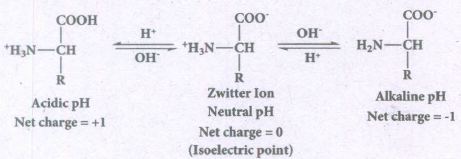
Zwitter ions behave as neutral molecules at pH isoelectric point.
8.
Glucose reacts with HCN to form cyanohydrin.
9.
When glycerol is treated with a well cooled mixture of concentrated sulphuric acid and fuming nitric acid, nitroglycerine is formed.
10.
11.
When a solid adsorbent is placed in a closed vessel containing some gas or a solution. The molecules of the gas or the solute are adsorbed on the surface so that their concentration or higher on the surface. Hence, it is called a surface phenomenon.
12.
(i) Nano materials such a metallic nano particles, metal oxides, etc., are used as catalyst in many chemical transformation. Nanocatalysts carry the advantages of both homogeneous and heterogeneous catalyses.
(ii) Like homogeneous catalysts, the nanocatalysts give 100% selective transformations and excellent yield and show extremely high activity.
(iii) Like the heterogeneous catalysts, nanocatalysts can be recovered and recycled.
13.
(i) When it is placed on the right-hand side of the zinc electrode, the hydrogen electrode reaction is,
2H++ 2e- ➝ H2
The electrons flow to the SHE and it acts as the cathode.
(ii) When the SHE is placed on the left hand side, the electrode reaction is
H2 ➝ 2H++ 2e-
The electrons flow to the copper electrode and the hydrogen electrode acts as the anode.
14.
During recharge process, the role of anode and cathode is reversed and H2SO4 is regenerated.
Oxidation occurs at the cathode ( now act as anode)
\(\stackrel {+2}{{ PbS }O}_{ 4(s) }+2{ H }_{ 2 }O(l)\rightarrow \stackrel{+4}{ Pb }O_{ 2(S) }+{ SO }_{ 4(aq) }^{ 2- }\)
Reduction occurs at the anode (now act as cathode)
\({ PbS }O_{ 4(s) }^{ }+2{ e }^{ - }\rightarrow { Pb }_{ (s) }+{ SO }_{ 4(aq) }^{ 2- }\)
Overall reaction:
\({ 2PbS }O_{ 4(s) }^{ }+2{ H }_{ 2 }O(l)\rightarrow { Pb }_{ (s) }+{ Pb }O_{ 2(S) }+{ 4H }_{ (aq) }^{ + }+{ SO }_{ 4(aq) }^{ 2- }\)
Thus, the overall cell reaction is exactly the reverse of the redox reaction which takes place while discharging
15.
The maximum work that can be obtained from a galvanic cell is
(Wmax)cell = - nFEcell ...(1)
Here the (-) sign is introduced to indicate that the work is done by the system on the surroundings. According to Second Law of thermodynamics, the maximum work done by the system is equal to the change in the Gibbs free energy of the system.
i,e, Wmax= ∆G .......(2)
From (1) and (2),
∆G = - nFEcell ....(3)
For a spontaneous cell reactions, the ∆G should be negative. The above expression (3) indicates that Ecell should be positive to get a negative ∆G value.
When all the cell components are in their standard state, the equation becomes
∆Go = -nFEocell
16.
17.
18.
Glycerol occurs in many natural fats and it is also found in long chain fatty acids in the form of glyceryl esters (Triglycerides). The alkaline hydrolysis of these fats gives glycerol and the reaction is known as saponification.
19.
Buffer index β, as a quantitative measure of the buffer capacity. It is defined as the number of gram equivalents of acid or base added to 1litre of the buffer solution to change its pH by unity.
\(\beta =\frac { dB }{ d(pH) } \)
Here,
dB = number of gram equivalents of acid / base added to one litre of buffer solution
d(pH) = The change in the pH after the addition of acid / base.
20.
(i) It is used as a strong oxidizing agent
(ii) It is used for the treatment of various skin infections and fungal infections of the foot.
(iii) It used in water treatment industries to remove iron and hydrogen sulphide from well water.
(iv) It is used as a Bayer's reagent for detecting unsaturation in an organic compound.
(v) It is used in quantitative analysis for the estimation of ferrous salts, oxalates, hydrogen peroxide and iodides.
21.
(i) When potassium dichromate is heated with any chloride salt in the presence of Conc. H2SO4, orange red vapours of chromyl chloride (CrO2CI2) is evolved.
(ii) This reaction is used to confirm the presence of chloride ion in inorganic qualitative analysis
.JPG)
(iii) The chromyl chloride vapours are dissolved in sodium hydroxide solution and then acidified with acetic acid and treated with lead acetate. A yellow precipitate of lead chromate is obtained
.JPG)
22.
Let the concentration of the reactant be [A] = a
Rate of reaction R = k [A]2
R=ka2
(i) R = k (2a)2
= 4 ka2
= 4R
∴ The rate of the reaction would increase by 4 times.
(ii) If the concentration of the reactant is reduced to half [A] = \(\frac { 1 }{ 2 } \) a than the rate of reaction would be
\(R=k\left( \frac { 1 }{ 2 } a \right) 2\)
\(=\frac { 1 }{ 4 } k{ a }^{ 2 }\)
\(=\frac { 1 }{ 4 } kR\)
∴ The rate of the reaction would reduced by \({ \frac { 1 }{ 4 } }^{ th }\)
23.
(i) The highest oxidation state in oxides and fluorides is due to small size and high electro negativity of F and O.
(ii) Many Cu+ compounds are unstable in aqueous solution and undergo disproportionation.
2Cu+ ⟶ Cu2++ Cu
This suggest that in aqueous solution Cu+(aq), converts into Cu2+(aq) which is due to much more negative Δhyd H- of Cu2+(aq) than Cu+, which compensates more for the second ionisation enthalpy of Cu.
24.
25.
(i) (a) Molecularity of the reaction is the number of molecules taking part in an elementary step.
(b) For this we require at least a single molecule leading to the value of minimum molecularity of one.
(c) Hence, molecularity of any reaction can never be equal to zero.
(ii) For elementary reaction, (i.e) the reaction which proceeds in a single step, order, and molecularity have the same value.
26.
(i) The thermal stability of hydrides of group 16 elements is directly proportional to the bond dissociation enthalpy of H- E bond.
(ii) On moving down the group, bond dissociation energy decreases and hence, E- H bond breaks easily.
(iii) Thus, the thermal stability of hydrides of group 16 elements decreases down the group. Hence the order of thermal stability is,
H2O > H2S > H2Se > H2Te > H2Po
27.
Structure of ammonia
(i) Ammonia molecule is pyramidal in shape N-H bond distance is 1.016Å and H-H bond, distance is 1.645Å with a bond angle 107°.
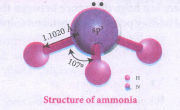
(ii) The structure of ammonia may be regarded as a tetrahedral with one lone pair of electrons in one tetrahedral position hence it has a pyramidal shape.
28.
Simple Cubic Lattice
100,101,111
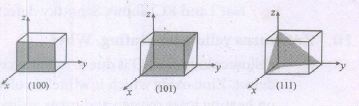
\({ d }_{ hkl }=\frac { a }{ \sqrt { { h }^{ 2 }+{ k }^{ 2 }+{ l }^{ 2 } } } \)
\({ d }_{ 100 }=\frac { 1 }{ \sqrt { { 1 }^{ 2 }+0^{ 2 }+0^{ 2 } } } =1\)
\({ d }_{ 101 }=\frac { 1 }{ \sqrt { { 1 }^{ 2 }+0^{ 2 }+0^{ 2 } } } =\frac { 1 }{ \sqrt { 2 } } \)
\({ d }_{ 111 }=\frac { 1 }{ \sqrt { { 1 }^{ 2 }+1^{ 2 }+1^{ 2 } } } =\frac { 1 }{ \sqrt { 3 } } \)
\(\\ { d }_{ 100 }:{ d }_{ 101 }:{ d }_{ 111 }=1:\frac { 1 }{ \sqrt { 2 } } :\frac { 1 }{ \sqrt { 3 } } (or)\)
=1:0.707:0.577
29.
\(M=\frac { d\times { a }^{ 3 }\times NA }{ g } \)
d = Density of the material
a = Length of the edge of the cell.
NA = Avogadro number
Z = No. of atoms
\(M=\frac { 10.5{ gcm }^{ -3 }{ (4.07\times { 10 }^{ -6 }cm) }^{ 3 }\times \left( 6.023\times { 10 }^{ 23 }{ mol }^{ -1 } \right) }{ 4 } \)
Atomic mass of silver M = 107.08 g mol-1.
30.
(i) Fullerenes are newly synthesised allotropes of carbon.
(ii) Unlike graphite and diamond, these allotropes are discrete molecules such as C32' C50' C60' C70' C76 etc.
(iii) These molecules have cage like structures.
(iv) The C60 molecules have a soccer ball like structure and is called buckminster fullerene or buckyballs.
(v) It has a fused ring structure consists of 20 six membered rings and 12 five membered rings.
(vi) Each carbon atom is sp2 hybridised and forms three σ bonds & a delocalised π bond giving aromatic character to these molecules.
(vii) The C-C bond distance is 1.44 Å and C=C distance 1.38 Å.
31.
Boric acid has a two dimensional layered structure. It consists of [BO3]3- unit and these are linked to each other by hydrogen bonds.
32.
(i) Metallic oxides such as Cr2O3 can be reduced by an aluminothermic process.
(ii) In this process, the metal oxide is mixed with aluminum powder and placed in a fire clay crucible.
(iii)To initiate the reduction process, an ignition mixture (usually magnesium and barium peroxide is used
\({ BaO }_{ 2 }+Mg\longrightarrow Bao+MgO\)
(iv) During the above reaction a large amount of heat is evolved (temperature up to 2400°C, is generated and the reaction enthalpy is: 852 kJ mol-1 which facilitates the reduction of Cr2O3 by aluminium power.
\({ Cr }_{ 2 }{ O }_{ 3 }+2Al\overset { \Delta }{ \longrightarrow } 2Cr+{ Al }_{ 2 }{ O }_{ 3 }\)
33.
(i) Roasting is the method, usually applied for the conversion of sulphide ores into their oxides.
(ii) In this method, the concentrated ore is oxidised by heating it with excess of oxygen in a suitable furnace below the melting point of the metal.
(iii) \(2PbS+{ 3O }_{ 2 }\overset { \Delta }{ \longrightarrow } 2PbO+{ 2SO }_{ 2 }\uparrow \)
\(2ZnS+{ 3O }_{ 2 }\overset { \Delta }{ \longrightarrow } 2ZnO+2{ SO }_{ 2 }\uparrow \)
\(2Cu_{ 2 }S+{ 3O }_{ 2 }\overset { \Delta }{ \longrightarrow } 2Cu_2O + 2SO_2\uparrow \)
(iii) Roasting also removes impurities such as arsenic, sulphur, phosphorous by converting them into their volatile oxides
(v) Ex.\(4As+{ { 3O }_{ 2 } }\longrightarrow { 2As }_{ 2 }{ O }_{ 3 }\uparrow \)
\( \mathrm{S}_{8}+8 \mathrm{O}_{2} \longrightarrow 8 \mathrm{SO}_{2} \uparrow \)
\(\mathrm{P}_{4}+5 \mathrm{O}_{2} \longrightarrow \mathrm{P}_{4} \mathrm{O}_{10} \uparrow\)
34.
Even though VBT explains many of the observed properties of complexes, it still has following limitations.
(i) It does not explain the colour of the complex.
(ii) It considers only the spin only magnetic moments and does not consider the other components of magnetic moments.
(iii) It does not provide a quantitative explanation as to why certain complexes are inner orbital complexes and the: others are outer orbital complexes for the same metal. For example, [Fe(CN)6]4- is diamagnetic (low spin) whereas [FeF6]4-is paramagnetic (high spin).

12th Standard Syllabus & Materials
12th Standard
TN 12th Computer Applications களப்பெயர் முறைமை (DNS) Sample Question Papers Study Material - QB365 Set A
NEW12th Standard
TN 12th Computer Applications வலையமைப்பு எடுத்துக்காட்டுகள் மற்றும் நெறிமுறைகள் Sample Question Papers Study Material - QB365 Set A
NEW12th Standard
TN 12th Computer Applications கணினி வலையமைப்பு ஓர் அறிமுகம் Sample Question Papers Study Material - QB365 Set A
NEW12th Standard
TN 12th Computer Applications PHP-உடன் MySQL-ஐ இணைத்தல் Sample Question Papers Study Material - QB365 Set A



Tamilnadu Stateboard 12th Standard Subjects

Maths
Chemistry

Physics

Biology

Computer Science

Business Maths and Statistics

Economics

Commerce

Accountancy

History

Computer Applications
Biology
Computer Technology
Computer Applications
Computer Science
Business Maths and Statistics
Commerce
Economics
Maths
Chemistry
Physics
Computer Technology
History
Accountancy

Tamil

English

French
Tamilnadu Stateboard Standards
