
 100% FREE ACCESS
12th Standard Syllabus & Materials
12th Standard
TN 12th Maths Applications of Matrices and Determinants Sample Question Papers Study Material - QB365 Set A
NEW12th Standard
TN 12th Computer Applications மின்னணு தரவு பரிமாற்றம் Sample Question Papers Study Material - QB365 Set A
NEW12th Standard
TN 12th Computer Applications மின் - வணிக பாதுகாப்பு அமைப்புகள் Sample Question Papers Study Material - QB365 Set A
NEW12th Standard
TN 12th Computer Applications மின்னணு செலுத்தல் முறைகள் Sample Question Papers Study Material - QB365 Set A
NEW12th Standard
TN 12th Computer Applications மின் - வணிகம் Sample Question Papers Study Material - QB365 Set A
NEW12th Standard
TN 12th Computer Applications திறந்த மூல கருத்துருக்கள் Sample Question Papers Study Material - QB365 Set A

Published on: 03/09/2020
12th Standard Chemistry English Medium Model 5 Mark Book Back Questions (New Syllabus) 2020
Download Tamil Nadu 12th Standard Chemistry question papers, model tests, one-mark questions, important questions, and public exam papers in PDF format. Free study materials and answer keys for TN State Board students.
Questions + Answers key
Take MCQ Chemistry Test
1.
Write a note on sacrificial protection.
2.
Comment on the statement: Colloid is not a substance but it is a state of substance.
3.
Ksp of AgCl is \(1.8\times10^{-10}\). Calculate molar solubility in 1 M AgNO3
4.
Write the structure of α-D (+) glucophyranose
5.
6.
Why first ionization enthalpy of chromium is lower than that of zinc?
7.
What is crystal field stabilization energy (CFSE)?
8.
Deduce the oxidation number of oxygen in hypofluorous acid – HOF.
9.
The selection of reducing agent depends on the thermodynamic factor: Explain with an example.
10.
Write the structure of the major product of the aldol condensation of benzaldehyde with acetone.
11.
Calculate the standard emf of the cell: Cd|Cd2+||Cu2+|Cu and determine the cell reaction. The standard reduction potentials of Cu2+|Cu and Cd2+|Cd are 0.34V and -0.40 volts respectively. Predict the feasibility of the cell reaction.
12.
Write a note on co –polymer
13.
The rate constant of a reaction at 400 and 200K are 0.04 and 0.02 s-1 respectively. Calculate the value of activation energy.
14.
15.
Aluminium crystallizes in a cubic close packed structure. Its metallic radius is 125pm. calculate the edge length of unit cell.
16.
A hydride of 2nd period alkali metal (A) on reaction with compound of Boron (B) to give a reducing agent (C). Identify A, B and C.
17.
An organic compound (A) of molecular formula C6H6O gives violet colour with neutral FeCI3. (A) gives maximum of two isomers (B) and (C) when an alkaline solution of (A) is refluxed with CCI4 (A) also reacts with C6H5N2CI to give the compound (D) which is red orange dye. Identify (A), (B), (C) and (D). Explain with suitable chemical reactions.
18.
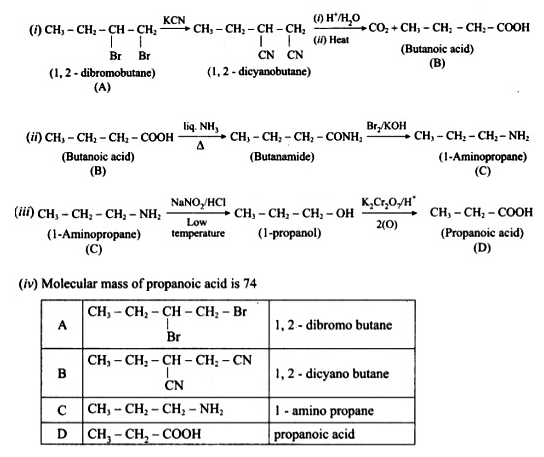
A dibromo derivative (A) on treatment with KCN followed by acid hydrolysis and heating gives a monobasic acid (B) along with liberation of CO2 . (B) on heating with liquid ammonia followed by treating with Br2 /KOH gives (c) which on treating with NaNO2 and HCl at low temperature followed by oxidation gives a monobasic acid (D) having molecular mass 74. Identify A to D.
1.
Cathodic protection:
In this technique, unlike galvanising the entire surface of the metal to be protected need not be covered with a protecting metal. Instead, metals such as Mg or zinc which is corroded more easily than iron can be used as a sacrificial anode and the iron material acts as a cathode. So iron is protected, but Mg or Zn is corroded. This known as sacrificial protection. (or) Cathodic protection.
2.
(i) A Colloid depends on the size of the particle. A Colloid is formed when the size of the particle lies between 1 nm and 100 nm. For example soap dissolves in water to form colloidal soap solution whereas it dissolves in alcohol to form a true solution. Thus change of state takes place. A colloidal state maybe an intermediate between a true solution and a suspension.
(ii) Also some crystalloids under certain conditions can be colloids. NaCl is a crystalloid in aqueous medium; but when mixed with benzene it acts as a colloid.
3.
Ksp = 1.8 \(\times\)10-10, [AgNO3]= 1 M
\(\mathrm{AgCl}_{(\mathrm{s})} \rightleftharpoons \mathrm{Ag}_{(\mathrm{aq})}^{+}+\mathrm{Cl}_{(\mathrm{aq})}^{-} \)
s s
\(\mathrm{AgNO}_{3(\mathrm{aq})} \rightleftharpoons \mathrm{Ag}_{(\text {aq })}^{+}+\mathrm{NO}_{3_{(\text {aq })}}^{-}\\ 1 \mathrm{M} \quad \quad \quad \quad \quad 1 \mathrm{M} \quad \quad 1 \mathrm{M} \)
\(\left[\mathrm{Ag}^{+}\right]=(\mathrm{s}+1) \approx 1 \quad(\therefore \mathrm{s}<<1) \)
\(\left[\mathrm{Cl}^{-}\right]=\mathrm{s} \)
\(\mathrm{K}_{\mathrm{sp}}=\left[\mathrm{Ag}^{+}\right]\left[\mathrm{Cl}^{-}\right] \)
\(1.8 \times 10^{-10}=(1)(s) \)
\(\therefore \mathrm{s}=1.8 \times 10^{-10} \mathrm{M}\)
4.
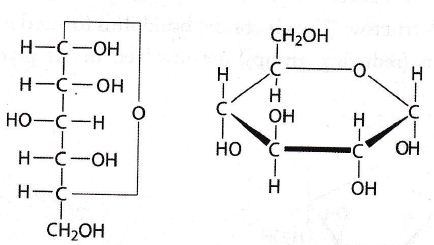
α-D (+) glucophyranose
5.
6.
Chromium (24), the electronic configuration is 3d54s1. It ready to lose its outer most electron (4s1) to get exactly half-filled stable electronic configuration. The electronic configuration of Zinc is 3d104s2.ie., It has completely filled stable configuration. From this configuration, the removal of 1e- from 4s orbital is very difficult & it required more ionisation enthalpy. Due to this reason Zn has higher first Ionisation enthalpy (1.E1) than that of chromium.
7.
The CFSE is defined as the energy of the electronic configuration in the ligand field minus the energy of the electronic configuration in the isotropic field.
CFSE (\(\Delta\)Eo) = {ELf}-{Eiso}
={[nt2g(-0.4) + neg(0.6)]\(\Delta\)o + npP} - {n'pP}
Here, nt2g is the number of electrons in t2g orbitals;
neg is number of electrons in eg orbitals;
np is number of electron pairs in the ligand field; &
n'p is the number of electron pairs in the isotropic field (barycenter).
P - pairing energy
8.
Oxidation number of F = -1
Oxidation number of H = +1
Oxidation number of O in HOF =x
(+1) + x + (-1) = 0
x = 0
Oxidation number of O in HOF = 0
9.
(i) The extraction of metals from their oxides can be carried out by using different reducing agents.
(ii) Consider the following reaction
\(\frac{2}{\mathrm{y}} \mathrm{M}_{\mathrm{x}} \mathrm{O}_{\mathrm{y}(\mathrm{s})} \rightarrow \frac{2 \mathrm{x}}{\mathrm{y}} \mathrm{M}_{(s)}+\mathrm{O}_{ 2(\mathrm{~g})}\) (1)
(iii) The above reduction may be carried out with carbon. In this case the reducing agent carbon may be oxidized to either CO or CO2
\(\mathrm{C}+\mathrm{O}_{2} \rightarrow \mathrm{CO}_{2(\mathrm{~g})} \) (2)
\(2 \mathrm{C}+\mathrm{O}_{2} \rightarrow 2 \mathrm{CO}_{(\mathrm{g})} \) (3)
(iv) If CO is used as a reducing agent
\(2 \mathrm{CO}+\mathrm{O}_{2} \rightarrow 2 \mathrm{CO}_{2(\mathrm{~g})}\) (4)
(v) A suitable reducing agent is selected based on the thermodynamics considerations.
(vi) We know that for a spontaneous reaction, the change in free energy (\(\triangle\)G) should be negative.
(vii) Therefore, thermodynamically, the reduction of metal oxide with a given reducing agent can occur if the free energy change for the coupled reaction is negative.
(viii) Hence, the reducing agent is selected in such a way that it provides a large negative \(\triangle\)G value for the coupled reaction.
10.
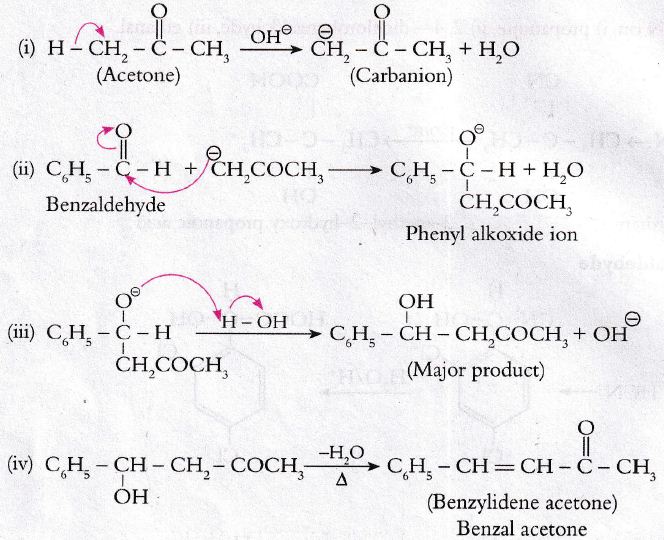
11.
Cell reactions:
Oxidation at anode: \(Cd_{(s)}\rightarrow Cd^{2+}_{(aq)}+2e^{-}\); (E0ox)cd|cd2+ = 0.40V ; (E0)cd|cd2+ = -0.40V
Reduction at cathode: \(Cu^{2+}_{(aq)}+2e^{-}\rightarrow Cu_{(s)} \); (E0red)cu2+|Cu = +0.34V
Adding: \(Cd_{(s)}+Cu^{2+}_{(aq)}\rightarrow Cd^{2+}_{(aq)}+Cu_{(s)}\)
E0cell=(E0ox)+(E0red)
=(-0.4) + 0.34V
= 0.74V.
Emf is +ve, so \(\Delta G\) is -ve, the cell reaction is feasible.
12.
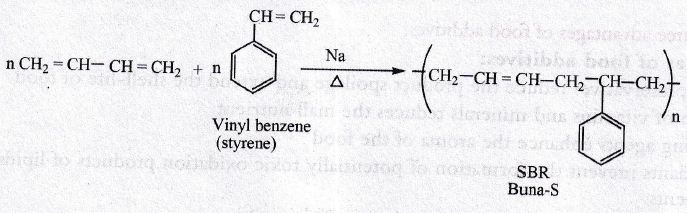
(i) A polymer containing two or more different kinds of monomer units is called a copolymer.
(ii) For example, SBR rubber(Buna-S) contains styrene and butadiene monomer units.
(iii) Copolymers have properties quite different from the homopolymers.
(iv) Mixture of styrene and 1,3 butadiene to form a copolymer (Buna -S)
Preparation of Buna-S:
It is a co-polymer. It is obtained by the polymerisation of buta -1,3 - diene and styrene in the ratio 3: 1 in the presence of sodium.
13.
According to Arrhenius equation
\(\log\left( \frac { { k }_{ 2 } }{ { k }_{ 1 } } \right) =\frac { { E }_{ a } }{ 2.303R } \left( \frac { { T }_{ 2 }-{ T }_{ 1 } }{ { T }_{ 1 }{ T }_{ 2 } } \right) \)
T2 = 400K ; k2 = 0.04 s-1
T1 = 200K ; k1 = 0.02 s-1
\(\log\left( \frac { 0.04}{ 0.02} \right) =\frac { { E }_{ a } }{ 2.303\times 8.314} =\left( \frac { 400-200 }{ 200\times 400 } \right) \)
\(\log(2)=\frac { { E }_{ a } }{ 2.303\times 8.314} =\left( \frac { 1 }{ 400 } \right) \)
Ea = log(2) \(\times\) 2.303 \(\times\) 8.314 \(\times\) 400
= 0.3010 \(\times\) 2.303 \(\times\) 8.314 \(\times\) 400
Ea = 2305 J mol-1 = 2.305 kJ mol-1
14.
15.
For cubic closed packed structure
\(r =\frac{a \sqrt{2}}{4} \)
\(\therefore a =\frac{4 r}{\sqrt{2}} \)
\(=\frac{4 \times 1.25 \times 10^{-8}}{1.414}=3.53 \times 10^{-8} \mathrm{~cm} \)
= 353 pm
16.
A hydride of 2nd period alkali metal (A) is lithium hydride (LiH).
Lithium hydride (A) reacts with diborane (B) to give lithium borohydride (C) which is acts as a reducing agent.
B2H6 + 2 LiH \(\xrightarrow[]{ether}\) 2 LiBH4
[Diborane (B)] [Lithium hydride (A)] [Lithium borohydride (C)]
Result:
| Compound | Formula | Name |
| A | LiH | Lithium hydride |
| B | B2H6 | Diborane |
| C | LiBH4 | Lithium borohydride |
17.
(i) Compound A giving violet colour with neutral ferric chloride is phenol (C6H5OH).
(ii) (B) and (C) isomers are formed when alkaline solution of (A) is refluxed with CCI4.

(iii) (A) when treated with C6H5N2CI, forms a red orange dye (D).

| Compound | Compound Name | Formula |
| A | Phenol | C6H5OH |
| B | o-Hydroxy benzoic acid | 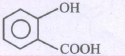 |
| C | p-Hydroxy benzoic acid | 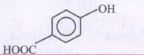 |
| D | p-Hydroxy azo benzene | 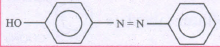 |
18.
Compound A,B,C and D

12th Standard Syllabus & Materials
12th Standard
TN 12th Computer Applications வலையமைப்பு வடமிடல் Sample Question Papers Study Material - QB365 Set A
NEW12th Standard
TN 12th Computer Applications களப்பெயர் முறைமை (DNS) Sample Question Papers Study Material - QB365 Set A
NEW12th Standard
TN 12th Computer Applications வலையமைப்பு எடுத்துக்காட்டுகள் மற்றும் நெறிமுறைகள் Sample Question Papers Study Material - QB365 Set A
NEW12th Standard
TN 12th Computer Applications கணினி வலையமைப்பு ஓர் அறிமுகம் Sample Question Papers Study Material - QB365 Set A



Tamilnadu Stateboard 12th Standard Subjects

Maths
Chemistry

Physics

Biology

Computer Science

Business Maths and Statistics

Economics

Commerce

Accountancy

History

Computer Applications
Biology
Computer Technology
Computer Applications
Computer Science
Business Maths and Statistics
Commerce
Economics
Maths
Chemistry
Physics
Computer Technology
History
Accountancy

Tamil

English

French
Tamilnadu Stateboard Standards
