
 100% FREE ACCESS
12th Standard Syllabus & Materials
12th Standard
TN 12th Maths Applications of Matrices and Determinants Sample Question Papers Study Material - QB365 Set A
NEW12th Standard
TN 12th Computer Applications மின்னணு தரவு பரிமாற்றம் Sample Question Papers Study Material - QB365 Set A
NEW12th Standard
TN 12th Computer Applications மின் - வணிக பாதுகாப்பு அமைப்புகள் Sample Question Papers Study Material - QB365 Set A
NEW12th Standard
TN 12th Computer Applications மின்னணு செலுத்தல் முறைகள் Sample Question Papers Study Material - QB365 Set A
NEW12th Standard
TN 12th Computer Applications மின் - வணிகம் Sample Question Papers Study Material - QB365 Set A
NEW12th Standard
TN 12th Computer Applications திறந்த மூல கருத்துருக்கள் Sample Question Papers Study Material - QB365 Set A

Published on: 02/09/2022
QB365 provides a detailed and simple solution for every Possible Creative Questions in Class 12 Chemistry Subject - Organic Nitrogen Compounds, English Medium. It will help Students to get more practice questions, Students can Practice these question papers in addition to score best marks.
Download Tamil Nadu 12th Standard Chemistry question papers, model tests, one-mark questions, important questions, and public exam papers in PDF format. Free study materials and answer keys for TN State Board students.
Questions + Answers key
Take MCQ Chemistry Test
1.
An organic compound (A) on reduction gives compound (B). (B) on treatment with CHCI3 and alcoholic KOH gives (C). (C) on catalytic reduction gives N - methyl aniline. Identify A, B, C and write its equation.
2.
An organic compound 'A' on reduction gives compound 'B' which on reaction with trichloromethane and caustic potash forms 'C'. Compound 'C' on catalytic reduction given N-methyl benzenamine. Identify A, B and C and write the reactions involved.
3.
Starting from the following reagents, how will your prepare ethanenitrile.
i) CH3Br
ii) CH3CONH2
iii) CH3CH=NOH
4.
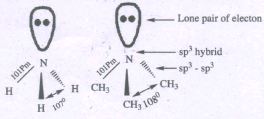
Write a note on structure of amine.
5.
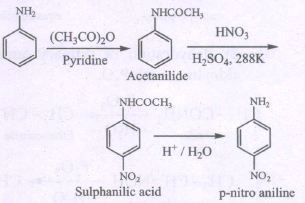
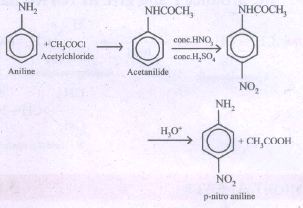
Convert aniline to p-nitro aniline
6.
How are the following compounds obtained from benzene diazonium chloride?
(i) phenol
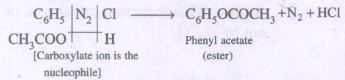
(ii) ester
(iii) p-hydroxy azo benzene
7.
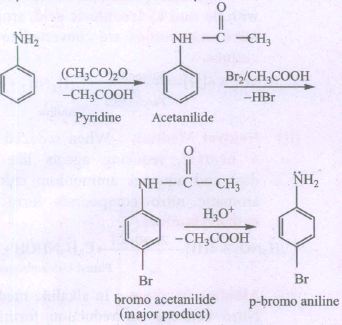
Aniline reacts with Br2/H2O to give a tribromo derivative. How would you convert aniline to get a monobromo derivate?
8.
How can the following conversion be effected?
i) Nitrobenzene to anisole
ii) Chloro benzene to phenyl hydrazine
iii) Aniline to benzoic acid
iv) Benzene diazonium chloride to ehtyl benzene.
9.
Outline the preparation of (a) para nitroaniline from aniline, (b) tri bromo benzene from tribromo aniline
10.
Explain Levine and hauser acetylation.
11.
An Organic compound (A) with molecular formula C6H7N gives (B) with HNO2 / HCI at 273 K. The aqueous solution of (B) on heating gives compound (C) which gives violet colour with netural FeCI3. Identify the compounds (A), (B) and (C) and write the equations.
12.
Write a note on the basicity of amines.
13.
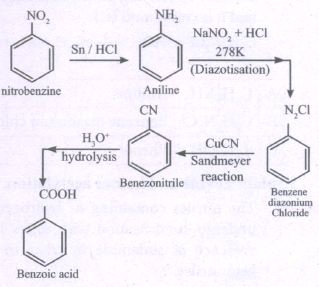
How will convert nitrobenzene to benzoic acid?
14.
How are nitro alkanes prepared for the following
i) alkyl bromides
ii) methane
15.
Write a note on acidic nature of nitro alkanes.
1.

2.
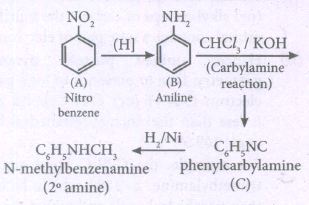
(i) A - C6H5NO2 - Nitro benzene
(ii) B - C6H5NH2 - Aniline
(iii) C - C6H5NC - Phenyl Carbylamine
3.
(i) Aryl cyanide cannot be prepared in this method because of their less reactivity towards nucleophilic substitution. Aryl cyanides are prepared using Sandmeyers reactions.
\(KCH+\underset { methyl \ bromide }{ { CH }_{ 3 }-Br } \rightarrow \underset { ethanenitrile }{ { CH }_{ 3 }-CN } +KBr\)
(ii) By dehydration' of primary amides a aldoximes with P2O5
\(\underset { Acetamide }{ { CH }_{ 3 }-CO{ NH }_{ 2 } } \xrightarrow [ { -H }_{ 2 }O ]{ { P }_{ 2 }{ O }_{ 5 } } \underset { Ethaneitrile }{ { CH }_{ 3 }-{ CN } } \)
(iii) \(\underset { Acetaldoximes }{ { CH }_{ 3 }-CH=NOH } \xrightarrow [ { -H }_{ 2 }O ]{ { P }_{ 2 }{ O }_{ 5 } } \underset { Ethaneitrile }{ { CH }_{ 3 }-{ CN } } \)
4.
Structure of amines:
(i) Like, ammonia, nitrogen atom of amines is trivalent and carries a lone pair of electron and sp3 hybridised, out of the four sp3 hybridised orbitals of nitrogen, three sp3 orbitals overlap with orbitals of hydrogen (or) alkyl groups of carbon, the fourth sp3 orbital contains a lone pair of electron.
(ii) Hence, amines possess pyramidal geometry. Due to presence of lone pair of electron C-N-H (or) C-N-C bond angle is less than the normal tetrahedral bond angle 109.5°.
For example, the C-N-C bond angle of trimethylamine is 108° which is lower than tetrahedral angle and higher than the H-N-H bond angle of 107°.
(iii) This increase is due to the repulsion between the bulky methyl groups.
5.
To get para product, the - NH2 group is protected by acetylation with acetic anhydride. Then, the nitrated product is hydrolysed to form the product.
6.
(i) Repl cementby-OH: When the aqueous solution is boiled, phenol is obtained

This is an example of SN1 reaction in which C6H5N2CI initially gives C6H5+ and water is the nudeophile.
(ii) Replacement of RO- (or) RCOO- groups Similarly -N2CI can be replaced acyloxy group by boiling with carboxylic acids.
(iii) Diazonlum coupling reaction: Diazonium salt reacts with aromatic amine and phenols to give azo compounds of the general formula.
Ar - N = N - Ar'
This reaction is known as Coupling reaction since all these compounds are intensely coloured and used as dyes, thousands of azodyes have been synthesised by this procedure.

7.
To get mono bromo compounds, -NH2 is first acylated to reduce its activity.
8.
(i) 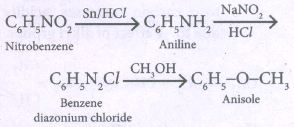
(ii) 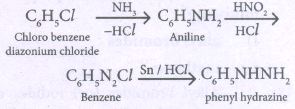
(iii) 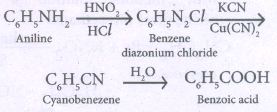
(iv) 
9.
(i) p-nitroaniline is prepared from aniline in three stages as follows:
(ii) 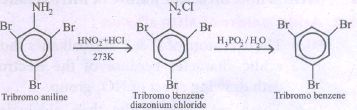
10.
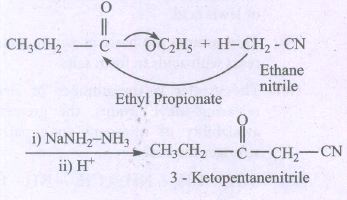
(i) The nitriles containing a-hydrogen also undergo condensation with esters in the presence of sodamide in ether to form ketonitriles.
(ii) This reaction is known as "Levine and hauser" acetylation.
(iii) This reaction involves replacement of ethoxy (OC2H5) group by methylnitrile (-CH2CN) group and is called as cyanomethylation reaction.
11.
(i) An organic compound (A) with molecular formula C6H7N is identified as Aniline C6H5NH2
(ii) Aniline on treatment with HNO2 / HCl at 273 K gives a clear solution of Benzene diazonium chloride C6H5N2CI the compound (B).
\({ C }_{ 6 }{ H }_{ 5 }{ NH }_{ 2 }+{ HNO }_{ 2 }\xrightarrow [ 273K ]{ NCl } \underset { Benzene \ diazonium \ chloride }{ { C }_{ 6 }{ H }_{ 5 }{ N }_{ 2 }Cl } \)
(iii) An aqueous solution of benzene diazonium chloride on heating gives phenol C6H5OH and it is compound (C).
\({ C }_{ 6 }{ H }_{ 5 }{ N }_{ 2 }Cl+{ HOH }\underrightarrow { \triangle } { C }_{ 6 }{ H }_{ 5 }OH-{ N }_{ 2 }+HCl\)
| A | C6H5NH2 | Aniline |
| B | C6H5N2Cl | Benzene diazonium chloride |
| C | C6H5OH | Phenol |
12.
(i) The nitrogen in amines possess an unshared pair of electrons (Lone Pair).
(ii) The lone pair of electrons is available for the formation of a new bond with a proton or lewis acid.
(iii) Thus amines are basic in nature and they react with acids to form salts.
(iv) The greater is the number of electron releasing alkyl. groups, the greater the availability of nitrogen's lone pair and stronger the base.
NH3 < CH3 - NH2 < CH3 - NH - CH3
13.
14.
(i) Alkyl bromides (or) iodides on heating with ethanolic solution of potassium nitrite gives nitroethane
\(\underset { Ethyl \ bromide }{ { CH }_{ 3 }{ CH }_{ 2 } } -Br+{ KNO }_{ 2 }\xrightarrow [ { SN }_{ 2 } ]{ ethanol/\triangle } \underset { Nitroethane }{ { CH }_{ 3 }{ CH }_{ 2 }-{ NO }_{ 2 } } +KBr\)
The reaction follows SN2 mechanism.
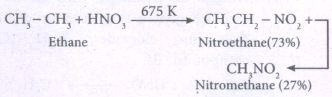
(ii) Gaseous mixture of methane and nitric acid passed through a red hot metal tube to give nitromethane.

Except methane, other alkanes (upto n- hexane) give a mixture of nitroalkanes due to C-C cleavage. The individual nitro alkanes can be separated by fractional distillation.
15.
Acidic nature of nitro alkanes:
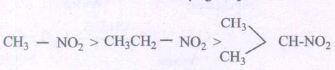
(i) The α -H atom of 10 & 20 nitroalkanes show acidic character because of the eIectron with drawing effect of NO2 group.
(ii) These are more acidic than aldehydes, ketones, ester and cyanides.
(iii) Nitroalkanes dissolve in NaOH solution to form a salt.
(iv) Aci - nitro derivatives are more acidic than nitro form.
(v) When the number of alkyl group attached to α carbon increases, acidity decreases, due to +1 effect of alkyl groups

12th Standard Syllabus & Materials
12th Standard
TN 12th Computer Applications வலையமைப்பு வடமிடல் Sample Question Papers Study Material - QB365 Set A
NEW12th Standard
TN 12th Computer Applications களப்பெயர் முறைமை (DNS) Sample Question Papers Study Material - QB365 Set A
NEW12th Standard
TN 12th Computer Applications வலையமைப்பு எடுத்துக்காட்டுகள் மற்றும் நெறிமுறைகள் Sample Question Papers Study Material - QB365 Set A
NEW12th Standard
TN 12th Computer Applications கணினி வலையமைப்பு ஓர் அறிமுகம் Sample Question Papers Study Material - QB365 Set A



Tamilnadu Stateboard 12th Standard Subjects

Maths
Chemistry

Physics

Biology

Computer Science

Business Maths and Statistics

Economics

Commerce

Accountancy

History

Computer Applications
Biology
Computer Technology
Computer Applications
Computer Science
Business Maths and Statistics
Commerce
Economics
Maths
Chemistry
Physics
Computer Technology
History
Accountancy

Tamil

English

French
Tamilnadu Stateboard Standards
