
 100% FREE ACCESS
12th Standard Syllabus & Materials
12th Standard
TN 12th Computer Applications மின்னணு தரவு பரிமாற்றம் Sample Question Papers Study Material - QB365 Set A
NEW12th Standard
TN 12th Computer Applications மின் - வணிக பாதுகாப்பு அமைப்புகள் Sample Question Papers Study Material - QB365 Set A
NEW12th Standard
TN 12th Computer Applications மின்னணு செலுத்தல் முறைகள் Sample Question Papers Study Material - QB365 Set A
NEW12th Standard
TN 12th Computer Applications மின் - வணிகம் Sample Question Papers Study Material - QB365 Set A
NEW12th Standard
TN 12th Computer Applications திறந்த மூல கருத்துருக்கள் Sample Question Papers Study Material - QB365 Set A
NEW12th Standard
TN 12th Computer Applications வலையமைப்பு வடமிடல் Sample Question Papers Study Material - QB365 Set A

Published on: 02/09/2022
QB365 provides a detailed and simple solution for every Possible Creative Questions in Class 12 Chemistry Subject - Organic Nitrogen Compounds, English Medium. It will help Students to get more practice questions, Students can Practice these question papers in addition to score best marks.
Download Tamil Nadu 12th Standard Chemistry question papers, model tests, one-mark questions, important questions, and public exam papers in PDF format. Free study materials and answer keys for TN State Board students.
Questions + Answers key
Take MCQ Chemistry Test
1.
Write the uses of nitroalkanes.
2.
An aromatic nitro compound (A) on reduction with Sn / HCl gives compound (B) C6H7N which on treatment with Benzoyl chloride in the presence of pyridine to give compound (C) Compound (B) on treatment with CH3Br to give compound (D) which further reacts with NaNO2 / HCl to give compound (E) with yellow oil liquid. Identify (A) to (E) and write the reactions.
3.
An Organic compound (A) -C7H7NO on treatment with Br2 and KOH gives an amine (B) which gives carbylamine test. (B) upon diazotization to give(C). (C) on coupling with p.cresol to give compound (D). Identify A. B. C and D with necessary reaction.
4.
CuSO4 on mixing with NH3 (1:4 ratio) does not give test for Cu2+ ions but gives test for SO42- ions. Why?
5.
Outline the mechanism of
(a) Nitration of aniline,
(b) Acetylation of aniline.
6.
Write a note on
(i) Carbylamine reaction
(ii) Mustard oil reaction
(iii) Acetylation of benzylamine
(iv) Formation of Schiff's base
(v) Diazotisation reaction
7.
How do primary, secondary and tertiary amines react with nitrous acid?
8.
Write the differences between nitro methane and nitro benzene.
9.
How can the following coversion be effected?
i) Nitrobenzene ⇾ Nitrosobenzene
ii) Nitrobenzene ⇾ Azoxybenzene
iii) Nitrobenzene ⇾ Hydrazobenzene
10.
Account for the following:
(i) Nitroethane is soluble NaOH
(ii) Nitroethane reacts with nitrous acid
(iii) 2-methyl-2-nitro propane has neither of the properties.
11.
Account for
i) Reduction of CH3CH gives CH3CH2NH2 while CH3NC gives (CH3)2NH.
ii) (CH3)2NH requires two molar proportion of CH3I to give the same crystalline product formed by (CH3)2N with one mole of CH3l.
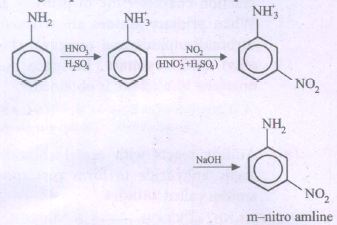
iii) Nitration of aniline with conc.HNO3 may end up with same meta nitro product.
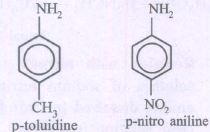
iv) p-toluidine is a stronger base than p-nitroaniline.
12.
What happens when ethylamine is treated with
(i) CHCl3/NaOH
(ii) CS2
(iii) C6H5CHO.
13.
Account for the following:
i) (CH3)2 NH is stronger base than NH3
ii) CH3CH2NH2 is more basic than CH3CONH2
iii) Aniline is less basic than Ethyl amine
iv) On sulphonation of aniline, p-amino benzene sulphonic acid is formed.
14.
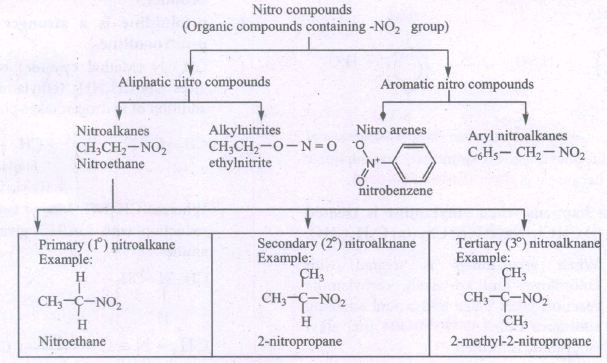
Draw a flow chart to show classification of nitro compound giving examples for each type.
15.
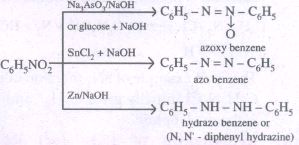
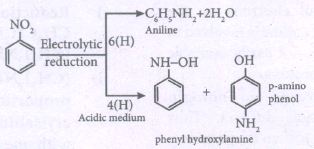
Write a note on the reduction of nitro benzene under different conditions.
1.
1. They are good solvents for a large number of organic compounds including vinyl polymers, cellulose esters, synthetic rubbers, oils, fats, waxes and dyes.
2. Used in organic synthesis
3. Nitromethane reacts with halogen in presence of alkali to form trihalogen derivative. (e.g,.) with chlorine it forms chloropicrin, CCl3NO2 which is used as soil sterilzing agent.
4. Nitroethane is also used as a fuel additive and a precursor to Rocket propellants.
2.
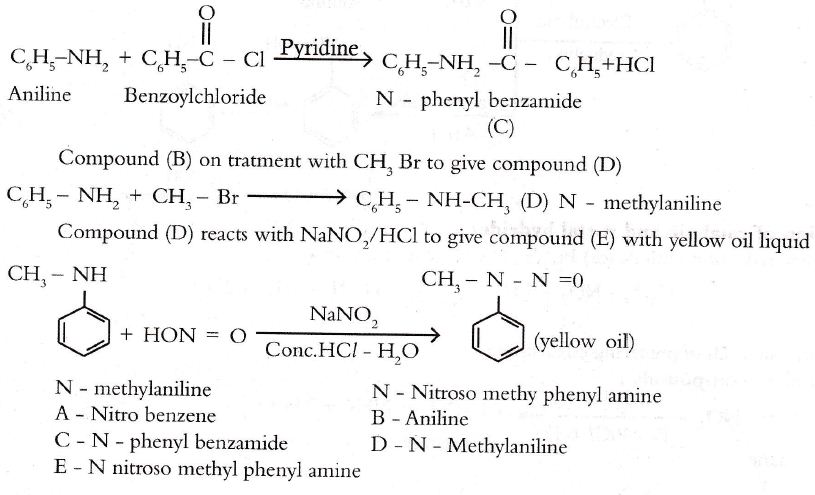
Compound (A) is nitro benzene on reduction with Sn / HCl gives compound (B) is Aniline
\(\underset {(A)} {\mathrm{C}_{6} \mathrm{H}_{5}-\mathrm{NO}_{2}}+6[\mathrm{H}] \stackrel{\mathrm{Sn} / \mathrm{HCl}}{\longrightarrow} \underset {(B)}{ \mathrm{C}_{6} \mathrm{H}_{5}-\mathrm{NH}_{2}}+2 \mathrm{H}_{2} \mathrm{O}\)
Compound (B) is Aniline reacts with Benzoyl chloride in the presence of pyridine to give compound (C) is N - phenyl benzamide.
Schotten - Baumann reaction:
3.
Hoffmann's degradation reaction
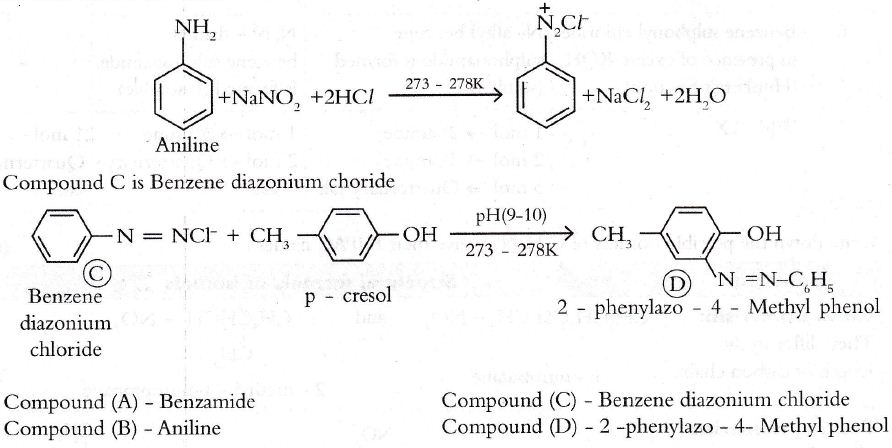
Compound (A) is Benzamide
\(\mathrm{C}_{6} \mathrm{H}_{5}-\mathrm{CO}-\mathrm{NH}_{2} \stackrel{\mathrm{Br}_{2} / \mathrm{KOH}}{\longrightarrow} \mathrm{C}_{6} \mathrm{H}_{5}-\mathrm{NH}_{2}+\mathrm{KBr}+\mathrm{K}_{2} \mathrm{CO}_{3}+\mathrm{H}_{2} \mathrm{O}\)
Compound B is Aniline (primary amine)
Diazotization reaction:
4.
It is because when NH3 coordinates to Cu2+ ions and it forms the complex [Cu(NH3)4]SO4 copper ions are present in coordination sphere, therefore. they are non-ionisable whereas SO42- ions are counter ions which are ionisable.
5.
(i) Nitration of aniline is accompanied by oxidation. But a mixture of cone. HNO3 and cone. H2SO4 gives m-nitroaniline also. Nitric acid is a strong acid. It protonates aniline forming anilinium ion C6H5NH3+ because of positive charge on nitrogen it is meta directing.
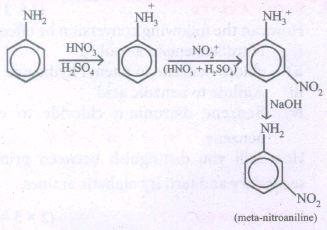
p-nitro aniline is prepared in the following three stages
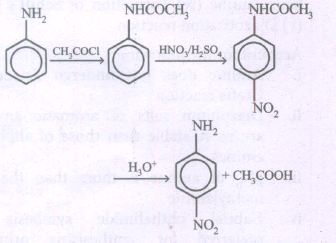
(ii) Aniline reacts with acetyl chloride and acetic anhydride to form corresponding amides called anilides.
\({ C }_{ 6 }H_{ 5 }{ NH }_{ 2 }+\underset { Acetylchloride }{ ClCO{ CH }_{ 3 } } \rightarrow \underset { Acetanilide }{ { C }_{ 6 }{ H }_{ 5 }NHCO{ CH }_{ 3 } } +HCl\)
\({ C }_{ 6 }H_{ 5 }{ NH }_{ 2 }+\underset { Aceticanhydride }{ { CH }_{ 3 }COOCO{ CH }_{ 3 } } \rightarrow \underset { Acetanilide }{ { C }_{ 6 }{ H }_{ 5 }NHCO{ CH }_{ 3 } } +{ CH }_{ 3 }COOH\)
6.
(i) Carbylamine reaction: Primary amines
on heating with chloroform and alcoholic potash forms a foul smelling substance called carbylamine or alkyl isocyanide
\(\underset { Chloroform }{ CH_{ 3 }{ NH }_{ 2 }+{ CHCl }_{ 3 } } +3KOH\rightarrow \underset { Methyl \ isocyanide }{ { CH }_{ 3 }NC } +3KCl+{ 3H }_{ 2 }O\)
This reaction is characteristic of primary amines. Secondary and tertiary amines do not undergo this reaction.
(ii) Mustard oil reaction: This is also a reaction characteristic of primary amine. When primary amines are warmed with carbon disulphide and mercuric chloride, alkyl isothiocyanate, having a pungent Mustard like odour is obtained
\(CH_{ 3 }{ NH }_{ 2 }+\underset { Carbondisulphide }{ S=C=S } \rightarrow \underset { Methyl \ isothicyanate }{ { CH }_{ 3 }-N=C=S } +{ H }_{ 2 }S\)
(iii) Aniline reacts with acetyl chloride and acetic anhydride to form corresponding amides called anilide.
\({ C }_{ 6 }H_{ 5 }{ NH }_{ 2 }+\underset { Acetyl \ chloride }{ ClCO{ CH }_{ 3 } } \rightarrow \underset { N-phenyl \ acetamide }{ { C }_{ 6 }{ H }_{ 5 }NHCO{ CH }_{ 3 } } +HCl\)
\({ C }_{ 6 }H_{ 5 }{ NH }_{ 2 }+\underset { Acetic \ anhydride }{ { CH }_{ 3 }COOCO{ CH }_{ 3 } } \rightarrow \underset { Acetanilide }{ { C }_{ 6 }{ H }_{ 5 }NHCO{ CH }_{ 3 } } +{ CH }_{ 3 }COOH\)
(iv) Formation of Schiff's base: Primary amines condense with aromatic aldehydes forming Schiff's base
\({ C }_{ 6 }H_{ 5 }CHO+{ H }_{ 2 }{ NCH }_{ 3 }\rightarrow \underset { Schiff's \ base\\ (benzal-N-methyl \ amine) }{ { C }_{ 6 }{ H }_{ 5 }CH=NC{ H }_{ 3 } } \)
(v) Reaction with nitrous acid: A cold solution of sodium nitrite reacts with aniline dissolved in hydrochloric acid, a clear solution is obtained. This solution contains 'benzene diazonium chloride'. This reaction is known as 'diazotisation'.
\({ C }_{ 6 }{ H }_{ 5 }N\boxed { { H }_{ 2 }+O } =N-OH\underrightarrow { HCl } \underset { Bensene\quad diazonium\quad chloride }{ { C }_{ 6 }{ H }_{ 5 }-N=N-Cl } \)
7.
(i) Primary amine react with nitrous acid to form alcohols and nitrogen gas
\(\underset { primary \ amine }{ { CH }_{ 3 }NH_{ 2 } } \rightarrow \underset { unstable }{ { [{ CH } }_{ 3 }-N=N-OH] } \rightarrow { CH }_{ 3 }OH+{ N }_{ 2 }\)
Aliphatic diazonium compound is unstable because of absence of resonance stabilisation.
(ii) Secondary amines react with nitrous acid to form N-nitroso amines which are water insoluble yellow oils.
\(\underset { Secondary \ amine }{ { { (CH }_{ 3 } })_{ 2 }NH } +HO-N=O\rightarrow \underset { N-nitroso \ dimethy \ amine-yellow \ oil\\ (insolube \ in \ water) }{ { (CH }_{ 3 })_{ 2 }N-N=O } \)
(iii) Tertiary amine react with nitrous acid to form trialkyl ammonium nitrite salts which are soluble in water
\(\underset { Tertiary \ amine }{ { (CH }_{ 3 })_{ 2 }N } +HONO\rightarrow \underset { trimethyl \ ammonium \ nitrite\\ (salt \ soluble \ in \ water) }{ { { (CH }_{ 3 }) }_{ 3 }{ NH }^{ + }{ NO }_{ 2 }^{ - } } \)
8.
| S. No. | Nitromethane | Nitrobenzene |
| i. | It is colourless | It is yellow coloured. |
| ii. | It is soluble in water | Insoluble in water. |
| iii. | Has pleasant smell | Has smell of bitter almonds. |
| iv. | Exhibits tautomerism | Doesnot exhibit tautomerism |
| v. | Used as good solvent | Used to prepare explosives Eg. TNT |
| vi. | Undergoes reduction in acidic and neutral medium. | Undergoes reduction in acidic, basic and neutral medium |
9.
i) Nitrobenzene ⇾ Nitrosobenzene
When nitrobenzene is treated with glucose and NaOH (alkaline medium) Nitrosobenzene is formed.
\({ C }_{ 6 }{ H }_{ 5 }N{ O }_{ 2 }\rightarrow \underset { Nitrosobenzene }{ { C }_{ 6 }{ H }_{ 5 }NO+{ H }_{ 2 }O } \)
ii) Nitrobenzene ⇾ Azoxybenzene
When nitrobenzene is subjected to reduction with glucose and NaOH forms the intermediate products nitrosobenzene and phenyl hydroxyl amine. These undergo bimolecular condensation reaction to give azoxy benzene.
\({ C }_{ 6 }{ H }_{ 5 }N{ O }_{ 2 }\underrightarrow { Glucose+NaOH } \underset { Nitrosobenzene }{ { C }_{ 6 }{ H }_{ 5 }NO+{ H }_{ 2 }O } \xrightarrow [ { H }_{ 2 }O ]{ \triangle } \underset { Azoxy\quad benzene }{ { C }_{ 6 }{ H }_{ 5 }-N=N{ C }_{ 6 }{ H }_{ 5 } } \)
iii) Nitrobenzene ⇾ Hydrazobenzene
When nitrobenzene is subjected to alkaline reduction in the presence of Zn+NaOH, hydrozo benzene is formed.
\({ C }_{ 6 }{ H }_{ 5 }N{ O }_{ 2 }\underrightarrow { Zn/NaOH } \underset { Nitrosobenzene }{ { C }_{ 6 }{ H }_{ 5 }NH+{ NHC }_{ 6 }{ H }_{ 5 }} \)
10.
(i) Nitroethane exhibits tautomerism of nitro form and aci form. Aciform of nitroethane contains (α - Hydrogen) replaceable hydrogen atom. Hence it dissolves in sodium hydroxide solution forming salt like compounds.
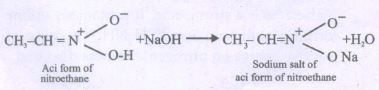
(ii) CH3CH2NO2 has two a-hydrogen and that reacts with HNO2
(iii) 2-methyl - 2 - nitro propane neither soluble in alkali nor reacts with nitrous acid. Because it contains a tertiary nitro group where aciform is not possible and . it does not contain α - H atoms. So it has neither of the properties.
11.
(i) CH3CN (Methyl cyanide) on reduction gives CH3CH2NH2 (ethylamine) because addition of hydrogen takes place at ≡ CN
\({ CH }_{ 2 }-C\equiv N\xrightarrow [ 4H ]{ { LiAH }_{ 4 } } { \underset { Ethylamine\\ (Primary\quad amine) }{ { CH }_{ 3 }-{ CH }_{ 2 }{ NH }_{ 2 } } }\)
Whereas CH3NC (Methyl isocyanide) on reduction with LiAlH4 gives secondary amine
\({ CH }_{ 3 }-\underset { \overset { | }{ H } }{ N } -{ CH }_{ 3 }\)
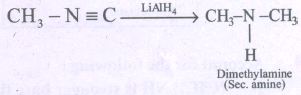
In methyl cyanide, -CN group is attached to alkyl group and by reduction it gives a primary amine wherease in methyl isocyanide -NC group is attached to alkyl group and by reduction it gives a secondary amine.
(ii) (CH3)2 NH (Secondary amine) requires 2 moles of CH3I to give a quaternary salt (crystalline product) whereas (CH3)2N (tertiary amine) require only one mole of CH3I to give the same quaternary salt. It is due to the number of alkyl groups present in amines.
\(\underset { Secondary \ anmine }{ { ( }{ CH }_{ 3 })_{ 2 }-NH+{ 2CH }_{ 3 }I } \rightarrow { { [(CH }_{ 3 })_{ 4 }N] }^{ + }\underset { Tetramethy\\ ammonium \ iodide }{ { I }^{ - } } \)
(iii) Nitration of aniline with cone. HNO3 results in the formation of m-nitro aniline because nitric acid is a strong acid. It protonates aniline forming anilinium ion C6H5NH3+ because of positive charge on nitrogen, it is meta directive and -NO2 group is substituted at meta position.
(iv) p-Toluidine contains a methyl group which has +I effect (electron withdrawing group and due to this, p-toluidine is a stronger base than p-nitro aniline in which the nitro group is less reactive and it deactivate the benzene rin make it a less basic
12.
(i) When ethylamines is treated with chloroform and an alkali, carbylamine reaction takes place and a foul smelling substance called carbylamlne (or) alkyl isocyanide is formed.
C2H5NH2 + CHCl3 + 3NaOH ➝ \(\underset { Ethyl \ isocyanide }{ { C }_{ 2 }{ H }_{ 5 }NC+3NaCl+3{ H }_{ 2 }O } \)
(ii) When ethylamine is warmed with CS2 and mercuric chloride, alkyl isothiocyanate having a pungent mustard like odour is obtained. This reaction is called mustard oil reaction.
C2H2NH2 + S = C-S \(\underrightarrow { Hg{ Cl }_{ 2 } } \) C2H5 - N = C = S + H2S
(iii) When ethylamine condense with aromatic aldehyde (benzaldehyde) Schiff's base is formed.
C6H5CHO + H2NC2H5 ➝ \(\underset { Schiffi's \ base \ Benzal-ethylamine }{ { C }_{ 6 }{ H }_{ 5 }CH=N{ C }_{ 2 }{ H }_{ 5 }+{ H }_{ 2 }O } \)
13.
i) (CH3)2 NH is stronger base than NH3:
(a) (CH3)2NH (Secondary amine) is a stronger base than NH3 (ammonia).
(b) In dimethylamine, the methyl group with +1 effects tends to Increase the electron density on the nitrogen atom.
(c) As a result, the electron releasing tendency or basic strength of amine increases.
ii) CH3CH2NH2 is more basic than CH3CONH2:
(a) Resonance and inductive effect possible in acetamide involving the non bonding pair of electrons on the nitrogen atom.
(b) Another important factor is that amides containing a powerful electron is not readily available for donation and it is less basic.
(c) Thus ethylamine is more basic than acetamide.
iii) Aniline is less basic than Ethyl amine:
(a) The lone pair of electrons on the nitrogen atom of aniline is involved in resonance and is not easily available for donation to protons.
(b) The positive charge on nitrogen makes protonation difficult. Thus aniline is less basic than ethylamine.
vi) When aniline is heated with fuming sulphuric acid, p-amino benzene sulphonic acid is formed.
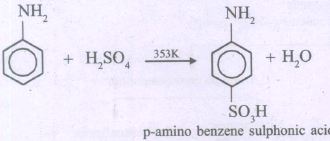
Aniline does not give o-amino benzene sulphonic acid because it is sterically less favoured.
14.
Classification of nitro compounds
15.
(i) Strongly Acidic Medium: When reduced with tin and hydrochloric acid, aromatic nitro compounds are converted to aryl amines.
\({ C }_{ 6 }{ H }_{ 5 }{ NO }_{ 2 }+6[H]\xrightarrow [ or \ Fe/con.HCl ]{ Sn/con.HCl } \underset { Aniline }{ { C }_{ 6 }{ H }_{ 5 }{ NH }_{ 2 }+2 } { H }_{ 2 }Oor\)
(ii) Neutral Medium: When reduced with a neutral, reducing agents like zinc dust and aqueous ammonium chloride, aromatic nitro compounds form aryl hydroxylamines.
\({ C }_{ 6 }{ H }_{ 5 }{ NO }_{ 2 }+4[H]\xrightarrow [ ]{ Zn/{ NH }_{ 4 }Cl } \underset { Phenyl\quad hydroxylamine }{ { C }_{ 6 }{ H }_{ 5 }{ NH }OH+ } { H }_{ 2 }O\)
(iii) Alkaline Medium: In alkaline medium, Nitro benzene on reduction forms the intermediate products nitro so benzene (C6H5NO) and phenyl hydroxylamine (C6H5NHOH). These undergo bimolecular condensation reaction. According to the appropriate reducing agent in alkaline medium different products are obtained.
(iv) Catalytic Reduction: Lithium Aluminium hydride is a powerful hydride ion donor. So it reduces nitro benzene to Aniline. This reduction can also be carried out by H/Ni.
\({ C }_{ 6 }{ H }_{ 5 }{ NO }_{ 2 }\underrightarrow { LiAl{ H }_{ 4 } } { C }_{ 6 }{ H }_{ 5 }{ NH }_{ 2 }[Aniline]\)
\({ C }_{ 6 }{ H }_{ 5 }{ NO }_{ 2 }\frac { { N }_{ 2 }/Ni }{ Catalytic \ hydrognation } { C }_{ 6 }{ H }_{ 5 }{ NH }_{ 2 }\)
(v) Electrolytic Reduction: When nitro benzene is reduced electrolytically in presence of concentrated sulphuric acid, phenyl hydroxylamine is first produced which rearranges to give p-amino phenol.

12th Standard Syllabus & Materials
12th Standard
TN 12th Computer Applications களப்பெயர் முறைமை (DNS) Sample Question Papers Study Material - QB365 Set A
NEW12th Standard
TN 12th Computer Applications வலையமைப்பு எடுத்துக்காட்டுகள் மற்றும் நெறிமுறைகள் Sample Question Papers Study Material - QB365 Set A
NEW12th Standard
TN 12th Computer Applications கணினி வலையமைப்பு ஓர் அறிமுகம் Sample Question Papers Study Material - QB365 Set A
NEW12th Standard
TN 12th Computer Applications PHP-உடன் MySQL-ஐ இணைத்தல் Sample Question Papers Study Material - QB365 Set A



Tamilnadu Stateboard 12th Standard Subjects

Maths
Chemistry

Physics

Biology

Computer Science

Business Maths and Statistics

Economics

Commerce

Accountancy

History

Computer Applications
Biology
Computer Technology
Computer Applications
Computer Science
Business Maths and Statistics
Commerce
Economics
Maths
Chemistry
Physics
Computer Technology
History
Accountancy

Tamil

English

French
Tamilnadu Stateboard Standards
